Showing posts with label Spain. Show all posts

Saturday, 8 March 2014

Policy and Self-Fulfilling Prophecies

I've been raging about confidence for a while now. Since any other form of stimulus is either unproductive (e.g. monetary policy due to the ZLB) or infeasible (e.g. QE or government spending), the only way we could actually see growth in the region is via an increase in confidence, which basically means an improvement in our current expectations about the future. Simply put, if I am going to either spend or invest more, I have to know that I will continue to have a job in the near future or that the overall situation in the economy will be better than now.

The problem is that many of us (especially journalists) take a particular liking to bad news; it appears that they sell more than good ones and that is why we tend to emphasize on that (disclaimer: I may have fallen into that trap myself at times). This wouldn't necessarily be hurtful to the economy if we did not live in a world where we somehow create it ourselves. In physics, bad news about a specific group of atoms would not cause all other atoms to stop obeying natural laws. In economics though, bad news about some may cause others to react badly as well.

Think for example what happens when austerity measures on the public sector are imposed: although it may be right that some workers in some countries are overpaid, lowering their wages in a recession comes at a cost. As civil servants lower consumption, the private sector sees its demand fall and reduces investment, causing unemployment to rise. Then, until we adjust to the situation, the economy moves in cycles of reduced demand and investment, causing unemployment to rise and incomes to fall. In the Eurozone, we are now experiencing the time where most of the adjustment has already taken place and even though demand is weak and investment is low, we are much better off (expectations-wise) than a year ago.

Yet, some still point out to the bad things; while, for example, the outflow of deposits from Cyprus appears to be stabilizing with the overall amount registering ups and downs in the past couple of months (compared to huge decreases before), some focus on the downs. The problem of over-focusing on the bad news is that it creates another cycle of uncertainty, one which, on its own, can cause more damage than policies can. You see, if I am bombarded with constant emphasis on how bad the economy is doing (it's not doing good by the way but it does certainly fare better than last year) then I will be more than skeptical to invest or spend. The cycle, as described in the previous paragraph, is indicative of what will happen when confidence falls; the issue here is that over-exposure to "bad" news means that these will turn out to be true if people believe them to be. It is the equivalent of fiat money: it works just because you trust it, nothing more and nothing less.

This kind of over-emphasis can actually derail many of the countries already in a bail-out agreement. Biased information about Greece is what made Greeks believe that they are faring worse than expected, pushing the vicious cycle of austerity deeper into the economy. Now that they are faring much better, biased information and vastly exaggerated opinions are still appearing on popular websites. While I am certainly not a fan of irrational optimism (remember I was one of the first to note that the Cypriot economy was badly in need of a rescue package in 2012 and that Spain is not really out of its trouble) I do think that we should really think before we offer an opinion, especially if it is bound to affect millions.

The bottom line is simple: be very careful of the information you use to make decisions. Emphasis on what could go wrong never really helped anyone; and neither  it will in the future

P.S. As far as forecasts are concerned here are my own (obviously biased) ones: Greece will need no more loans after 2014, but she will most probably not exit the bailout programme by year-end as the Greek PM has predicted. Cyprus will have a tough year but it may actually show us some quarter-to-quarter growth in late 2014. Spain will be rather stable with a slight increase in GDP compared to last year but the big question is what will happen in Italy and whether Slovenia will opt for a bail-out. On the latter two we just wait and see.

Friday, 17 January 2014

CEO compensation and Worker Job Security

That CEO's are earning big money is nothing we didn't know about. Yet, the size of their paychecks is at times enough to make those who are not earning 6-figure salaries furious. In the list of the top 15 earners for 2013, the lowest CEO compensation is at $36 million. It is true that their earnings fluctuate with the earnings and general performance of their firms. In fact, they have done a wonderful job tracking the S&P 500 especially since the 1990's:
As the reader may observe, CEO compensation was not following stock market development right from the start. In fact, for the first 10-15 years since the 1960's, the upward trend in compensation was not an outcome of a strong stock market; the S&P was on a long downwards trend during that time. Yet, in modern times, CEO's more than made up for their losses. In 1978, the CEO-pay-to-worker ratio was 26.5-to-1; in 1995 it went to 136.8-to-1 and in 2012 it was 202.3 times the typical worker's salary as the EPI reports (the peak of this ratio was in 2000 when it reached 411.3-to-1).

The difference is astonishing. Most of us would (rightly) think that we have overemphasized the importance of a CEO: she/he may be worth a lot and have much more worries than the average worker, but try working a day without him and another without 200 typical employees and see which is more important for the firm. Still, what is more interesting is not that, since the 2000 peak, the ratio of CEO pay to average worker has decreased, but the timing and reason behind that. For example, look at the following table from the same publication:
Note the two highlighted numbers: CEO compensation has actually decreased in 2011-2012, by approximately 7.1% while the decrease for workers has been a much lower 0.6%; the ratio of earnings during that period narrowed by about 6%. The problem here is worker wages are also falling during a crisis. Thus, even though CEO compensation is falling, the fall is reduced from the worker wage reduction (this is the same as debt-to-GDP ratio analysis where if GDP falls even when debt falls the ratio may remain unchanged). This isn't just the case for the US mind you; the same gap (albeit not so exacerbated) also exists in Spain (where higher salaries continued to grow through the crisis, with 2009 being the only exception) and most likely every other EU nation. As the article on Spain notes, there are two possible explanations: either CEO salaries were the first to go down so the first to go up, or firms are focusing on people who, in their opinion are bringing the greatest value in the organization.

Defendants of CEO pay might argue that since their compensation varies widely through time, indicating more risk, it makes sense that these people get more money in return. Yet, when there is mostly an upwards trend, a few points indicating a decrease hardly matter. In fact, Kaplan notes that the historical average of CEO compensation is in the mid 1990's: the figure for 1995 is 6,303 and the ratio at 141.1-to-1. Thus, even though CEO compensation has been falling since 2000 the fact remains that at its peak it was much higher than expected. Just like the dot-coms at the time, it was a bubble itself.

A more important point is that their compensation, although decreased at times of recession (contemporaneously as the data show; see 2007-2009), the value of their money was not reduced by as much, given the deflationary pressures of the time. Yet, the defendant might comment that worker wages increased during that time. This is the most interesting part of the analysis: it appears that, in 2007-2010, worker wage was increasing (a total increase of 5.6%), while CEO compensation fell by 11.8%. In contrast to what many might believe, it appears that worker compensation declines only long after the event, indicating that wages are sticky (for details see this). The bad part here is that unemployment isn't.

In fact, unemployment in the US soared to 10% from less than 5.5%, in 2008-2010. It was only after unemployment peaked, at the start of 2010, that firms decreased wages. This brings out a more important topic: that after all, worker wage is not only volatile, but workers also face the extra uncertainty of becoming unemployed. For the CEO's higher pay means that the cost of being replaced is accommodated, as is the cost of higher volatility. The problem is that the cost of being replaced isn't covered by the wage increases of the average worker.

This doesn't just happen in the US though; it is also the case in Spain, and Greece and other countries. The point is that we compensate CEO's for the higher risk of getting fired or higher volatility in earnings. Still, the wages they earn are sufficient enough for their children to live in luxury. The average worker not only does not earn that much, but also faces the increased probability of being fired at a time when it is most difficult to encounter another occupation, just because of wage stickiness.

What we have been arguing basically reduces to one of two options: either we start thinking that we are overpaying CEOs or that we are underpaying workers. I'll leave it up to you to decide. But if you ask me, lowering the ratio to the early 1990's levels would be much better.

Friday, 3 January 2014

Spain's "Sucess"

Big news this week was that the ESM had successfully ended the support towards Spanish banks, a story which came in addition to the already positive outlook for the country. In the words of the Spanish Finance Minister "2014 will see the net creation of jobs, higher even than we predicted in September in the budget, and the jobless rate will fall". The ESM has also provided us with a list of the positive developments in Spain which made it possible for it to exit:
1. Bank restructuring is well underway.
2. Transfer of impaired assets to an asset management company (SAREB, i.e. a "bad bank") has been completed.
3. Steady reduction of Eurosystem funding.
4. Positive banking results in 2013.
5. Markets acknowledging Spain's progress.

While these are all good news, there are still many problems which have been kept hidden under the carpet. First of all, we 'll start with the infamous unemployment rate, currently at the staggering 26.7%, meaning that more than one out of 4 people in Spain is unemployed. Add to that an astonishing 56.1% of youth unemployment and you get a much better picture of how things are doing in the country. Oh, wait there's more: 7.1% of the labour force in the second quarter of 2013 was just working part-time, brining the percentage of the people working full time is just 66.2% of the population.
What does high unemployment indicate*? Since people tend to consume out of income, it means less consumption. The trend has been obvious in Spain over the past years:
With less consumption, firms will be facing more trouble than before, with the trend of new orders and firm bankruptcies continuing:
Don't let the decrease in Q3 bankruptcies fool you: remember that the Spanish economy is highly seasonal (as are most of the periphery countries, especially those with a large inflow of tourists) and as restructuring specialists commented "2013 is going to be the year with the most bankruptcy filings in Spain's history, without any doubt".

All of the above have important consequences to the health of the banking system: overall Bad Loan ratio climbed to 12.7% in September 2013 compared to 12.1% in August, while the severe deleveraging of the banks' balance sheets continues as we speak. The ESM focuses on the positives, yet the problem is that they use just Q2 data, which allows them to focus on what they like. For example, in Q2 industrial production rose by 0.8%, making some very happy. Yet, the Q3 data show that the increase was not permanent:
One cannot be certain of how Spain will fare in 2014, yet the popular opinion (and the one shared by yours truly) is that the coming year will be better than 2013. This has also been shared by the market: with the danger for a Spanish or an Italian default reduced, bond yields have decreased over time. Yet, whether the over-optimistic estimations of the Spanish Finance Minister will occur is something which is really doubtful. For significant growth, we need stabilization and Spain has unfortunately not yet stabilized.


The fact that the ESM stopped its backing of the Spanish economy is rather irrelevant to the stabilization of her economy: the credit provided was just the amount needed for her banks to continue functioning and nothing more. The Spanish authorities have agreed to exiting the ESM based on the fact that the worse is over. We agree on that; but it doesn't mean that the situation will get better. If anything, optimists would expect the situation to stabilize over 2014, with some quarter-to-quarter growth after the stabilization as the austerity-based new budget, with more cuts in spending and more wage-freezing for public servants. The country's increased exports make it more prone to external shocks and the payments for the debt assumed in order to revive the banks will drive policy for some years to come.

So, ESM, let's be realistic: Spain is anything but stable. Don't focus on just the positives and please give out up-to-date data. 2014 will be good for stabilizing the economy and some slight growth if the increased austerity does not cause more harm in the end. Everything else is just wishful thinking.

*Some argue that unemployment fell in December 2013. The problem is that the hires were highly seasonal and in addition, the Spanish labour force appears to be shrinking as Euronews reports. Thus, the good news are nothing but the absence of bad ones

Thursday, 14 February 2013

GDP is falling down...

Eurostat published its latest statistics on Q4 2012 in the Eurozone. Nothing that we did not expect actually: Portugal -1.8%, Cyprus -1.0%, Italy -0.9%, Spain -0.7%. No statistics were published regarding the state of the Greek economy.

These results indicate that during the last three quarters the Eurozone had a contraction in each and every one of them. (I would remind you that the definition of a recession is two consecutive quarters with negative GDP growth. And we are experiencing three...)

What many did not expect though was the following:
Germany: -0.6%
Finland: -0.5%
France: -0.3%
UK: -0.3%

We all thought that the German economy was impervious to such things as recessions right? Well, let me remind you that this was a not-so-unexpected phenomenon. I have explained that the recession would have a very important effect on the German exports (which are about 60-65% to countries within the EU, and specifically within the Eurozone) in this article published in mid-November. Wolfgang Schäuble was said to secretly prepare for this downfall in the last days of 2012 by "cutbacks to prepare for a weakening economy and possible fallout from the euro crisis" (for details read this).

It looks like this time is now here for Germany. I have no other explanation for persistence in plans which do not work than obstinance and illusory beliefs and views of the world. If Schäuble is allowed to do the same with Germany as he proposed (and unfortunately pulled through) with Greece, Spain, Portugal and Cyprus the Germans are in for a much worse fate than they expected. 

And this will only be the beginning...

Thursday, 17 January 2013

Do we feel Europeans?

Over the last few months, after watching most of the recent developments (either positive or negative) in the EU, what made the greatest impression on me is our ability to shift our minds and opinions from one end to the other. This should normally be considered as a positive, yet being ready to alter our words and actions in the blink of an eye has to mean that we are in fact being affected by those who express these opinions more than we should have; in addition, it also means that we had formed our mind about our previous conviction(s) without being sure of the subject.

There are of course plenty of examples in recent history: notably the case of Greek exit or Greek default. In the summer months, almost every media source in Europe was roaring with stories about Greece exiting the Eurozone, the EU or defaulting; the stories were either by economists, analysts, journalist or even politicians and heads of states. Speculation had reached its maximum. In mid-August or early September, the EU decided it had had enough of this and spoke strongly against those who were exploiting the situation in order to promote themselves. Then all of a sudden voices of support arose. People stopped thinking that a Grexit would be good and started supporting the Greeks. Can these two groups (those who were in favour of a Grexit and those against it) consist of different people? Or is it just that we have changed our minds over some time?

Overreaction and mean-reversion, some may state, may account for this situation. Maybe. Yet, what is an even more probable explanation for this is disintegration. We are not yet a family. Have a look at the following example: let us say that you have a brother whose business has failed and faces prison time because he owes money to the bank. What do you do? Wouldn't you feel bad if he had to go to jail and wouldn't you try to do anything to help him stay out? Most of us would do so. Now, how about this scenario: a person in the next town (unknown to you) is in the same position as your brother. Would you feel the same you would feel with your brother if that person went to jail?

The answer would obviously be no (OK we exclude the case were you would not really like your brother). The above scenario bares many similarities with the present state of the EU. Even if we hate to admit it we do not consider ourselves Europeans. Geographically, it makes sense. To a large extent, a person is much more a resident of Granada or Marseille than a resident of Spain or France. You may imagine how someone might feel when Europe is merely a notion. 

This situation is exacerbated by the lack of truly European ideals and policies. A simple case is the debate on whether we should have an EU army. If not, how would we react if for some strange reason a foreign nation attacks Cyprus, Poland or Romania? What will the EU do then? Condemn the action and just stand by watching or take military action against the assailant? People feel united if they have something to look and say "This is ours" instead of mere notions. 

We have obviously gone a long way since the early 2000's. Largely thanks to programs like the Erasmus student exchange we have destroyed many barriers to uniting the people. It is quite uncommon to find people today who have never traveled to another EU country, or do not have any friends or acquaintances in another EU nation. Yet, although people are more European now than ever before, we still do not feel it as strongly as we should have. This is the main difference between the EU and the US. Ask someone in Alabama, Texas or New York if he/she feels American. The answer will be a definite "Yes".

Another example is the large number of foreign embassies. If I am from the Netherlands or the UK and wish to travel and work in Denmark why should we need a whole embassy to take care of diplomacy and etc when by definition there should be no diplomacy amongst equals? National governments would in fact save many billions if their staff in each country was reduced. Yet we still hold the notions of previous decades and we refuse to give way to change. 

Thus we come to the main problem which tantalizes Europe, especially nowadays:
We are afraid it will not last. 
Europeans do not think that the EU is permanent. Why? Because many nationalist media sources in some countries say so, because deep down we are still afraid that we will not support each other when time is hard, because others in foreign states bet against our survival. Traders in many countries had put large bets against the euro surviving during the months when the Greek crisis was at its peak. Instead of condemning such actions our media said that it was something to worry about. As if we did not have enough already. In the end, all these investors ended up losing money. And instead of being happy that we have survived the first major crisis in the history of the EU and making sure we have understood what went wrong so as not to repeat it we just do it again (Spain). And again (Cyprus). And we believe that it was right the first time (Ireland), the second time (Portugal) and the third time (Greece) although each and every one of these examples pointed to the exact opposite. As if this was not enough we always brought the IMF to assist us, because the ECB did not have the "power" of doing so. We do not even seem to care about a country exiting the euro (be it the UK, Cyprus or Greece), or whether that should have any non-economic consequences in the Union.

We are undermining the EU from within. We are not allowing it to function as it should. Even worse, we  are preventing the proper functioning based on irrational beliefs and strange rationales derived from obsolete notions of the world. To paraphrase Warren Buffett "the flat world society will always exist". It is our choice whether we adhere to their beliefs or not.

If we cannot help ourselves no-one will. It is about time we show, first to ourselves and then to the world, that we are really united. This cannot happen with politicians and mentalities of the Cold War era. We need fresh blood, we need idealists and we need unison.

Tuesday, 15 January 2013

The Consequences of Exits

The case of Cyprus undoubtedly resembles the case of Greece. The amount the country needs is not large per se, as was the case with Greece, yet it is the equivalent of about 100% of its GDP, casting doubts on whether its lenders would ever be able to get their money back. In both cases, two options exist (and existed): either give the country all the money it requires to completely avoid default or let it fall and consequently exit the EU or more likely the Eurozone.

Advocates of the latter base their arguments mainly on whether it is rational or good practice to send good money after bad, or whether the EU will forever be the lender of last resort for troubled nations. As the number of Member-States which face trouble as a consequence of either irrational expenditure or housing bubbles continues to rise, proponents of the Pontius Pilate method (i.e. "I wash my hands of the subject") believe that a line should be drawn somewhere. Yet, where should that line be drawn and what are the consequences, if any, of that action?

During the most severe case of the Greek crisis over the last 6 months, notably over the summer months, it was stated that there was a great danger of Greece exiting the Union. What we have witnessed, however, is that Brussels made the decision to support the nation, both monetary as well as politically, given that the Greeks would play their part as well (which they did). Economic consequences would have been severe had Greece exited, but what of the consequences of a Cyprus exit or another small country's?

Here, the problem is mainly political and not an economic one. Having barely 0.2% of the EU's GDP does not qualify the island on being an economic force whatsoever. Nevertheless, think of the consequences of setting a precedent by letting Cyprus fail. The probability exists that all other countries will fear that their turn will come if they do not pay attention to their fiscal policies and they will do their best to follow suit on the instruction of the IMF and Brussels (or is it Berlin?). Yet, there is another possibility: that the Member-States will think that such a behaviour is not an acceptable one, and one could liken it with bullying: kick the little guy out so the medium ones can see what will happen to them if they disobey. And what of the probability that other Member-States may think "if Cyprus is out of the Eurozone and can work it out why don't we exit as well?"

It has to be considered though that it is highly unlikely that another country will be in direct need of assistance in the near future (one cannot foresee the outcome of the Italian elections however). This would mean that essentially what the EU would be doing is that they should be supporting one of their own; or even better something they created. Was it not Victor Frankenstein's fault for the monster he had created? Now it is their fault for not looking two steps ahead when they were making the decision on the Greek haircut about a year ago. 

Exits should not be an option for either Eurozone or EU countries. If even a small country the size of Cyprus exits then you may mark the day as the one which set off the destruction of the EU. All that has been built over the past 70 years, all that nations have been through over the past couple of years, with uncertainty and economic misery would be in vain. What is the message by the EU officials if when a nation is in trouble we fail to assist it?

Cyprus is merely an example. Greece was the example in the last few months, and hopefully Italy will not become the next example in the following ones. We cannot have a perfect Member-State, we cannot have a perfect Union. Yet, we can support each other, regardless of petty issues. Spiegel mentions that the island is considered a safe haven for tax fugitives. One can remember posts about Russians moving funds to Cyprus for the last couple of years. Why now? Why didn't the EU try to impose stricter regulations on Cypriot banks earlier than that? 

The same issues arose in Greece, Italy and Spain. Why did Brussels fail to do nothing, not even suggest something when they had known about tax evaders in Greece since 2009 (the now notorious Lagarde list featuring more than 100 names of fraudsters with millions of deposits abroad)? Or why did they not try to change the Italian election law, which essentially does not let the people elect whom they want to lead them? Even better, why haven't they tried to do it when Mario Monti was in charge (he tried to pull it through but I believe that the legislation has not yet been passed) or even try to push Italian politicians now to do it? How about Spain and the horrible situation with evictions and homeless people? 

I can agree that the EU does not have the power to meddle in Member-States legislation and politics; nor should it. Yet, it should be noted that EU law is superior to country law, and thus many a legislation could be passed on in Brussels; legislation on important issues like election law, money laundering or evictions. What is more is that they should be able to impose severe sanctions to the members who disobey on serious issues. Being an optimist I hope that the memorandums have given the EU an opportunity to make the living environment better in the ailing countries than it was before; not used merely for punishment.

Cypriot presidential candidate Nikos Anastasiades with Angela Merkel.
As for a prediction: the EU will grant Cyprus its memorandum and support. How much money the island will receive and what sacrifices they will have to do I cannot know. Yet, it is highly unlikely that they will receive it before the February election results as a change of government will bring a change in credibility; the same issue with Greece over the summer. Just wait and see...

Sunday, 23 December 2012

Join the Club

Designed by polandball
A great thanks to Bernd for the quick response

Tuesday, 4 December 2012

Machtpolitik

News from the EU today state that Spain has requested a bail-out package for its banks and that the Eurozone finance Ministers have agreed to grant the nation with €39.5 billion which will be awarded next week. Normally, such a procedure would need experts from the IMF, the European Commission and the European Union (the so-called Troika) to go through. Nevertheless, in the words of Jean-Claude Junker "We have also welcomed the decision by the ESM (European Stability Mechanism) board of directors to authorise the first tranche of the programme of up to 39.5 billion (euros). The disbursements will be made in mid next week," 

This is an overall positive reaction of the EU, which has for the first time used the availability of ESM/EFSF funds to assist a nation in need. This is the main reason that the above mentioned funds were created in the first place. The handling of this situation should be made an example of any similar cases in the future. Neverthless, one things springs to mind: why weren't solutions like the above used to assist nations like Greece and Cyprus as well? Why were the Greek and Cypriot banks denied of direct assistance from the ESM/EFSF fund?

The answer is simple and it was given to me by Craig James Willy: Machtpolitik. The terms has its origins in 1979, in a book by Martin Wight, and it is used to describe power politics in the international scene. It is used as a form of international relations in which sovereign entities protect their own interests by threatening one another with military, economic or political aggression. To put this in a less subtle way this is what the Eurogroup is saying: Greece and Cyprus are much smaller and of much less importance to the EU than Spain.

Martin Wight. Source: Wikimedia Commons
Whilst I am positive that some will in fact disagree with me on this, I would be that this is what the Greeks and Cypriots feel. They have to pay for the sins of their banks, and yet someone else is getting better treatment than they are. And of course I am not going against to what I have been saying all this time and state that Spain should also suffer from more austerity measures. On the contrary, this was an excellent decision. However, it should be implemented to Greece and Cyprus as well.

The EU in its design, was aimed at promoting solidarity and equality amongst nations. Why should a nation which has suffered so much as Greece being forced to suffer more when the alternative is both easier to implement and less brutal on the people? Why should Cyprus have to go through the same as Greece just to conduct an economic experiment, with an ending act we already know?

The situation is not just of two small nations. It is of how we treat the little guy in general. If the Union does not care of two small nations why should it care of poorer citizens, why should it bother with assisting those in need? If we do not protect the little guy how can we protect the rich and strong ones? To quote JFK "If a free society cannot help the many who are poor, it cannot save the few who are rich."

The same situation in Greece and Cyprus now can easily happen in some other state in the future. What is the EU going to do about that? Make that country suffer and then assisting it or just help it like it should? As the answer to that is ambiguous, uncertainty about the future grows. The power to make the EU more democratic, efficient and sustainable is in our hands. We will use it?

Monday, 12 November 2012

Short-term lessons to be remembered

I have been so far bewildered by the Troika's proposals, although to be fair we should all be waiting for the actual proposals and not base our comments on the policies several media sources are surfacing. It has happened before to witness that the actual measures were much less severe than the ones presented by the media. (One wonders how the media got those excessively inflated stories in times where information is so widely available).

If however, what the media are stating is true, then Troika is pushing for a reform in Cypriot legislation which would allow banks to confiscate and sell the real estate fortune of those who cannot meet the needs of their mortgages. Given that Cyprus has a population of 838,000 people according to Wikipedia, the outcome of even 1000-2000 confiscations would be disastrous. What would happen would be analogous to the late 2000's recession in the US, where a large portion of the population could not repay their mortgage, banks confiscated their properties and then could not sell them in a falling economy. What then happened was the worse drop in real estate value since the Great Depression of 1929 and the banks were left with thousands of unwanted real estate in their balance sheets and no liquidity.

The same situation would happen in Spain as well had Mariano Rajoy's government not proposed a 2-year moratorium on evictions (for more details and an alternative solution read this). As banks become loaded with "useless" real estate, what usually occurs is what is called as a Minsky Moment. The Minsky Moment is in simple words, the wanting of investors (or banks in this case) to get cash for their illiquid assets, which results in a sharp decline in the value of the goods. The late 2000's recession was also coined as a Minsky Moment.

An increase in illiquid assets in addition to falling prices will wreck havoc to balance sheets. The simple case is that banks do not need houses or apartments or commercial blocks. They need cash

Spain: Bad Solutions to a Known Problem

It looks like some countries have started paying the price of austerity in people. I am of course talking about Spain where at least 10 people have committed suicide due to their lack of paying their loans and the subsequent bank and court decision for their eviction. Now, after 10 fellow humans have left this world, Mariano Rajoy's government has decided to put up a moratorium on evictions for the next 2 years. As this excellent article from Mike Shedlock states, the policy is expected to blow up spectacularly.
An old man evicted in Santiago de Compostela, Spain. Source: Wikimedia Commons
The reason is simple: suppose that you are paying your mortgage loan regularly and you have never missed a payment although you are financially struggling. Now if a law comes up which says that they cannot kick you out of your house even if you do not pay your mortgage, for the next 2 years, what is your motive to repay as you did? I would agree that most people would continue to pay their loans regularly because people have a high sense of values, and also know that when the 2 years end then they will face a much greater loan amount than before. Nevertheless, as Mike states, it is obvious that some people will take the option of not repaying, thus making the bank take a turn for the worse. 

What has always amazed me in the world of politics and economics, is the lack of imagination from its practitioners. In the words of John Maynard Keynes they "are usually the slaves of some defunct economist". Yet, as most of them would hate to admit, they have neither the knowledge nor the imagination to produce solutions which would work in practice rather than in theory. Politicians lack understanding of basic economic truths. Economists lack understanding of world functioning. And unfortunately the combination provides us with solutions that are neither well applicable nor produce the right results. (You may ask the IMF for details on this. It has vast experience from the Greek experiment)

As usual, I wouldn't like to criticize without proposing something else. (you may imagine how I feel when I hear politicians argue about policies without actually proposing an alternative) What Spain should have done, is separate class of borrowers. What do I mean by that? For example the first class would be the persons who are unemployed for more than 6 months. The second class would be those who are unemployed for less than 6 months. The third would be those who are earning minimum wage, or due to other circumstances are facing troubles even though their earning power is larger (e.g. have many children, provide support to elders, etc), and the 4th class would be comprised by those who have "regular" jobs and can pay their mortgage.

To continue, it is more than obvious that the first and second class would need more support than the 3rd and 4th ones. However, the moratorium should not be aimed at people ceasing mortgage payments. First of all, a mortgage restructure, allowing for more installments with a lower amount, should take place. In simple words, if a mortgage has 20 years left and has a monthly installment of 400 euros, a restructuring would allow it to go for 30-40 years with an installment of approximately 200 euros. Now, this is more likely to work for the second group than the first. In that case, the moratorium could take place, although in a different notion: the bank would be allowed to sell the house/apartment, nevertheless, the tenant would be allowed to remain there for as long as it takes for the bank to find a seller. After the sale is completed, the bank will have to return an amount of money to the original tenant, who due to unemployment could not repay his/her mortgage. The amount, which would have an upper limit, will be directed at paying the rent on the tenants new house/apartment and will be deposited directly each month to the house/apartment owner's account. This would allow the unemployed to have a place to live, and it would prevent them for abusing the money if given in a lump sum. To avoid having to do this for everyone, it should be stated that this would occur only after a person has reached 6 or more months of unemployment.

Obviously, since this is just a proposal, groups of people may be more in practice, although I do believe that 4 classes would be a good number as well. This was not very hard to come up with. It is a policy which assists people in need and does not allow them to abuse the policy for their own purposes. Now, if I can come up with something like this, why don't they try to do it as well and not endanger neither banks nor people?

Thursday, 8 November 2012

Who's fault is it for the Crisis?

To be honest, I wanted to write this article for a while now. I have heard almost everything concerning whose fault it is for the current situation: banks, politicians, people, Greece etc. Thus, today I am giving you my honest opinion on whose fault it is for the chaos we are currently living. The answer is not, as some may have thought, just a person or a nation. It is a continuing series of absurd, irrational mistakes which have, step-by-step, led us to this situation. Without further ado I present you with the list of the 3 groups of people to blame for this situation:

1. Greek Politicians and Greek People
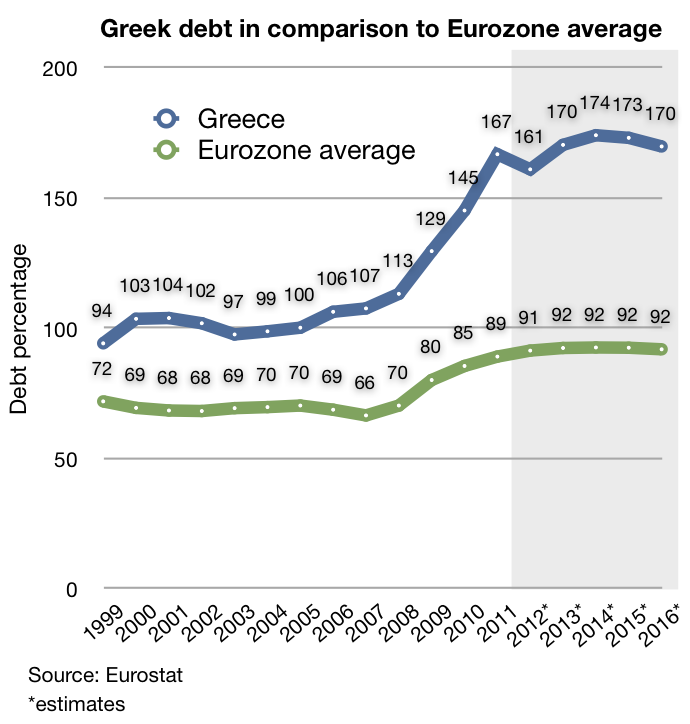
Politicians in Greece, strong proponents of a system named Kleptocracy, which in essence means a system where the government increases the personal wealth and political power of its officials and the ruling class at the expense of the wider population. Greek politicians were (are?) notorious for embezzling state funds, shipping their money to Swiss bank accounts and receiving bribes so that they could arrange something for someone. Greek government debt, issued to fund such abuse of power rose from 94% in 1999 to 167% in 2011 as one may see from the graph below.
Source: Wikimedia Commons and Eurostat
The reason for this astonishing debt growth is obviously the large government deficits, which allowed for politicians and other officials (or their affiliates and business partners) to practically steal from the state using as a preface works for public good. 

Then why the Greek people one might ask? Well, to put it simply because they tolerated and perpetuated this situation. When in public hospitals (which are supposedly free for everyone) you have to bribe doctors for the right to an examination, when you know that many are stealing from state funds and not only you do not do anything to oppose such a thing but try to come up with ways to steal some yourself, when people's parents die and do not mention the fact to the police so that they can continue to receive their pensions (and this has happened repeatedly) then one cannot just blame politicians for it. I am not at all suggesting that every person in Greece is at fault for this directly. Nevertheless, they are at fault indirectly since they have tolerated and perpetuated this situation throughout the years. All that is necessary for the triumph of evil is that good men do nothing.

2. EU Banks

Although EU (and non-EU for that matter) banks must have had the data for the increase of the Greek debt (Eurostat publishes a quarterly analysis which is free and open to public) they had chosen to ignore the possibility that a country issuing large amount of bonds could possibly face trouble. The following data is from the Bank for International Settlements in 2011 and indicate the exposure of non-Greek banks to Greek sovereign debt.
An casual observer can see that the first 12 banks have an exposure of more than 1 billion. At first, your reaction might be that obviously they had enough money to compensate for large losses in Greek debt. After all they are large, well-off organizations aren't they? Well, have a look at the next data set.
What is more astonishing is that people running the two Cypriot banks, Dexia or BPI, Commerzbank or any other bank which had a large exposure in Greek debt, did not think about having more than 10-20% of their equity in one single country. Now I am no expert in risk management, but from what I can remember there is a notion called diversification which means that you shouldn't put all your eggs in one basket. It looks like the officials who ordered such massive buys of Greek bonds should have taken a good look a their exposure and the amount of Greek debt before they invested. They did not.

3. Decisions by the EU

So far the usual suspects were at blame: greedy bankers and corrupt state officials. Now how about we take it to the next level? In an announcement in February 2012 the Eurogroup decided that the Private Sector Involvement (PSI) in the Greek debt restructuring would amount to a total of 75%. For those of you counting, the first 15 banks of the above chart lost a total of 21 billion euros in one day. These were the biggest losses of all times for most of the banks involved. 

As if this was not enough for the banks, the European Banking Authority had issued a "temporary" rule (which now is bent on making it permanent - for details read this) of increasing Core Tier 1 Capital requirements from 8% to 9%. Although this might not seem like much, the increase forced the banks to come up with €116 billion of new capital. And all that in the midst of a crisis, where finding funds is even more difficult. For a detailed view of where these funds came from have a look at the following image:

Source: Wall Street Journal
Thus, keeping in mind that when banks are in need for money they do not lend out much it not amazing why we have reached a situation where individuals and companies are struggling for liquidity. The worst part is that due to the severity of the decisions many banks in the EU are struggling for liquidity as well, which has led countries like Cyprus and Spain to seek for assistance. What has happened is that, in essence, the EU authorities have taken a country-specific crisis and transformed it to an EU-wide one through erroneous handling. These decisions can (unfortunately) be compared to the ones the US Federal Reserve had made in the early 1930's which had strengthen the Great Depression, prolonged its duration and increased its severity.

As a conclusion I would like to remind you of the timeline of errors which led to the crisis:
1. Corrupt officials and politicians in Greece were stealing money from the country and were financing their spending with government bonds,
2. Banks had not paid attention to the increase in government debt and kept on buying more and more lured in by the high returns offered, and
3. EU authorities, by handling the situation badly, have transformed the Greek crisis to an EU crisis

The situation worsens as politicians and policymakers in the EU are throwing good money to follow bad. As they cannot admit their mistakes they hope that two wrong can make a right. Well, the saying doesn't go that way. 

Wednesday, 7 November 2012

Easier to Preach than Implement

Don't know if you have seen it, but an article in Der Spiegel states that although Angela Merkel and Wolfgang Schäuble have forced almost every Southern nation in the EU to take harsh austerity measures, they do not plan to follow that recipe themselves. With less than a year until elections, Angela Merkel is planning on increasing government spending in the form of subsidies and pension raises. While this may be speculative as the German Chancellor has committed to presenting a balanced budget for 2013, it is in severe contrast with Schäuble's on austerity in the current G-20 summit in Mexico City.

You see, as in most philosophies and other principles and values, it is easier to preach and condemn people for not implementing them or even force people to apply them, than to use them yourself. The great socioeconomic experiment we are currently witnessing in Greece (and will soon witness in Cyprus as well) is indicative of people who are stuck in ideology and cannot understand simple economic reality. I am not talking about complex equations or ideas here: what I mean is the mere understanding that if you cut salaries and wages things will get worse than what they were. Any high school student could see and understand this. Sadly, we have no high school students in a position to apply policy.

If austerity measures were implemented to reduce structural problems the countries were facing, I would admit that, even though rapid implementation is never good, the measures were aimed at producing something good. Nevertheless, the measures are only aimed at reducing expenses and not addressing problems. As a result, they do nothing to improve a country's well-being. In contrast, what they do is deepen the gap between social classes, as the lower class assumes most of the burden.

The Greek domino effect. Source: socialistrevolution.org
It would look like policymakers and politicians in the EU are not really reading any blogger articles. The EU blogosphere has been expressing its objections about this for months now. What seems to be even more amazing is that even though blogger voices against austerity have increased over time, nothing is being done to correct the situation. What I fear is not that a nation will be destroyed. It is the domino effects of this destruction that I fear the most. A Greek bankruptcy, or even a fall of the government, would most likely force the nation out of the Union and the common currency. And if this occurs then maybe Cyprus, Spain and Italy will also flee, thus rendering the EU a non-Mediterranean union. Although the ties between nations are strong, which can be evidently seen in the youth, they are nevertheless weaker in the older population. As the older generation rules, it will be more difficult not to follow suit if Greece exits the Union.

What is suggested above is not just a far-fetched scenario. It is one of extreme likelihood if the austerity measures are not passed through the Greek parliament. And I am not sure what is worse for the Greeks: the painful austerity plans or the fall of a government? In the long run obviously the second would yield worse results, but in the short run austerity will bring those of the Greeks still standing, to their knees. 

Unfortunately, Greece, as well as Cyprus in a few days, is at the mercy of its creditors. They tell the country how much it shall be lent, when and what is should do with the money. It is essentially being an unelected and uninvited government. Can you really blame the citizens for not liking the Troika and what it represents?

Tuesday, 30 October 2012

Berlusconi Behind Bars Now!

On Friday, a court in Milan had sentenced the former Italian Prime Minister Silvio Berlusconi, to 4 years of jail for crimes concerning tax fraud related to the acquisition of TV rights by his company Mediaset. He was also banned from public office for five years and ordered to pay €10m (£8.3m) to the Italian tax office, but these are just minor compared to a 4-year incarceration sentence. Nevertheless, as we now read, Berlusconi will most likely never see a prison cell in his life. 

Well I hope not! Source: http://www.soxfirst.com/
The reasons are simple: In 2006, a centre-left government had introduced a 3-year amnesty for crimes committed before that year, which would mean that Berlusconi's sentence would essentially be reduced to 1 year. In addition to that, the former Prime Minister is entitled to two appeals before a definitive sentence. Given the speed of the Italian courts' this would probably never end, as the aforementioned trial lasted for about 6 years and the statute of limitations (a legal term stating that if a legal system has a statute, for example, limiting the time for prosecution of a debt or crimes designated as misdemeanors to two years after the offense occurred, under such, if a person is discovered to have committed a misdemeanor three years later, the time has expired for the person to be prosecuted.) of the Mediaset case will take effect in about a year from now. In addition as an Italian journalist has stated in The Guardian: "The fine and the ban on public office will only take effect after the final appeal, but if he is given a conclusive conviction, he will have to leave parliament. In Italy, you go to jail only if you receive three years, so if the sentence is cut to one, Berlusconi will not go to jail."

Well if you ask me, this is something more than ridiculous! We expect our citizens to respect the laws, nevertheless it takes 6 years to complete the trial of an "important" member of the society and it will probably take as long as that to reach a definitive conclusion. And he will not even be put in jail. This is not just for Berlusconi. The former Prime Minister is an example of a judicial system which does not function properly. People in Italy, Greece and Cyprus (and to a much lesser degree in Spain and Portugal) are certain that the rich will never pay for what they have done! And the courts do nothing else than to confirm this notion.

In another article, a commentator in The Guardian has stated that even though Berlusconi will never see the inside of a prison cell, the decision matters politically as its party now has much less support than before. He is implicitly stating that the Italians, fed up with corruption and paid politicians/policymakers/lawmakers will will make a better choice for leaders this time. 

I am not sure of that. If Berlusconi, or any other "Berlusconi" for that matter, is allowed to walk away like nothing has happened, then what is the point of sentencing him? It is the same as politicians promising a million things and not doing even one. People are tired of this. They want credibility. They want a person who will say something, mean it, and then do it. Theories and political games are out-of-date. They want leaders and policymakers/lawmakers who are not afraid to stand up for what they believe and fight for it. They are not afraid of a corrupt system nor of the power of industrialists and businessmen. 

This is the main reason why "Golden Dawn" has become so successful in Greece: they do what they say they will. (for an excellent article on Golden Dawn read Protesilaos Stavrou's article here or here) Even if I disagree with what they represent, what we must understand from their action is that people prefer honesty to anything else. 

And this is exactly what must be done in the South. We need a system which we can trust, a system where even though some occasional members will be corrupted, we have to know that this will not be tolerated. But most of all we need honesty. We need people who they will say something, mean it and do it. We need more people like Giovanni Falcone and not like Silvio Berlusconi or the majority (if not all) of politicians in South.

And that is why Berlusconi needs to be sent to jail. To signify the end of an era of corruption, control of government by industrialists, and an era where money made a difference whether you could be behind bars or not. Let's hope that the people of Italy and the Italian courts make a stand on this.

Friday, 26 October 2012

Youth, Politics and Incredibility

European Leaders on Vacation. Can you spot a young one? Picture Credit: Euronews
 Recently, the Cypriot Ministry of Finance had reevaluated its estimation on the country's fiscal deficit. The new estimation assumed that the 2012 fiscal deficit would amount to 4.5% of GDP, instead of the 3.5% it had originally announce. Now, as the negotiations with Troika are supposed to come to an agreement, new evidence show that in the January-September period of 2012, fiscal deficit amounted to about 3.27% of GDP, instead of 3.08% over the same period in 2011. Note: 2011's deficit reached an astonishing 6.3%.

Although I have credited incredibility as the main source of trouble for most of the EU-periphery, it looks like no-one has learned anything about what I have been saying for months. It is a political tradition in the South to promise things you cannot deliver. And people have always known about this, yet the times when they actually chose to do something about it were extremely rare. People, especially politicians, have very short memories. It looks like they cannot even remember what they promised, promoted, supported last week if this goes against their interests. The worst thing about this situation: People always followed and supported them.

It is really annoying to find people nowadays who are still blinded by ideology. And ideology based on what? A politicians ideas and slogan? I am not at all against believing in people. Far from it. But following people, and especially obsolete political parties, blindly is what got us to this situation. 

People (especially the young) do not believe (much less trust) their governments anymore. Why should they? What has changed over the last 10,20 or sometimes even 30 years? Just the faces. The same ideas, the same persistent ideologies, the same arguments we have heard for thousands of times over the course of our lifetime and that we have grown so accustomed to that we have even stopped paying attention to what they say. 

Why? Because all they do is talk. Assigning blame to one another, talking about what should be done, about what they should have not done, talk, talk, talk. As for action: none.

I do not know whether they have heard that actions speak louder than words. Well, they do really. Most of the people in the EU are now looking at their governments with mistrust. They know they supposedly are there to serve them but what do they do: they serve themselves. 

People in governments, especially those older than 50, are still reminiscing of a time where the world is not as it is now. When they could promise and not deliver, when incompetence did not matter, where people believed and admired politicians in spite of their inability to rule. Well, this is over. The world moves forward and it seems like they are getting left behind. 

It is not just them, however. It is their voters as well. People who are of a certain age, who are too old to protest, to do anything else but work. People who did not have the same access to information and world events, like we now do and who are too stubborn to change their mind, not because they have some good arguments for their beliefs, but because having those belief has so defined them that they can no longer change.

From what I hear, you have to be at least 25 years of age to be elected in the parliament, and over 35 to be elected as a Prime Minister/President. Yet, the majority of nation leaders are much older than that:
  • Mariano Rajoy - Spain: 57
  • Mario Monti - Italy: 69
  • Antonis Samaras - Greece: 61 
  • Demetris Christofias - Cyprus: 66
  • Pedro Passos Coelho - Portugal: 48
  • François Hollande - France: 58
  • Angela Merkel - Germany: 58 
In comparison, Sweden's Prime Minister was only 42 when he was elected, Denmark's was 45 as was Norway's. Even more impressive, Finland's Prime Minister, Jyrki Katainen, was just 40 years old when he was elected in 2011, having before been voted as the best Finance Minister in Europe by the Financial Times in 2005, when he was just 34.

I would not support that every young person is better than any older person. Yet, as you may see from above, the political scene in the South needs immediate youthification. And this are just the ages of the nations' leaders since I could not get my hands on the Parliament's average age or the average Cabinet age in each country . I am sure that we will find that most of them are near (if not) retired as well.

The problem is not so much age as persistence to a failed system and false (or belonging to a different age) ideologies. Youths usually lack experience yet they more than compensate for that with drive, determination and the belief that they can change the world. As the older generation sits back, protesting in their armchairs that the world would never change, the youth try to make the change. 

The young ones do not possess the pessimism surrounding most of the older generation. They start life with enthusiasm and will to achieve something to make the world a better place. Yet, due to this political mechanism under which politicians are elected only when they reach retirement age, pessimism and inaction are substituted with more pessimism and inaction. 

The situation reminds me of a George Bernard Shaw quote (although a bit modified to suit the situation):
 
The old look at the world and think "Why?" while the young look at it and think "Why not?".

Wednesday, 24 October 2012

Eurozone Debt On the Rise

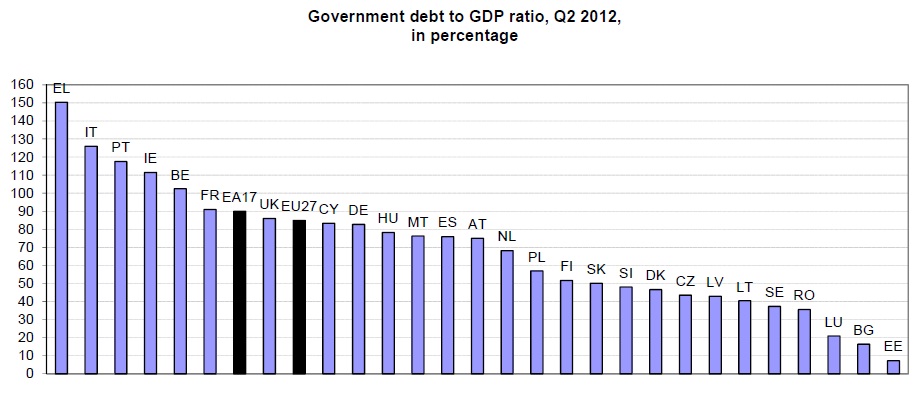
Nothing unusual about yesterday's announcement by Eurostat: Government debt in the EA17 and the EU27 in 2012's second quarter rose by 1.8% and 1.4% respectively. The usual suspects came up first with Greece reaching 150.3%, Italy 126.1%, Portugal 117.5% and Ireland 111.5%. Twenty out of a total of 27 Member-States have increased their debt burden over the last quarter.
Source: Eurostat
The highest increases were observed in Greece (13.4%), Cyprus (8.3%) and Portugal (5.6%). Even though the highest increases were somewhat expected (however, Portugal's future remains a riddle as social unrest has reached extreme levels in the nation, and I would be worrying that new austerity measures would render them in the same situation that Greece is facing now) the size of increase in Greece's debt does amaze. The Greeks fear another severe recession as a result of the new austerity measures to be announced (shortly?) and with good reason. Nevertheless, Greece's debt has decreased over the last year, with the total decrease for the 2011Q2-2012Q2 period reaching 8.5%. In absolute numbers the Greek debt has decreased from 340.906 billion to €300.807 billion over the course of the year. This would mean that GDP in 2011Q1 was 214.676 billion while in 2012Q2 has declined to €200.137. If GDP had remained stable over the course of this year then the Greek debt would account for "just" 140% of output. If the Greek GDP grows in the next year, then reducing the existing debt burden would be a much easier task. As for the rumors advocating large lay-offs in the country's government sector, let us remind them that the largest component of GDP is consumption. (for more details on GDP read here)

The next two candidates for a bail-out memorandum, Cyprus and Spain, have seen their debt reach 83.3% and 76% of GDP respectively. If Cyprus can negotiate the terms with Spain, then the terms might not be so rough on the island. If left alone, fear for the worst. Spain on the other hand, does have an ace up her sleeve. With debt reaching "just" 76% of GDP, the nation can negotiate for a lighter memorandum which would allow her not to impose extreme austerity measures to an already shaking economy. For those interested, debt in Spain rose by 9.3% on a yearly basis, and in Cyprus by a staggering 16.5%. A reminder: those who believe that the over-spending South is the cause for the recent crisis should look at the announcement and note that Spanish debt was just 66.7% in 2011 and Cyprus's 66.8%, much lower than France's, Germany's or the UK's at the time. (actually both countries' debt is still lower than the aforementioned three, with Cyprus just having a 0.1% larger debt than Germany)

Another question is what is going to happen with Italy. Although Mario Monti's measures have managed to keep the debt increase to 2.4%, if the country's debt does not begin to fall soon then they might face greater troubles than they expected. In a yearly basis, from 2011Q2 to 2012Q2 Italy's debt has increased by 4.4%, which is not good news at all.

For some good news, the IMF has approved a €1.5 billion loan disbursement to Portugal today, confirming that the nation is on track with its 78 billion international bailout. Nemat Shafik, deputy managing director of the IMF has stated that: "A weaker external outlook and rising unemployment have increased risks to the attainment of program objectives. Additional efforts are necessary, with the support of euro-area partners, to further advance fiscal consolidation and boost long-term growth."

Let's hope that they keep that "long-term growth" goal in mind and at the same time remember that for long-term growth, the short-term one is also needed.

The Worst Isn't Over. Or is it?

Yesterday, German Finance Minister Wolfgang Schäuble uttered what I have been saying for months now: "I'm not so sure that the worst of the crisis is behind us"
Source: Wikimedia Commons

On the other hand European Commission Vice President Olli Rehn told the Bangkok Post a week ago that: "there is no likelihood of any country leaving the euro zone. The key message I told the ministers was that there is cause for prudent optimism. I think that the worst is over for the euro debt crisis."

So who is right and who is not? Is there reason for optimism or is pessimism a better strategy in anticipating the future? I guess Rehn was right for the first part of his statement. There is indeed a very small likelihood of any country leaving the euro zone. And this is sufficient enough for everyone to note progress. Actually, compared to the Kassandras of the summer, where predictions even specified the day of Grexit or Itexit or any other exit, this is indeed an action which promotes solidarity amongst the EU. 

Alas, the near future does not appear rosy. It is more than obvious that although much has been done towards addressing EU's tantalizing problems, the time for them to end completely is yet to come. Greece is doing much better than before, yet with new austerity measures to be applied before the end of 2012 (hopefully they will reach an agreement with the Troika soon, as the negotiations are really starting to get annoying to the people watching) another deep recession is feared. In Cyprus and Spain, the memorandum currently under discussion is also expected to bestow a deeper recession in the countries in 2013. And although Italy is holding up well, if Monti is not re-elected as Prime Minister in the April elections, then the country's future may be at stake. Unless of course his successor is much better than he is. 

Schäuble seems to be correct in his prediction yet up to a point. In the short-run,  and I mean until the end of 2012, the crisis will almost certainly get worse. I believe that statistics to be announced from the ECB will indicate that the EU27 as well as the EA17 will officially be in recession. As for 2013, it would depend on how well the nations are coping with the austerity measures. Although the effects of a memorandum in Spain and Cyprus are expected to drive consumption and GDP down, this does not mean that after mid-2013 the nations' economies will not bounce back. (Given the size of these economies, it will be easier for Cyprus to bounce back. Nevertheless, Spain's start-ups and innovation may play an important role and allow it to bounce back faster) The same holds for Greece, although a full-blown recession is expected yet again for 2013. However, the contraction might be less in the end of 2013.

In the words of Yogi Berra: Prediction is very difficult, especially about the future.
And as Schäuble has stated on the Greek "experiment": "We are all sinners"

Wednesday, 17 October 2012

Troika's Strange Ideas

Talks about the new Greek austerity measures have been raging for over a month and a half now. It was the end of August when negotiations between Greek authorities and the Troika had began, and although things has come a long way since then, nothing has been formally agreed yet. It is said that the Troika wants the Greeks to proceed into slashing more wages, benefits and allowances. Yet, even though the Greek economy has been on life support over the duration of these negotiations and things can only get worse without the additional aid they have been promised, these talks do not seem to reach an end.

One cannot help but wonder whether it is the Troika's or the Greek's fault for this. Prolonged negotiations may be good for an organization already earning a substantial amount of money, nevertheless, they are not for a nation whose economy is getting weaker by the month. It is my understanding that the Troika has arguments on whether the allowance cuts proposed on this budget can be considered as new measures or they should be considered as part of earlier agreements. My question is what difference does it make? The point of the austerity measures is to make the Greek economy more competitive and eliminate the chance of bankruptcy. The important part is not whether allowance cuts are new or old, it is whether they are implemented or not. The Greek government has so far slashed everything: wages, salaries, pensions, allowances, benefits. The Troikans even wanted to slash allowances for people with disabilities. What the? Who proposes something like that? What are these people? Some kind of economic machines and they think only in €? I thought people like those only existed in movies. 

The Troika is missing it's target if it is just focusing on numbers and not reforms. In a country ridden by unemployment, (reaching 24.4% last quarter) you do not propose a lay-off of 3,000 government employees. Sure the government sector needs less people. Yet it does not have to happen now, it can be done gradually until 2020. Obviously, someone needs to keep an eye on them. Nevertheless, with the Greek accounts expected to reach a primary surplus over the next year, unless in a case of severe recession, the Troika does not need to cause that recession itself!

The idea of sticking to numbers and not having a look at what the consequences will be is like looking at a tree and missing the forest. The Troika is so focused on getting budget cuts that it does not see what changes need to be done. For example, the Cypriot government has issued counter-proposals, which, although they include severe wage cuts, they do not take into consideration the need for fiscal reform in the island. Not even one. And yet in pure monetary terms, the measures proposed by the Cypriot policymakers are harsher than the Troika ones. If the Troika representatives are really willing to assist a nation then they should insist on reforms and not just cuts. I am curious about their answer and I really hope that it doesn't take them a month to let us know.

P.S. Have a look at the unemployment rate in Spain over the last 37 years:
Source: Eurostat
Does something appear strange? Exactly. Unemployment in Spain had never been lower than 8% (and only lower than 10% in 3 years) and it has been growing rapidly since 2008. Now the million-euro question is this: Why wasn't anything done about unemployment since 2008? Or even 2010 when it reached 20%? I will let you decide on that.