Showing posts with label Portugal. Show all posts

Thursday, 17 January 2013

Do we feel Europeans?

Over the last few months, after watching most of the recent developments (either positive or negative) in the EU, what made the greatest impression on me is our ability to shift our minds and opinions from one end to the other. This should normally be considered as a positive, yet being ready to alter our words and actions in the blink of an eye has to mean that we are in fact being affected by those who express these opinions more than we should have; in addition, it also means that we had formed our mind about our previous conviction(s) without being sure of the subject.

There are of course plenty of examples in recent history: notably the case of Greek exit or Greek default. In the summer months, almost every media source in Europe was roaring with stories about Greece exiting the Eurozone, the EU or defaulting; the stories were either by economists, analysts, journalist or even politicians and heads of states. Speculation had reached its maximum. In mid-August or early September, the EU decided it had had enough of this and spoke strongly against those who were exploiting the situation in order to promote themselves. Then all of a sudden voices of support arose. People stopped thinking that a Grexit would be good and started supporting the Greeks. Can these two groups (those who were in favour of a Grexit and those against it) consist of different people? Or is it just that we have changed our minds over some time?

Overreaction and mean-reversion, some may state, may account for this situation. Maybe. Yet, what is an even more probable explanation for this is disintegration. We are not yet a family. Have a look at the following example: let us say that you have a brother whose business has failed and faces prison time because he owes money to the bank. What do you do? Wouldn't you feel bad if he had to go to jail and wouldn't you try to do anything to help him stay out? Most of us would do so. Now, how about this scenario: a person in the next town (unknown to you) is in the same position as your brother. Would you feel the same you would feel with your brother if that person went to jail?

The answer would obviously be no (OK we exclude the case were you would not really like your brother). The above scenario bares many similarities with the present state of the EU. Even if we hate to admit it we do not consider ourselves Europeans. Geographically, it makes sense. To a large extent, a person is much more a resident of Granada or Marseille than a resident of Spain or France. You may imagine how someone might feel when Europe is merely a notion. 

This situation is exacerbated by the lack of truly European ideals and policies. A simple case is the debate on whether we should have an EU army. If not, how would we react if for some strange reason a foreign nation attacks Cyprus, Poland or Romania? What will the EU do then? Condemn the action and just stand by watching or take military action against the assailant? People feel united if they have something to look and say "This is ours" instead of mere notions. 

We have obviously gone a long way since the early 2000's. Largely thanks to programs like the Erasmus student exchange we have destroyed many barriers to uniting the people. It is quite uncommon to find people today who have never traveled to another EU country, or do not have any friends or acquaintances in another EU nation. Yet, although people are more European now than ever before, we still do not feel it as strongly as we should have. This is the main difference between the EU and the US. Ask someone in Alabama, Texas or New York if he/she feels American. The answer will be a definite "Yes".

Another example is the large number of foreign embassies. If I am from the Netherlands or the UK and wish to travel and work in Denmark why should we need a whole embassy to take care of diplomacy and etc when by definition there should be no diplomacy amongst equals? National governments would in fact save many billions if their staff in each country was reduced. Yet we still hold the notions of previous decades and we refuse to give way to change. 

Thus we come to the main problem which tantalizes Europe, especially nowadays:
We are afraid it will not last. 
Europeans do not think that the EU is permanent. Why? Because many nationalist media sources in some countries say so, because deep down we are still afraid that we will not support each other when time is hard, because others in foreign states bet against our survival. Traders in many countries had put large bets against the euro surviving during the months when the Greek crisis was at its peak. Instead of condemning such actions our media said that it was something to worry about. As if we did not have enough already. In the end, all these investors ended up losing money. And instead of being happy that we have survived the first major crisis in the history of the EU and making sure we have understood what went wrong so as not to repeat it we just do it again (Spain). And again (Cyprus). And we believe that it was right the first time (Ireland), the second time (Portugal) and the third time (Greece) although each and every one of these examples pointed to the exact opposite. As if this was not enough we always brought the IMF to assist us, because the ECB did not have the "power" of doing so. We do not even seem to care about a country exiting the euro (be it the UK, Cyprus or Greece), or whether that should have any non-economic consequences in the Union.

We are undermining the EU from within. We are not allowing it to function as it should. Even worse, we  are preventing the proper functioning based on irrational beliefs and strange rationales derived from obsolete notions of the world. To paraphrase Warren Buffett "the flat world society will always exist". It is our choice whether we adhere to their beliefs or not.

If we cannot help ourselves no-one will. It is about time we show, first to ourselves and then to the world, that we are really united. This cannot happen with politicians and mentalities of the Cold War era. We need fresh blood, we need idealists and we need unison.

Tuesday, 20 November 2012

Ideologies Redux

Have you heard of Hans-Werner Sinn? If you have not (like I had not until very recently) then as a quick search in Wikipedia could have indicated, he is an economist and the President of the Ifo Institute for Economic Research. So far so good. According to an article in today's Spiegel he is also promoting the idea that Portugal and Greece should temporarily exit the monetary Union until their competitiveness is restored and then return to it.

(Sigh) Some people never see the real world... First of all, let us assume that it is indeed better for Portugal and Greece to exit the monetary Union. Then they exit, and supposedly nothing bad happens during that transition period. Then let us assume that, after some unspecified period of time, their competitiveness is finally restored. Then why on earth would theses two countries ever want to return to the monetary Union? Their competitiveness is high, they still do not pay tariffs for goods to and from the EU because they are still members and they possess an ability to devalue their currency every time their public debt reaches high levels.

Then, if relatively small countries like Portugal and Greece should exit then why not Spain or Italy? What would stop them from returning back to the peseta and the lira? The plan Sinn is proposing is not one of strengthening the Union but one of demolishing it. People do not realize that if one country exits the Eurozone then many will follow. And many, (amongst them myself) have stated it in the past: we need more solidarity not more division.

We have also assumed that nothing bad happens to Portugal and Greece if they exit the monetary Union. But if you would remember, I had posted the following chart about inflation rates after the Euro induction in the Eurozone countries:
On average, inflation in the Eurozone countries was higher by 0.95% in the times after the initiation of the Euro than before. (for a detailed analysis I would refer you to this) You may imagine the chaos that would be presented if they suddenly returned to their own currency. Another round of high inflation would render the nations completely uncompetitive for the at least the next 5-10 years.

According to Sinn, "Euro-zone member states have made available €1,400 billion ($1,780 billion) in bailout loans, €700 billion of which has been contributed by the Bundesbank through its TARGET loans. On top of this, there is the ESM with €700 billion, which is to be leveraged to €2,000 billion with the help of private investors. This stabilizes the capital markets, but it also destabilizes the remaining stable European states and wipes out the savings of retirees and taxpayers." 

What he seems to be forgetting is that the way out of the crisis is by the devaluation of the currency and not by letting it remain at high levels. Yet, he seems to remain stuck to the idea of a strong currency. I fail to see how the bail-outs would have caused any harm had the Germans allowed the ECB to just print money. Yes, I can understand that this is something against German ideology of strong and stable currency, but how could this have hurt German taxpayers and retirees? Had Germany not wanted to play the part of the lender of all nations then none of this would have made sense.

By allowing the ECB to print money in order to finance the ailing nations, then the Euro would have just been devalued and no harm would be possible for the German taxpayer or retiree. On the contrary it would have boosted German as well as EU exports.

I am not blaming the Germans for this situation. Just some of their politicians and policymakers. But having an economist state that an exit and a return of a country in the Union is the best alternative to this situation is just the case I presented here where economists do not consider a real world with implications for every action. In addition the German taxpayer should not be worried if his/her government allowed the ECB to function the way a real central bank does. Only if...

Friday, 26 October 2012

Youth, Politics and Incredibility

European Leaders on Vacation. Can you spot a young one? Picture Credit: Euronews
 Recently, the Cypriot Ministry of Finance had reevaluated its estimation on the country's fiscal deficit. The new estimation assumed that the 2012 fiscal deficit would amount to 4.5% of GDP, instead of the 3.5% it had originally announce. Now, as the negotiations with Troika are supposed to come to an agreement, new evidence show that in the January-September period of 2012, fiscal deficit amounted to about 3.27% of GDP, instead of 3.08% over the same period in 2011. Note: 2011's deficit reached an astonishing 6.3%.

Although I have credited incredibility as the main source of trouble for most of the EU-periphery, it looks like no-one has learned anything about what I have been saying for months. It is a political tradition in the South to promise things you cannot deliver. And people have always known about this, yet the times when they actually chose to do something about it were extremely rare. People, especially politicians, have very short memories. It looks like they cannot even remember what they promised, promoted, supported last week if this goes against their interests. The worst thing about this situation: People always followed and supported them.

It is really annoying to find people nowadays who are still blinded by ideology. And ideology based on what? A politicians ideas and slogan? I am not at all against believing in people. Far from it. But following people, and especially obsolete political parties, blindly is what got us to this situation. 

People (especially the young) do not believe (much less trust) their governments anymore. Why should they? What has changed over the last 10,20 or sometimes even 30 years? Just the faces. The same ideas, the same persistent ideologies, the same arguments we have heard for thousands of times over the course of our lifetime and that we have grown so accustomed to that we have even stopped paying attention to what they say. 

Why? Because all they do is talk. Assigning blame to one another, talking about what should be done, about what they should have not done, talk, talk, talk. As for action: none.

I do not know whether they have heard that actions speak louder than words. Well, they do really. Most of the people in the EU are now looking at their governments with mistrust. They know they supposedly are there to serve them but what do they do: they serve themselves. 

People in governments, especially those older than 50, are still reminiscing of a time where the world is not as it is now. When they could promise and not deliver, when incompetence did not matter, where people believed and admired politicians in spite of their inability to rule. Well, this is over. The world moves forward and it seems like they are getting left behind. 

It is not just them, however. It is their voters as well. People who are of a certain age, who are too old to protest, to do anything else but work. People who did not have the same access to information and world events, like we now do and who are too stubborn to change their mind, not because they have some good arguments for their beliefs, but because having those belief has so defined them that they can no longer change.

From what I hear, you have to be at least 25 years of age to be elected in the parliament, and over 35 to be elected as a Prime Minister/President. Yet, the majority of nation leaders are much older than that:
  • Mariano Rajoy - Spain: 57
  • Mario Monti - Italy: 69
  • Antonis Samaras - Greece: 61 
  • Demetris Christofias - Cyprus: 66
  • Pedro Passos Coelho - Portugal: 48
  • François Hollande - France: 58
  • Angela Merkel - Germany: 58 
In comparison, Sweden's Prime Minister was only 42 when he was elected, Denmark's was 45 as was Norway's. Even more impressive, Finland's Prime Minister, Jyrki Katainen, was just 40 years old when he was elected in 2011, having before been voted as the best Finance Minister in Europe by the Financial Times in 2005, when he was just 34.

I would not support that every young person is better than any older person. Yet, as you may see from above, the political scene in the South needs immediate youthification. And this are just the ages of the nations' leaders since I could not get my hands on the Parliament's average age or the average Cabinet age in each country . I am sure that we will find that most of them are near (if not) retired as well.

The problem is not so much age as persistence to a failed system and false (or belonging to a different age) ideologies. Youths usually lack experience yet they more than compensate for that with drive, determination and the belief that they can change the world. As the older generation sits back, protesting in their armchairs that the world would never change, the youth try to make the change. 

The young ones do not possess the pessimism surrounding most of the older generation. They start life with enthusiasm and will to achieve something to make the world a better place. Yet, due to this political mechanism under which politicians are elected only when they reach retirement age, pessimism and inaction are substituted with more pessimism and inaction. 

The situation reminds me of a George Bernard Shaw quote (although a bit modified to suit the situation):
 
The old look at the world and think "Why?" while the young look at it and think "Why not?".

Wednesday, 24 October 2012

Eurozone Debt On the Rise

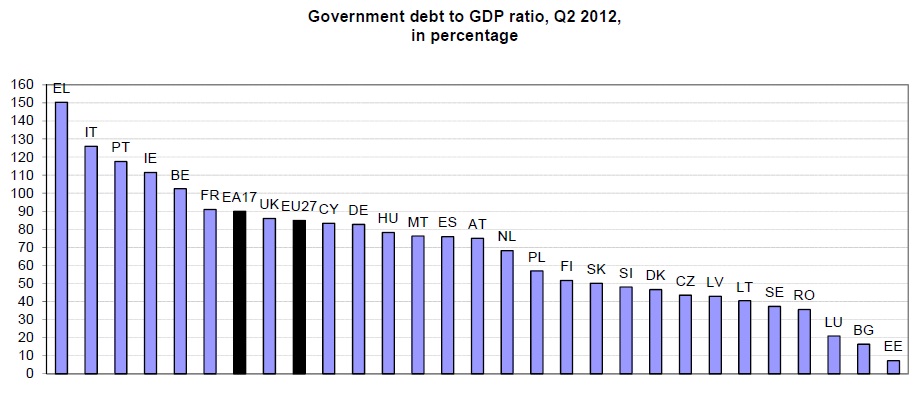
Nothing unusual about yesterday's announcement by Eurostat: Government debt in the EA17 and the EU27 in 2012's second quarter rose by 1.8% and 1.4% respectively. The usual suspects came up first with Greece reaching 150.3%, Italy 126.1%, Portugal 117.5% and Ireland 111.5%. Twenty out of a total of 27 Member-States have increased their debt burden over the last quarter.
Source: Eurostat
The highest increases were observed in Greece (13.4%), Cyprus (8.3%) and Portugal (5.6%). Even though the highest increases were somewhat expected (however, Portugal's future remains a riddle as social unrest has reached extreme levels in the nation, and I would be worrying that new austerity measures would render them in the same situation that Greece is facing now) the size of increase in Greece's debt does amaze. The Greeks fear another severe recession as a result of the new austerity measures to be announced (shortly?) and with good reason. Nevertheless, Greece's debt has decreased over the last year, with the total decrease for the 2011Q2-2012Q2 period reaching 8.5%. In absolute numbers the Greek debt has decreased from €340.906 billion to €300.807 billion over the course of the year. This would mean that GDP in 2011Q1 was €214.676 billion while in 2012Q2 has declined to €200.137. If GDP had remained stable over the course of this year then the Greek debt would account for "just" 140% of output. If the Greek GDP grows in the next year, then reducing the existing debt burden would be a much easier task. As for the rumors advocating large lay-offs in the country's government sector, let us remind them that the largest component of GDP is consumption. (for more details on GDP read here)

The next two candidates for a bail-out memorandum, Cyprus and Spain, have seen their debt reach 83.3% and 76% of GDP respectively. If Cyprus can negotiate the terms with Spain, then the terms might not be so rough on the island. If left alone, fear for the worst. Spain on the other hand, does have an ace up her sleeve. With debt reaching "just" 76% of GDP, the nation can negotiate for a lighter memorandum which would allow her not to impose extreme austerity measures to an already shaking economy. For those interested, debt in Spain rose by 9.3% on a yearly basis, and in Cyprus by a staggering 16.5%. A reminder: those who believe that the over-spending South is the cause for the recent crisis should look at the announcement and note that Spanish debt was just 66.7% in 2011 and Cyprus's 66.8%, much lower than France's, Germany's or the UK's at the time. (actually both countries' debt is still lower than the aforementioned three, with Cyprus just having a 0.1% larger debt than Germany)

Another question is what is going to happen with Italy. Although Mario Monti's measures have managed to keep the debt increase to 2.4%, if the country's debt does not begin to fall soon then they might face greater troubles than they expected. In a yearly basis, from 2011Q2 to 2012Q2 Italy's debt has increased by 4.4%, which is not good news at all.

For some good news, the IMF has approved a €1.5 billion loan disbursement to Portugal today, confirming that the nation is on track with its €78 billion international bailout. Nemat Shafik, deputy managing director of the IMF has stated that: "A weaker external outlook and rising unemployment have increased risks to the attainment of program objectives. Additional efforts are necessary, with the support of euro-area partners, to further advance fiscal consolidation and boost long-term growth."

Let's hope that they keep that "long-term growth" goal in mind and at the same time remember that for long-term growth, the short-term one is also needed.

Monday, 17 September 2012

Too much benefits?

After viewing Eurostat's "Government Finance Statistics" publication for 1/2012 in which all data concerning income, expenditure, debt, deficit, and much more were visible, what amazed me was the size of social benefits paid by each country in the EU. Take a look at the following:
What is obvious from the above statistics is that all crisis-ridden nations have seen their social benefits rise over the past 15 years. Greece, Portugal and Cyprus are the top three in increases with 8.4%, 9.5% and 7% respectively. On the other hand, Germany and Finland have reduced the social benefits they pay by 1.5% and 2.6% respectively. It is noteworthy that the nations whose social benefits rose substantially over the last 15 years were the ones which in 1996 had the lowest percentages (Cyprus: 8.3%, Ireland: 12.5%, Portugal: 12.6%, Greece: 13.5%) This phenomenon is rather strange as citizens of most of the aforementioned countries will indicate that they were better off in 1996 than 2012. As politicians and policymakers increases social benefits

Tuesday, 21 August 2012

Should the Crisis last?

Although I have yet to see any decisive action from politicians and policymakers in the EU I have the notion that from 2013 the situation will be better for the Union. I base this on the current actions by private banks, which are either selling their non-core loans or trading their existing loan portfolio in a country, in order to deleverage themselves (for details read this). I would assume that banks, tired of waiting for the officials to act, have decided to take action into their own hands. 

What worries me more than overcoming the crisis, is overcoming it without the opportunity to learn something from it. If the crisis terminates and we have the banks to thank, what would politicians and policymakers have done about it? Practically nothing. At the same time nothing will be done to safeguard the Union's future, as no extra authority will be given neither to the ECB nor the European Council. If the same causes provoke another crisis in the future nothing will be able to halt it at its beginning, since no measures have been taken now.

If the crisis ends without any political (or government) intervention then politicians will understand that they need to do almost nothing to correct the situation: procrastination, austerity measures and maybe a stimulus package will be more than enough. It would also mean that Southern Countries, with their productivity to the low end of the EU average will have done nothing to correct the situation. Cyprus, Portugal and Italy will continue to see their people work more than everyone else, alas, with lower productivity. You may notice that I exclude Greece from this. In my opinion Greece will be the nation which will mostly benefit from this situation. It is the only nation which has been through the process of reorganizing its finances, cutting excessive spending and making reforms and structural changes in its economy. Although the speed of this process is not one which would allow it to witness less contraction and unemployment, the process itself will be beneficial for the nation, something which will be more visible in the next 5 years. Nevertheless, had the process been slower the negative effects would have been less now, with the positive ones still occurring. (this scenario is of course based on the assumption that Greece will be given the extra €2.5 billion it will need this year, and will remain both within the Union and the Eurozone, which it should!)

On the other hand, Cyprus, Portugal and Italy have done little yet to correct this situation. Although all countries have undertaken measures to reduce their fiscal deficit (which is good if they are aimed at reducing irrational expenses), I have not yet seen one take any measures to increase productivity. What we so far witness is tax increases, salary cuts and reductions in pensions. All of which are mainly aimed at the older population!

As for the youth? It seems that no country has so far taken any action towards reducing youth unemployment or implementing incentives to increase start-up creation.  Have a look at youth unemployment in the EU (source: Eurostat)
Both the EU-17 and the EU-27 youth unemployment are over 22%! And nothing is yet to be done about this situation. I am guessing that until a change of mind occurs to the heads of politicians and policymakers, no change will occur in the EU. Well, I hope that the crisis lasts enough for them to make that change.

Wednesday, 15 August 2012

Welcome Recession

Yesterday, Eurostat published a news release concerning the GDP data of the Eurozone countries, compared to last year's. Not surprisingly, the results were that Greece's output shrunk by 6.2%, Spain's by 1%, Cyprus's by 2.4%, Italy's by 2.5% and Portugal's by 3.3%. Even in the UK, output was reduced by 0.8% compared to 2011. The only surprise was France, which avoided recession (which is measured as two consecutive quarters of negative growth) by reporting a 0.0% change compared to the previous quarter.

Germany's GDP on the other hand, rose by 1.0% a change attributed mainly to an increase in exports and domestic consumption, as investment levels have fallen. In general, GDP dropped by 0.2% both in the EA17 and EU27, while in the previous quarter it had remained stable at 0.0% change. What does this mean? Well essentially, if the next quarter is one of negative growth, the EU will officially be in recession. And I am almost certain that there will be negative growth in the next one.

That is, unless Mario Draghi (or any other EU official) decides to do something about this. By something, I mean effectively use his power as the ECB governor and buy bonds directly, which would boost investment and restore confidence in the region, something that he directly stated that the ECB could do in the future. I hope that Mario Monti's statement that "we have to reach the night before the euro collapses in order for the ECB to do what it has to do" proves to be wrong. I really hope that the officials will come to their senses before it is too late and large-scale measures to save the Eurozone have to be devised. 

Nevertheless, I do think that another quarter of negative growth, moving the EU in the recession zone, will be their wake-up call. We are humans, and like human beings most of us have do not care as much about the future as we do about the present (talking about German policies here; to be accurate it's just Merkel policies as many in Germany oppose her actions). In order to change ideas and mentalities we have to be convinced that things are going bad. Entering a recession will do that kind of convincing.

It seems that "smart" people need to wait until the very last minute to be convinced that their policies have created more chaos rather than reconstructing the Union. That is why an EU-wide recession is needed and, unfortunately, we are going to get one. Just wait until the next quarter.

P.S. The only person acknowledging what the bailed-out countries have done is Olli Rehn in one of the best articles I have read about the Eurozone. One cannot wait until September Olli, in order to see whether the ESM will be able to recapitalize banks directly.

Do we need a Crisis?

When people face difficulties, it is always easier to blame someone else for their mishaps. When a nation views its own problems, and as nations are governed by people, it is more than easy to criticize and assign fault to others. The same has happened now, as many Northern Europeans believe that the responsibility for the crisis lies only on the shoulders of Southern Europeans who, "do not work enough".

This, however, couldn't be farther from truth. Although South Europe is portrayed in the media as a place where everyone is constantly partying and nobody is working this seldomly depicts real life in the South. Germany on the other hand has the reputation of being a hard-working country. Still, German working hours are amongst the lowest in the world. So is France's. Look at the following chart comparing work hours in the OECD countries:
So what happens here? Are the poor Greeks and Italians working hard the whole time but the bad Germans take the GDP from their hands? In all fairness, no. It seems that although South Europeans are working many hours, what they lack is productivity. A quick glance in Wikipedia may help: Italy, Greece and Cyprus have below average productivity. Specifically, in the case of Cyprus and Portugal, their productivity is much lower than the EU average.

The only difference, is mentality. While Germans and French work less, their time put to better use and thus their productivity is greater. On the other hand, whilst Greeks, Italians, Cypriots and Portuguese work many hours, they do not do much in that time. The big question here is why? Is it just that they sit around and do nothing all day? I hardly think so (although many civil servants in the South are accused of doing so). The problem here lies in the heavily bureaucratic systems, with many anachronistic rules, laws and perceptions. The legal systems in Cyprus, Greece, and Italy were graded by Moody's as some of the worst in the EU, whilst Portugal's was merely average. Spain's on the other hand was very good.

This is why the South is in need of a crisis. A change in mentality and institutions is essential. Greece has only begun to realize these changes and the effect is disastrous. People are never ready to rapidly move from one mentality to another as this would mean a change of the world they live in. In the words of Olli Rehn: "And even in Greece, more has been achieved than is often realized."

This is one reason I state that change should be slower than it is now. Humans do not enjoy change. The labor force has been shown to be more resistant to change than anything else, surprisingly more than capital! (By capital one means things like machinery, plant and equipment). This reminds me the frog anecdote: If a frog is put in hot water then the frog jumps right out. If the frog is put in cold water and the water is heated slowly until it reaches the same temperature as the hot water from before, then the frog stays in and gets boiled.

The case is the same with measures: Move too rapidly and people will revolt. Take change slowly, allow people to adjust to it and you will have much better results. If you don't trust me just take a look at Greece nowadays!

Monday, 6 August 2012

Start-ups, Democracy and Growth

While the economic climate is deteriorating rapidly in South Europe what seems to raise our expectations about the future is the fact that in Spain, with unemployment reaching 25% and youth unemployment more than 50%, young people have began creating start-up businesses as a response to the economic crisis in the country. (for more information concerning start-ups in Spain read this).

Europe, especially in the South, does not have the same mentality or maybe not even the same resources when it comes to start-ups and establishing new businesses, as countries like the US or Israel do. The only nation in the EU that comes near this mentality is the technology-oriented Estonia which in 2005 it became the first country to offer Internet voting nationally in local elections. The feature itself is very impressive and something I would love to see in all countries. This will bring a new era in democracy, allowing citizens to have a direct opinion on many aspects of national affairs through courses of action like referendums. For those who love numbers 1.9% of the Estonians (approximately 9,300 people) voted online in 2005 whilst the percentage rose to an impressive 15.4% (150,800 persons) in the 2011 parliamentary elections.

Returning on the start-up discussion, with a simple visit to the EU grants website the reader may observe how many grants are targeted in  start-ups. Exactly none. Entrepreneurship is left to be promoted by individual countries and not at the EU level. Nevertheless, whilst in the UK (and to a much lesser degree in Germany), entrepreneurship attracts a rather significant amount of young talent, the South European mentality states that a job at a large corporation or in the government sector is a much more prestigious one. This is rooted in genes of all South European people, maybe a fact which derives from the instability in governments over the last century and has resulted in a need for a stable job, salary and life. (remember that Italy, Spain, Portugal and Greece suffered through dictatorship regimes over the last century, with all of them experiencing terrorist attacks over time and Cyprus had been prone to rough civil disputes and a Turkish invasion in 1974). These experiences lead to a risk-averse society, with the specific mentality passing on to the next generations.

However, when talking to today's youth, this mentality seems to be changing. This might be the result of the economic catastrophe the aforementioned countries are facing, where the most stable of organizations of the past, the banking institutions, are proposing layoffs and shrinking of business activities to survive. It seems that the most prestigious employers have lost their reputations.

My hope for the future is that EU governments understand the importance of start-ups in the economy and provide financial assistance, in the form of subsidies or state-owned Venture Capital (VC) firms to aid individuals get the funding needed to start their business. This need only be done for a short period of time, since after the initial phase, more and more privately held VC firms and angel investors will emerge. The cost of funding a start-up is also very low as most of them require less than 100,000 euros to function. Given the amounts each country spends on foolish expenses each year sparing 10 million a year for start-up funding is infinitesimal. On the contrary, the outcome of such policies will be extremely beneficial as the now deteriorating economies will be able to bounce back, create thousands of jobs and restore confidence in the nation as a whole.