Showing posts with label government. Show all posts

Friday, 31 May 2013

Is QE deflationary? A Conjecture

On Monday, a very interesting post came to my attention: Frances Coppola commented that the possibility of Quantitative Easing (QE - the process by which the Central Bank buys back government bonds and gives "cash" back to the banks so that they could increase lending) being deflationary instead of inflationary, as theory expects it to be, is large; and the data seem to agree with her (for her excellent points have a look here). This discussion, spurred spin-off blog where an abundance of sources on the issue can be found. As in any discussion, supporters of both views exist. An example would be Pawel Morski, who provides a very interesting graph and comments that QE is nothing but the only option, and this is better than doing nothing at all.

Although QE may be better than sitting idly around, the question of it being either inflationary or deflationary still exists. Thus, the question now becomes how QE can affect the level of prices. As the quantity theory of money states, MV=PQ. Given that we want to observe the effects QE has on the price level, we want to check how it affects money, velocity and output (M,V and Q respectively). The theoretically obvious effect of QE is on the money supply. If banks have more cash, then they would be inclined to lend more money, thus increasing money supply.

The above would hold if and only if the banks decide to increase their lending. If the banks are constrained by their regulatory needs or choose not to give out loans for any other reason, having more cash will not assist them in increasing spending (for further details on how this works I refer the reader to a previous post). During the QE phase, banks essentially swapped a 0% risk-weighted asset (bonds) with another 0% risk-weighted asset (cash), thus their risk-weighted assets (RWA) have not changed; yet, RWA will be increased if banks lend out any money (all personal/mortgage/corporate loans have a risk weight of at least 20%).

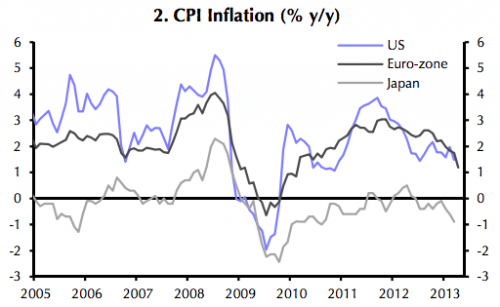
Nevertheless, the money supply indices (both credit and monetary base) show an increasing trend even after QE, while inflation appears to decrease:

Source: FT Alphaville
A careful look at the data provided by the Federal Reserve shows that the increase in money supply is losing speed: In the first 4 months of 2012 it was 1.18%; in the first 4 months of 2013 it was 0.7% (note: the Fed itself states that the increase was 2.9%. After re-doing the calculations the above percentages came up). Thus, money creation is slowing down, which forces inflation to fall. The fact that the monetary base in increasing is basically pittance given the amount of money in the system, although if it was reduced then inflation would drop even further. Yet, are credit/money creation and unwilling banks the whole story or is there something more to QE?

Enter velocity of money. According to theory, money velocity depends on an additional 6 factors, of which the quantity of money, the propensity to consume and liquidity preferences (with the 2nd and 3rd factors being essentially the same) are the most volatile. As we have seen in the previous paragraph, QE does not affect the quantity of money unless new credit is created by the banks (and the slow increase is shown in the above graphs). As a consequence, all we are left with is the marginal propensity to consume, or basically how much of our income we choose to save or consume. It is a well-known fact that people spend more (and save less) in times of boom and spend less (thus saving more) in times of recession/depression. Thus, at times of depression it is only logical that, even if the money supply is constant, the velocity of money is reduced and thus the price level is reduced.

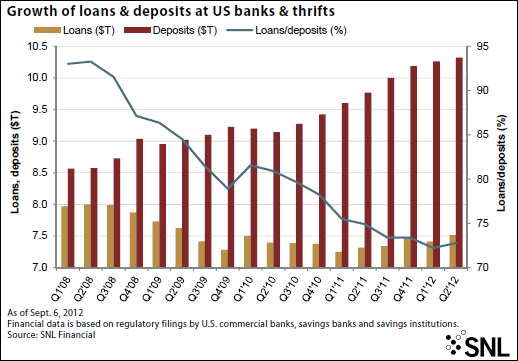
The above appear to have nothing to do with QE, yet, as we also know, it is difficult (extremely difficult to be fair) to distinguish between the forces which affect inflation. Thus, we cannot really infer by how much prices are affected by the QE or by the business cycle (i.e. the recession) in general. Thus, even as QE is initiated, bank loans are growing by much less than bank deposits (until 2012). Nevertheless, deposits and loans are again not telling us the whole story: why is inflation falling now and not in 2012 when the loans/deposits ratio reached its lower value? In 2013, Fed data show that loans have been increasing by more than deposits once again.
Source: The Wall Street Journal

The most obvious outcome of QE is an increase in bond and stock prices; which is what it should do, in order for stock and bond returns to lower and people start using their money for other investment plans. However, although there exists a ceiling over which bonds do not offer a good return to their owners, this does not exist in the stock market. Shares can, theoretically at least, increase forever (and the 1990's have shown such examples of rapid and strong growth).
As a commentator stated "QE is to stocks as booze is for self-confidence". Since people believe that QE is good for the economy, their expectations concerning growth are raised. Continuing on the chain of causality, when the economy grows, it is only rational that stock prices will rise. Thus, in order to make profits from that increase in stock market prices people pour more funds in the market to buy them while they are "cheap". In addition, an increase in the stock market indices, is an added incentive to invest in it, since returns are high and risk is relatively low. Then, as more money is poured in the stock market, prices rise, while consumption lags. As consumers focus more on the future than the present, it is obvious that short-term consumption will be decreased, an outcome of both the shifting of preferences and the increased returns of the stock market. Then if preferences are shifted from the present to the future, an increase in the stock market makes more people want to invest (long-term possibly?). Thus, consumption (i.e. money velocity and aggregate demand) is decreased while savings and stock market investment is increased. (Note that because of the recession, most investors are more risk-averse than what they were during the boom phase. Thus, they have an added incentive to invest in already established "blue chip" listed companies than riskier start-ups or smaller firms)

Summing up the chain of causality:
1. Government announces QE because the economy is doing bad, hoping that the banks will use that extra money to create additional credit.
2. If banks are not constrained by either the risk/reward trade-off or by any regulatory requirements, they lend and more credit creation results in increased inflation.
3. If not, then banks lend much less than the government hoped for.
4. Since investors are unaware of whether #2 or #3 hold, they choose to invest in the stock market, given that in any of the two cases growth is more than what they were currently experiencing and thus stock prices are expected to rise.
5. Thus market prices rise because more agents enter the market.
6. With prices rising, consumers who have been saving a much larger amount of their income than they were doing before because their time preferences have changed (i.e. they lower current consumption for future consumption), wish to increase the amount they will be able to use in the future by investing in the market (either directly or indirectly).
7. In addition, banks may use that extra QE "cash" to invest (speculate?) themselves in the stock market.
8. Thus, either by reducing credit or by reducing the amount spent, both aggregate demand and money velocity are reduced.
9. This leads to a slowing of inflation or to deflation.
10. Nevertheless, this situation will not necessarily perpetuate. As people see stock prices rise, they start selling off at one point and they choose to either invest in other products (i.e. lend if they are banks) or consume more (if they are individuals).

In short, QE might be deflationary if banks can and choose not to lend and stock prices rise; yet, it can also be inflationary if they do so. The deflationary effects are not permanent though: over time, and with the effect of QE declining, funds will flow from to the stock market to the real economy, boosting both consumption and money velocity. Overall, QE is not a bad strategy. Nevertheless, it does not always work like policymakers expected.

UPDATE: It looks like Paul Krugman had suggested that the QE2 success was in promoting growth via increasing consumption by raising stock prices. This appears to agree with point #10, where the  people start selling off to capitalize on their gains. Yet, if this increasing trend in stock prices persists, people, assisted by the uncertainty of the current era, will tend to defer consumption for the future, as long as they believe that they will be able to consume more then than now.

Thursday, 8 November 2012

Who's fault is it for the Crisis?

To be honest, I wanted to write this article for a while now. I have heard almost everything concerning whose fault it is for the current situation: banks, politicians, people, Greece etc. Thus, today I am giving you my honest opinion on whose fault it is for the chaos we are currently living. The answer is not, as some may have thought, just a person or a nation. It is a continuing series of absurd, irrational mistakes which have, step-by-step, led us to this situation. Without further ado I present you with the list of the 3 groups of people to blame for this situation:

1. Greek Politicians and Greek People
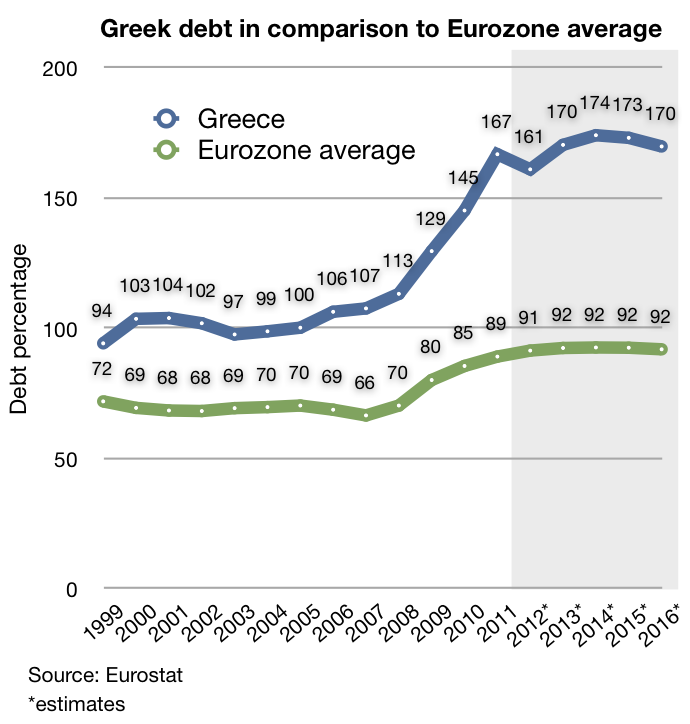
Politicians in Greece, strong proponents of a system named Kleptocracy, which in essence means a system where the government increases the personal wealth and political power of its officials and the ruling class at the expense of the wider population. Greek politicians were (are?) notorious for embezzling state funds, shipping their money to Swiss bank accounts and receiving bribes so that they could arrange something for someone. Greek government debt, issued to fund such abuse of power rose from 94% in 1999 to 167% in 2011 as one may see from the graph below.
Source: Wikimedia Commons and Eurostat
The reason for this astonishing debt growth is obviously the large government deficits, which allowed for politicians and other officials (or their affiliates and business partners) to practically steal from the state using as a preface works for public good. 

Then why the Greek people one might ask? Well, to put it simply because they tolerated and perpetuated this situation. When in public hospitals (which are supposedly free for everyone) you have to bribe doctors for the right to an examination, when you know that many are stealing from state funds and not only you do not do anything to oppose such a thing but try to come up with ways to steal some yourself, when people's parents die and do not mention the fact to the police so that they can continue to receive their pensions (and this has happened repeatedly) then one cannot just blame politicians for it. I am not at all suggesting that every person in Greece is at fault for this directly. Nevertheless, they are at fault indirectly since they have tolerated and perpetuated this situation throughout the years. All that is necessary for the triumph of evil is that good men do nothing.

2. EU Banks

Although EU (and non-EU for that matter) banks must have had the data for the increase of the Greek debt (Eurostat publishes a quarterly analysis which is free and open to public) they had chosen to ignore the possibility that a country issuing large amount of bonds could possibly face trouble. The following data is from the Bank for International Settlements in 2011 and indicate the exposure of non-Greek banks to Greek sovereign debt.
An casual observer can see that the first 12 banks have an exposure of more than 1 billion. At first, your reaction might be that obviously they had enough money to compensate for large losses in Greek debt. After all they are large, well-off organizations aren't they? Well, have a look at the next data set.
What is more astonishing is that people running the two Cypriot banks, Dexia or BPI, Commerzbank or any other bank which had a large exposure in Greek debt, did not think about having more than 10-20% of their equity in one single country. Now I am no expert in risk management, but from what I can remember there is a notion called diversification which means that you shouldn't put all your eggs in one basket. It looks like the officials who ordered such massive buys of Greek bonds should have taken a good look a their exposure and the amount of Greek debt before they invested. They did not.

3. Decisions by the EU

So far the usual suspects were at blame: greedy bankers and corrupt state officials. Now how about we take it to the next level? In an announcement in February 2012 the Eurogroup decided that the Private Sector Involvement (PSI) in the Greek debt restructuring would amount to a total of 75%. For those of you counting, the first 15 banks of the above chart lost a total of 21 billion euros in one day. These were the biggest losses of all times for most of the banks involved. 

As if this was not enough for the banks, the European Banking Authority had issued a "temporary" rule (which now is bent on making it permanent - for details read this) of increasing Core Tier 1 Capital requirements from 8% to 9%. Although this might not seem like much, the increase forced the banks to come up with €116 billion of new capital. And all that in the midst of a crisis, where finding funds is even more difficult. For a detailed view of where these funds came from have a look at the following image:

Source: Wall Street Journal
Thus, keeping in mind that when banks are in need for money they do not lend out much it not amazing why we have reached a situation where individuals and companies are struggling for liquidity. The worst part is that due to the severity of the decisions many banks in the EU are struggling for liquidity as well, which has led countries like Cyprus and Spain to seek for assistance. What has happened is that, in essence, the EU authorities have taken a country-specific crisis and transformed it to an EU-wide one through erroneous handling. These decisions can (unfortunately) be compared to the ones the US Federal Reserve had made in the early 1930's which had strengthen the Great Depression, prolonged its duration and increased its severity.

As a conclusion I would like to remind you of the timeline of errors which led to the crisis:
1. Corrupt officials and politicians in Greece were stealing money from the country and were financing their spending with government bonds,
2. Banks had not paid attention to the increase in government debt and kept on buying more and more lured in by the high returns offered, and
3. EU authorities, by handling the situation badly, have transformed the Greek crisis to an EU crisis

The situation worsens as politicians and policymakers in the EU are throwing good money to follow bad. As they cannot admit their mistakes they hope that two wrong can make a right. Well, the saying doesn't go that way. 

Wednesday, 24 October 2012

Eurozone Debt On the Rise

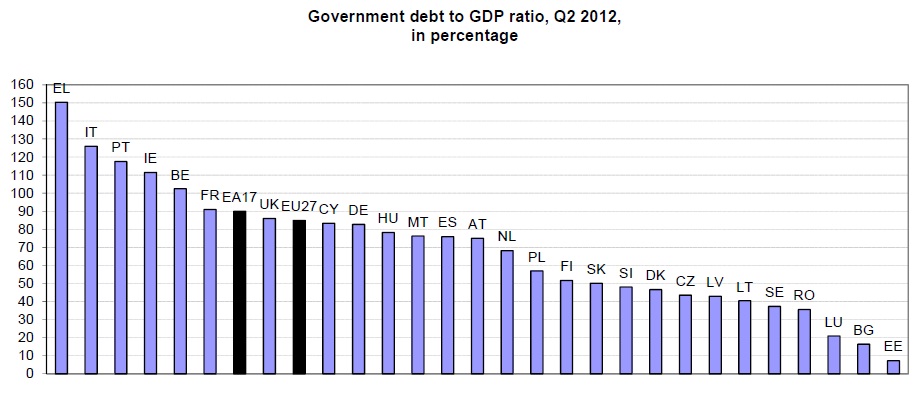
Nothing unusual about yesterday's announcement by Eurostat: Government debt in the EA17 and the EU27 in 2012's second quarter rose by 1.8% and 1.4% respectively. The usual suspects came up first with Greece reaching 150.3%, Italy 126.1%, Portugal 117.5% and Ireland 111.5%. Twenty out of a total of 27 Member-States have increased their debt burden over the last quarter.
Source: Eurostat
The highest increases were observed in Greece (13.4%), Cyprus (8.3%) and Portugal (5.6%). Even though the highest increases were somewhat expected (however, Portugal's future remains a riddle as social unrest has reached extreme levels in the nation, and I would be worrying that new austerity measures would render them in the same situation that Greece is facing now) the size of increase in Greece's debt does amaze. The Greeks fear another severe recession as a result of the new austerity measures to be announced (shortly?) and with good reason. Nevertheless, Greece's debt has decreased over the last year, with the total decrease for the 2011Q2-2012Q2 period reaching 8.5%. In absolute numbers the Greek debt has decreased from 340.906 billion to €300.807 billion over the course of the year. This would mean that GDP in 2011Q1 was 214.676 billion while in 2012Q2 has declined to €200.137. If GDP had remained stable over the course of this year then the Greek debt would account for "just" 140% of output. If the Greek GDP grows in the next year, then reducing the existing debt burden would be a much easier task. As for the rumors advocating large lay-offs in the country's government sector, let us remind them that the largest component of GDP is consumption. (for more details on GDP read here)

The next two candidates for a bail-out memorandum, Cyprus and Spain, have seen their debt reach 83.3% and 76% of GDP respectively. If Cyprus can negotiate the terms with Spain, then the terms might not be so rough on the island. If left alone, fear for the worst. Spain on the other hand, does have an ace up her sleeve. With debt reaching "just" 76% of GDP, the nation can negotiate for a lighter memorandum which would allow her not to impose extreme austerity measures to an already shaking economy. For those interested, debt in Spain rose by 9.3% on a yearly basis, and in Cyprus by a staggering 16.5%. A reminder: those who believe that the over-spending South is the cause for the recent crisis should look at the announcement and note that Spanish debt was just 66.7% in 2011 and Cyprus's 66.8%, much lower than France's, Germany's or the UK's at the time. (actually both countries' debt is still lower than the aforementioned three, with Cyprus just having a 0.1% larger debt than Germany)

Another question is what is going to happen with Italy. Although Mario Monti's measures have managed to keep the debt increase to 2.4%, if the country's debt does not begin to fall soon then they might face greater troubles than they expected. In a yearly basis, from 2011Q2 to 2012Q2 Italy's debt has increased by 4.4%, which is not good news at all.

For some good news, the IMF has approved a €1.5 billion loan disbursement to Portugal today, confirming that the nation is on track with its 78 billion international bailout. Nemat Shafik, deputy managing director of the IMF has stated that: "A weaker external outlook and rising unemployment have increased risks to the attainment of program objectives. Additional efforts are necessary, with the support of euro-area partners, to further advance fiscal consolidation and boost long-term growth."

Let's hope that they keep that "long-term growth" goal in mind and at the same time remember that for long-term growth, the short-term one is also needed.

Tuesday, 23 October 2012

Steps Towards a Better Future?

Good news for Greece yesterday, as according to Reuters and the Bank of Greece, the nation has posted a current account 1.6 billion surplus for August 2012. What is more impressive is that this is happening for a second consecutive month, with July also presenting a 642 million surplus. Overall, in the January-August period the current account deficit of the country has been reduced by 9.1 billion, an impressive feat. In the following table, where the current account data of the last 6 months can be observed, one may notice a huge improvement compared to last year. Hopefully, the Greeks will be able to keep this up for the next couple of years as well.


Some of you may wonder what a current account is. Well the current account, in addition with the capital account are the two main components of the balance of payments. Now, the balance of payments is just
an accounting record of all monetary transactions between a country and the rest of the world. 

The main equation of the Current Account is:

CA = (X - M) + NY + NCT

where X stands for exports, M for imports, NY for net income from abroad (which accounts for companies/individuals in the country receiving income from abroad, foreign companies investing in domestic companies or local governments and income from tourism) and NCT for net current transfers (mostly direct country-to-country currency provisions like donations, aid or official assistance).

Traditionally a Current Account is important since under traditional balance-of-payment accounting, the CA plus the Valuation Effects equal the net foreign asset position (NFA)of the country, with NFA being the value of the assets that country owns abroad, minus the value of the domestic assets owned by foreigners and Valuation Effects being the change in the value of assets held abroad, minus the changes in the value of domestic assets held by foreign investors. This is considered to essentially reflect the foreign indebtedness of that country. 

Nevertheless, as most economic indicators, this should be taken with a grain of salt as although in general a CA deficit is considered bad, in cases like Australia, where a persistent 18-year CA deficit been driven by private sector has brought more growth to the economy than problems. What should be noted of course is that Australia's public debt is a mere 6% of GDP, compared to 170.6% for Greece. Thus, in the case where debt is minimal, CA could be either positive or negative without much impact on the economy (it may also be true that negative CA could be good for the economy), however, as debt is extremely high in the EU-periphery, a positive CA should be much better.

Monday, 8 October 2012

Incentive Compatibility Problem

Direct quote from Paul Krugman article in the New York Times more than 2 years ago:
"When I was young and naive, I believed that important people took positions based on careful consideration of the options. Now I know better. Much of what Serious People believe rests on prejudices, not analysis. And these prejudices are subject to fads and fashions. ... For the last few months, I and others have watched, with amazement and horror, the emergence of a consensus in policy circles in favor of immediate fiscal austerity. That is, somehow it has become conventional wisdom that now is the time to slash spending, despite the fact that the world’s major economies remain deeply depressed. This conventional  wisdom isn’t based on either evidence or careful analysis. Instead, it rests on what we might charitably call sheer speculation, and less charitably call figments of the policy elite’s imagination — specifically, on belief in what I’ve come to think of as the invisible bond vigilante and the confidence fairy."

Hmm, this does sound a lot like what the Troika has been trying to pull in Europe over the last couple of years doesn't it? To be honest, was young and naive until a few time ago. That was when I believed that people in power and in a position where they could influence policy knew what they did. Unfortunately this was not the case: Most of the politicians, policymakers, economists, specialists and experts have absolutely no idea what they are doing. Take a look at what is happening in Europe nowadays: the Troika proposes, with their experts, specialists and economists not thinking about the consequences such a thing would have on each nation's economy, and politicians, policymakers, economists and specialists in the nation accept it with no arguments. Even if they propose any arguments, they are usually either of the "won't do any reforms" or the "instead of these measures how about these harder ones?" kind.

The scenario boils down to three things: 
1. Economists, specialists, politicians, policymakers and etc do not think at all about the consequences
2. They do not care about the consequences because although they may affect them, it is unlikely that they will end up starving or without a job.
3. Both
Which of the three seems more possible?

Well you guessed it. Either the latter one or a combination of the two. It is always easier for someone to make a tough decision about slashing salaries and bringing the economy to a rapid recession when he/she knows that her/his salary will keep getting in his bank account at the end of each month. Obviously, most members of the parliament, economists, policymakers and others earn much more than the average wage. They reasoning is that they should provide an important job to the society and thus they should be rewarded. However, there seems to be an incentive compatibility problem.

Obviously, when a general wage cut occurs every person receiving a governmental salary should be affected. However who is more affected with a 10 or 15% cut? The one who makes 1000 euros a month or the one who earns 5000? I guess having to live with 4500 or 4250 euros beat trying to live with 900 or 850! Obviously, the one receiving the larger salary is doing something more than the one earning the lowest.  Still, a 10% decrease in wages is very hard for people who are not in the high income scale. The wages of public servants (those in the higher tax brackets that is) should not be awarded as a lump sum. They should be awarded based on their performance, as well as the performance of the general nation (in their area of expertise obviously). This would allow for them to think twice before they accept or condemn policies which are prone to throw GDP down the drain.

What should be done, is that nothing more than a 5% decrease every two years should occur. If the South wants a more effective public sector it is better off limiting entries than reducing salaries that much. This would allow an economy to exit the recession and not make the debt unsustainable, provided of course that they try to limit budget deficits to a minimum.

Wednesday, 19 September 2012

What is GDP?

After several discussions and arguments recently, I discovered that although most people are bombarded with statements of the "GDP has retracted by 1%" or "the banks' assets are greater than the nation's GDP" kind, many do not have a clear image of what GDP is, or what it counts. To begin with, GDP is short for Gross Domestic Product, was developed by economist Simon Kouznets in a UN report in 1934, and has been the main measure of a country's economy since the Bretton Woods conference in 1944.

GDP is calculated as follows (based on the expenditure method, meaning that every good or service has a price and is therefore measurable):

GDP = Private Consumption (C) + Gross Investment (I) + Government Spending (G) + (Exports - Imports)

Now let's see what the components of GDP are (most of the definitions used here are from Wikipedia):
1. Private Consumption falls under one of the following categories: durable goods, non-durable goods, and services. Examples include food, rent, jewelry, gasoline, and medical expenses but do not include the purchase of new housing.
2. Investment includes, for instance, business investment in equipment, but does not include exchanges of existing assets. Examples include construction of a new mine, purchase of software, or purchase of machinery and equipment for a factory. Spending by households (not government) on new houses is also included in Investment. In lieu of the common use of investment, i.e. purchase of financial products, these are not considered as investment but as savings.
3. Government Spending is the sum of government expenditures on final goods and services. It includes salaries of public servants, purchase of weapons for the military, and any investment expenditure by a government. It does not include any transfer payments, such as social security or unemployment benefits.
4. Exports are gross exports within the year measured and Imports are the gross imports within the same year.

What some people believe is that GDP is some sort of state income, which is distributed to people in some way. This is far from true as GDP is merely a rough measure of the economy's ability to produce and not any sort of income, although it is measured on an annual basis. As economist note, the main driving force of the above equation is Private Consumption (C). If for example, due to a prolonged crisis, people are afraid to go out and shop, since they believe that they will need the money later on, or if their income has fallen, C will go down and drag GDP will it. Similarly, in a crisis, Investment usually falls, as less people are likely to buy new houses and less firms invest in new equipment. Imports usually fall as well since people, faced with less purchasing power than before due to their unwillingness to spend, or lack of income, are less eager to purchase foreign goods.

The only part of the equation which is really a matter of government is G (Government Spending). That is the reason why in most nations where budget cuts are implemented, in the form of wage reductions, GDP falls. However, as one may observe, transfers from the government to the people (e.g. social benefits, pensions) are not included in the definition for government spending. Nevertheless, this does not mean that it these will not affect GDP, since a reduction in pensions, such as the one currently occurring in Greece, affects GDP indirectly, as pensioners with fewer money will spend less and C will drop.

As a matter of fact, GDP is neither a measure of welfare as it can only measure what is measurable and lacks an ability to quantify quality. Although sometimes it is used as such, even Kuznets himself has separated the ability of GDP to measure an economy's production and its use as a measure of welfare:
"Distinctions must be kept in mind between quantity and quality of growth, between costs and returns, and between the short and long run. Goals for more growth should specify more growth of what and for what." (Kuznets, 1962)

Saturday, 28 July 2012

Cyprus Bailout and Austerity Measures

Having written an opinion on austerity measures in South Europe I think it is time to focus on the current problems faced by Cyprus. Although its government states that it has money to hold until September (other sources state that it has money to make it until the end of the year) it is common knowledge that the island is bankrupt. For more information on the situation read this article by Wolf Richter where the nation's current situation is outlined. Prospects appear as dark as they can get while the Troikans believe that the island will need about 10 billion euros to cover it's needs (both for the fragile banking system as well as for a black hole in it's finances). 

The Cypriot government is headed by a President whose communist views have spurred controversy even amongst its European Allies and who seems unable to commit to actions that will alter the situation. The only moves that have been made towards fixing public finances were done in September and December 2011, by a Finance Minister (Kikis Kazamias) who resigned in March stating "medical reasons". However, the Cypriot President, Demetris Christofias, despite his growing unpopularity even amongst its own party, has requested that the structural changes that need to be done in the Cypriot economy should span over the next 6 years and not over the next one.

For once, I do believe he has the right idea, although for the wrong reasons. His reasons are strictly political as he must think, and many others in his place would have thought the same, that the effect of strict fiscal discipline will be devastating for the future of his party. With elections coming on February 2013 he has every reason to be worried. (However, I don't think that this will do much more harm to his reputation than he has already caused to himself by his inability to face reality).

My reasons are strictly economic. Changing fiscal policy so rapidly will cause a wave of new issues to the already problem-ridden island. Cyprus has one of the highest private debt ratios in the world of about 300% of the GDP. Add to that an exposure of about 40% of the Cypriot banks' loan portfolio to Greece and an economic confidence level at its lowest since they have started compiling one, and you get an explosive package. So, if one may ask, what happens when to a country with a 300% of GDP private debt when fiscal policy is abruptly tightened without an expansion of credit? Well, I guess (the troikans can verify this if they can) that foreclosures, bankruptcies, a confidence level even lower and unemployment levels reaching 15-20%  are the logical consequences. After that, you can understand that the next victims are the banks themselves.

Cyprus Popular Bank, the second largest bank on the island has led already agreed with 185 employees on a "voluntary" retirement scheme. This would help it fulfill a target of reducing employees by 7% this year. The rapid and rather stupid expansion of Cypriot banks in both Cyprus (Bank of Cyprus, the leading bank of the island has about 120 branches in a nation where the total area is less than 6,000 square kilometers. The same numbers more or less hold for Laiki Bank. However the exaggerations in both banking and fiscal policies must not be revoked immediately as this would not bring the island to the brink of destruction - it will push it over the cliff.

If the austerity measures are pursued with severity and results are expected from the first year of imposition the island will need another group of Troikans until next year to hand over several billion more to save them.

Thursday, 26 July 2012

Impressions from a Southern European Country

After watching that Cyprus has also applied for a bailout from the EFSF/ESM fund (following Greece, Ireland, Spain and Italy) I decided to to watch a bit more carefully on how the situation will be handled this time. From what I can see in the news, the group of experts (or technocrats if you prefer) of the International Monetary Fund, the European Commission and the European Central Bank (the so-called troika) have reached the same conclusions as they had done before for the case of Greece, Ireland, Spain and Italy: Austerity Measures. Surprise, Surprise! As if any European citizen was expecting anything else.

News stories of what they intend to propose specify things like large cuts on government expenses, decreases in civil servant wages and benefits and increases in direct and indirect taxes. Although I am positive that the Cypriot state needs to perform some sort of rationalization over its expenses (the Southern European states have a much deserved reputation of not being very logical when it comes to government spending. An excellent example of such irrationalities is Greek government's allowance to the civil workers who arrived at work on time) this sort of thinking and acting will not ease the burden of a sovereign debt crisis. Judging however of the ease at which the troikans believe that austerity measures are a panacea I would propose that the next country that will need a bailout ship its accounting books to them and spare the EU some money on traveling!

As one may observe, austerity measures have not so far helped in easing the effects of the near-bankruptcy of Greece. In Spain, unemployment has reached 25% amongst the population and about one out of two youths under 25 is jobless. And yet, Mariano Rajoy's government announced huge cuts in the nation's budget which will only worsen the situation. Mario Monti's government of technocrats in Italy (in my opinion the best leader in the EU at the moment) has only taken 30bn euros worth of measures, and those in December 2011. In comparing the two states it would now seem that prospects seem slightly brighter for the Italians as per the spring 2012 European Commission forecasts. (for more details read the European Commission Economic Forecast. Be warned it is 190 pages long!)


As one may observe the Commission states that after 2012, a bright future awaits the Union.However I do not believe that such a comeback will be feasible so easily. In an already depressed economy the cost of slashing government spending is going to be more than the amount of money not spend.

As one may see from Google's public data Spain had negative growth only twice in the last 50 years while the more politically unstable Greece and Italy have had more ups and downs. On the other hand Cyprus's only year of negative growth since 1961 was 2009 (wouldn't it be nice if they could just keep it up? Damned bank exposure to Greece!). However, if you exclude the 1974 change in Greek authorities after the 1967 coup d'état, a year which was marked by a 6,44% Greece had not faced major economic downturns. The same holds for the Italians whose worst year was 1975 with a 2,09% drop.

According to the Debt-Deflation Theory of the Great Depression by Irving Fisher and the academics who have studied and written about it over the years (one of which in the Governor of the Bank of England Mervyn King) a large government sector has stabilizing consequences to an economy. In Hyman Minsky's Stabilizing an Unstable Economy (you can find it here) this idea is revisited and it is once again shown that a large government (up to a point obviously) is beneficial for the financial stability of a nation. (I am under the impression that the troika will not especially enjoy this paragraph) Thus the danger that may arise from an excess of austerity measures is to make the already fragile system more prone to future crises.

Following this ideas it is more essential to provide incentives for growth and then impose austerity measures. The logic behind the EFSF so far has been: we give you money if you promise to be frugal with them. Well gee EFSF thanks a lot! What would actually make sense would a be a policy of ''we give you money, spend them to boost the economy, and then impose some austerity measures". (If you are one of those who like to derive examples from economic history you may use the one of Theodore Roosevelt and the Great Depression) I once again state that I am not against the rationalization of government expenses. However, this should be done after the economy stabilizes and not before! If the economy does not grow how is the nation going to pay back it's lenders?

I guess that following the traditional German logic of keeping inflation low and finances tight at all costs led us to where we are now (a note on the solution of the Greek debt haircut on posts to come) and will keep us there until the Germans realize that the hyperinflation of the 1920's will not occur if the let the ECB act as regular central bank and print money. It would even make the value of the dollar fall which would help German exports! 

(Mrs Merkel please listen to reason! Most Europeans are bored of the same meetings with the same conclusions!)