Showing posts with label Italy. Show all posts

Saturday, 8 March 2014

Policy and Self-Fulfilling Prophecies

I've been raging about confidence for a while now. Since any other form of stimulus is either unproductive (e.g. monetary policy due to the ZLB) or infeasible (e.g. QE or government spending), the only way we could actually see growth in the region is via an increase in confidence, which basically means an improvement in our current expectations about the future. Simply put, if I am going to either spend or invest more, I have to know that I will continue to have a job in the near future or that the overall situation in the economy will be better than now.

The problem is that many of us (especially journalists) take a particular liking to bad news; it appears that they sell more than good ones and that is why we tend to emphasize on that (disclaimer: I may have fallen into that trap myself at times). This wouldn't necessarily be hurtful to the economy if we did not live in a world where we somehow create it ourselves. In physics, bad news about a specific group of atoms would not cause all other atoms to stop obeying natural laws. In economics though, bad news about some may cause others to react badly as well.

Think for example what happens when austerity measures on the public sector are imposed: although it may be right that some workers in some countries are overpaid, lowering their wages in a recession comes at a cost. As civil servants lower consumption, the private sector sees its demand fall and reduces investment, causing unemployment to rise. Then, until we adjust to the situation, the economy moves in cycles of reduced demand and investment, causing unemployment to rise and incomes to fall. In the Eurozone, we are now experiencing the time where most of the adjustment has already taken place and even though demand is weak and investment is low, we are much better off (expectations-wise) than a year ago.

Yet, some still point out to the bad things; while, for example, the outflow of deposits from Cyprus appears to be stabilizing with the overall amount registering ups and downs in the past couple of months (compared to huge decreases before), some focus on the downs. The problem of over-focusing on the bad news is that it creates another cycle of uncertainty, one which, on its own, can cause more damage than policies can. You see, if I am bombarded with constant emphasis on how bad the economy is doing (it's not doing good by the way but it does certainly fare better than last year) then I will be more than skeptical to invest or spend. The cycle, as described in the previous paragraph, is indicative of what will happen when confidence falls; the issue here is that over-exposure to "bad" news means that these will turn out to be true if people believe them to be. It is the equivalent of fiat money: it works just because you trust it, nothing more and nothing less.

This kind of over-emphasis can actually derail many of the countries already in a bail-out agreement. Biased information about Greece is what made Greeks believe that they are faring worse than expected, pushing the vicious cycle of austerity deeper into the economy. Now that they are faring much better, biased information and vastly exaggerated opinions are still appearing on popular websites. While I am certainly not a fan of irrational optimism (remember I was one of the first to note that the Cypriot economy was badly in need of a rescue package in 2012 and that Spain is not really out of its trouble) I do think that we should really think before we offer an opinion, especially if it is bound to affect millions.

The bottom line is simple: be very careful of the information you use to make decisions. Emphasis on what could go wrong never really helped anyone; and neither  it will in the future

P.S. As far as forecasts are concerned here are my own (obviously biased) ones: Greece will need no more loans after 2014, but she will most probably not exit the bailout programme by year-end as the Greek PM has predicted. Cyprus will have a tough year but it may actually show us some quarter-to-quarter growth in late 2014. Spain will be rather stable with a slight increase in GDP compared to last year but the big question is what will happen in Italy and whether Slovenia will opt for a bail-out. On the latter two we just wait and see.

Friday, 20 December 2013

The Original Sins: EU's entry decisions

Once upon a time there was a continent, which was made up by 50 countries. One day the countries decided they would benefit from being united instead of fighting each other thus they formed a Union which they soon thought would be able to issue its own currency; one which would work in all of these countries and become one of the leading currencies in the world. But who would enter? They couldn't just let anyone in so some rules had to be made. Thus, they thought of the easiest task: you wouldn't be able to join the currency area, unless your public debt was less than 60% and your government deficit was less (or very close) to 3%. They even formalized this by signing a treaty in a smallish town somewhere North.

The problem with this treaty was that it was too rigid for its own good. By the time the new currency was brought to the markets, many of the countries wanted to join the whole charade and play with the big boys but couldn't. The reason was that they were constrained by 3-60 rules of the treaty. Why should they want to enter ans lose the enormous power of issuing their own currency one might ask. The reason was simple: it was better than the one they had until then and it opened the door to numerous opportunities for growth. Up until the initiation of the common currency the countries which wanted most of all to enter the Union and could not grappled with high inflation and perpetually-depreciated currencies. For example, three of the countries wanting to join the currency Union had an exchange rate of 166.386, 353.101 and 1,936.27 to one with the common currency*.

However, those countries really wanted in. But what could they do? Their public debt was more than the 60% limit and their deficit exceeded 3%. There was no real way to reduce the debt by issuing new money as that would mess with the exchange mechanism they were tied to, given their willingness to join the Union. Thus all there was to reduce was the deficit; but which politician would be willing to and announce a reduction in spending and risk sacrificing his chair to the altar of joining a Union? The stakes were too high for such actions. Still, they had promised their voters (and their voters really wanted it) that they would join the Union.

Being mostly politicians and bureaucrats they had no idea of what they could do. Thus they invited the big investment bankers for advice. The latter, known for their quick wit, eagerness to solve a problem they will receive a big compensation and willingness to find loopholes in legislation found a simple solution: they would be able to reduce the deficit using a Swap. In a swap, two counterparts change cash flows, usually in order to reduce risk. In this case, the supposed risk was the exchange rate since there was a bond issue in Japanese Yen. The following graph shows how a swap should look like. Note that these sort of swap transactions were legal and approved both by the sovereign's central bank as well as the Union's.
Source: ZeroHedge
Yet, this is not how the transaction went on. What the investment bankers did was increase the one-off final payment and make the payment coming from the sovereign borrower negative. In simple words, the country was receiving the fixed payments in yen and was again receiving payments at the time it was supposed to pay. The following graph illustrates what happened:
Source: ZeroHedge
Why would they do this if the payment in the end was huge the reader might ask. Remember that the country had no intention of reducing its debt since it could not do it in short notice; it was aiming at reducing its deficit. Using the above swap, the country was receiving two payments from the bankers which meant that first it wouldn't have to pay any interest thus reducing the government deficit and second it was getting money back and it could either repay outstanding loans or use it to show further budget improvement. The country did both. And this is how it fared:

The bond was issued in 1995 and the swap took place in 1996. Note the impressive decrease of government deficit as a percentage of GDP from 1996 to 1997 by 4.3% to within the limits of the 3% rule; something which lasted until 2002, the year when the common currency was introduced to the public (although to be fair, the specific swap expired in 1998). The strategy was so successful that it soon found imitators: others sought to find the magic deficit-decreasing swap. In 2001, Greece tried the same and somehow it worked in allowing it to join the Eurozone:
But things didn't work out as planned by the Greeks: by the time they signed the deal, they were already 600million more in debt than the originally planned 2.8 billion to be repaid. The perils of secret negotiations and under-the-table agreements came up in 2009, forcing the country to require a bail-out. Not that Italy is doing any better now but having a stronger economy can assist in overcoming recessions faster.

The author of "Derivatives and Public DebtManagement", Gustavo Piga (the person who unearthed the story about Italy) suggests that secret treaties are just a way of exploiting the taxpayer. The problems in the Eurozone have not arisen because of some secret agenda or as a result of a global conspiracy. They were there to begin with. Neither Greece's nor Italy's debt management practices were ideal and those who allowed them in the Eurozone knew about this (even Eurostat was to to blame since it had knowledge of the fact according to ZeroHedge) and chose to close their eyes. Evidence of mismanagement were there: just look at the exchange rates of the three countries mentioned earlier. 

The accumulated sins of the Eurozone structures were bound to come and haunt us. They just did sooner than anyone expected. If there is a moral to this story it's that in economics, when you do something bad it will come back and hit, just like a boomerang. But that was not what the Italian and Greek authorities thought when they made the swaps. Too bad; for their taxpayers that is.

*Spanish peseta, Greek Drachma and Italian lire respectively.

Thursday, 14 February 2013

GDP is falling down...

Eurostat published its latest statistics on Q4 2012 in the Eurozone. Nothing that we did not expect actually: Portugal -1.8%, Cyprus -1.0%, Italy -0.9%, Spain -0.7%. No statistics were published regarding the state of the Greek economy.

These results indicate that during the last three quarters the Eurozone had a contraction in each and every one of them. (I would remind you that the definition of a recession is two consecutive quarters with negative GDP growth. And we are experiencing three...)

What many did not expect though was the following:
Germany: -0.6%
Finland: -0.5%
France: -0.3%
UK: -0.3%

We all thought that the German economy was impervious to such things as recessions right? Well, let me remind you that this was a not-so-unexpected phenomenon. I have explained that the recession would have a very important effect on the German exports (which are about 60-65% to countries within the EU, and specifically within the Eurozone) in this article published in mid-November. Wolfgang Schäuble was said to secretly prepare for this downfall in the last days of 2012 by "cutbacks to prepare for a weakening economy and possible fallout from the euro crisis" (for details read this).

It looks like this time is now here for Germany. I have no other explanation for persistence in plans which do not work than obstinance and illusory beliefs and views of the world. If Schäuble is allowed to do the same with Germany as he proposed (and unfortunately pulled through) with Greece, Spain, Portugal and Cyprus the Germans are in for a much worse fate than they expected. 

And this will only be the beginning...

Thursday, 17 January 2013

Do we feel Europeans?

Over the last few months, after watching most of the recent developments (either positive or negative) in the EU, what made the greatest impression on me is our ability to shift our minds and opinions from one end to the other. This should normally be considered as a positive, yet being ready to alter our words and actions in the blink of an eye has to mean that we are in fact being affected by those who express these opinions more than we should have; in addition, it also means that we had formed our mind about our previous conviction(s) without being sure of the subject.

There are of course plenty of examples in recent history: notably the case of Greek exit or Greek default. In the summer months, almost every media source in Europe was roaring with stories about Greece exiting the Eurozone, the EU or defaulting; the stories were either by economists, analysts, journalist or even politicians and heads of states. Speculation had reached its maximum. In mid-August or early September, the EU decided it had had enough of this and spoke strongly against those who were exploiting the situation in order to promote themselves. Then all of a sudden voices of support arose. People stopped thinking that a Grexit would be good and started supporting the Greeks. Can these two groups (those who were in favour of a Grexit and those against it) consist of different people? Or is it just that we have changed our minds over some time?

Overreaction and mean-reversion, some may state, may account for this situation. Maybe. Yet, what is an even more probable explanation for this is disintegration. We are not yet a family. Have a look at the following example: let us say that you have a brother whose business has failed and faces prison time because he owes money to the bank. What do you do? Wouldn't you feel bad if he had to go to jail and wouldn't you try to do anything to help him stay out? Most of us would do so. Now, how about this scenario: a person in the next town (unknown to you) is in the same position as your brother. Would you feel the same you would feel with your brother if that person went to jail?

The answer would obviously be no (OK we exclude the case were you would not really like your brother). The above scenario bares many similarities with the present state of the EU. Even if we hate to admit it we do not consider ourselves Europeans. Geographically, it makes sense. To a large extent, a person is much more a resident of Granada or Marseille than a resident of Spain or France. You may imagine how someone might feel when Europe is merely a notion. 

This situation is exacerbated by the lack of truly European ideals and policies. A simple case is the debate on whether we should have an EU army. If not, how would we react if for some strange reason a foreign nation attacks Cyprus, Poland or Romania? What will the EU do then? Condemn the action and just stand by watching or take military action against the assailant? People feel united if they have something to look and say "This is ours" instead of mere notions. 

We have obviously gone a long way since the early 2000's. Largely thanks to programs like the Erasmus student exchange we have destroyed many barriers to uniting the people. It is quite uncommon to find people today who have never traveled to another EU country, or do not have any friends or acquaintances in another EU nation. Yet, although people are more European now than ever before, we still do not feel it as strongly as we should have. This is the main difference between the EU and the US. Ask someone in Alabama, Texas or New York if he/she feels American. The answer will be a definite "Yes".

Another example is the large number of foreign embassies. If I am from the Netherlands or the UK and wish to travel and work in Denmark why should we need a whole embassy to take care of diplomacy and etc when by definition there should be no diplomacy amongst equals? National governments would in fact save many billions if their staff in each country was reduced. Yet we still hold the notions of previous decades and we refuse to give way to change. 

Thus we come to the main problem which tantalizes Europe, especially nowadays:
We are afraid it will not last. 
Europeans do not think that the EU is permanent. Why? Because many nationalist media sources in some countries say so, because deep down we are still afraid that we will not support each other when time is hard, because others in foreign states bet against our survival. Traders in many countries had put large bets against the euro surviving during the months when the Greek crisis was at its peak. Instead of condemning such actions our media said that it was something to worry about. As if we did not have enough already. In the end, all these investors ended up losing money. And instead of being happy that we have survived the first major crisis in the history of the EU and making sure we have understood what went wrong so as not to repeat it we just do it again (Spain). And again (Cyprus). And we believe that it was right the first time (Ireland), the second time (Portugal) and the third time (Greece) although each and every one of these examples pointed to the exact opposite. As if this was not enough we always brought the IMF to assist us, because the ECB did not have the "power" of doing so. We do not even seem to care about a country exiting the euro (be it the UK, Cyprus or Greece), or whether that should have any non-economic consequences in the Union.

We are undermining the EU from within. We are not allowing it to function as it should. Even worse, we  are preventing the proper functioning based on irrational beliefs and strange rationales derived from obsolete notions of the world. To paraphrase Warren Buffett "the flat world society will always exist". It is our choice whether we adhere to their beliefs or not.

If we cannot help ourselves no-one will. It is about time we show, first to ourselves and then to the world, that we are really united. This cannot happen with politicians and mentalities of the Cold War era. We need fresh blood, we need idealists and we need unison.

Friday, 21 December 2012

Downgrades and Indecisiveness

My warning yesterday was that the Cyprus memorandum would not be sustainable; this morning the Standard&Poor's rating agency rushed to agree with me. In their report, they state that the two-notch downgrade to CCC+ is because of  a considerable and rising risk that the country, may default. Heavily exposed banks (with the banking system assets around €95 billion), an optimistic forecast of a 3.5% contraction in GDP and EU indecisiveness with the agency calling it "hesitant attitude of Cyprus' Eurozone partners toward sharing the cost of a severe banking crisis" are what the S&P see as causing the most trouble.
S&P headquarters in Manhattan, New York.
Source: Wikimedia Commons Author: Beyond My Ken
Well, this isn't something new: the EU leaders speak of more union and yet fail to keep up with what they suggest. The EFSF/ESM funds have been created exactly because sovereign governments should not be liable to rescue banks unassisted; official EU assistance should be made available in order for the underlying country not to assume large debt burdens. Yet, the funds have not yet supported neither Greece nor Cyprus and thus far I am not quite sure about what they plan to do with Spain.

Spiegel states that the IMF officials have demanded a debt haircut before anything is signed. Unfortunately, these people appear to be as stubborn and unwilling to change their minds as the EU colleagues. It would appear that narrow-mindedness is in the job description.
Question 1: Who owns the majority of the Cyprus sovereign debt?
Answer: EU banks, notably Greek and Cypriot banking institutions
Question 2: Who is going to be in trouble when a debt haircut occurs?
Answer: The Cypriot and Greek banks who are already in life support.

The point of the above two questions is that if a haircut occurs, then the IMF and the EU will need even more money to support the system. What has happened to Greece will be repeated in Cyprus as well. Two or more years of a huge recession, which will destroy the economy's production capability, throw consumption down the drain and minimize investment. Austerity measures will lead to more austerity measures and the result will be like a vicious cycle.

The EU officials fear that a haircut will undermine investor trust in the Eurozone. You think? Undermine is putting it softly. What do you believe a major investor will think when every time a country faces trouble the EU forces it to cut down its debt? Obviously there are safer markets and better returns to put his money in. Now my question becomes: what do you think will be easier than the EU supporting the Cypriot or any other country's banks directly, just like it announced it would do? Incredibility once again. And then politicians wonder why markets do not trust them. Even if direct support from the EFSF/ESM funds cannot happen (if this holds then just shut them down why keep them?) then why not lend the country with an interest rate of 1% or lower, or even cancel interest payments for the first two years? Either of these should work and this was what they should have done with Greece.

In a short note, moving to a different country, Italy's Prime Minister Mario Monti is expected to resign tomorrow and new elections are to be held. God only knows if things will ever get better in the country as one of the most popular candidate appears to be former PM Silvio Berlusconi. If any of the readers has ever watched Frank Capra's "Mr. Smith Goes to Washington" then you will certainly see the similarities. Old, rich guy tries to gain more power for himself by manipulating the media channels he owns. In the movie, however, we were pleased to see a happy ending; now it is time for the Italians to choose their own.

Tuesday, 30 October 2012

Berlusconi Behind Bars Now!

On Friday, a court in Milan had sentenced the former Italian Prime Minister Silvio Berlusconi, to 4 years of jail for crimes concerning tax fraud related to the acquisition of TV rights by his company Mediaset. He was also banned from public office for five years and ordered to pay €10m (£8.3m) to the Italian tax office, but these are just minor compared to a 4-year incarceration sentence. Nevertheless, as we now read, Berlusconi will most likely never see a prison cell in his life. 

Well I hope not! Source: http://www.soxfirst.com/
The reasons are simple: In 2006, a centre-left government had introduced a 3-year amnesty for crimes committed before that year, which would mean that Berlusconi's sentence would essentially be reduced to 1 year. In addition to that, the former Prime Minister is entitled to two appeals before a definitive sentence. Given the speed of the Italian courts' this would probably never end, as the aforementioned trial lasted for about 6 years and the statute of limitations (a legal term stating that if a legal system has a statute, for example, limiting the time for prosecution of a debt or crimes designated as misdemeanors to two years after the offense occurred, under such, if a person is discovered to have committed a misdemeanor three years later, the time has expired for the person to be prosecuted.) of the Mediaset case will take effect in about a year from now. In addition as an Italian journalist has stated in The Guardian: "The fine and the ban on public office will only take effect after the final appeal, but if he is given a conclusive conviction, he will have to leave parliament. In Italy, you go to jail only if you receive three years, so if the sentence is cut to one, Berlusconi will not go to jail."

Well if you ask me, this is something more than ridiculous! We expect our citizens to respect the laws, nevertheless it takes 6 years to complete the trial of an "important" member of the society and it will probably take as long as that to reach a definitive conclusion. And he will not even be put in jail. This is not just for Berlusconi. The former Prime Minister is an example of a judicial system which does not function properly. People in Italy, Greece and Cyprus (and to a much lesser degree in Spain and Portugal) are certain that the rich will never pay for what they have done! And the courts do nothing else than to confirm this notion.

In another article, a commentator in The Guardian has stated that even though Berlusconi will never see the inside of a prison cell, the decision matters politically as its party now has much less support than before. He is implicitly stating that the Italians, fed up with corruption and paid politicians/policymakers/lawmakers will will make a better choice for leaders this time. 

I am not sure of that. If Berlusconi, or any other "Berlusconi" for that matter, is allowed to walk away like nothing has happened, then what is the point of sentencing him? It is the same as politicians promising a million things and not doing even one. People are tired of this. They want credibility. They want a person who will say something, mean it, and then do it. Theories and political games are out-of-date. They want leaders and policymakers/lawmakers who are not afraid to stand up for what they believe and fight for it. They are not afraid of a corrupt system nor of the power of industrialists and businessmen. 

This is the main reason why "Golden Dawn" has become so successful in Greece: they do what they say they will. (for an excellent article on Golden Dawn read Protesilaos Stavrou's article here or here) Even if I disagree with what they represent, what we must understand from their action is that people prefer honesty to anything else. 

And this is exactly what must be done in the South. We need a system which we can trust, a system where even though some occasional members will be corrupted, we have to know that this will not be tolerated. But most of all we need honesty. We need people who they will say something, mean it and do it. We need more people like Giovanni Falcone and not like Silvio Berlusconi or the majority (if not all) of politicians in South.

And that is why Berlusconi needs to be sent to jail. To signify the end of an era of corruption, control of government by industrialists, and an era where money made a difference whether you could be behind bars or not. Let's hope that the people of Italy and the Italian courts make a stand on this.

Wednesday, 24 October 2012

Eurozone Debt On the Rise

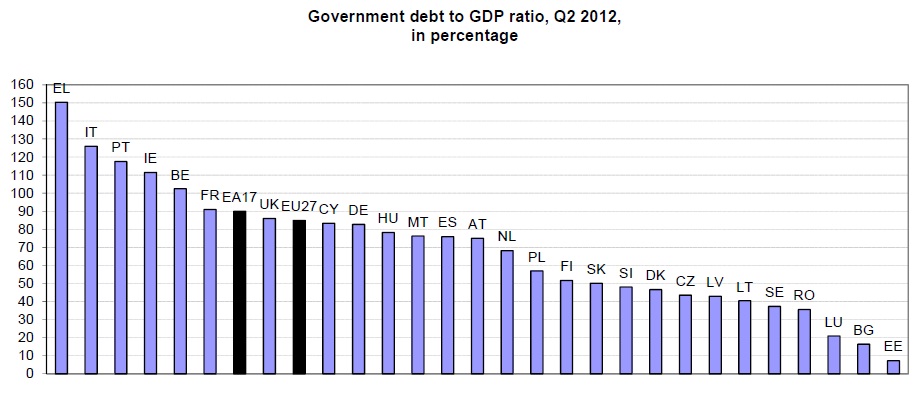
Nothing unusual about yesterday's announcement by Eurostat: Government debt in the EA17 and the EU27 in 2012's second quarter rose by 1.8% and 1.4% respectively. The usual suspects came up first with Greece reaching 150.3%, Italy 126.1%, Portugal 117.5% and Ireland 111.5%. Twenty out of a total of 27 Member-States have increased their debt burden over the last quarter.
Source: Eurostat
The highest increases were observed in Greece (13.4%), Cyprus (8.3%) and Portugal (5.6%). Even though the highest increases were somewhat expected (however, Portugal's future remains a riddle as social unrest has reached extreme levels in the nation, and I would be worrying that new austerity measures would render them in the same situation that Greece is facing now) the size of increase in Greece's debt does amaze. The Greeks fear another severe recession as a result of the new austerity measures to be announced (shortly?) and with good reason. Nevertheless, Greece's debt has decreased over the last year, with the total decrease for the 2011Q2-2012Q2 period reaching 8.5%. In absolute numbers the Greek debt has decreased from 340.906 billion to €300.807 billion over the course of the year. This would mean that GDP in 2011Q1 was 214.676 billion while in 2012Q2 has declined to €200.137. If GDP had remained stable over the course of this year then the Greek debt would account for "just" 140% of output. If the Greek GDP grows in the next year, then reducing the existing debt burden would be a much easier task. As for the rumors advocating large lay-offs in the country's government sector, let us remind them that the largest component of GDP is consumption. (for more details on GDP read here)

The next two candidates for a bail-out memorandum, Cyprus and Spain, have seen their debt reach 83.3% and 76% of GDP respectively. If Cyprus can negotiate the terms with Spain, then the terms might not be so rough on the island. If left alone, fear for the worst. Spain on the other hand, does have an ace up her sleeve. With debt reaching "just" 76% of GDP, the nation can negotiate for a lighter memorandum which would allow her not to impose extreme austerity measures to an already shaking economy. For those interested, debt in Spain rose by 9.3% on a yearly basis, and in Cyprus by a staggering 16.5%. A reminder: those who believe that the over-spending South is the cause for the recent crisis should look at the announcement and note that Spanish debt was just 66.7% in 2011 and Cyprus's 66.8%, much lower than France's, Germany's or the UK's at the time. (actually both countries' debt is still lower than the aforementioned three, with Cyprus just having a 0.1% larger debt than Germany)

Another question is what is going to happen with Italy. Although Mario Monti's measures have managed to keep the debt increase to 2.4%, if the country's debt does not begin to fall soon then they might face greater troubles than they expected. In a yearly basis, from 2011Q2 to 2012Q2 Italy's debt has increased by 4.4%, which is not good news at all.

For some good news, the IMF has approved a €1.5 billion loan disbursement to Portugal today, confirming that the nation is on track with its 78 billion international bailout. Nemat Shafik, deputy managing director of the IMF has stated that: "A weaker external outlook and rising unemployment have increased risks to the attainment of program objectives. Additional efforts are necessary, with the support of euro-area partners, to further advance fiscal consolidation and boost long-term growth."

Let's hope that they keep that "long-term growth" goal in mind and at the same time remember that for long-term growth, the short-term one is also needed.

The Worst Isn't Over. Or is it?

Yesterday, German Finance Minister Wolfgang Schäuble uttered what I have been saying for months now: "I'm not so sure that the worst of the crisis is behind us"
Source: Wikimedia Commons

On the other hand European Commission Vice President Olli Rehn told the Bangkok Post a week ago that: "there is no likelihood of any country leaving the euro zone. The key message I told the ministers was that there is cause for prudent optimism. I think that the worst is over for the euro debt crisis."

So who is right and who is not? Is there reason for optimism or is pessimism a better strategy in anticipating the future? I guess Rehn was right for the first part of his statement. There is indeed a very small likelihood of any country leaving the euro zone. And this is sufficient enough for everyone to note progress. Actually, compared to the Kassandras of the summer, where predictions even specified the day of Grexit or Itexit or any other exit, this is indeed an action which promotes solidarity amongst the EU. 

Alas, the near future does not appear rosy. It is more than obvious that although much has been done towards addressing EU's tantalizing problems, the time for them to end completely is yet to come. Greece is doing much better than before, yet with new austerity measures to be applied before the end of 2012 (hopefully they will reach an agreement with the Troika soon, as the negotiations are really starting to get annoying to the people watching) another deep recession is feared. In Cyprus and Spain, the memorandum currently under discussion is also expected to bestow a deeper recession in the countries in 2013. And although Italy is holding up well, if Monti is not re-elected as Prime Minister in the April elections, then the country's future may be at stake. Unless of course his successor is much better than he is. 

Schäuble seems to be correct in his prediction yet up to a point. In the short-run,  and I mean until the end of 2012, the crisis will almost certainly get worse. I believe that statistics to be announced from the ECB will indicate that the EU27 as well as the EA17 will officially be in recession. As for 2013, it would depend on how well the nations are coping with the austerity measures. Although the effects of a memorandum in Spain and Cyprus are expected to drive consumption and GDP down, this does not mean that after mid-2013 the nations' economies will not bounce back. (Given the size of these economies, it will be easier for Cyprus to bounce back. Nevertheless, Spain's start-ups and innovation may play an important role and allow it to bounce back faster) The same holds for Greece, although a full-blown recession is expected yet again for 2013. However, the contraction might be less in the end of 2013.

In the words of Yogi Berra: Prediction is very difficult, especially about the future.
And as Schäuble has stated on the Greek "experiment": "We are all sinners"

Monday, 1 October 2012

Politics vs Economics: The South Combat

It looks like the Troika has changed their plans for Greece, as now the budget cuts and reforms have to reach €14 billion instead of the €11,9 which was the number about 2-3 weeks ago. (sigh) What will ever happen to those Greeks? It appears that even after chances for a Grexit has been significantly reduced (to the fact that almost no-one is considering this as a possible scenario) the probability of a Greek bankruptcy has not yet been diminished.

Der Spiegel reports that the Troikans are unimpressed by the progress Greece has undergone over the last year. Why would they be impressed need I ask? Except some budget cuts and reduction of wages and pensions, (of peculiar allowances, i.e. a benefit for arriving on time or a benefit for washing your hands!) nothing of importance has taken place in the country. No reforms whatsoever. The only positive is that the public sector is gradually shrinking in numbers, as it has become less attractive to the Greeks (well obviously if you cannot get an allowance for arriving on time why bother be in the public sector?!).

Greece is not the only nation which has similar problems. From what I hear, the leaders of Cyprus are proposing a plan under which they propose an increase in taxation instead of a reduction of public benefits. Really guys? So the solution, according to Cyprus's authorities is: "We are overspending. We know it. Why bother reducing expenses when this will make people turn against us? Why not just increase taxes which will not?" Really? 

I do not know how the Cypriots think about this, but in my opinion, every rational man would prefer to have benefits cut instead of ending up paying more in taxes. What should be done is better control of expenses and a taxation aimed specifically at the richer caste. A general increase in taxes would not benefit the public even if they maintain their benefits. 

Tax evasion is another thing: both countries (especially Greece) see their incomes reduced every year due to several well-off individuals who manage to somehow hide what they are earning. Although many steps have been made so far in this subject, and even more arrests have occurred (especially in Greece, I have not heard anything similar for Cyprus) the hole in public finances still looms. And this is one of the reforms that the South has to deal with.

The same situation more-or-less holds in Italy. Anti-tax evasion measures and reforms have not been implemented as of now, and thus many Italians are still dissatisfied with their government. Although Mario Monti is doing whatever he can to keep Italy from failing, he has not done anything in order to boost the public's confidence to their government, or to reduce tax evasion. 

Spain on the other hand, is worried that Mariano Rajoy's proclamations are merely theory and lack of action. While the government is trying to push through more austerity measures, the general public, fed up with increasing unemployment and no sign of their troubles ending, is protesting (quite rightly at times) for their lack of employment and in more severe cases their lack of money. 

Although the politicians are trying to implement mild budget and benefit cuts, in order not to lose the public's liking (which has been lost during the summer for most governments in the South) no-one has even tried to reduce unemployment in the region. With focus on austerity measures, no politician or policymaker seems to realize that an increase in the number of employed people would mean higher consumption, more taxes and even more savings so that the banks could lend. Yet it seems that the simple equation of how GDP is calculated and the simple logic of what a decrease in unemployment may do eludes the authorities of the South.

Thursday, 27 September 2012

Resistance: Politics and Economics

In what seems to be a great development in Italian politics, 37-year-old mayor of Florence Matteo Renzi is roaming around Italy, visiting 20 cities in 2 days, in order to promote himself as the Democratic Party (PD) candidate for the Italian presidency. In the eyes of the young Italians, disgusted from numerous scandals, trials, bribes and overall incompetence of the previous generation of politicians, many of which are still key players in the country's political scenes, Matteo Renzi is the hope for the future. 

Renzi's most controversial view is that politicians which have been around for more than 20 years should retire from the scene. Although this has been accepted with enthusiasm by his supporters, the politicians who are going to be affected by this, as expected, do not share that enthusiasm. This has always been the norm in both Italian as well as world politics. When new contestants appeared, willing to perform important changes in a nation, resistance to this kind of progress was always evident to those who would be affected, i.e. politicians, policymakers and policy-beneficents.

This has long been evident in both economics and business. As many business fight for their survival, governments, under political pressure, arrange for subsidies and other benefits so that those firms should continue to exist, without any regard to whether the time for that business to perish has come. This resembles the case where a patient has already died and the doctors keep pumping him with drugs. Job destruction is an unavoidable fact which means that the time has come for an industry to die and for another to take its place. For example the last company which produced typewriters in the world (located in India) has closed down about 2 years ago.

What many do not understand is the economy's everlasting change of leading companies. Thirty years ago Microsoft was a miniature of a firm. So was Apple. Yet today they one of the largest companies in the world. The same holds for Altavista which was once the world's best search engine and was taken down from the web in 2011. (It has again reappeared, however, using the Yahoo! search engine).

In the US, from March 1999 until March 2000, as many as 90,000 establishments were closed. If the amount seems extremely large then one should also note that during the same period 106,000 new establishments opened. (for details click here). During the same period, the labour market grew by 383,000. Thus, many more people were employed during that year than the previous one. What is true is that the situation now does not resemble the one in the US during 1999, when the dot-com bubble was at its peak. Nevertheless people should never forget that ups always follow downs and vice versa. 

The message I intend to pass here is not that every business should be allowed to collapse (and I need not remind you that a bank is not like any other company). It is that many companies are not worth saving while some others are. The same holds for the politics of Matteo Renza. Not every politician who has been in the stage for more than 20 years is incompetent (for example Mario Monti would be one although his career is not exactly one of a politician). However, if one is presented with the choice of keeping or discarding them all, being either politicians or companies in distress, in my opinion, one should be better off in discarding them. 

Thursday, 20 September 2012

Extending vs Haircutting the Greeks

Although today has been heralded as the day when the Greek government and Troika would reach an agreement on the new austerity measures and reforms, don't hold your breath. While the Greeks are waiting to see how many benefits will be cut and how much will salaries and pensions will be reduced, for the rest of the world, hope is that with this package, voices claiming a future Grexit will quiet down. 

On the subject, David Riley, a director at Fitch Ratings, has stated that "An agreement on any change to the Greek program before the next EU summit in October would reduce the risk of a Greek exit or second default". He has also stated that the resolution of the crisis will not be quick and that any positive development would support Fitch's view that the Eurozone would survive. Oh the support! It seems just like yesterday when most rating agencies had their money on the Eurozone failing (or was it a month ago? I wonder what John Paulson and George Soros are betting on now).

Truth is, Fitch is right. The Eurocrisis is not over and it will be quite long until its over. Although I am not good at predictions, I think that 2013 will not be a great year as well, however, still better than 2012 for most nations (with the exception of Cyprus and probably Spain. The biggest question is what will happen to France and Germany). I would like to agree with predictions that 2014 will bring growth back to the Union, nevertheless, I would prefer to refrain from it for the time being. Time will tell. If the Greek austerity-and-reform package is granted an extension then the EU will be a much quieter place in 2013. What remains to be seen is what kind of "magic" will Mario Monti and Mariano Rajoy will do in Italy and Spain respectively to prevent their economies from blowing up.

The CEO of Commerzbank, Martin Blessing, has said that another Greek debt haircut is eminent. What exactly are they going to cut? Banks are now going to receive about 21 cents for each euro they have invested in Greece and this has been the main cause for financial turmoil in Europe. If a even if another 30% haircut is implemented then banks will receive 15 cents for each euro invested. If that does not wreck more havoc in the already trembling South economies then nothing will ever will. Bank applications for bail-outs will soar and the ESM will put its newly printed money into good use if a new Greek haircut is promoted. So, thanks Martin but keep the Blessing for yourself. (as a note, Commerzbank has no exposure to Greek debt, so the CEO might feel a bit free do say what he pleases on the subject)

Extending the period of restructuring in Greece would be a much better alternative than a new haircut, especially for Cypriot, Italian and Spanish banks. If changes are implemented in a longer horizon then GDP will not contract as much (maybe even at all if the reforms are gradual) which would mean that debt, as a percentage of GDP, will be reduced in the future, thus making it more sustainable.

Tuesday, 18 September 2012

Incredible Threats?

Yesterday, Yanis Varoufakis presented an article over his concerns about the OMT (Outright Monetary Transactions) program announced by Mario Draghi almost two weeks ago. In the article, Yanis, after depicting the arguments in game theory style, states that if Mario Monti decides to take up Draghi's offer for OMT, then the former would be better off by not enforcing reforms and austerity measures in Italy, because the threat that Draghi will stop OMT operations in incredible. In essence, Draghi will be caught between a rock and a hard place.

Yanis states that it would be disastrous for Draghi to back out once he has agreed to fund Italy (or any other country for that matter) since the result would be that Italy would most likely exit the euro. However, I think that in his analysis, Yanis fails to state three points:
1. Money will not be given as a lump sum as soon as the agreement is signed. What should take place is an instalment-based assistance just like in the case of Greece.
2. Economic theory (and game theory) states that rational people will choose what is best for themselves under certain circumstances. However, behavioral economists have proven that people are not at all like the rational beasts economists perceive them to be. (Paradoxically, economists themselves are not as rational as they think they are)
3. The consequences for Italy if the country exits the Eurozone.

If game theory was right, it would mean that the Greek government would have an incentive to exit the Eurozone and declare bankruptcy as soon as

Monday, 17 September 2012

Too much benefits?

After viewing Eurostat's "Government Finance Statistics" publication for 1/2012 in which all data concerning income, expenditure, debt, deficit, and much more were visible, what amazed me was the size of social benefits paid by each country in the EU. Take a look at the following:
What is obvious from the above statistics is that all crisis-ridden nations have seen their social benefits rise over the past 15 years. Greece, Portugal and Cyprus are the top three in increases with 8.4%, 9.5% and 7% respectively. On the other hand, Germany and Finland have reduced the social benefits they pay by 1.5% and 2.6% respectively. It is noteworthy that the nations whose social benefits rose substantially over the last 15 years were the ones which in 1996 had the lowest percentages (Cyprus: 8.3%, Ireland: 12.5%, Portugal: 12.6%, Greece: 13.5%) This phenomenon is rather strange as citizens of most of the aforementioned countries will indicate that they were better off in 1996 than 2012. As politicians and policymakers increases social benefits

Thursday, 6 September 2012

A change in mentality?

Over the last week a serious change in attitude towards ailing countries within the EU has occurred. Leading with Chancellor Angela Merkel, the political scene in Europe has witnessed a 180 degrees turn. The change was so radical and impressive that Der Spiegel has published a full article on this. This could mean one of three things: 
1. The South has made real progress over the last month (hmm or week maybe?).
2. Merkel has understood that her policies and stance are making both her as well as Germans in general extremely unpopular in Europe (and elections are coming up in a year).
3. She has accepted that trying to push through many things very rapidly is not such a great policy after all.

Whatever the reason may be (Spiegel states that it's No2) the fact is that leaders now appear to be more united than ever before. Even statements of the "Greece should leave the euro/Union" kind are treated coldly by EU officials now. Still, as progress for unification in the political level appears to be improved the economy still fails to recover. Italy, just like Spain and Greece, has seen unemployment rates soar over the last months. While Mario Monti is doing his best to improve the overall economy, unemployment of youths under 25 has reached 40%. And with recession here to stay in Italy (forecasts expect GDP to contract by 2% this year) the situation does not seem to improve. 

European leaders fail to understand that people cannot live on GDP. After an EU-wide summit on unemployment nothing seems to have changed: the employed have not (cannot?) find anything to do about the jobless. I have proposed my set of ideas over reducing unemployment here, and while the list I have presented is not exhausting nothing has been done yet. Just as I have predicted, the EU will face a recession over the next few months. New evidence indicate that the recession will be far worse than we expected. The Purchasing Managers' Index (PMI) for the Eurozone predicts that the output will shrink by 0.5-0.6% over the current quarter instead of the initial 0.2% prediction. 

The worst part of these forecasts is that the EU's safest economy, the one where people actually paid to invest their money, Germany, is bound to move to the red. The OECD predicts that although Germany has grown by 0.5% and 0.3% in the first two quarters, in the following two an annualized contraction of 0.5% and 0.8% is expected. Only France may be able to remain more-or-less unscathed with output falling this quarter and rising on the next.

In addition to all these, Mario Draghi has announced a program allowing unlimited purchases of sovereign bonds in the secondary market, in order to keep interest rates at sustainable levels. The only opposition to this program is Bundesbank head Jens Weidmann who believes that the program is too close to state financing through the money press. He may be right up to a point, however, I do believe that the program is much ado over nothing, The problem with what Draghi has proposed is that the ECB will only assist countries that appeal for help to the euro bailout fund and submit to the required austerity conditions. What he also meant is that the ECB would only be able to do this for nations which are not considered as junk by the 3 rating agencies (Moody's, Fitch, S&P), i.e. Greece and Cyprus cannot be assisted.

Thus this leaves only two countries: Italy and Spain. However, the announcement failed to mention the amount which would be available to fund this action. Given the size of the Italian and the Spanish economy, it would have to be enormous. Yet, we are still unaware of the size and extent of the intervention and it would be nice to know some more details about it instead of the general idea.

In the meanwhile, what journalists have not yet proposed is that another reason of Merkel's newly appeared empathy towards the crisis-ridden countries maybe be that she is preparing to identify herself with the rest of the ailing nations if OECD forecasts are true. We will just have to wait until the official data is published to find out.

Tuesday, 4 September 2012

Resistance to change: 3 reasons Unions and the Public are unreasonable

One of the usual pieces of news in the EU (especially in the South) is that spokesmen from various trade unions declare that they will not accept/negotiate/give in to the reforms that the Troikans or the nations' governments (or both) are proposing. It is my opinion that in order for the spokesmen/leaders of several organizations to appear powerful, they indulge in a game of what in economics is called an "incredible threats" (an incredible threat is a situation where somebody would threaten to do something that would harm himself as well as the other. Rational people would never choose to propose nor do any of those threats. An example is: a person enters your car and threatens that if you do not give him money he would blow your car with him inside it.) These are the reasons why I consider the aforementioned threats are incredible (or irrational):

1. Neither the Unions nor the Member-States requesting bail-outs are in a proper position to negotiate, since they are not considered credible any more. The lack of credibility derives from the fact that during the crisis their actions had been close to none. The only countries which are currently trying to restore market confidence are Italy and Greece. Only after their creditors are convinced that much has been done by their respective leaders will Italy and Greece (especially the latter) be able to negotiate. That is exactly what the Greek Prime Minister is trying to accomplish at the moment with harsh austerity measures which will allow him to expand the austerity horizon by 1-2 years. One may easily realize that if a national leader is not able to negotiate, the Union leaders or spokesmen have even less ability to do so. (In a similar note, the Cypriot GDP contraction is expected to be 1.5% in 2012 rather than 0.5% as it was originally estimated, another incredible estimate from Cyprus)

2. Not imposing any reforms or other austerity measures is even more irrational than imposing a lot rapidly (e.g. Greece). Blame for the current situation in Greece can only be assigned to the Greek politicians who had been overspending over the last 10-20 years. The political system in Greece was correctly defined as Kleptocracy rather than democracy. Both Italy and Greece are considered more corrupt than all of the other EU nations, where Cyprus, Portugal and Spain are just above average. In order for the crisis-ridden states to move forward and hope for a better future many necessary reforms should take place, notably concerning the public sector size and pay-scale. Reforms should also promote more transparency, so that nations may regain their lost credibility and their people will start believing in them again. (A major issue both in Italy and Greece)

3. Union leaders and others believe that when salaries, wages or benefits decrease, their lives will be more difficult. Although this may be partially true in the short run, (up to 6 months) in the long run, prices will adjust to the lack of liquidity (i.e. money) in the economy and they will subsequently fall. Let's use Greece as an example here: the proposed austerity measures state that the cuts will be 2% for pensions of up to 1,000 euro, 3% for pensions from 1,000 to 1,300 euro, 5% for pensions from 1,300 to 1,600 euro, 10% for pensions from 1,600 to 2,000 euro and 15% for pensions of 2,000 euro and more.  This would mean that all prices in the Greek economy would drop (though not from one moment to another, although much faster than any other other nation), which may even raise the standard of living for the Greeks.

People cannot distinguish between nominal and real income. Neither can economists in their real life. Obviously people would like to see their salaries and benefits rise in perpetuity regardless of prices. However, this is not rational thinking as with a 3% inflation and a 2% rise in wages people would be worst off. This was exactly what had happened over the last few years after the introduction of the Euro in the Southern EU nations. (for more details see here)

Although it may appear to be unthinkable to many, especially those who are -erroneously- relying on the state to cover their expenses, accepting the reforms and  austerity measures will be the only way forward.

Sunday, 26 August 2012

Mario Monti and the Lost Generation

One piece of news which made a great impression on me was this: Italy's Secretary to the Prime Minister Antonio Catricalà has stated that youth under the age of 35 can start a business with only 1 euro as capital. I have said it before and I will say it again now: Mario Monti is amongst the best politicians (albeit an economist) who have ever set foot in the European stage. He cares about his country and is neither blinded by ideology nor afraid of any political consequences either at the national or the European level. He does what he knows best: revive the Italian economy.

It is the first sample of growth policies we have seen in the EU for months now. Announced measures for infrastructure in Italy are expected to reach 300 billion euros from now until 2020. Troubled areas in Rome, Naples and Florence are expected to receive an "upgrade" worth approximately 2.5 billion. 400 million are expected to be invested in internet technology to digitize the country's social services and boost buying and selling through the internet. For me what is most important is what I began with: every youth until the age of 35 may start a business with as little as 1 euro for capital.

It would be amazing if we could see such action from other member-nations of the EU. For the time being only Monti was able to show that he truly understands the situation and is willing to do something about it. What are we waiting for? For youths to start migrating from the EU to Australia like it is currently happening in Greece? (read this detailed article in the Guardian for more information). Should we stop and watch as people under 30 are constantly leaving their native nations for a "better" life elsewhere?

Mario Monti has spoken of a lost generation. What he meant were the myriads of young Italians fleeing the country in order to find employment elsewhere. Many leaders speak of the future, while they focus their policies to the over-50's population. The future cannot exist without the young. I remember Ernest Hemingway's story in the 1920's Paris: an old garage director told his young subordinate that he belonged to "une génération perdue". Hemingway wondered whether the youth who had seen the evils of war, were disciplined and polite could really be considered lost.

The same rationale holds today. Who is worse off might I ask: the person whose salary was reduced from 3000 to 2500 euros or the person who is desperately searching for a job and cannot find one? Yet with the notable exception of Italy, no nation (or politician for that matter) is doing anything about it.

Tuesday, 21 August 2012

Should the Crisis last?

Although I have yet to see any decisive action from politicians and policymakers in the EU I have the notion that from 2013 the situation will be better for the Union. I base this on the current actions by private banks, which are either selling their non-core loans or trading their existing loan portfolio in a country, in order to deleverage themselves (for details read this). I would assume that banks, tired of waiting for the officials to act, have decided to take action into their own hands. 

What worries me more than overcoming the crisis, is overcoming it without the opportunity to learn something from it. If the crisis terminates and we have the banks to thank, what would politicians and policymakers have done about it? Practically nothing. At the same time nothing will be done to safeguard the Union's future, as no extra authority will be given neither to the ECB nor the European Council. If the same causes provoke another crisis in the future nothing will be able to halt it at its beginning, since no measures have been taken now.

If the crisis ends without any political (or government) intervention then politicians will understand that they need to do almost nothing to correct the situation: procrastination, austerity measures and maybe a stimulus package will be more than enough. It would also mean that Southern Countries, with their productivity to the low end of the EU average will have done nothing to correct the situation. Cyprus, Portugal and Italy will continue to see their people work more than everyone else, alas, with lower productivity. You may notice that I exclude Greece from this. In my opinion Greece will be the nation which will mostly benefit from this situation. It is the only nation which has been through the process of reorganizing its finances, cutting excessive spending and making reforms and structural changes in its economy. Although the speed of this process is not one which would allow it to witness less contraction and unemployment, the process itself will be beneficial for the nation, something which will be more visible in the next 5 years. Nevertheless, had the process been slower the negative effects would have been less now, with the positive ones still occurring. (this scenario is of course based on the assumption that Greece will be given the extra €2.5 billion it will need this year, and will remain both within the Union and the Eurozone, which it should!)

On the other hand, Cyprus, Portugal and Italy have done little yet to correct this situation. Although all countries have undertaken measures to reduce their fiscal deficit (which is good if they are aimed at reducing irrational expenses), I have not yet seen one take any measures to increase productivity. What we so far witness is tax increases, salary cuts and reductions in pensions. All of which are mainly aimed at the older population!

As for the youth? It seems that no country has so far taken any action towards reducing youth unemployment or implementing incentives to increase start-up creation.  Have a look at youth unemployment in the EU (source: Eurostat)
Both the EU-17 and the EU-27 youth unemployment are over 22%! And nothing is yet to be done about this situation. I am guessing that until a change of mind occurs to the heads of politicians and policymakers, no change will occur in the EU. Well, I hope that the crisis lasts enough for them to make that change.

Friday, 17 August 2012

The Political Consequences of EU crisis

"Man is characterized as the only animal who can learn from his mistakes and his unwillingness to do so." Thus said Mark Twain in the late 19th century.

Another Twain quote states that history does not repeat itself, but it does rhyme. The fact is that we may observe many similarities between today and every other financial crisis in the European continent. For example, let's remember the period after WWI in Germany, specifically June 1921 until January 1924. For those of you too young to remember, this was the era when the German hyperinflation occurred. The German Mark was fixed to about 60marks per dollar in 1921 and rose to 8000 per dollar by the end of 1922. Over the next year: On 1st November 1923 1 pound of bread cost 3 billion, 1 pound of meat: 36 billion, 1 glass of beer: 4 billion. How did this occur? The insistence of French and British officials that Germany should pay war reparations and the inability of German economists to handle the situation well. (remember what I said about Economists and Real Life?)

Why the history lesson you may ask? Well, in the end of this crisis and while unemployment was still very high in Germany, a young ambitious politician took advantage of the situation, blaming the politicians in power, the Jewish community and the Allies for insisting in paying the reparations, gained large popularity, which resulted in him becoming Vice-Chancellor at first and Chancellor next. His name: Adolf Hitler. I think you all remember what happened next!

During a crisis many nationalistic, far-right movements gain popularity. Examples are plenty: the Golden Dawn in Greece, Viktor Orbán, the Hungarian prime minister, Timo Soini, leader of the True Finns party in Finland and Marine Le Pen in France. (I think I am forgetting someone, though...) Since the beginning of the EU crisis the above have seen the popularity of their political parties rise to unprecedented levels. In times of desperation, anxiety and turbulence, people always look for a scapegoat. It's always the others: the foreigners, the democratic-minded, the immigrants, other nations except their own, because in their minds they, as a country, cannot be wrong.

It would take many years before people begin to realize that a Union is a great idea. In fact, not until all old people are replaced with young minds should this change occur. In Europe we have 27 independent countries. The EU is just a notion now. It isn't something tangible for most people. We may see the meetings, the debates, the arguments, the politicians but we live in a single country, with most news stories coming from that country and many of us are ignorant of what happens at the EU level. What should be done is promote the idea that we are all in a big EU family.

Make people believe that the EU cares about their country. For example, Greece, Spain or Italy should not feel that they are the outcasts of the EU; they must believe that support will be given to them by the European Commission and they should not be afraid of the future as the EU will help all its children. Statements of the "we are not afraid of a Greek exit"-type should be avoided. They do not assist at all. 

I have said this before: We are modeled like the United States of America. We just call ourselves the EU. Think about it: if any state of the USA would be in trouble, would the US politicians remove it from the country? Their were cases like this in recent history if you think the example is far-fetched: New York State and California. They are not out of the US now are they?

Then why should we even consider to exit a country from the EU? To satisfy the whims of some politicians? Exit one country and the end of the Union will follow rapidly. A new age of nationalism will emerge, one which will not be a glorious one...

Thursday, 16 August 2012

Two-Speed Euro aka the Moses Plan

It has been proposed before and it seems that it's back in vogue: Make a 2-speed euro. The idea is that richer countries like Germany, Finland, Luxemburg, Austria and others, should have an "expensive" euro, whilst Greece, Spain, Italy and others which face problems should be better off with a "cheaper" euro. I like to call this the Moses solution (think of what he did to the Red Sea). The rationale is that now, the Euro is too cheap for rich countries (whatever that may mean!), while it is too expensive for the poorer ones.

It is not the first time something like this has been proposed. The main problem in the Eurozone is non-integration and what is the brilliant solution of some economists? An idea that divides the EU even more. Remember what I said about economists and real life?

The idea is simply absurd: First of all what does it mean that a currency is too cheap for a rich country? I don't think that the Germans are having trouble sleeping because their exports have boomed, due to a falling euro. The same holds for all other "rich" countries. Second, what defines what a rich country is? Ireland was a rich country before 2008 but I don't believe that anyone would consider letting them in the "rich" country ghetto now.

As in the case of Ireland, a nation may be rich one year and in the next, faced with an unprecedented disaster (of any kind not just economic) may fall into the "poor" class of countries. What would happen then? Just change to the low currency and if the country gets back on its feet change back to the expensive one again? I do not think that the public would really much appreciate this, having to change their hard money every time the economy takes a downturn. The future is unpredictable and uncertain. No country can guarantee that it will be solvent and trustworthy in the future.

Another important consequence is that there will be a "rich country ghetto" in the Union. To be accepted into the rich currency you will have to be accepted by the already existing countries, which would breed political disputes. The same problems would occur when a country should be exited from the rich country union as nations would be reluctant to dismiss a country like Germany, even if it has sever financial problems.

What economists with no real-life experience fail to see is the infeasibility of a Moses plan and the disastrous consequences that it may have if it is applied. Now is the time for more union and more integration. Dividing the EU would be a step towards breaking it up. I do not think that if the South US states had a problem, Bernacke would divide the dollar into two. Why should we?

Wednesday, 15 August 2012

Welcome Recession

Yesterday, Eurostat published a news release concerning the GDP data of the Eurozone countries, compared to last year's. Not surprisingly, the results were that Greece's output shrunk by 6.2%, Spain's by 1%, Cyprus's by 2.4%, Italy's by 2.5% and Portugal's by 3.3%. Even in the UK, output was reduced by 0.8% compared to 2011. The only surprise was France, which avoided recession (which is measured as two consecutive quarters of negative growth) by reporting a 0.0% change compared to the previous quarter.

Germany's GDP on the other hand, rose by 1.0% a change attributed mainly to an increase in exports and domestic consumption, as investment levels have fallen. In general, GDP dropped by 0.2% both in the EA17 and EU27, while in the previous quarter it had remained stable at 0.0% change. What does this mean? Well essentially, if the next quarter is one of negative growth, the EU will officially be in recession. And I am almost certain that there will be negative growth in the next one.

That is, unless Mario Draghi (or any other EU official) decides to do something about this. By something, I mean effectively use his power as the ECB governor and buy bonds directly, which would boost investment and restore confidence in the region, something that he directly stated that the ECB could do in the future. I hope that Mario Monti's statement that "we have to reach the night before the euro collapses in order for the ECB to do what it has to do" proves to be wrong. I really hope that the officials will come to their senses before it is too late and large-scale measures to save the Eurozone have to be devised. 

Nevertheless, I do think that another quarter of negative growth, moving the EU in the recession zone, will be their wake-up call. We are humans, and like human beings most of us have do not care as much about the future as we do about the present (talking about German policies here; to be accurate it's just Merkel policies as many in Germany oppose her actions). In order to change ideas and mentalities we have to be convinced that things are going bad. Entering a recession will do that kind of convincing.

It seems that "smart" people need to wait until the very last minute to be convinced that their policies have created more chaos rather than reconstructing the Union. That is why an EU-wide recession is needed and, unfortunately, we are going to get one. Just wait until the next quarter.

P.S. The only person acknowledging what the bailed-out countries have done is Olli Rehn in one of the best articles I have read about the Eurozone. One cannot wait until September Olli, in order to see whether the ESM will be able to recapitalize banks directly.