Showing posts with label EU. Show all posts

Friday, 20 December 2013

The Original Sins: EU's entry decisions

Once upon a time there was a continent, which was made up by 50 countries. One day the countries decided they would benefit from being united instead of fighting each other thus they formed a Union which they soon thought would be able to issue its own currency; one which would work in all of these countries and become one of the leading currencies in the world. But who would enter? They couldn't just let anyone in so some rules had to be made. Thus, they thought of the easiest task: you wouldn't be able to join the currency area, unless your public debt was less than 60% and your government deficit was less (or very close) to 3%. They even formalized this by signing a treaty in a smallish town somewhere North.

The problem with this treaty was that it was too rigid for its own good. By the time the new currency was brought to the markets, many of the countries wanted to join the whole charade and play with the big boys but couldn't. The reason was that they were constrained by 3-60 rules of the treaty. Why should they want to enter ans lose the enormous power of issuing their own currency one might ask. The reason was simple: it was better than the one they had until then and it opened the door to numerous opportunities for growth. Up until the initiation of the common currency the countries which wanted most of all to enter the Union and could not grappled with high inflation and perpetually-depreciated currencies. For example, three of the countries wanting to join the currency Union had an exchange rate of 166.386, 353.101 and 1,936.27 to one with the common currency*.

However, those countries really wanted in. But what could they do? Their public debt was more than the 60% limit and their deficit exceeded 3%. There was no real way to reduce the debt by issuing new money as that would mess with the exchange mechanism they were tied to, given their willingness to join the Union. Thus all there was to reduce was the deficit; but which politician would be willing to and announce a reduction in spending and risk sacrificing his chair to the altar of joining a Union? The stakes were too high for such actions. Still, they had promised their voters (and their voters really wanted it) that they would join the Union.

Being mostly politicians and bureaucrats they had no idea of what they could do. Thus they invited the big investment bankers for advice. The latter, known for their quick wit, eagerness to solve a problem they will receive a big compensation and willingness to find loopholes in legislation found a simple solution: they would be able to reduce the deficit using a Swap. In a swap, two counterparts change cash flows, usually in order to reduce risk. In this case, the supposed risk was the exchange rate since there was a bond issue in Japanese Yen. The following graph shows how a swap should look like. Note that these sort of swap transactions were legal and approved both by the sovereign's central bank as well as the Union's.
Source: ZeroHedge
Yet, this is not how the transaction went on. What the investment bankers did was increase the one-off final payment and make the payment coming from the sovereign borrower negative. In simple words, the country was receiving the fixed payments in yen and was again receiving payments at the time it was supposed to pay. The following graph illustrates what happened:
Source: ZeroHedge
Why would they do this if the payment in the end was huge the reader might ask. Remember that the country had no intention of reducing its debt since it could not do it in short notice; it was aiming at reducing its deficit. Using the above swap, the country was receiving two payments from the bankers which meant that first it wouldn't have to pay any interest thus reducing the government deficit and second it was getting money back and it could either repay outstanding loans or use it to show further budget improvement. The country did both. And this is how it fared:

The bond was issued in 1995 and the swap took place in 1996. Note the impressive decrease of government deficit as a percentage of GDP from 1996 to 1997 by 4.3% to within the limits of the 3% rule; something which lasted until 2002, the year when the common currency was introduced to the public (although to be fair, the specific swap expired in 1998). The strategy was so successful that it soon found imitators: others sought to find the magic deficit-decreasing swap. In 2001, Greece tried the same and somehow it worked in allowing it to join the Eurozone:
But things didn't work out as planned by the Greeks: by the time they signed the deal, they were already 600million more in debt than the originally planned 2.8 billion to be repaid. The perils of secret negotiations and under-the-table agreements came up in 2009, forcing the country to require a bail-out. Not that Italy is doing any better now but having a stronger economy can assist in overcoming recessions faster.

The author of "Derivatives and Public DebtManagement", Gustavo Piga (the person who unearthed the story about Italy) suggests that secret treaties are just a way of exploiting the taxpayer. The problems in the Eurozone have not arisen because of some secret agenda or as a result of a global conspiracy. They were there to begin with. Neither Greece's nor Italy's debt management practices were ideal and those who allowed them in the Eurozone knew about this (even Eurostat was to to blame since it had knowledge of the fact according to ZeroHedge) and chose to close their eyes. Evidence of mismanagement were there: just look at the exchange rates of the three countries mentioned earlier. 

The accumulated sins of the Eurozone structures were bound to come and haunt us. They just did sooner than anyone expected. If there is a moral to this story it's that in economics, when you do something bad it will come back and hit, just like a boomerang. But that was not what the Italian and Greek authorities thought when they made the swaps. Too bad; for their taxpayers that is.

*Spanish peseta, Greek Drachma and Italian lire respectively.

Wednesday, 10 April 2013

The Economic Consequences of a CY-Exit

Ever since the latest Cyprus fiasco, many have been wondering whether a country exiting the Eurozone could be a possibility. The fact is that the Eurozone cannot evacuate a country as it will set a precedent (not that setting a precedent seems to bother them a lot, given that lately we have learned that every deposit over €100,000 is not safe). For the sake of argument we can assume that the Eurozone leaders can understand that if one country exits then it is only a matter of time before more leave; thus it is to their better interest to keep every country in the monetary union.

In addition to the assumption that leaders do understand the consequences of their actions, we will also assume that the exiting the Eurozone will allow the exiting country to remain in the EU which means that forcing it out will not forbade it from the common market (details on the subject will be discussed later).
To make things more specific, Cyprus will serve the cause of a case study. 

We know that Cyprus has an 87% debt-to-GDP ratio, a ratio slightly more than the EU average of 81%. As stated in a previous post, Cyprus currently has €9bn of her debt held by domestic creditors. Thus, even under the English law (which does not allow for any changes in the bond structure) if more than 75% of creditors are in agreement then the bond terms can by altered. One can only assume that the Cyprus Central Bank can excess some kind of pressure to the state creditors making them agree on longer duration and lower interest rates (from the creditors' point of view this would not be a bad deal; the alternative would be default and losing all the invested funds). Thus, if this can happen in Cyprus then it is not irrational to assume that it can happen in every other EU nation.

Re-structuring the domestic debt means less expense for the government for the next 10-20 years; the excess could be employed to boost the economy. Then, according to Alex Apostolides an additional €3.9bn would be remain (the rest was bank recapitalization needs which after the fall of Laiki bank are no longer needed), in addition to approximately €5-6bn of ELA money. Then the matter of which issue has more seniority arises. According to Megan Green:


Thus, in the case of an exit, ELA debt and any other European debt (such as Target2 balances) would be equal to every other issue. Then, if Cyprus (or any other country for that matter) chooses to partially default on debt repayments the ECB cannot do anything more than seize assets (which I doubt since it is not senior to any other debt and no actual assets are being on mortgage when a bond is issued-unlike bank loans). Under those terms the ECB would be forced to re-structure any loans it has made to Cyprus (again, the other alternative would be default).

Then we move to the trickier parts of the equation and first of all how will the new currency be introduced. An award-winning paper on Euro-exit states that at the time of the exit, the new currency and the euro should be at a 1-to-1 parity and that euros should be allowed for small transactions for a further 6 months. The first issue that has to be made clear here is that in the case of a euro exit, the new currency and the euro cannot co-exist for more than a week. Many have been arguing for parallel currencies yet, as history has shown and common economic sense dictates, this will cause much trouble.

The reason is simple: assume that on the first day the new currency will have a 1-to-1 parity with the euro. Nevertheless, the new currency will suffer a severe devaluation within the first hours (minutes?) of trading. Thus, if we assume a 40% devaluation as the most popular scenarios do, it would make 1 unit of the new currency equal to €0.60, which would mean that prices would have to be altered again as it would mean that now what cost €1 should cost 1.4 units of the new currency, just to make up for the exchange rate losses. Making matters even worse, the rate would not be at all stable during the transition period. 

A possible solution would be either to peg the new currency to the euro at 1-to-1 parity. However, this would never hold as the George Soros pointed out to the Bank of England in the 1990's. In addition, the willingness of Brussels to do that for a "traitor" is highly questionable. The only remaining alternative is a short transition period and capital controls through it. In order for the transition period to go without any severe effects on the economy (the two-week bank "holiday" is expected to cost approximately 2% to the country's GDP) it has to be fast and swift, with capital controls loosening significantly after it (unlike the very slow steps taken now). 

The only real problem faced by any nation who wishes to exit the Eurozone is inflation. The award-winning paper suggested that:

"The exiting country would immediately announce a regime of inflation targeting, adopt a set of tough fiscal rules, monitored by a body of independent experts, outlaw wage indexation, and announce the issue of inflation-linked government bonds.It also recommends that government should redenominate its debt in the new national currency and make clear its intention to renegotiate the terms of this debt."

The only trouble with the above is that inflation targeting does not assist in the short-run, where the economy will face harsh problems through increased energy prices. In addition, all of the proposed measures are more for the sake of credibility than actual good (in the short-run that is). Although inflation would be needed as a means to boost the economy, too much of it will prove to be disastrous, especially with regards to imports (it has been suggested that deposits will lose their value. This is not an issue per se for residents as everything will be evaluated in the new currency. This is only an issue with hyperinflation and increased import prices).

Economic theory (and practice) indicates that there are the following determinants of an exchange rate:
1. Domestic Money Supply/Inflation and Interest Rates
2. Import demand and Export Demand
3. Productivity (with respect to other countries)
4. Current Account balance and the Trade Balance
5. Domestic Reserves in Gold and other currencies

Another issue which cannot be measured is investor/speculator sentiment. For example, although the US has employed three rounds of monetary expansion (commonly known as QE) the euro continues to depreciate against the dollar because of the Eurozone uncertainty. We will return to that later.

The following data are before Cyprus's entry in the Eurozone (in 2008) and shall assist us in determining the needs of the country for a stable currency (click on the image for enlargement):
Source
The above graph indicates the exchange rate between USD and CYP (the reason for not choosing EUR/CYP is of less history and the fact that energy prices are quoted in dollars). The exchange band of the currencies fluctuated from a low of $1.44 per CYP (in late 2000, after Cyprus's stock market bubble crashed) and $2.5414 (in late 2007, perhaps due to the sub-prime lending crisis). In the meantime, Cyprus's other indicators were:


 In contrast to the views of many, it appears that from 2001 until 2007, when the CYP/USD rate was increased by 76%, money supply rose by 191% and foreign reserves by 112% (at their all time high). Inflation was rising during the period, with an approximate increase of 21.4% (or approximately 3% per year).
In addition, the current account was not doing any better either. The data show that as it reached its all-time low (by then) in 2001, the exchange rate did not resume its fall (it moved within the same band for about a year), and the year-end CYP/USD rate was actually increased. In addition, CYP continued its appreciation (reaching the all-time high) regardless of the fact that its current account reached new depths in 2007.
The Import/Export data do not show any significant difference over time either. Their average was pretty much zero until 2004, when the Trade Balance fell continuously until 2007. Yet, however, the CYP increased in value.
Oil prices are always important in an economy.Yet, although oil price rose from 1996 to late 2000 by 70% and the exchange rate fell to approximately $1.50, thus forcing the price of oil to rise more than 130%, real GDP rose by approximately 0.94% per quarter.

The last part of economic theory is interest rates: if interest rates are high, the investors/speculators will want to hold on to the currency; if they are low they do not wish to hold any of it. Yet, as interest rates are higher in a country, higher inflation appears and growth is supposed to be less than it could potentially be if the rates had been lower. 
Having an extremely high interest rate in 1999 did nothing to stop currency deterioration. As the reader may recall, the lowest point of the USD/CYP pair was in late 2000, just before the interest rate was lowered. As interest rates dropped to an average of 3.5% (which again is very high compared to other nations), the currency started appreciating.

In comparison, Cyprus today (as of 2012Q3) stands at:
- minus 990m on the current account (48% less than 2007 but 10% more than 2006 although the full year total will probably be less than 2006)
-341m of reserves (less than any period since 1995)
-101m of forex reserves (again an all-time low)
-563m in gold (an all-time high due to the increased price of gold)
-Deposit rates at about 3-3.5% for term deposits
-The least Balance of Trade (-1bn) it had over the past 8 years (since 2005)
-A slowing inflation (up just 1.2% in 2012 and expected to be near zero in 2013)

The only problems in Cyprus's position are foreign reserves and general reserves. The catch here is what Paul Krugman has been stating and many (including many Cypriots) ignore: 

-Income from tourism in 2012: €1.927bn or approximately 11% of GDP. (The income was actually higher in 2001 when the CYP was in place)

Such an influx of money (which will be even more if the depreciating currency brings more tourists than 2012) will increase the country's foreign reserves and help stabilize her currency. That is the reason why a euro exit should occur either before the summer season or just after it (if the island can survive until then that is). A devaluation of the new currency would in fact assist Cyprus to gain more tourists thus increasing that income.

The main cause of worry for the Cypriots should be oil prices. Yet, as the graphs have shown, rising oil prices is not the end of the world. Real estate, tourism and business services (which comprise approximately 60% of GDP) would be benefited from a devaluation of the currency, which means that more money would be pouring in Cyprus than before. This will again help stabilize the currency thus making prices less susceptible to oil shocks.

In addition, the other worry would be that of money supply. At its highest, M1 supply in Cyprus was approximately 36% of real GDP. Thus, according to data on 2012Q2, the amount of money supply would have to be roughly the same as it was in 2007 to compensate for that (i.e. €4.5bn). The amount of money used to recapitalize banks would not affect M1 as bank reserves are not included in its definition (nor are they included in the M2 definition). (This justification obviously assumes that money needed for recapitalization purposes will be treated as cash/reserves by the banks and not directly used for lending purposes).

A few paragraphs above, there was mention of investor/speculator sentiment. Imagine this: a country exits the Eurozone. Which that country is, does not really matter since once a country is out everybody else will start thinking about their own exit. Consequence: the euro depreciates. Sharply. With fears of a euro break-up, speculators will start shorting the currency driving its price down. Simultaneously, the CYP will itself depreciate, yet not such a fast pace as the euro, leaving it stronger than assumed. In addition, the USD will itself depreciate with regards to the CYP as the effects of the three rounds of QE will once again be visible. What economists seem to be forgetting in their analyses is that an exchange pair does not really count on just one currency but on both: if both deteriorate the same then the exchange rate is unaltered. 

Should the new CYP parity be 1-to-1 with the euro? Not in my opinion. The island would be better off in setting the parity a 0.5CYP to a euro to compensate for any potential currency depreciation. In addition, having the above-suggested parity would need less money supply to support it, making it both easier to create in shorter notice and simultaneously having the reverse effects of exchange rate overshooting in the short run (i.e. currency appreciation instead of depreciation).

Hugo Dixon presented the idea that Cyprus could lose competitiveness if the CYP depreciated because foreign labour will no longer be cheap. Yet, in a country with the largest increase in unemployment over the past year this will not be an issue. If cheap foreign labour force turned expensive it could easily be replaced with cheap domestic labour (unemployment is currently at 15% and rising). As for the current account having a deficit of 5% of GDP, the country never really had a strong current account balance (the least current account deficit was back in 1999 and it was approximately 4.95%).

What can be seen above is that if Cyprus wants to exit the Eurozone it is to its benefit. Although I would not strongly suggest that it does, the island has a very strong negotiating position now: it can request (or threaten) a euro-exit. Most commentators fail to see that if the country exits (or any country exits for that matter) consequences will be severe both for those who left as well as for those who are left behind. Cyprus has nothing to lose at the moment: she is facing at least a 15% decline in GDP in 2013 with no idea when growth will return. If she exits then a significant decline in GDP will also occur. The benefit though, is that it can control both its monetary as well as its fiscal policy which is much more than those which will be left in the Euro can brag about. 

If one country chooses to exit the Eurozone, either with the others' consent or without, the rest will have to live forever with the ghost of uncertainty lurking above them. Any austerity measures taken until now will appear to in vain. Which country will be the next? Will Italy, without a government and eager to relieve its citizens from the perils of austerity exit next? Will Greece? Or will mighty Germany decide to give up the throne of the Queen of Europe? Uncertainty will reign and the euro rate will collapse. Bond spreads will rise and the ECB will have to either use the OMT it has proudly presented in summer or watch it all fall like a tower of cards.

There is also another issue: whoever exits first, gains the most. Less depreciation, less uncertainty, less bond yields and more time to control its finances if (or until) someone else also leaves. As Megan Greece comments, in another example of a half-baked union "There is no mechanism through which Cyprus could be pushed out of the European Union in retaliation." In addition, there should be no country willing to kick another out of the EU just because they wish to exit the Eurozone since they can understand that their time may come soon enough. 

Thus, it can be safe to assume that Cyprus will not be etched out of the EU if it decides to return to the pound. The consequences of that are not as harsh as most people believe; yet they are not to be taken lightly. However, the island has more to lose if it remains in the Euro than if it exits in both the medium- as well as the long-run and it would be wise to use the exit scenario as a bargaining card.

Tuesday, 26 February 2013

Regional vs Local Stability in Investment

Note: This post is a continuation of the ideas presented in Horatiu Ferchiu's "Investment as localized panacea or growth opportunity?" article.

We learn from basic economic theory, often taught in first-year university students, that stability is a good thing. Without a stable political regime, a country cannot progress as people will be reluctant to invest if they believe that they might lose their money. What this theory does not directly tell us is that an investment opportunity can never be safer than the country it is in, if one has a look at the three ratings agencies. For example, the ECB (and the EFSM/ESM funds) now enjoys a AAA rating by Moody's Analytics. If this rating falls to AA then no country in the Eurozone should have a greater rating than that. 

What does this has to do with investing? Basically, it has everything to do as it encompasses both the regional and the local element. This can be viewed more clearly if one has a look at the United States: will an investor feel the same if he puts his money in bonds issued by the federal government than if he puts it in bonds issued by one of the states comprising it? The answer would be a definite no. How about if one was to choose between investing in New York and Kansas? Definitely not the same feeling is it? The same line of reasoning can be used to explain why Greece suffers from lack of investments and the Northern countries do not. 

The question of whether the EU can do something about this is ambiguous. As stated in Horatiu's article, the issue becomes whether the EU can (or should) interfere with the internal politics of each Member-State. Many may claim that this already occurs since EU laws have supra-national power. Yet, this is totally different. What makes a country stable is not the availability or passing of laws but their actual enforcement. At another level, corruption, ease of doing business and availability of funds and potential customers are also very important. The above all can be summarized in one word: mentality.

It is not that the people in Germany, Finland and Austria think that much differently than the people of Italy, Spain and Romania. They all think about their job, money, education, love affairs, food and so on. What makes the difference between a Dutch and a Cypriot though is the expectations they have on the conduct of business in their country. If the latter believes that finding cash, resources or potential customers is extremely difficult then this will be visible to any foreigner who wishes to invest in his/her country. Now the big question is: can we change this?

The answer is unfortunately not simple. What is more not all regions are equal even if all the aforementioned barriers have been overcome. For example, an area in Germany can be much less developed than another (the former East Germany comes to mind). Yet, this does not mean that things cannot be improved. It just means that inequalities will always exist between regions are they always exist between people (think about a different people's abilities in sports, arts or other subjects for example). Any effort for changing the current state of affairs will, as always, face the resistance of those who are unwilling to change. People do not change as fast as other factors of production.

The only chance to promote additional investment to under-performing areas is to make the returns to these investments more lucrative than elsewhere. To do that we have to make sure that investors know about this and do not see a chance that their money will be permanently lost; at the same time we should not forget that one investment usually brings more in. An increase in the projects funded by the European Investment Bank could probably help, yet with an increase in these projects some are bound to turn out to be unprofitable which would render the institution less willing to fund any more. Thus, the golden mean between no investment and enough investment to initiate an investment cycle should be found.

This is obviously a non-exhaustive proposal of possible things that may be done in our region in order to boost investment. The issue of growth is not one which can be taken lightly. Yet, as we emphasize in other issues now (austerity for example) this is unfortunately left behind.

Friday, 11 January 2013

Should the EU bail-out Cyprus?

Cyprus Ministry of Finance. Source: Wikimedia Commons
From what I have seen, I was the first blogger to bring attention (on July 28th!) on the worsening situation in Cyprus and the imminent bailout. Media sources have had their reports before that of course but they were largely focused on Greece and the probabilities of a Grexit. Now, it is more than evident that Cyprus is having liquidity issues, largely due to their banks' exposure to Greece (both in sovereign debt as well as private loans). Now, as usual, many media sources have expressed their own views on whether the EU should lend the island money to overcome its difficulties. For example, the Wall Street Journal states that a line has to be drawn and Cyprus should be let to default.

It's always easy to hit the little guy isn't it?

For me, the rationale behind the statement "draw the line" is not very clear. Draw the line where? Let small economies collapse because their effect on the economy will not be as large as the effects of a Greek default? It is the same irrational rationale which has forced the US government to bail-out AIG, Bank of America, General Motors and about 15 other large institutions (for details on the TARP program read here). The message: do not worry if you are large; we shall do anything to save you. Yet if you are small, bankruptcy is your only option. Hmm that doesn't sound very democratic does it?

On the other hand shall we pay €18 billion to a country where the debt-to-GDP ratio is expected to rise over 130-140%? The answer is it depends. First of all the amount is ridiculous. 18 billion is approximately 100% of Cyprus's GDP! (for the calculation have a look at this) It is impossible for a nation to require that much money. Even if they did, the amount could easily come from the ECB's printing machine. Value of euros produced by the EU just in 2012: €184 billion. Cyprus requires less than 10% of that even at the utmost extreme scenario, which again is highly irrational.

Let us take things from the start. Cypriot banks stupidly put more than 50% of their equity in Greek government bonds. Then came the infamous Greek PSI. Had there not been for that, Cypriot banks would not have lost approximately €4 billion's worth of bonds, and they would not have been at the situation they are currently facing. Still one might add, that to the previously mentioned amount of €18 billion, the Troika delegates have calculated about €10 billion for bank recapitalization, and the rest for debt repayment and government needs. Let us examine them one by one.

First, letting the banks collapse should be out of the question. Bank default would cost much more than what it would take for them to recapitalize, even at the extreme scenario of €10 billion. Now let's examine this differently. The island current faces a debt-to-GDP ration of approximately 75% and has a deficit of about 4% of GDP. The latter figure is expected to be reduced to 2.5-3% in 2013 and even further by 2014. This would mean that essentially from 2015 onwards the Cypriot debt will start moving downwards. The issue is what happens until 2015.

What I would propose is in fact very simple. In addition it would only cost around €3 billion. From what I have been reading, Cypriot banks have issued about €1.2 billion in CoCo bonds (for a definition read this). So if they transform these bonds in ordinary shares, their equity base will be significantly strengthened, and they will surely need much less help in finding the necessary capital for them to continue functioning. In addition, another €3 billion should be lent to the Cypriot banks, conditional on the term that they should lend it back to the state to fund its needs. Given that the hole in the banks' balance sheets is about €2.5-3 billion, they would more than cover it with the €4.2 billion influx received, even given that the low ratings Cyprus has received from the ratings agencies. It is highly unlikely that the island would need more than €3 billion for the next year (or even the year after), provided of course that it can roll-over its current debt; which will have no trouble doing given that most of its lays in the hands of Cypriot banks and pension funds. 

In addition, given that Greece is on the verge of a crisis-reversal in 2013, banks would start receiving profits in either 2013 or 2014 from their exposure there, which they could use to directly fund the Cypriot state by 2015. Even if the huge influx of capital due to the gas depositories in the area does not occur, then by a combination of very few austerity measures and an increase in consumption (which will occur if banks influx just a percentage of that €4.2 billion back to the system) the future would be much brighter for the island than any other scenarios. What makes this plan even better is that the EU only has to lend the island about €3 billion, which is essentially nothing to them. Oh, and it can do so by directly funding the banks through the EFSF/ESM funds instead of just having €300 billion sitting around. 

The alternative presents a much darker situation: if Cyprus obtains a loan is excess of €10 billion, then another memorandum and a debt haircut are inevitable. This is not so difficult to see; we have the Greek experiment to indicate that these issues are not so incomprehensible and difficult to forecast as people who are just bored to think two moves ahead may believe. More so, it is their job to do so. (talking about the Cypriot and Irish minister here, who did not veto decisions which were aimed against their countries in two different Eurogroups. As Constantin Gurdigev has commented, their actions resemble the Stockholm Syndrome)

If they are denied of help then the Cypriots have two options: either default and stay in the Union, or exit the Union and avoid default. As forecasts state that there is enough natural gas in deposits near Cyprus to support probably half of Europe, politicians would not risk letting them leave the Union. Yet, Cypriot politicians might actually be too afraid for such a radical solution. These are the odds to which the game is played: the little guy, more often than not succumbs to the will of the big guy, so the latter obtains continuous small profits from their relationship. It is the same rationale with stock market: bets which bring small profits very often when the market seems to be listening to whims of investors. Occasionally though, the market decides it has had enough of them and takes a large fall. What do you think happens to the big guy then?

Monday, 7 January 2013

Eurozone in Recession

It appears that what we had been thinking about has become a reality. In a recent article, Eurostat indicates that the Eurozone has retracted by 0.1%, while it rose by 0.1% in the EU27 in the 3rd quarter of 2012. Add this to the previously known -0.4% and -0.2% for the second quarter and we have our very first official recession for the Eurozone, meeting the formal definition of two consecutive quarters with negative GDP growth. 

What difference does it make one may ask? If one considers that GDP is a broad measure of the economy's well being, then it says a lot; notably that our economy is getting smaller and smaller with this having tremendous effects on unemployment, consumption, production and investment. As can be seen from the publication, investment has fallen by 0.7% meaning that the next quarter will be even harder if measures are not taken to ensure that investors regain their trust in the economy.

In the meantime, Spiegel has stated that Angela Merkel should tackle the problem of stabilizing Europe against the crisis in 2013. So far, the German government has done nothing to ensure that the crisis will soon be eliminated. All they have achieved until now, is a mountain of austerity measures which have destroyed the productive ability of most of the South's economies and proceeded in the alienation of Germany's views and tactics from the rest of Europe.

A rapid proponent of these views and tactics is the most important German economist (as a result of his position) is nowadays Jens Wiedmann, Bundesbank's President. In a recent interview, (which can be found here) he has stated that:
"The core of the crisis is located in the periphery countries: burgeoning household debt, excessive government debt and insufficient competitiveness, which creates doubts that those countries will be able to manage their debt burden on their own."
Not willing to come off very bad here Jens, but isn't the Greek haircut one of the major causes of the worsening of this situation? And let us remember who designed, proposed and voted for it: the Eurogroup. Let's also assume that every politician in the South was stupid enough to accept this without viewing the consequences it would have to their countries. How about the Bundesbank or the ECB? Out of the thousands of economists employed there not even a voice of disagreement on the had been heard. And now, competitiveness, household and government debt are being blamed. 
Hamburg Bundesbank. Source: Wikimedia Commons. Author: Andreas Praefcke
I would not argue against the South having these problems. Yet the transition between over-spending and spending would have been easier than the transition between over-spending and no-spending! The point is we did not need such a great recession in the first place. The transition could have been much smoother had the ECB and the Eurogroup taken better measures to tackle the situation. Let us not forget however that the crisis is, first of all a crisis in institutions either in business and finance or in politics.

Nobody can remember all announcements by either the ECB nor the Bundesbank but if my memory serves me right neither of the aforementioned institutions had said anything about competitiveness or household and government debt in the periphery. If they had not known then why are they blaming Member-nations now or if they had known why didn't they warn us about this? It appears that the Bundesbank is merely trying to save its reputation and justify its actions and stance on the whole subject by assigning the blame to someone else.

Thursday, 6 December 2012

A Detailed Scheme for Funding Innovation in the EU

After reading Horatiu Ferchiu's excellent blog post on a scheme for funding innovation and start-ups in the EU, it is time that we elaborate on the subject. Building on the idea that Horatiu has presented, I would like to add some details in order for his plan to become ready for implementation.  The following article consists of almost every idea that should be implement in designing an innovation-funding scheme.

The Entities

At first, a distinction between the EU Investment Fund, based in Brussels or anywhere else in the EU and the Sovereign Fund should be made. 

Sovereign Fund: This fund should be where the innovators should apply at the first round of money and it should be based on each Member-State. The government of each nation should commit itself to contribute no less than 20% (but no more than 70%) of the amount to be assigned to each company, proportionately receiving an amount of equity from the company (for details see Seed Money later on). The rest of the money should be allocated directly through the EU budget. Employees at this Fund should be considered EU employees and receive their remuneration directly from the EU and not the Member-State, to avoid any issues which may arise (favoritism between candidates due to political beliefs or other connections, personal favours, etc). This Fund should be audited twice a year to ensure proper handling of the allocated funds. In addition, to avoid bureaucracy in the Fund, any application whose answer is delayed more than 1 month (given that the applications should be very concise and not exceed two A4 sheets), can be submitted directly to the EU Investment Fund where measures should be taken for punishing Sovereign Fund personnel. Although the aforementioned may appear hard on some, they are not imposed as a means of punishing anyone or to assign blame, but rather as a form of ensuring that the whole procedure flows without any problems in design.

Investment Fund: The Fund should be based in Brussels or any other EU territory, and should be under the supervision of the European Central Bank (ECB). This would ensure that the funds allocated to the ECB are directly used for promoting growth, innovation and start-up businesses. This Fund's duties would include the unremitting monitoring and supervision of the Sovereign Funds, as well as the filtering of applications for greater amounts of funding by EU businesses which have outgrown the seed stage. Continuous monitoring of the procedure would mean that any bureaucratic obstacles can be removed as the Fund becomes more experienced in handling applications; this would reduce the amount of time necessary for a new company to function, and assist the innovator(s) in setting up their business faster. Under the current state of affairs, much paperwork is needed to indicate where the funds received have been used, especially at the state level. The Investment Fund should monitor that every Sovereign Fund uses the same procedures, protocols and forms, which should be maintained to a minimum level, so that companies should be focused on innovation and development and not in endless paperwork.

The Ideas

Although the scheme is aimed in promoting innovation, care must be taken in defining what innovation is. For example, nobody would argue that Facebook or DropBox were an innovation. How about Google? Although most of us would definitely say yes, a careful observer would note that search engines existed before Google. What Google did was not invent something new but improve a current procedure or situation. This is what innovation should be titled.

No less significance should be given to a mechanism improving teaching in universities, than to a new electric car. Both should be considered and treated equally as innovation, and receive funding based on whether that idea is good or not. Another issue that should not bother the Funds is the exact number of the potential market for the products or procedures. Motorola could not even imagine the market for mobile phones when they were invented in 1972, and neither could Steve Jobs and Steve Wozniak when they brought forth the first personal computer (one could argue that this was not an innovation as well. They just assembled the parts in a way nobody had ever thought about before).

Meritocracy is what should prevail in such institutions, and this should be an outcome of the people working at the Funds. A selection of capable and energetic persons should constitute the workers of such places; age does not matter in such context as people with less experience are many times more capable of understanding a great idea than others who are more seasoned. As both the Sovereign Fund and the Investment Fund should be liable and receive remuneration from the EU directly, the ECB or some other organization should be responsible for drafting the first peeople in them. After the first year, the Funds would be able to operate autonomously and thus would be in need for much less assistance.

Course of Action

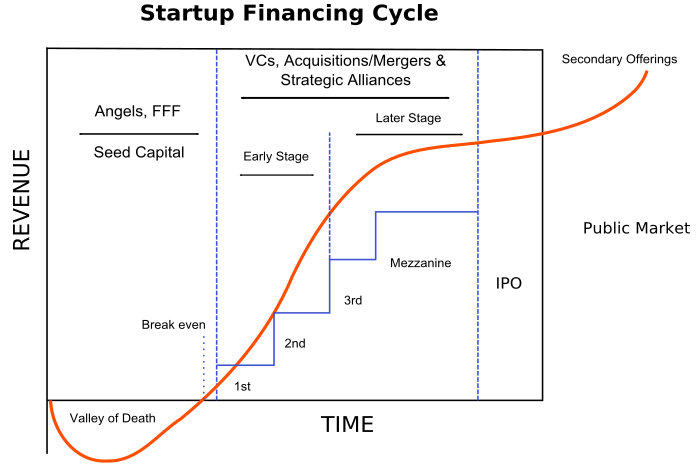
As can be seen from the graph below the usual startup financing cycle moves from seed money to Venture Capitals, Alliances and Mergers&Acquisitions to IPO's in the open market.
Source: Wikimedia Commons
Thus, in this case as well, the pre-IPO course of action of the aforementioned two organizations should be divided into 2 stages:

1. Seed Money: During this first phase of development, the innovator(s) present their ideas (or products if they have already developed them) to the Sovereign Fund which is to decide whether they should be granted some money to continue development or not. At this point, no detailed business plan will be required as this will only be the starting point of the whole procedure. No more than 1-2 pages describing what the innovator(s) is proposing along with some details on how (s)he is aiming to achieve this. Funding at this stage should approximately be around €20,000 for one innovator, €25,000 for two innovators and €30,000 for 3 or more. For those of you who believe that €20,000 is a very small amount, I would remind you that DropBox began with the equivalent of less than €11,000, as have Facebook and Google. Since this stage is the one where risk is particularly high, all funds should be granted in exchange for an equity share in the company. The Sovereign Fund should collect about 5-7% of equity per company; the owners of the company should undertake their company's registration themselves, before the funds are received but after they have been granted with them. Nevertheless, company registration pending should not delay fund release as time is of the essence in the innovation industry. The idea behind receiving equity for the funds is for the owner(s) of the company not have to repay debts for the rest of their lives just because something did not work out as planned. By forcing them to pay for the company registration themselves, the Fund would make an attempt to make the innovator(s) believe that they have and will put more than just their work into that company; a small part of their hard-earned money has been put to use as well. Given that Member-State governments should commit to contribute no less than 20% and no more than 70%, they should receive an amount of equity proportionate to their contribution while the rest will belong to the Investment Fund. (e.g. 20% of a total of 5% to be received would equal 1% for the participating government. Similarly 30% of 6% equals 1.8% and so on)

2. Start-up stage: This is where the EU Investment Fund first comes in. After the successful completion of the seed money stage, and at the point where the previously received funds have started to decrease dangerously and the company has reached (or is close to) break-even point, the second stage of the procedure should be initiated. The Investment Fund should reconsider all companies which have managed to fulfill their stage one requirements like product development, market analysis or even product launching and grant them another round of funding which should be much greater than the previous one (between €500,000 and €1,500,000). This kind of funding should allow the company to further develop and/or remain alive until its revenues begin to be sufficient enough to sustain its own growth. The Investment Fund should either obtain 7-10% of the company's capital or lend the money to the company with a very low interest rate (as in the Jeremie family of loans where the EU indirectly lends an amount to the company, through banks in the Member-State where the firm is located). Note that a mixture of the above could also work (e.g. 4% of equity plus €400,000 as a loan), but that is up to both the Fund and the company to decide. Banks in the Member-State should not have anything to do with actually granting the loan. The application and whole procedure should go through the EU Investment Fund, so that it could allocate the funds as it deems fit, and avoid unnecessary bureaucratic delays. The Investment Fund should not limit itself just to cases where the company had received previous funding by the Sovereign Fund, but should welcome applications by independent start-up companies, with a life-cycle of less than a year and a half. If a company between 1.5 and 2.5 years would like to apply, then the Investment Fund should only grant it with a Jeremie-like loan, at its own discretion. Nevertheless, for the 1.5-2.5-year-old companies, the application should be made directly at a banking institution of the company's Member-State.

The IPO Phase

As in most start-up companies, a time comes when the firm is "obliged" to go public, so that the organizations which assisted in its creation (in this case the Sovereign and the Investment Funds) can obtain some profit from the whole procedure. As most venture capitalists know, it only takes one Google, or one Facebook every 200 companies to more than make up for everything invested. Thus, quantity of companies gone public should not matter as much as quality. This would mean that even though companies should be "forced" to go public after a certain threshold (i.e. if they are currently employing more than X persons, where X would depend on the size of the country, or if they have a yearly turnover of more than €X million, again depending on the size of the economy). The reasons behind this are that when a company gets larger, it become more important to the country's economy as it both employs a large amount of persons and contributes greatly to its growth. Thus, the authorities should monitor such firms, in order to ensure that thousands of people will not become unemployed in the blink of an eye due to poor decision-making, as recent experience from EU banking institutions has shown. For example, a firm employing 300 people would not have a major effect in Germany if it collapsed, nevertheless it would have a much greater effect in countries like Malta, Greece and Ireland. As already stated, large type of companies are not the norm in any funding organization. Nevertheless, with more companies funded, the probability of having at least one Google-like firm increases.

After the IPO, both government and Investment Fund, will see their equity stakes reduced, and receive cash in their place. From then on, it is on both the government and the Investment Fund whether they choose to sell out and receive cash or continue with the same amount of equity they have left after the IPO. To avoid any speculation, neither the government nor the Funds should be allowed to increase their share of equity in the company, other than the one agreed upon in the first or second phase of funding.

Economic Aspects of the Scheme

Horatiu has proposed the hypothetical amount of €100 billion to be attributed to this scheme. Nevertheless, simple math would point out that even an amount of €1 billion would be sufficient to cover the needs of this program. Assuming that €300 million will be assigned as seed money and €700 million will be used for the Investment Fund, it would mean that even if all companies are in the 3 or more innovators category, approximately 10,000 start-ups firms from all over Europe could be assisted could be assisted. Since, this funding should occur proportionately in each nation, dividing this with the number of MEP's (expected to become 751) and given that the minimum amount of MEP's is 6 and the maximum 96, it would mean that a number between 80-1290 companies per nation can be assisted.

One may only imagine how much 80 companies per year would mean to a small nation like Malta and Cyprus, not to mention the 1000+ companies in countries like Germany, Spain and Italy. Even if half of that amount is allocated (i.e. €500 million), even a minimum of 40 companies per country would still be a significant boost to growth and innovation.

Social Outcome

According to recent data about 5.5 million youths are unable to find employment and 7.5 million people between the ages of 15-24 are out of employment, training or education. The cost of this situation has been estimated to more than €150 billion euros, or approximately 1.2% of the EU's GDP. This situation is not expected to improve in the next periods of time, and many are actually happy that this number will remain stable and not increase. Good news are that these numbers can be reduced. €1 billion is merely 0.008% of the EU's GDP and less than 0.001% of the budget currently under discussion.

Start-ups are not a magic solution however: do not expect that unemployment will be reduced drastically by next year if this scheme is implemented. Expect, nonetheless, that in the next 3-4 years this kind of unemployed will not be present. As companies grow, and more innovative and vigorous people enter the market the situation can only get better. That is if we just assist them in doing what they do best: innovate.

Monday, 3 December 2012

Poverty

According to the latest Eurostat publications 16.9% of the EU27 population were at risk-of-poverty after social transfers. This essentially means that 1 in 6 people in the Union were at the brink of poverty. Note that the data are for 2011, before the crisis-ridden nations initiated their plans for fiscal austerity, which have decreased social transfers.

Not surprisingly, the nations which face the largest problem include Spain and Greece with 21.8% and 21.4% respectively and Portugal with 18%. (The only reason I am not quoting the countries of the East like Bulgaria, Estonia or Lithuania where the problem is severe as well is not because I do not consider that region important or anything. It is just because the crisis has not hit them yet and they have not been forced to reduce public spending. Yet.)

In the same publication the percentage of persons severely materially deprived can be found. Of the countries which have opted for a bail-out, only Greece and Cyprus have percentages which are in excess of 10%. Yet, I remind you that these numbers were for 2011 only and as recent experience in Spain has shown, it does not take much to make a change for the worst.

Unfortunately, the worst is yet to come. As more and more emphasis is being given to austerity and not growth, people will face the ugly side of life before they meet its good side. The EU authorities, comprised of people who have stable jobs and their salary is never late, have so far failed to understand the effects their policies have on the ordinary person.

For those who may have misunderstood what I have stated, I am not blaming anyone for having a good, stable job secured for the rest of their lives. What I would ask if for everyone to have this opportunity. Unfortunately, with the current policies, this opportunity seems to become rarer and rarer.

Thursday, 8 November 2012

Who's fault is it for the Crisis?

To be honest, I wanted to write this article for a while now. I have heard almost everything concerning whose fault it is for the current situation: banks, politicians, people, Greece etc. Thus, today I am giving you my honest opinion on whose fault it is for the chaos we are currently living. The answer is not, as some may have thought, just a person or a nation. It is a continuing series of absurd, irrational mistakes which have, step-by-step, led us to this situation. Without further ado I present you with the list of the 3 groups of people to blame for this situation:

1. Greek Politicians and Greek People
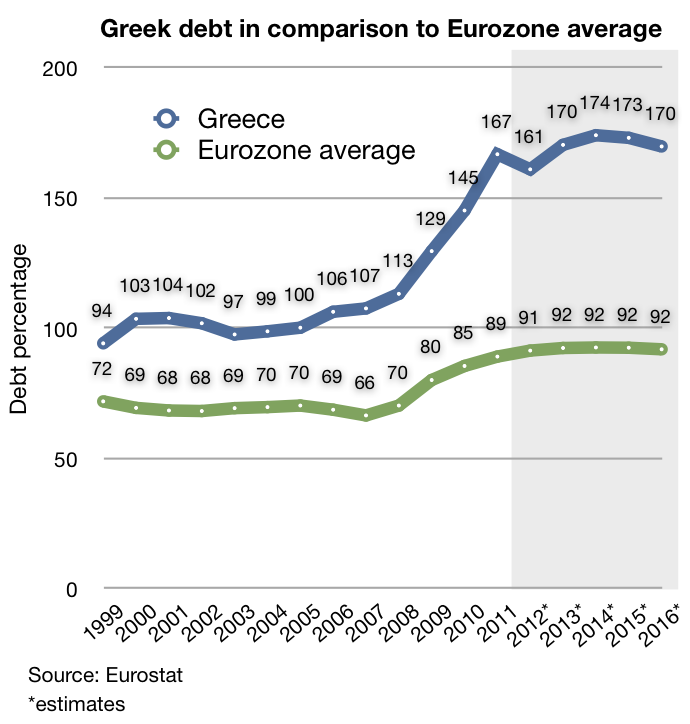
Politicians in Greece, strong proponents of a system named Kleptocracy, which in essence means a system where the government increases the personal wealth and political power of its officials and the ruling class at the expense of the wider population. Greek politicians were (are?) notorious for embezzling state funds, shipping their money to Swiss bank accounts and receiving bribes so that they could arrange something for someone. Greek government debt, issued to fund such abuse of power rose from 94% in 1999 to 167% in 2011 as one may see from the graph below.
Source: Wikimedia Commons and Eurostat
The reason for this astonishing debt growth is obviously the large government deficits, which allowed for politicians and other officials (or their affiliates and business partners) to practically steal from the state using as a preface works for public good. 

Then why the Greek people one might ask? Well, to put it simply because they tolerated and perpetuated this situation. When in public hospitals (which are supposedly free for everyone) you have to bribe doctors for the right to an examination, when you know that many are stealing from state funds and not only you do not do anything to oppose such a thing but try to come up with ways to steal some yourself, when people's parents die and do not mention the fact to the police so that they can continue to receive their pensions (and this has happened repeatedly) then one cannot just blame politicians for it. I am not at all suggesting that every person in Greece is at fault for this directly. Nevertheless, they are at fault indirectly since they have tolerated and perpetuated this situation throughout the years. All that is necessary for the triumph of evil is that good men do nothing.

2. EU Banks

Although EU (and non-EU for that matter) banks must have had the data for the increase of the Greek debt (Eurostat publishes a quarterly analysis which is free and open to public) they had chosen to ignore the possibility that a country issuing large amount of bonds could possibly face trouble. The following data is from the Bank for International Settlements in 2011 and indicate the exposure of non-Greek banks to Greek sovereign debt.
An casual observer can see that the first 12 banks have an exposure of more than 1 billion. At first, your reaction might be that obviously they had enough money to compensate for large losses in Greek debt. After all they are large, well-off organizations aren't they? Well, have a look at the next data set.
What is more astonishing is that people running the two Cypriot banks, Dexia or BPI, Commerzbank or any other bank which had a large exposure in Greek debt, did not think about having more than 10-20% of their equity in one single country. Now I am no expert in risk management, but from what I can remember there is a notion called diversification which means that you shouldn't put all your eggs in one basket. It looks like the officials who ordered such massive buys of Greek bonds should have taken a good look a their exposure and the amount of Greek debt before they invested. They did not.

3. Decisions by the EU

So far the usual suspects were at blame: greedy bankers and corrupt state officials. Now how about we take it to the next level? In an announcement in February 2012 the Eurogroup decided that the Private Sector Involvement (PSI) in the Greek debt restructuring would amount to a total of 75%. For those of you counting, the first 15 banks of the above chart lost a total of 21 billion euros in one day. These were the biggest losses of all times for most of the banks involved. 

As if this was not enough for the banks, the European Banking Authority had issued a "temporary" rule (which now is bent on making it permanent - for details read this) of increasing Core Tier 1 Capital requirements from 8% to 9%. Although this might not seem like much, the increase forced the banks to come up with €116 billion of new capital. And all that in the midst of a crisis, where finding funds is even more difficult. For a detailed view of where these funds came from have a look at the following image:

Source: Wall Street Journal
Thus, keeping in mind that when banks are in need for money they do not lend out much it not amazing why we have reached a situation where individuals and companies are struggling for liquidity. The worst part is that due to the severity of the decisions many banks in the EU are struggling for liquidity as well, which has led countries like Cyprus and Spain to seek for assistance. What has happened is that, in essence, the EU authorities have taken a country-specific crisis and transformed it to an EU-wide one through erroneous handling. These decisions can (unfortunately) be compared to the ones the US Federal Reserve had made in the early 1930's which had strengthen the Great Depression, prolonged its duration and increased its severity.

As a conclusion I would like to remind you of the timeline of errors which led to the crisis:
1. Corrupt officials and politicians in Greece were stealing money from the country and were financing their spending with government bonds,
2. Banks had not paid attention to the increase in government debt and kept on buying more and more lured in by the high returns offered, and
3. EU authorities, by handling the situation badly, have transformed the Greek crisis to an EU crisis

The situation worsens as politicians and policymakers in the EU are throwing good money to follow bad. As they cannot admit their mistakes they hope that two wrong can make a right. Well, the saying doesn't go that way. 

Monday, 5 November 2012

Is it money or reforms they are after?

Yanis Varoufakis's latest article states that the Greek government should only cut about 2.5 billion euros, which is the nation's primary deficit at the moment, and then renegotiate the loan agreement with the Troika. Although it does sound like a good idea in theory, I am afraid that the only way to achieve what he proposes would be for the Greek government to exercise tremendous political on the ECB or the IMF.

In short, what Yanis proposes is for the Greeks to cut 2.5 billion, receive 31 billion and then renegotiate the loan agreement. Yet I am under the impression that if the "old-heads" of the IMF won't see the measures they have proposed, passed through the Parliament, they will not allow for the 31 billion tranche to reach Greece. As the stupidity that the EFSF-ESM will not directly recapitalize Greek banks remains then I am afraid that all Greece, Spain and Cyprus are doomed to forever move in a recessionary spiral.

Norwegian chocolate bar Troika. Too bad their measures are bitter. Source: Wikimedia Commons
It is impossible to understand why the Germans and many other Northerners are opposing the idea of a direct aid to the EU banks. If that was to occur, then the EU nations which opted for a bail-out would only have to receive half of the aid they are currently receiving, if not even less. And for those who do not remember, most (if not all) of the EU banks are facing troubles due to the decision to haircut the Greek bonds held by the private sector by essentially 79% (30% plus 70% on the remaining) and the equally irrational decision to raise Core Tier 1 capital adequacy ratios by 1% in the midst of the crisis. 

For those who fear that the "German taxpayer" would have to pay for bank recapitalization, I need not remind you that the ECB can just guarantee the adequacy of the EU banks, without spending a cent, forcing the banks to come up with the money in a number of years and not now. Nevertheless a money injection in the ailing banks could be good for the economy as a whole. And if you consider this to be greatly risky for taxpayer I repeat: money does not have to be spent to make the Union's wheels turning.

While Yanis's proposal is great in theory, I am afraid that the only way around the austerity measures proposed would be to pass them through the Parliament, receive the 31 billion and then annul some of them. This however, would not make the Greeks more credible, nevertheless it would make it more possible for them to get through 2013 without another severe recession. As a Kathimerini article states today, some fear that the recession will be closer to 9% than 4.5% in 2013.

What worries me more is that while the country is at the brink of disaster, the Troika or the EU does not seem to understand the effects the undertaken measures will have on the ordinary people. In the previous article I have stated that the measures affect the low- and medium-income families much more than the higher income ones. Given that the latter have much more elastic demand it is more than obvious that when their income is reduced, their consumption is reduced by a large factor. (the formal term is propensity to consume)

Thus, although eliminating the primary deficit and renegotiating the loan agreement would be a good idea, it would be nearly impossible, given the state of mind of the Troika and the EU officials. What we need is rational measures, implemented on a long time-frame, with structural reforms and mentality changes. Yet, all we see is spending cuts. What are the Troika objectives is really beyond me.

Saturday, 13 October 2012

Europe's Nobel

Alfred Nobel. Source: Wikimedia Commons
It looks like the decision from the Norwegian committee to award the 2012 Nobel Peace Prize to the European Union was very controversial after all. The critics of the decision state that the prize could have come at a worse time for Europe: economic disaster, a fear of the future, and a questionable form of solidarity. Daily Telegraph commentator Iain Martin, comments that "... when Greek protesters are wearing Nazi uniforms, and Spanish youth unemployment is running at 50 per cent, a look at history suggests there is always the possibility of a bumpy landing.". In addition he states that "Daftest of all is the notion that the EU itself has kept the peace. It was the Allies led by the Americans, the Russians and the British who defeated and disarmed the Germans in 1945."

It looks like Iain suffers from what I called Obsolete Illusions in this article one and a half months ago. In it although I somehow forgot to mention the vast amounts of nationalism which still haunts some of the English, I mentioned why each nation currently facing economic difficulties had reasons to look back to its past and have some sort of national pride. What many, including Iain, fail to see is that you cannot see the future looking back. Obviously, Britain and the US played an important role to the outcome of WWII. And yes it was German nationalists who began the war. Yet, educating ourselves from history and derive our prejudices from it are two very different things. (those who wish to associate economics with this should have a look at the definition of sunk costs)

True, things could have been better for the EU. The economy would have been greater had the Greek sovereign debt crisis not occurred. However, I have not heard of any voices from the UK opposing the Greek haircut. Was this not just because British banks had very little exposure to Greek debt?

They say that people are on the streets, protesting, and claim that this is not "peace". Yet, what is peace and democracy if people cannot express their opinions freely on the streets or wherever they see fit and make governments afraid of the people instead of people afraid of their governments? Protests are more of a sign of solidarity than anything else in the EU. What is more supportive than each nation in the EU-periphery protesting both for their rights as for the rights of their fellow Member-States? What would promote integration more than Spanish, Portuguese, Italians and Greeks protesting not only for themselves but for their ailing neighbors? Obviously extremes should be avoided yet still extremes will always exist.

As for wars in Europe? Have a look at Wikipedia's list of conflicts in Europe and let me know how many of the wars or conflicts had taken place after the nation had joined the EU. I think its none but those who doubt should have a look. 

I would not, even for a minute, state that the EU is at its best. Yet, the future shall be brighter for us, even if it this means that things will get worse before they get better. More needs to be done to safeguard Europe and promote integration, in many areas. Nevertheless, the chance for destruction exists and it is up to us whether the chance will become a reality or not. As for me, I just hope it doesn't.

Wednesday, 3 October 2012

Joseph Stiglitz vs the US and the EU

Nobel laureate, Professor Joseph Stiglitz gave an interesting review of the situation in the US at the moment. Notably, he mentioned that in 2011 the six heirs of the Wal-Mart empire had a combined wealth of $70 billion, which equals the combined wealth of the bottom 30% of the US population! Just 6 people. Although I do not consider myself a populist, these figures are amazing. I wouldn't want to know by how much this percentage would rise if both Bill Gates and Warren Buffett joined the above 6. 

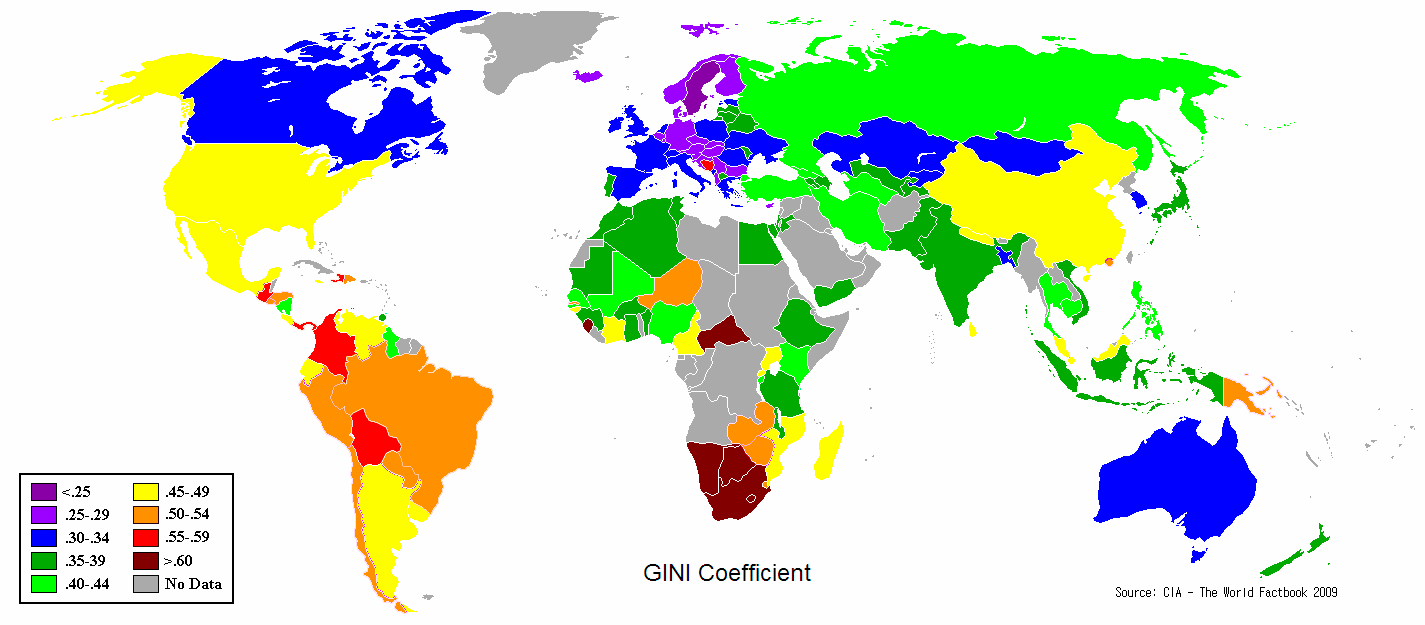
Stiglitz states that there has been no improvement in the well-being of the typical American over the last 40 years. On the other hand, the top earners have weekly incomes of 40% more than their compatriots earn in a year. Income inequality appears to be large in the US, compared to other nations in the world. This is measured statistically using an index called the Gini coefficient. Have a look at the following:
Gini Coefficients by nation. Source: Wikipedia
What this Gini coefficient measures is income inequality, with 0.0 being the case where everyone has exactly the same income and 1.0 the maximum inequality where only one person has all the income. It is one of the very few indices where the smaller the better for society. As one may see from the graph, most EU nations have Gini coefficients which are quite low (with the exception of Portugal). The US on the other hand have more income inequality than China, Iran and Uganda! 

Why this difference you may ask? The US are considered to be the largest economy in the world and the American Dream of rags-to-riches has haunted many generations of both immigrants as well as residents. However, this seems more of a fable now than of a plausible scenario. The now rich pay less than 30% of their income and if their profits result from capital gains they get off with much less. And nothing much has been done about this. Greed was the main cause of the sub-prime loan fiasco in 2008, a disaster from which the economy has not fully recovered.

Yet Stiglitz has an important view of the EU at the moment: "The main problem in Europe right now are the austerity packages, they depress demand and weaken economic growth. The reversal of this policy is absolutely essential to develop growth and more equality. Spain, for example, gets weaker and weaker, money flows out of the country, and it is a vicious downward spiral."
And: "No, Europe's crisis is not caused by excessive long-term debts and deficits. It is caused by cutbacks in government expenditures. The recession caused the deficits, not the other way around. Before the crisis Spain and Ireland ran budget surpluses. They cannot be accused of fiscal profligacy. More fiscal discipline will only worsen the downturn. No economy ever recovered from a downturn through austerity"
And still: "... countries are different from households. If a citizen cuts back his spending, it is without any consequences for the country. Unemployment does not increase. But if the government cuts back its spending, it has a major effect. An expansion of spending can increase production by creating jobs that will be filled by people who would otherwise be unemployed."
Stiglitz even answers to those who believe that Draghi will not be able to take the injected liquidity out of the system: "A well-managed central bank has lots of tools. It can raise interest rates or reserve requirements for private banks. So I think there is actually relatively little danger. The weakness in the European economy poses much more of a risk than any risk of moderate inflation. Better some job where the pay has declined in real terms by a few percent than no job at all."

Stiglitz mentions that their are two strategies: one of "more Europe" and one of "no Europe". Although he recognizes that both options will cost Germany some money, the first one will cost much less.

Well, its one of the few times in my lifetime that I have ever agreed with an economist.