
 |
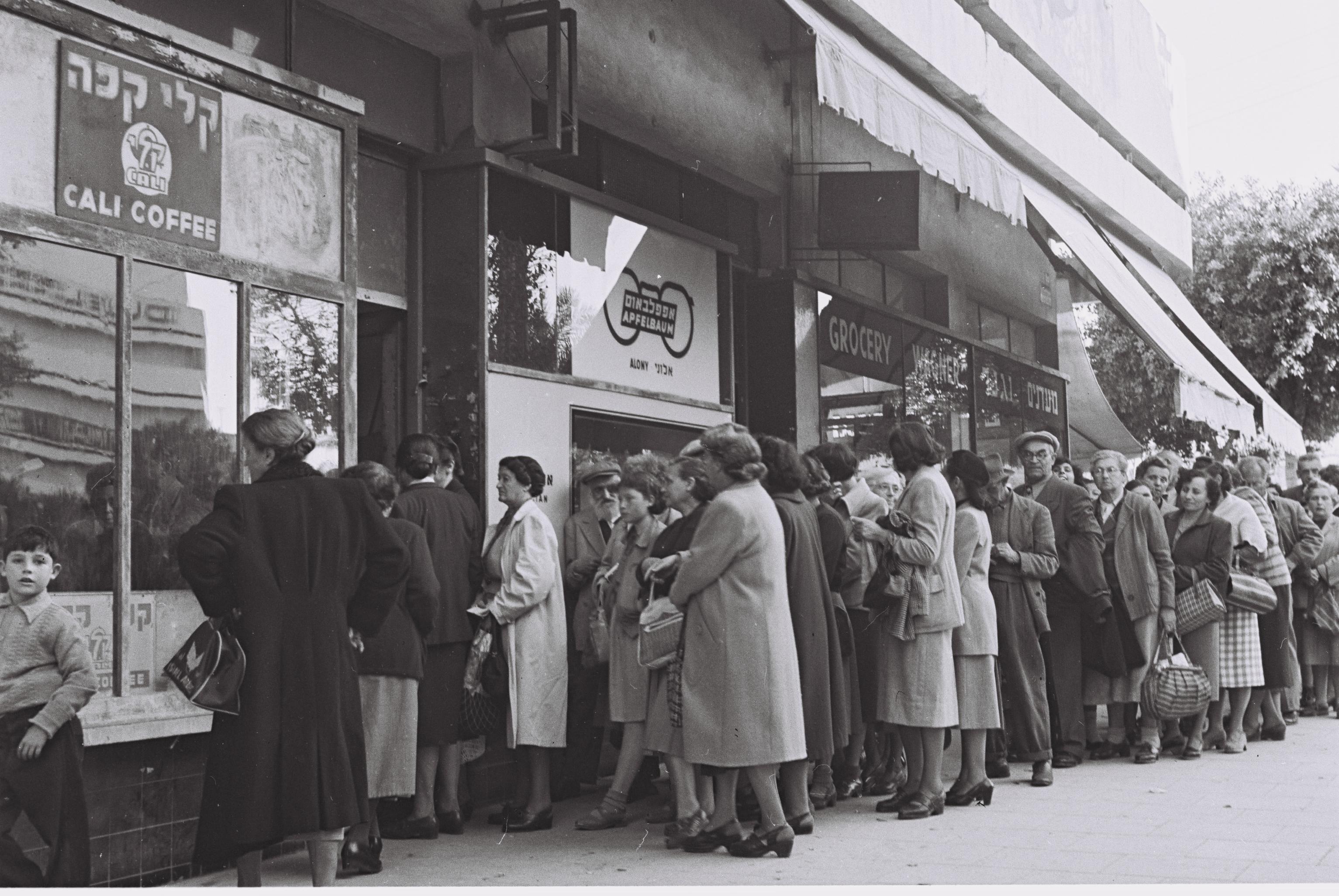
| Citizens of Israel standing in line to purchase food using coupons |
When attributing more attention than necessary to one aspect we are condemning another into obscurity. When we emphasize on macroeconomic, aggregate, indicators we are depriving attention from the welfare of the everyday person, which is what our lives are really about. We are, in a sense, worrying too much about making the forest grow that we forget to examine whether the trees constituting it are sick or declining. Nick Malkoutzis signifies the 400,000 families in Greece who have nobody earning an income, the 300,000 who are "employed" but their employers have not paid them for months now, the 1.3 million unemployed persons and those who have a job but their wage is too low to make it through (unconfirmed stories about full-time employees earning 200 euros a month have reached my ears).
The IMF also appears to support the view that the burdens of austerity are not equally distributed (at least in Greece):
"The rich and self-employed are simply not paying their fair share, which
has forced an excessive reliance on across-the-board expenditure cuts
and higher taxes on those earning a salary or a pension."
It is not just that the rich and self-employed are not paying their fair share of taxes. It's that labour costs have been decreased without the price level decreasing, which makes the situation even worse for everyone. People observe this, and as a consequence they turn to be tax evasion just because their scarce money are too valuable for them to share with their government.
Judging from the above, it appears that what Noah Smith is proposing might be just the opposite of truth:
"I conjecture that "austerians"
are concerned that anti-recessionary macro policy will allow a country
to "muddle through" a crisis without improving its institutions. In
other words, they fear that a successful stimulus would be wasting a good crisis."
It is not that the "elites" (as Paul Krugman calls them) believe that a crisis will go through without pushing through any "neoliberal policies even if these policies are essentially irrelevant to the sources of disaster", but because they are hoping that the status quo will not change because of austerity. While austerians
may be right that many reforms would never occur if it were not for a
crisis forcing their implementation, emphasis should be given on who these
measures affect and not just their aggregate results.
What difference does it make for any billionaire (or millionaire) if he has to pay 25% instead of 20% VAT or if you start paying income tax at 5,000 euros instead of 10,000? Nothing whatsoever. Although it may appear that VAT is an equally-distributed tax, the work of Simon Kuznets back in 1953 reminds us that the higher the income, the more of that income is used as savings.Thus, the rich and the poor are not affected the same as a percentage of their income. In contrast, although Francois Hollande's adherence to the 1 million euro tax may be wrong, he at least got the right idea. You may squeeze the money from the middle and lower classes for long, but at one point you will need to come up with new ideas since they will no longer have money for the government to take.
Focusing on long-term aggregate indicators tends to blind us on how shorter-term non-aggregate ones are behaving (and remember, people cannot live on GDP). Standards of living have been falling in most of Europe over the past years and fertility rates are at their lowest levels ever. A middle class crisis appears to be what we should expect in the near future, with citizen welfare and equality being the first to bear the signs. In a weird example of self-fulfilling prophecies, economic models with too much emphasis on agents maximizing consumption have made people see the world through their "rational" eyes. Adhering to such policies, we have learned, the hard way, that the thing which matter cannot necessarily be priced and what is priced does not necessary matter; in fact, the sum of the parts does not mean anything if the parts are largely unequal.

