Showing posts with label Schäuble. Show all posts

Thursday, 27 December 2012

Recession in Germany?

Although these are festive days and everybody deserves to be happy, one cannot help but comment on this article on Der Spiegel, stating that "Wolfgang Schäuble is secretly planning cutbacks to prepare for a weakening economy and possible fallout from the euro crisis". Hate to say "told you so" Wolfgang, but I did here about 1.5 months ago. What had mentioned in that article was that given that German exports within the EU accounted for about 60-65% of the total exports. If demand falls in those countries guess who would be in trouble: exactly, Germany.

It appears that German strategists in the center-right coalition parties are planning to enhance benefits for families, pensioners and the long-term unemployed while experts in Schäuble's ministry are believe that the next government - no matter who - won't be able to boost spending but it will have to impose a rigorous spending restraint. It appears that Schäuble wants to give his countrymen a taste of the medicine he (along with Angela Merkel) has been promoting in Europe over the past couple of years.

The measures promoted by Schäuble will include decreases in pensions for early retirement instead and a significant reduction the 55% of their deceased spouse's income widowers and widows now receive. It appears that Germany has now reached the tipping point; either they go down with the rest of Europe or they manage to save themselves along with the rest of the countries in critical condition. The first scenario is easy to picture: Germany imposes austerity measures, people reduce consumption, and investment along with the already reduced government spending and GDP falls. The same old story as in Spain, Italy, Greece, Cyprus and Portugal. 

The second scenario is the most difficult of the two. How can Germany and Europe be saved? The answer is not as complicated as it appears though. The ECB should be allowed to directly finance banks, under the EFSF/ESM funds. This means that it will be able to gather all problematic banking institutions under a common umbrella and thus deal with their problems without any pressuring time constraints. To those who believe that this appears to be similar to what Jens Weidmann, Bundesbank's President, has dubbed as "supporting countries with the printing-machine" I would agree that it is. Yet, there is one significant difference: Weidmann's comment was referring to bond guarantees by the ECB, which in essence mean direct nation support, instead to what this proposal is: direct banking support. Would anyone disagree that it is the definition of the Central Bank's duties to monitor and support banking institutions and this is the main reason Central Banks were invented in the first place? 
It could might as well be now: unemployed workers waiting in line
in 1938, towards the end of the Great Depression.
By directly funding the banks we would not, of course, solve every problem we currently face. Still, we would solve the greatest one, banking recapitalization which is the main issue in countries like Spain and Cyprus and a major secondary issue in Greece. In Portugal and Italy, policymakers would just have to implement moderate spending cuts (like the ones the Monti government had applied in Italy) to survive. Even with the aforementioned solution, it is irrational to believe or hope that everything would be better in the next year. The effects of such reforms would not start to show until 2014. Nevertheless, if we do not implement such solutions, it would mean that we cannot even hope for an improvement of the situation in 3 or 4 years from now. 

The outcome of the proposed austerity measures will be the reason why future economists and politicians will condemn us. We will be responsible for promoting a regional crisis to Europe's Great Depression; and we all know that this will not be a good outcome. Have a look at the 1930's and 1940's decades and history will tell you what happens after great calamities. We have to learn from our mistakes and fast: otherwise it will be too late to alter the situation

Thursday, 29 November 2012

Questions on the Crisis

Source: council-tvnewsroom.eu
After observing the outcome of the latest Eurogroup meeting (you may find a commentary on that here and here) and thinking about what led us to where we got not, there are still parts which do not make sense. Things that could have easily been avoided and yet nothing was done to safeguard growth and stability in the EU. The 2 major questions which spring to mind when considering past and present decisions are:

1. Why did European Finance Ministers agree for a nominal haircut of 53.5% on Greek bonds held by private investors?

We can all understand that the European leaders all wanted to find a fast solution for the enormous amount of Greek debt. That time was of the essence and a clear plan was in need. Nevertheless, the fact that Finance Ministers in Cyprus, Spain and other nations who had large exposures to Greek debt failed to oppose such a plan still amazes me. What happened? They did not know what the consequences would be? If most newspapers around Europe knew how much government debt each bank had they how could they have not known? The mathematics of calculating the results are more than straightforward: a 9-year-old could have done them without the use of a calculator. Even if we do accept that the German Finance Minister Wolfgang Schäuble pushed for the deal to go through, given that German banks were large enough to take their losses without causing any problems to the economy, and even if he had support from other Ministers, why did the Southern Ministers not oppose or veto his proposal? There are only 2 rational explanations for this: either Finance Ministers are incompetent and did not think of what the effects would have been, or that they are parts of dark plan to bring the EU to an end. Given that they are now trying to solve the problems they themselves have created we can easily assume that the latter does not hold. So that leaves us with option 1...

2. If the IMF and the EU both know that growth is more important than austerity when trying to cope with a large debt burden, why are they imposing harsh austerity measures on any country who asks for a bail-out?

To quote IMF Chief Economist Olivier Blanchard's Ten Commandments for Fiscal Adjustment in Advanced Economies article, "a one percentage point increase in potential growth—assuming a tax ratio of 40 percent—lowers the debt ratio by 10 percentage points within 5 years and by 30 percentage points within 10 years, if the resulting higher revenues are saved." We can easily assume that if the Chief Economist knows and writes about such an issue, then everybody in the IMF should know this as a fact too. If this is true, and by the way if one studies the aforementioned article more arguments against extreme austerity can be found, then why is the IMF so bent on imposing so harsh measures? Nobody can agree more than me that reforms are needed in all EU-periphery countries; even if they are harsh and difficult to be implemented. Yet, a reform is a much different thing than just slashing pensions and wages. I can understand abolishing most (if not all) of allowances paid by the state to civil servants. I can even understand a reduction in social allowances like unemployment benefits and support allowances due to the fact that state expenses have to be reduced. Yet I cannot see any possible rationale for slashing wages and pensions by large amounts, especially during a crisis period where the state is supposed to help boost consumption and not further reduce it. What makes things even worse is that even though the "Greek experiment" yielded terrible results over the 1.5 years that the Troika has been involved in it, they are pushing the same "reforms" in Cyprus. If Spain and Italy follow, then France and Germany will be next in line, until they finally decide to do as they preach.

The above have been puzzling me for some time now. If any one can assist me in understanding the rationale behind these decisions please do. I, and the rest of Europe will be forever grateful.

Wednesday, 14 November 2012

Additional Aid

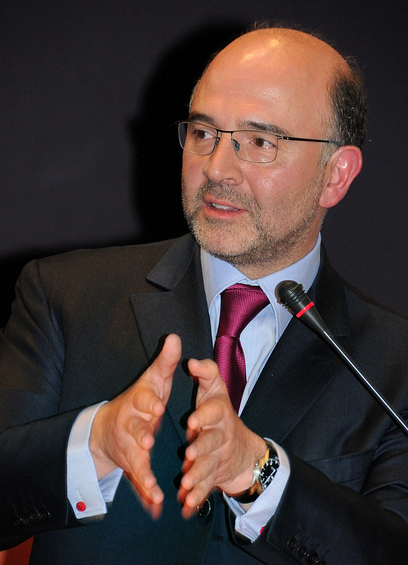
It looks like Bild Zeitung has posted that German and French Finance Ministers Wolfgang Schäuble and Pierre Moscovici are considering a €44 billion installment to Greece, instead of the previous €31.5 billion. The reason is that Greece was expected to receive €31.2 billion in June. Further loans were to be paid out totaling €5 billion in the third quarter and €8.3 billion in the fourth quarter, but due to the Greek election and delays in implementing reforms, which delayed a report on Greece's progress in restructuring its economy, the loans have still not been paid out.

Pierre Moscovici. Source: Wikimedia Commons
Although from what Bild writes, this is not a "gift" of any kind, more like something the Greeks well deserved, it is a very positive development. Given that the majority of the €31 billion (a bit more than €20 actually) would have been used to recapitalize the Greek banks, having an additional €13 billion to use in order for the economy to grow would be a good idea. I just hope that the Greek Prime Minister is as good as I believe he is and will use the money appropriately (in contrast to how his predecessors were using the money).

For those of you wondering how the Greek government should use the money, if it ever gets them that is, the answer is obvious: promote public utility works like roads, (those who have been in Greece know that its road system is a mess) and other works which would bring the building industry to its feet, force the banks to restructure non-performing loans of small and medium businesses and support the businesses directly and most importantly, give incentives to the youth for starting new businesses. With youth unemployment reaching 55% there is little hope for the future if jobs are not created. For those saying that overall unemployment should be tackled first, I would like to remind you that public utility and debt-restructuring would do that. In addition, given that youths are more likely to spend in renting/buying apartments, general shopping and other consumption goods, it is obvious that as youth unemployment falls, more and more jobs will be created and thus both youth as well as overall unemployment will continue falling as well. What we should also bear in mind is that it takes much less money to promote new businesses than to support existing ones so it would be easier to implement it.

If Greece receives that money, it really needs to put it in good use. Generating more jobs will also increase government income and lower the debt/GDP ratio. Time will show that growth is much better than extreme austerity. Let us hope that the same fate does not await Cyprus and Portugal.

Wednesday, 7 November 2012

Easier to Preach than Implement

Don't know if you have seen it, but an article in Der Spiegel states that although Angela Merkel and Wolfgang Schäuble have forced almost every Southern nation in the EU to take harsh austerity measures, they do not plan to follow that recipe themselves. With less than a year until elections, Angela Merkel is planning on increasing government spending in the form of subsidies and pension raises. While this may be speculative as the German Chancellor has committed to presenting a balanced budget for 2013, it is in severe contrast with Schäuble's on austerity in the current G-20 summit in Mexico City.

You see, as in most philosophies and other principles and values, it is easier to preach and condemn people for not implementing them or even force people to apply them, than to use them yourself. The great socioeconomic experiment we are currently witnessing in Greece (and will soon witness in Cyprus as well) is indicative of people who are stuck in ideology and cannot understand simple economic reality. I am not talking about complex equations or ideas here: what I mean is the mere understanding that if you cut salaries and wages things will get worse than what they were. Any high school student could see and understand this. Sadly, we have no high school students in a position to apply policy.

If austerity measures were implemented to reduce structural problems the countries were facing, I would admit that, even though rapid implementation is never good, the measures were aimed at producing something good. Nevertheless, the measures are only aimed at reducing expenses and not addressing problems. As a result, they do nothing to improve a country's well-being. In contrast, what they do is deepen the gap between social classes, as the lower class assumes most of the burden.

The Greek domino effect. Source: socialistrevolution.org
It would look like policymakers and politicians in the EU are not really reading any blogger articles. The EU blogosphere has been expressing its objections about this for months now. What seems to be even more amazing is that even though blogger voices against austerity have increased over time, nothing is being done to correct the situation. What I fear is not that a nation will be destroyed. It is the domino effects of this destruction that I fear the most. A Greek bankruptcy, or even a fall of the government, would most likely force the nation out of the Union and the common currency. And if this occurs then maybe Cyprus, Spain and Italy will also flee, thus rendering the EU a non-Mediterranean union. Although the ties between nations are strong, which can be evidently seen in the youth, they are nevertheless weaker in the older population. As the older generation rules, it will be more difficult not to follow suit if Greece exits the Union.

What is suggested above is not just a far-fetched scenario. It is one of extreme likelihood if the austerity measures are not passed through the Greek parliament. And I am not sure what is worse for the Greeks: the painful austerity plans or the fall of a government? In the long run obviously the second would yield worse results, but in the short run austerity will bring those of the Greeks still standing, to their knees. 

Unfortunately, Greece, as well as Cyprus in a few days, is at the mercy of its creditors. They tell the country how much it shall be lent, when and what is should do with the money. It is essentially being an unelected and uninvited government. Can you really blame the citizens for not liking the Troika and what it represents?

Friday, 2 November 2012

Strange Tactics

To my (and I think everyone's) surprise, yesterday German Finance Minister Wolfgang Schäuble, has stated that he does not expect concrete negotiations between Cyprus and international lenders to start before 2013, suggesting that the island has missed a November 12 deadline and could be at risk of running out of money before the end of the year. In addition, the Cypriot are now fearing that Troika will enforce an increase in the tax rate for businesses, which is now at an attractive 10%. What ever happened to your supporting the Eurozone Wolfgang?

It seems that Schäuble's comments where not the only strange stories on the news. Having heard the estimates for the financial aid Cyprus will need to overcome the current situation I was struck with amazement: Troika suggests a €12 billion pack for the two large Cypriot banks (Bank of Cyprus and Popular Bank) and an additional €5 billion for government needs. If one has a look at the balance sheets of those two companies (you can find them here for the Bank of Cyprus and here for the Popular Bank) the total number of loans of both banks combined does not exceed €50 billion. (To be fair the amount is about €46 billion, nevertheless I will be kind to Troika and round it up to 50). Thus we have: €50 billion in loan portfolio and €12 billion in aid, which means, hmm that essentially 24% of ALL loans given out by the two banks are considered as non-performing.

Really? 24%? How on earth could these banks have survived so far? Were they using nothing as collateral? If the numbers are true, then it would be better to incarcerate all of the top management of both banks, and all officers of the regulatory authority. Nevertheless, if those numbers were true, the banks should have been declared insolvent a long time ago. If one every 4 loans is non-performing I cannot see how a bank could have survived. However, to the extent of my knowledge, (and in accordance to their financial statements) both banks are still functioning and are still profitable.

Source: politico.ie

I do not know how the Troikans have reached these conclusions but they hardly seem plausible. Negotiations seem to reach an impasse on the amount of assistance the island needs. The Cypriot government says €6 billion, Troika insists on €12 billion. I think this is the first time in history when the receiver of the loan states that he does not need more and the loan giver insists on him taking some more. (then again a resemblance with the sub-prime lending policies in the US does come in mind...). Imagine it happening in a bank:

Client: Can I have a €10.000 loan?
Bank Officer: I think you should have a €20.000 one. It is better for you.
Client: But I believe that €10.000 would be sufficient, and besides I would have trouble repaying any larger amount.
Bank Officer: Still, I think that you should take the €20.000.

Thank God the IMF is not a regular bank or we would be bailing them out every now and then. 

Thursday, 1 November 2012

Poor Greece... (Literally)

At last, the outline for the new austerity measures has been agreed with Troika and presented yesterday... Good news for Troika, horrible news for the Greek people. 

Greece's next economic model. So unfortunately true... Source: Wikimedia Commons
With the announcement of the austerity package came the announcement for a 48-hour general strike next week, when the measures are expected to be voted on the Parliament. The total monetary value of the austerity package is expected to be about €13.5 billion, the majority of which (€9.2 billion to be exact) is expected to be implemented in 2013. The package consists of a two-year increase in retirement age (from a current 65), pension cuts and even greater taxation. Greece is now waiting for the additional installment of €31 billion from the IMF and EU, without which the country will run out of money on November 16th.

As for the latest forecasts for Greece's indicators: unemployment will rise to 22.8%, government debt to 189.1% of GDP, deficit will grow from 4.2% to 5.2%, primary surplus of a mere 0.4% and an economic contraction of 4.5%! One cannot help but wonder what the outcome would have been, had the measures been lighter and Greece received the €31 billion installment. I guess things would have been better wouldn't they?

Now, pessimism will prevail in all issues of the economy, uncertainty will rule everyday life and with this, economic activity will take a larger tumble. One cannot understand the rapidity of movements concerning budget cuts. If the country was not already in a recession, then effects would not have been that great and rapid, harsh reforms could have been pushed through faster and will less implications. Yet, this is not the case.

Greece's lenders want their money back. That makes sense, but why do they need it now? When banks invest in government bonds, they either stick to their investment until maturity or try to sell it through the secondary market. It seems like Greece's lenders do not want either of these! Using the same rationale, banks should be allowed to force a man who has a contract for a 20-year housing loan, to repay them in 5 years! Now that seems to be a bit odd doesn't it? They say that markets know better. Well they do, and when a person goes to a bank and says "I cannot pay the remainder of my housing loan with the monthly installment this high" the bank does not force that person to take severe cuts in his life to repay it. Instead it refinances the loan for a longer period of time, with less monthly installments, making them both happier: the person can pay less per month and live better than before, and the bank receives more cumulative interest. 

Truth or Lies? Your choice. Source: Wikimedia Commons
The same idiotic reasoning holds with Schäuble's proposal for an all-powerful Commissioner to have veto rights over countries' national budgets. Really? Then why not have an all-powerful Commissioner to dictate policy in all matters of the EU? Or why not have that Commissioner draft the budgets himself? (for a great discussion on Schäuble's proposal read Protesilaos's article here)

Let's focus again on Greece: rapid solutions, especially in times of recession, cause extreme trouble. The US, after the collapse of Lehman Brothers in 2008 injected 3 Quantitative Easing packages in the economy. And the economy has only now started to grow. In comparison, Greece has only made budget cuts and reforms. I do not know whether the Troika has a "long-run plan" but the "short-term" consequences are horrid. And any recession which is expected to last for 6 years is not "short-term" any more. Remember Keynes: "In the long-run we are all dead"

A €13.5 billion package could have been easily broken up to fit a 3- or 4-year horizon. That way, the consequences from it would have been much softer. What difference does it make to Troika if a pensioner in Greece earns €600 or €700 a month? None. It only cares whether the country can repay its debt and that its lenders do not lose any money. Thus, why not have a longer horizon? If GDP rises, then it would make sense that income from taxes will rise too. Then, the debt-to-GDP ratio would have been lower and the country would be able to continue paying its interest and even imposing more reforms, tax increases or budget cuts GRADUALLY!

I guess the above plan was too difficult for the IMF, EU and EC "experts" to understand. If they can understand this then I would ask the Troika to let us know whether or not they are interested in destroying just specific economies (e.g. Spain, Cyprus, Greece) or the EU in general. Worst of all, the Germans, usually (supposedly?) people with patience and common sense, agree with them.

Wednesday, 24 October 2012

The Worst Isn't Over. Or is it?

Yesterday, German Finance Minister Wolfgang Schäuble uttered what I have been saying for months now: "I'm not so sure that the worst of the crisis is behind us"
Source: Wikimedia Commons

On the other hand European Commission Vice President Olli Rehn told the Bangkok Post a week ago that: "there is no likelihood of any country leaving the euro zone. The key message I told the ministers was that there is cause for prudent optimism. I think that the worst is over for the euro debt crisis."

So who is right and who is not? Is there reason for optimism or is pessimism a better strategy in anticipating the future? I guess Rehn was right for the first part of his statement. There is indeed a very small likelihood of any country leaving the euro zone. And this is sufficient enough for everyone to note progress. Actually, compared to the Kassandras of the summer, where predictions even specified the day of Grexit or Itexit or any other exit, this is indeed an action which promotes solidarity amongst the EU. 

Alas, the near future does not appear rosy. It is more than obvious that although much has been done towards addressing EU's tantalizing problems, the time for them to end completely is yet to come. Greece is doing much better than before, yet with new austerity measures to be applied before the end of 2012 (hopefully they will reach an agreement with the Troika soon, as the negotiations are really starting to get annoying to the people watching) another deep recession is feared. In Cyprus and Spain, the memorandum currently under discussion is also expected to bestow a deeper recession in the countries in 2013. And although Italy is holding up well, if Monti is not re-elected as Prime Minister in the April elections, then the country's future may be at stake. Unless of course his successor is much better than he is. 

Schäuble seems to be correct in his prediction yet up to a point. In the short-run,  and I mean until the end of 2012, the crisis will almost certainly get worse. I believe that statistics to be announced from the ECB will indicate that the EU27 as well as the EA17 will officially be in recession. As for 2013, it would depend on how well the nations are coping with the austerity measures. Although the effects of a memorandum in Spain and Cyprus are expected to drive consumption and GDP down, this does not mean that after mid-2013 the nations' economies will not bounce back. (Given the size of these economies, it will be easier for Cyprus to bounce back. Nevertheless, Spain's start-ups and innovation may play an important role and allow it to bounce back faster) The same holds for Greece, although a full-blown recession is expected yet again for 2013. However, the contraction might be less in the end of 2013.

In the words of Yogi Berra: Prediction is very difficult, especially about the future.
And as Schäuble has stated on the Greek "experiment": "We are all sinners"

Monday, 15 October 2012

Schäuble

I have to admit that I have not been the greatest follower of Wolfgang Schäuble. Especially when his ideas of more austerity, harsh measures and reforms are still echoing in my ears. But I have to admit that ever since he, Angela Merkel and the majority of European leaders have changed their attitude towards Greece and the austerity measures undertaken there, I have grown fonder of them. (Up to a point that is!) Nevertheless, one has to recognize that the man has some guts. In a recent trip to Singapore discussion, he has stated the following: 

"If we are not fast enough for markets, sorry, but markets have to wait"

Well, he is right on this one. As it is known, markets are handled by people who are more than eager to see action, rapid movements and fast decisions. Unfortunately, in the real world, fast decisions seldom make good decisions. This is a fact that markets have to live with. I would be much happier if it took 2 months to make a decision which would restore prosperity in the region than if a decision was agreed upon in 2 weeks and its results were mediocre. 

Wolfgang Schäuble, winner of the 2012 Charlemagne Prize. Source: Wikimedia Commons
In another interview, Schäuble has commented that "I think there will be no government bankruptcy in Greece.". I think German and (most) European politicians have come to understand that you can gain much more by supporting someone than by constantly criticizing and degrading. His recent trip to Singapore was primarily focused on convincing investors in the booming Southeast little giant to invest in European bonds. Truth be told, it will be an extremely difficult task. Investors will be hard to agree in investing at a region where fiscal stability is far from achieved. Nevertheless, if things work out in the end, returns of Greek, Spanish, Italian and Cypriot bonds will be much higher than those in most nations in the world.

Tuesday, 7 August 2012

Super Mario vs German Stubbornness

In my past articles, I have stated that the only trustworthy person in the crisis-involved countries is Mario Monti. And he proved me right! Yesterday afternoon he asked for more flexibility from Angela Merkel concerning the way the EU tackles the crisis and for "moral support not financial". While his popularity has dropped significantly from 70% to about 40%, Monti seems to be the only European leader who understands the situation more than anyone else. He introduced measures to reduce Italy's huge deficit and is going along just fine without so far any assistance from Troika or the EU.(I really hope I don't jinx the guy!)

In yesterday's statement, he stated a fact which Berlin does not want to acknowledge: there is growing resentment in the South towards the Germans and Europe. He states that if borrowing costs do not fall until next year's elections then the newly-elected government may be a Euro-sceptic one. This is not only true for Italy as most Southern countries have started viewing favorably to an exit from the Union. If exits from the Eurozone begin to occur, then Germans can be proud of producing an unprecedented collapse of the world economy, which will be far worse than the Great Depression.

Germany has become one of the greatest beneficiaries of the crisis, since it is considered a safe investment, and it has maintained an extremely low interest rate for its bonds. It is reported that for July bond issues the yield was -0.06%. Yeah, that's right. People are losing money in order to invest in Germany! Even Wolfgang has stated that interest rates are unusually low. If that wasn't enough, it seems like Germany is actually saving most of the money it has obtained from bond issued to use it as a windfall! (for details read this) These savings are about to reach three digits soon (and that's in billions). And of course, Wolfgang, a direct descendant of the German arrogance and stubbornness which led to two World Wars and an economic collapse in the first half of the previous century (and after conversations with many Germans, I thought of being extinct) states that Germany does not have to apologize for financial markets trusting them. Hmm, even if that is because you steadily hold everyone else down Wolfgang?

Paris and Berlin speak of austerity: they were the first ones to break the pact for Stability and Growth in 2005. Yet, the EU did not (and will never) fine them. It looks like laws and pacts are like spider webs; small animals get trapped in them, while larger ones break through. Both countries are in favor of a low Euro. It helps the boost their exports significantly and this is very helpful as, although their economies are stronger than all of the Southern ones, they are still weak. Meanwhile, if a country or more exits the Union, the consequences for both countries will be severe. Losses from a Greek exit could reach 66bn for France and 89bn for Germany and the global impact of it would reach 1 trillion euro. (for details on these calculation read this) You still don't care about Grexit Rösler?

You may easily imagine what will happen if Spain, Italy or both exit the Union. Germany will say goodbye to those hard gathered savings from the low interest rates. Conclusion and moral of the story above: Act to save the Union before it's too late for everyone.

Friday, 3 August 2012

The Politics of Credibility and Inaction

In the postscript of my last article I noted that the difference between theory and action is the difference between masturbation and sex. This was amply proven in yesterday's press conference where Mario Draghi has said that doing whatever it takes (to save the euro that is) might take weeks or months. On hearing this, world markets started moving downwards. It now seems that the ECB governor has found out the hard way that when officials with perceived credibility and a certain position of responsibility say something important, people and thus markets believe them.

Now, Draghi can say goodbye to his credibility. Who will believe a leader if all he does is promise and never deliver? Especially if the specific leader holds the key for reversing the situation in the Eurozone. In response to the recent developments even Obama started making comments about trusting the EU leaders to do what is right (hmm I wouldn't bet on that Barack). His Secretary of the Treasury, Timothy Geithner, (the guy who tried to sell his house in the midst of the sub-prime lending crisis. Now if that isn't being optimistic I don't know what is!) even came to Europe to meet with EU officials. Indecisiveness in the EU can be spotted all the way across the Atlantic and they expect us here not to notice it?

While in Europe, Tim met with my friend Wolfgang (Schäuble that is) and urged him to take immediate short-term measures to support Spain and Italy. (Obviously the Americans don't really care about Greece or Cyprus. Well if they were thinking straight they would. Here is why). Both stated that they have confidence in the member-states efforts. To be honest, I believe Tim, it's Wolfgang I do not trust.

The Germans have a history of seeking financial stability and a low inflation said Tim. I do not think that anyone would disagree on that. It's a wonderful policy and it should be pursued. Nevertheless, it should be pursued when the economic climate allows you to do so. The delay of significant measures to halt the recession will only worsen the situation. (If you don't believe me read about what happened to the Americans during the Great Depression in the early 1930's and during the same period in the UK when policy makers did not want to abandon the gold standard.)

In the end, it all boils down to credibility. A man of higher standing such as Draghi cannot make any statements concerning policy and then try to avoid implementing them. People lose their credibility much faster than they can regain it. It seems that hordes of economists all over the EU have forgotten the consequences of the non-credibility of Central Bankers. The same problem holds throughout Europe. Think about any government. Who would you believe if they said anything concerning policy? Governments in Cyprus and Greece stated that they would not need any help in overcoming their financial strains only days before applying for help. There only two kinds of officials in Europe that I would trust (of the ones involved in the crisis I mean. I have nothing against Scandinavian, Dutch or Austrian governments which are one of the most stable economies in the world): the Germans when it comes to denying any help (and not in saying that they will do anything to help the Euro) and Mario Monti who seems never to say more than is needed.

However, with credible or non-credible leaders the need for decisions remains. In a world where inertia and idleness do nothing but wrong, we have to able to move fast and without hesitation when needed. If it takes 10 summits and 100 voting procedures every time the ECB wants to pass and implement a plan of action then we are going to be forever lost in a bureaucratic troubled ocean.