Showing posts with label credibility. Show all posts

Friday, 23 November 2012

Democratic Masochism

In a discussion yesterday, Alexandru F. Ghita coined the term democratic masochism for the countries which seem to vote the same people over and over again despite their obvious lack of credibility. I have always been wondering about the cause of this phenomenon and it would appear that habit is stronger than common sense or the ability to change. The main rationale appears to be "well, we know that the people we have running our country are [insert negative word here] but at least we know who they are and we have been seeing them over some time, so they must know something. Why elect someone new, with ideas different than those we have been living with up to now? Right?'' Wrong.

We cannot escape our human nature: we are creatures of habit; we seek the same thing over and over again, not because we really enjoy it, but mainly because we are used to it and our expectations meet reality every time. Truth is, that occasionally something happens and wakes us up from our lethargy. However, events of that significance occur only once in a lifetime and we cannot count on them; thus, we have to make the change ourselves.

For those of you thinking "sure but this does not happen with me or my country" I would challenge you to remember how much the political leadership in Southern Europe has changed over the past 10-15 years. Any new faces? Any new ideologies, morals or beliefs? None whatsoever. The same adherence to old regimes, undemocratic and obsolete beliefs, rigid principles combined with an exquisite ability of politicians to switch to any side of the political spectrum suits better to their plans of assuring a position of power. Name one country in the South, or maybe in the whole of Europe as well, where this has not been taking place over the past years.

The worst part is that younger politicians seem to be a carbon copy of the older generation. You cannot enter the political life of a country with an ideology of your own. No political party will ever accept you in its ranks if you do not fully embrace its beliefs and support each and every decision it makes, whether it makes sense or not. Independent thinking is punishable with expulsion, and that would mean the end of one's political career. The only solution would be forming a new party, but only very few would be willing to go through the trouble of obtaining just 1% or less in elections, with the hope that someday that percentage will rise.
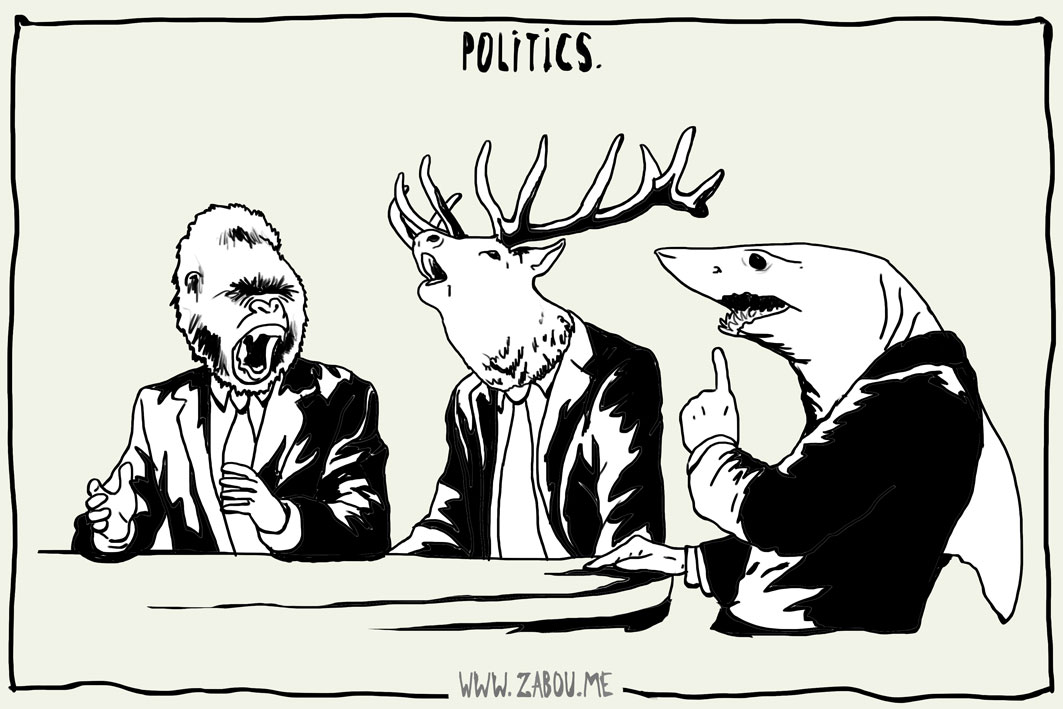
Source: zabou.me
So what does the future hold for us in politics? Although the formation of new parties continues, very few of them will ever be in a position to obtain enough votes to affect anything. For example, the Pirate Party in Sweden received a 7.13% in the European election and its German affiliate a 2% in the national ones. Nevertheless, the German participants seem unable to act on what they preach and thus the party appears to be on the brink of disaster, with voters repulsed from what they are watching.

Which brings us to credibility. If the leader(s) of a party cannot act on what they say, then nobody will ever do the same. That is the main reason why Golden Dawn has been so successful in Greece: they may support nationalistic, racist and fascist ideas but at least they abide to what they preach and people know what to expect from them.

This is where is all boils down: honesty. If politicians are honest then people trust them with their votes. And believe me, people know...

Wednesday, 22 August 2012

Undelivered Promises

The Cypriot government has announced that its fiscal deficit has reached 3% for the first 6 months of 2012. Not long ago, they were stating that the deficit would be 3.5% for the fiscal year of 2012. Now, I am no expert in numbers but anyone in their right mind would understand that having a mere 0.5% rise in deficit over the next 6 months is a Midsummer night's dream (Unless of course very drastic measures are taken, a far-fetched scenario however). The Cypriot government has moved along the same lines as the ECB. It usually states "we will not have a deficit of more than 3.5%" or "austerity measures will be taken", however, nothing of the like ever takes place. The credibility of the government is long lost in international markets and regaining it would be hard (if not impossible).

Credibility issues have been a problem in the Eurozone ever since the sovereign debt crisis has emerged. You may remember Draghi's statements of doing what it takes. Of the crisis-ridden economies only Mario Monti has held to his credibility, and to my surprise the Greek Prime Minister Antonis Samaras is trying to regain it for his nation. Who would expect a Greek to deliver what he had promised? Certainly not the Germans, and certainly not most Europeans. In an interview in Bild (found here in English), Samaras states that what they are asking is for more time not more money. In his words: "Let me be very explicit: we demand no additional money. We stand by our commitments and by fulfilling all our requirements. All we want is a bit of 'air to breathe' to get the economy running and to increase state income. More time does not automatically mean more money."

What Antonis is asking is what I have proposed here, here and here. Specifically that he is given a larger time-frame to push through the additional reforms. I was stating yesterday that if the crisis ends now, Greece will be the only country in the South to benefit from it. To back me up on that, Samaras stated: "We will soon have a smaller, healthier and significantly more efficient public service.We are making progress, we are reducing the overall number of public servants and I have decided to hire only one person for every 10 retired civil servants."

Large public sectors and low productivity have always been an issue in the South. I can confirm that as well, based on personal experience. What now seems to change is mentality and the political will to promote reforms. I honestly hope that this is not just an outcome of EU pressure on the country. It would be too bad if it was. The Greeks now have a genuine opportunity to live in a better country. It would be a shame to blow it like they did in the past. Credibility... It haunts people and nations for so long...

Friday, 3 August 2012

The Politics of Credibility and Inaction

In the postscript of my last article I noted that the difference between theory and action is the difference between masturbation and sex. This was amply proven in yesterday's press conference where Mario Draghi has said that doing whatever it takes (to save the euro that is) might take weeks or months. On hearing this, world markets started moving downwards. It now seems that the ECB governor has found out the hard way that when officials with perceived credibility and a certain position of responsibility say something important, people and thus markets believe them.

Now, Draghi can say goodbye to his credibility. Who will believe a leader if all he does is promise and never deliver? Especially if the specific leader holds the key for reversing the situation in the Eurozone. In response to the recent developments even Obama started making comments about trusting the EU leaders to do what is right (hmm I wouldn't bet on that Barack). His Secretary of the Treasury, Timothy Geithner, (the guy who tried to sell his house in the midst of the sub-prime lending crisis. Now if that isn't being optimistic I don't know what is!) even came to Europe to meet with EU officials. Indecisiveness in the EU can be spotted all the way across the Atlantic and they expect us here not to notice it?

While in Europe, Tim met with my friend Wolfgang (Schäuble that is) and urged him to take immediate short-term measures to support Spain and Italy. (Obviously the Americans don't really care about Greece or Cyprus. Well if they were thinking straight they would. Here is why). Both stated that they have confidence in the member-states efforts. To be honest, I believe Tim, it's Wolfgang I do not trust.

The Germans have a history of seeking financial stability and a low inflation said Tim. I do not think that anyone would disagree on that. It's a wonderful policy and it should be pursued. Nevertheless, it should be pursued when the economic climate allows you to do so. The delay of significant measures to halt the recession will only worsen the situation. (If you don't believe me read about what happened to the Americans during the Great Depression in the early 1930's and during the same period in the UK when policy makers did not want to abandon the gold standard.)

In the end, it all boils down to credibility. A man of higher standing such as Draghi cannot make any statements concerning policy and then try to avoid implementing them. People lose their credibility much faster than they can regain it. It seems that hordes of economists all over the EU have forgotten the consequences of the non-credibility of Central Bankers. The same problem holds throughout Europe. Think about any government. Who would you believe if they said anything concerning policy? Governments in Cyprus and Greece stated that they would not need any help in overcoming their financial strains only days before applying for help. There only two kinds of officials in Europe that I would trust (of the ones involved in the crisis I mean. I have nothing against Scandinavian, Dutch or Austrian governments which are one of the most stable economies in the world): the Germans when it comes to denying any help (and not in saying that they will do anything to help the Euro) and Mario Monti who seems never to say more than is needed.

However, with credible or non-credible leaders the need for decisions remains. In a world where inertia and idleness do nothing but wrong, we have to able to move fast and without hesitation when needed. If it takes 10 summits and 100 voting procedures every time the ECB wants to pass and implement a plan of action then we are going to be forever lost in a bureaucratic troubled ocean.