Showing posts with label Consumption. Show all posts

Tuesday, 25 March 2014

Real Life Effects of Deflation

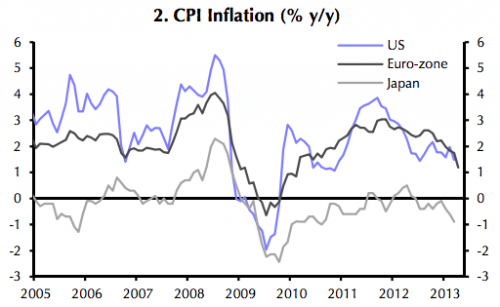
Deflation is defined as the decrease in the level of prices:
As economic theory dictates, the causes are a fall in the money supply, in addition to (in the short-run) a fall in wages and salaries.
Compensation of Employees (aggregate) Source: ECB
Just like any other economic happening, there are those who claim that any type of deflation is disastrous and should be avoided at all cost while others believe that it is wonderful (since it lowers prices) and we should embrace it. As usual though, they are both wrong. The answer, simply put, is that it depends on the severity, duration and the overall state of the economy at the time when deflation is manifested. What follows are three points on the effects of the current rates of deflation on the real economy of the Eurozone.

1. As long as deflation is not severe and not persistent then the effects on consumption are small.
There is no person who would be willing to forgo a month's consumption of food just because it would get cheaper next month. Parents do not tell their children "you will not attend university now because it will be 2% cheaper next year". We have some basic needs which we will continue to satisfy as long as the deflation rate is not so severe so that an apple will be worth 50% less tomorrow than it does today. Prices fluctuate every day and a deviation of 1-2% per annum for a short period of time (e.g. 1-2 years until an economy gets back on track) does not really change our incentives for non-durable consumption.

Nevertheless, there is an effect on what we call durable goods (e.g. houses, automobiles, etc) but these are just a fraction of what we purchase (approximately 1/3 of our purchases are of durable goods). Even though 1/3 may appear to be large, remember that the reduction in price is more severe in some sectors than in others; automobile prices have not dropped by much (if any) while real estate prices have sunk compared to 2006. In addition, when a person has lower income than before, the first thing he stops purchasing is durable goods, not everything else. Thus, the drop in durable goods consumption can be seen as a natural reaction to the overall drop in confidence, investment and subsequently wages. Still, if deflation persists and becomes even higher in 2014-2015, a large drop in the consumption of durable goods might signify a reduction in investment, resulting in more wage losses and thus creating a vicious cycle.

2. Deflation has a stronger effect when households and non-financial corporations are heavily indebted.
The reason is simple: given that aggregate wages have dropped, prices also drop, triggering another round of wage drop and so on. Although this is an issue for durable consumption as discussed above, it is also a problem when it comes to debt as it takes more money in real terms to repay the amount owed. Thus, if in a country most of its citizens are over-indebted (see all periphery countries) deflation is bad because it makes repaying that debt even harder. Not only that, but it also creates a "death spiral": the more people try to repay their loans, the less they consume and thus prices and wages fall even further making the real amount they owe even higher. This is exactly what happened with austerity policies: less spending means less consumption thus less income for the state, leading to higher deficits and debt and forcing new austerity measures once again.

3. Deflation equals lower prices but it does not mean it's good for us.
This is one of the most common fallacies ever: if prices fall then it is great. It is most of the times but it always depends on the reason prices fall. If they do because raw material are cheaper or because of a productivity rise then great. But if they happen because people have less money than before then your purchasing power is most likely hurt in the short run (prices usually do not respond fast to shifts in consumption, even if those are permanent). In addition, if we shift from inflation expectations to deflation expectations then what we will see is less and less consumption, leading to lower wages and then lower production. This is the time when deflation gets serious as, with higher rates, we can actually see the economy reach a halt.

What should be noted is that the severity of deflation has a direct effect on the magnitude of the above. If deflation is at a very moderate rate of 1% per annum for a year or so, then most likely its effects on consumption and loan repayment will be very small; more or less of the same extent of what happens in the economy during every other recession. Only if deflation persists, becomes larger and is embedded in expectations will we need to seriously start about the future of the economy.

In order not to come to the worrying part though, policy (here's looking at you ECB) should be re-addressed so that confidence in the region is re-instated. Otherwise, we will soon see if markets can adjust fast enough not to cause any major casualties.

Saturday, 27 July 2013

Work Hours, Job Turnover and Aggregate Demand in the US

It has been said that our perception of the world economy has changed. We are no longer constrained by limited goods like we did in the early- and mid-20th century; in fact, we have more goods than we have ever had in the past. Our economic understanding has shifted from supply problems to demand issues (not all economists adhere to this, but the flat earth society still exists doesn't it?) and our view of crises has been exactly that: a sharp drop in demand causes an abundance of goods and services remaining unsold, resulting in losses for corporations which, given their worsening economic situation have to let go many employees, if not all. This vicious cycle can be easily seen in any economy where austerity has been defining policy in the past couple of years with politicians unfortunately still adhering to flat-earth remedies (an excellent review of this shifting of ideas can be found in Tom Streithorst's Post-Scarcity Economics).

What has come to be an increasing worry is whether the US can really break out of the current secular trend of falling demand and continue on a path where demand is higher and more stable. In the case of the US, many appear to be pessimistic on whether this could be implemented. While others argue that the time of a permanent decrease in demand has come, others (like yours truly) believe that demand could actually be increased. Despite the camp the reader chooses to abide with the truth is that data are not so terrible as many present them. Job turnover has averaged about 3% per month, much lower than the early 2000's 4%, yet still quite high.
Job Turnover Rate. Source
In addition, real wages which had been falling ever since the 1970's, according to the Federal Reserve, show a clearly increasing trend since the mid-1990's, despite some ups and downs during the years.
Source: CPI and Wages
The unemployment rate has been decreasing since 2008 (although quite slowly) yet the most alarming issue is that the number of hours worked by the average American in the past years has been steadily increasing. While on average people were working 54.3 hours per week in 1979, in 2012 this has increased to 60.0. The trend seen in the next chart is more than obvious:
(Weekly compensation divided by Hourly compensation. Data can be found in the BLS website under codes LEU0208183700 and LEU0258178300 respectively.)
A most straightforward question which comes to mind is why do people feel like they need to increase their working hours if their real wages are increasing every year since 1996? The turning point in the graph was 2007. The reader will notice that between 1992 and 2007 working hours had fluctuated in the 56-57.4 interval without ever going past it. Yet, when the late-2007 crisis occurred, a jump in the graphs could be observed: between 2007 and 2009 people were working 1.5 hours more per week. In addition, labour productivity was also increasing in the 2007-2012 period which means that it wasn't that Americans were producing less than other periods in their history so they had to work longer to make up for it. Then, was this trend due to high turnover or high unemployment? Was it due to increased worry about what the future would bring or a willingness to save for debt repayment? My opinion is all of the above. It's not that easy to see everything around you shutter and not be willing to work some more in order to secure your job.
Source:BLS
This, however, comes at a cost. The more people are afraid, the more they are willing to postpone spending for the future, thus making the situation even worse. It is a sort of citizen-imposed austerity, with the same results as the state-imposed one. People work more, spend less, and watching unemployment rise and others around the world (e.g. Europe) facing difficulties makes them willing to live on a shoestring. As people get more and more afraid they fell victims to their employers' whims and requests as they are "willingly forced" to work longer hours out of uncertainty about their job stability and their future employment prospects; this uncertainty manifests as fear and spreads like wildfire through the economy.

Although the increasing trend in the number of hours worked is worrying there are remedies which can assist in making things better. Many still believe that even if people are finally persuaded to spend more, demand will never reach the heights of the pre-2008 era. I would respectfully disagree with them: data are not supportive of their claims and opportunities are still plenty. Unfortunately, they are still plenty because not all is good in the US.


Real personal consumption is increasing ever since the 1940's, despite the sharp drop during the recession. Yet, as commentators indicate, the crisis has taken its toll on the people: real household income had decreased by 4% in 2011 (data for 2012 are not yet available) and the poverty rate reached 15% or 46.5 million people in the same year, up from 14.3 in 2009 and 13.2% in 2008. Thus, there is plenty which can be done to boost demand, with most of it includes some sort of government intervention; either direct or indirect. Underprivileged members of the society could be given better education (in a country where some universities have endowments of over $1 billion, only 27% of the population has a bachelor degree) and more importantly a better chance to work somewhere that offers them the opportunity for personal and professional growth.

Many a policy (e.g. tax breaks for corporations hiring them, subsidies, scholarships, etc) could be implemented in order for the underprivileged to overcome their financial difficulties, yet these are beyond the scope of this article. What matters is that if income is increased by just $1000 a year on average then an additional $46.5 billion would be available for spending. This might not seem like much compared to the $9.5 trillion of total spending per year, yet the effect of these would be further increased over time with the increase in bank credit and accumulated jobs which would further stimulate the economy. In contrast to austerity's vicious cycle we would experience a virtuous cycle which would reduce the poverty level, increase real wages, decrease the total hours of work and in addition create more jobs and boost consumption, thus making the economy grow.

Those who fear that aggregate demand will fall in the future may be proven right if nothing is done to prevent such a turning of the events and the US will be one of the first countries to witness a permanent abundance of supply over demand, resulting in worsening economic circumstances. Regardless of whether we call it Keynesianism or Monetarism (which are in essence the same) the truth is that markest appreciate assistance in times of crises. I am not arguing that they would never get out of the crisis on their own, yet why should we force ourselves through the torment of a long-lasting depression when we know the doctrine which would help us overcoming the problems?

Friday, 21 June 2013

Counter-economics for the Japanese Economy: Interest Rates and Growth

Japan provides one of the most interesting cases of economic booms and bursts the world has ever experienced and provides a staggering example of how the real world is affected by the state of the economy. Since the Japanese real estate bubble of the late 1980's, the economy has gone through what has been dubbed as the Japanese lost decade(s). Strangely, although many indicators show that the economy has been growing and things should be doing much better, it does not really feel like this to most economists and certainly not to most residents. (Click to enlarge graphs; all data from tradingeconomics.com)


The above indicate that both government and consumer spending have been on the rise for the past 15 years, and although confidence has seen its ups and downs it nevertheless is approximately at the same levels as during the late 1980's boom, as it was during the mid-2000's. Thus why no growth? Population (which has been slowly declining) would matter in these data only if aggregate consumer spending was less than before. Yet, this does not appear to be the issue. In addition, increased government spending also adds to aggregate demand, thus making its rise even greater. Interest rates, both interbank and central bank, are at all-time lows, which means that people should have incentives to invest or spend. This should, theoretically boost the economy and take it out of the recessionary cycle. Right? Wrong.


Despite what prevalent economic theories proclaim, interest rates are not dictated by policy but by the market. Using, the basic supply and demand knowledge from Economics 101, it is easy to see that when supply of funds is greater the interest rate paid to keep those funds in the bank is lowered. Conversely, when the economy is booming and people tend to spend more than they save, demand for money is higher by the banks (since they need it to lend more and thus have more income), making rates higher. The graph below should further clarify the subject.
The line indicates the long-term trends in savings and as you may see it has been clearly rising over the past 15-18 years and has only recently shown signs of slowing. This should also make us understand why bank credit has also been falling since the mid-1990's, with a mild recovery in the mid-2000's. Since savings have been on the  rise for the last 15 years, then people had no incentives to invest, thus no incentive to borrow money.
Thus, not surprisingly, the increase in the M2 money measure (whose increase has also been slowed down since the early 1990's) was driven by the increase in the monetary base. When the M0 trend was slowing in the mid-2000's, the rise in private sector loans made up for that loss, thus keeping the M2 trend stable.

Where I am getting with this? Bear with me for a second. Up to now, economic thinking has taught us that the central bank dictates policy, lowering rates in times of recession so that people can borrow with greater ease thus boosting investment and consumption; raising rates in times of growth, to hold things from exploding. Nevertheless, this successful policy is not an issue Japan can be proud of. Deflation has set its game in the country over the past few years and is not about to leave any time soon. Whether you call the situation a liquidity trap or anything else it matters very little to the people. Then big question is how this can be changed.

You cannot have too much of good thing and QE in Japan is living proof for this. We cannot know what result Shinzo Abe's policies will have on the economy, but we can nevertheless be optimistic that they will continue to put an upwards pressure on prices. This should induce investment and growth in both the medium- and the long-run. We are forgetting though that QE is nothing more than an asset swap, supposedly forcing banks to lend more money since they have all that excess liquidity in their hands. What it does not say is how much banks will lend and how willing are customers to assume those loans.

As mentioned before, economists traditionally believed that monetary policy, as dictated by the Central Bank, was tantamount to countering crises and recessions. After years of education, finance practitioners have also grown accustomed to the "fact" that the interest rates are dictated by the almighty Central Banker. These are the gospels of monetary policy and, along with "unorthodox" measures like Quantitative Easing are supposedly the most important facets of the Central Bank's function.

This understanding of the world dates from the monetarist view of the 1950's. The previous understanding of how the world functions can be found in Keynes's "Tract on Monetary Reform", where it is stated that interest rates are mainly formed by the continuous interaction between banks and customers and not the Central Bank. When demand for money is higher (i.e. customers want to borrow) banks increase their interest rates both so that they can attract more funds (to loan out later) and as a response to the increase demand for their supply (if demand for a good is increased then, all else being equal, price would rise).

While it is true that increasing or decreasing the interest rate has some effect on the overall state of the economy, it is however also true that the trend is dictated by the economy and not by the central bank. Thus, in the case of Japan, although the interest rate has been kept at very low levels over the past decade we have seen no significant increase in bank lending (other than the slight increase in the mid-2000's) or investment. This can only lead to one conclusion: people are more prone to save than to spend or invest, thus keeping the interest rate down.

The question then becomes when do people tend to spend more. The answer is relatively obvious: when they have more money and feel wealthier, as Ben Bernanke states. Low interest rates should in theory boost lending but the fact is that lending is also high when interest rates are high. The rather counter-intuitive to economic thinking, conclusion we may reach is that if interest rates are increased then both consumption and investment can potentially rise. The reason is that higher interest rates also boost spending. The maths are really simple (formulas from Wikipedia)

The future value of an annuity depends on both the interest rate on money and the number of periods. If a person wishes to save €100,000 in the next 10 years at a 1% interest rate then he will have to save approximately €790 per month. Increasing the interest rate to 3% would mean that the amount he saves would be decreased to €720 per month. The difference between these amounts is the potential increase in private consumption. The intuition behind these calculations is that people wish to save for their future, keeping a specific number in mind.They save enough to reach that number, but when assisted by increased interest rates they can save less and also reach their goals. This has a three-fold advantage: it assists people reach their goals, makes uncertainty about the future fall, increases current spending making investment and inflation grow and subsequently rises asset and stock market prices fulfilling the "feeling wealthier" notion. 

Although the idea appears to be strange, eliminating uncertainty about the future which is what makes savings fall and consumption rise. Quoting Bernanke,
"To the extent that home prices begin to rise, consumers will feel wealthier, they’ll feel more disposed to spend. If house prices are rising people may be more willing to buy homes because they think that they will make a better return on that purchase. (...) The issue here is whether or not improving asset prices generally will make people more willing to spend. (...) If people feel that their financial situation is better because their 401(k) looks better for whatever reason, or their house is worth more, they are more willing to go out and provide the demand." 
In addition, while realizing that higher wages and lower unemployment would make 65% of people spend more as a recent poll suggests, we tend to forget that the only thing which could make wages increase is an increase in consumption and spending. Then why shouldn't we use this doctrine in the US or other countries a reader might inquire. For the simple reason that Japan is facing stagnation not for the past couple of years but for the last 2 decades. Risk aversion is now deeply rooted in the Japanese culture and only a strong shock would be able to bring them back to a more sustainable path.

Critics might argue that raising interest rates would mean more trouble in repaying existing loans or creating new ones. What is forgotten here is that with an increase in the price level means that the real value of the loans will be decreased, thus allowing them to repay them with more ease. In addition, the increase in the level of prices should increase investment and consumption, leading to higher nominal wages, again assisting with loan repayments.

What should not be forgotten here is that the aforementioned policy cannot go on indefinitely (although the program should not have a specific end date) because of crowding out effects. When the economy reaches (or is close to) full capacity, government spending should be significantly decreased to counter for the expansion in consumption and investment. This should (in theory at least) bring the country to a more stable growth path than the current one.

Friday, 31 May 2013

Is QE deflationary? A Conjecture

On Monday, a very interesting post came to my attention: Frances Coppola commented that the possibility of Quantitative Easing (QE - the process by which the Central Bank buys back government bonds and gives "cash" back to the banks so that they could increase lending) being deflationary instead of inflationary, as theory expects it to be, is large; and the data seem to agree with her (for her excellent points have a look here). This discussion, spurred spin-off blog where an abundance of sources on the issue can be found. As in any discussion, supporters of both views exist. An example would be Pawel Morski, who provides a very interesting graph and comments that QE is nothing but the only option, and this is better than doing nothing at all.

Although QE may be better than sitting idly around, the question of it being either inflationary or deflationary still exists. Thus, the question now becomes how QE can affect the level of prices. As the quantity theory of money states, MV=PQ. Given that we want to observe the effects QE has on the price level, we want to check how it affects money, velocity and output (M,V and Q respectively). The theoretically obvious effect of QE is on the money supply. If banks have more cash, then they would be inclined to lend more money, thus increasing money supply.

The above would hold if and only if the banks decide to increase their lending. If the banks are constrained by their regulatory needs or choose not to give out loans for any other reason, having more cash will not assist them in increasing spending (for further details on how this works I refer the reader to a previous post). During the QE phase, banks essentially swapped a 0% risk-weighted asset (bonds) with another 0% risk-weighted asset (cash), thus their risk-weighted assets (RWA) have not changed; yet, RWA will be increased if banks lend out any money (all personal/mortgage/corporate loans have a risk weight of at least 20%).

Nevertheless, the money supply indices (both credit and monetary base) show an increasing trend even after QE, while inflation appears to decrease:

Source: FT Alphaville
A careful look at the data provided by the Federal Reserve shows that the increase in money supply is losing speed: In the first 4 months of 2012 it was 1.18%; in the first 4 months of 2013 it was 0.7% (note: the Fed itself states that the increase was 2.9%. After re-doing the calculations the above percentages came up). Thus, money creation is slowing down, which forces inflation to fall. The fact that the monetary base in increasing is basically pittance given the amount of money in the system, although if it was reduced then inflation would drop even further. Yet, are credit/money creation and unwilling banks the whole story or is there something more to QE?

Enter velocity of money. According to theory, money velocity depends on an additional 6 factors, of which the quantity of money, the propensity to consume and liquidity preferences (with the 2nd and 3rd factors being essentially the same) are the most volatile. As we have seen in the previous paragraph, QE does not affect the quantity of money unless new credit is created by the banks (and the slow increase is shown in the above graphs). As a consequence, all we are left with is the marginal propensity to consume, or basically how much of our income we choose to save or consume. It is a well-known fact that people spend more (and save less) in times of boom and spend less (thus saving more) in times of recession/depression. Thus, at times of depression it is only logical that, even if the money supply is constant, the velocity of money is reduced and thus the price level is reduced.

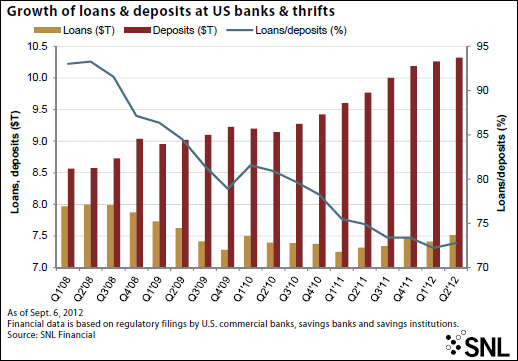
The above appear to have nothing to do with QE, yet, as we also know, it is difficult (extremely difficult to be fair) to distinguish between the forces which affect inflation. Thus, we cannot really infer by how much prices are affected by the QE or by the business cycle (i.e. the recession) in general. Thus, even as QE is initiated, bank loans are growing by much less than bank deposits (until 2012). Nevertheless, deposits and loans are again not telling us the whole story: why is inflation falling now and not in 2012 when the loans/deposits ratio reached its lower value? In 2013, Fed data show that loans have been increasing by more than deposits once again.
Source: The Wall Street Journal

The most obvious outcome of QE is an increase in bond and stock prices; which is what it should do, in order for stock and bond returns to lower and people start using their money for other investment plans. However, although there exists a ceiling over which bonds do not offer a good return to their owners, this does not exist in the stock market. Shares can, theoretically at least, increase forever (and the 1990's have shown such examples of rapid and strong growth).

As a commentator stated "QE is to stocks as booze is for self-confidence". Since people believe that QE is good for the economy, their expectations concerning growth are raised. Continuing on the chain of causality, when the economy grows, it is only rational that stock prices will rise. Thus, in order to make profits from that increase in stock market prices people pour more funds in the market to buy them while they are "cheap". In addition, an increase in the stock market indices, is an added incentive to invest in it, since returns are high and risk is relatively low. Then, as more money is poured in the stock market, prices rise, while consumption lags. As consumers focus more on the future than the present, it is obvious that short-term consumption will be decreased, an outcome of both the shifting of preferences and the increased returns of the stock market. Then if preferences are shifted from the present to the future, an increase in the stock market makes more people want to invest (long-term possibly?). Thus, consumption (i.e. money velocity and aggregate demand) is decreased while savings and stock market investment is increased. (Note that because of the recession, most investors are more risk-averse than what they were during the boom phase. Thus, they have an added incentive to invest in already established "blue chip" listed companies than riskier start-ups or smaller firms)

Summing up the chain of causality:
1. Government announces QE because the economy is doing bad, hoping that the banks will use that extra money to create additional credit.
2. If banks are not constrained by either the risk/reward trade-off or by any regulatory requirements, they lend and more credit creation results in increased inflation.
3. If not, then banks lend much less than the government hoped for.
4. Since investors are unaware of whether #2 or #3 hold, they choose to invest in the stock market, given that in any of the two cases growth is more than what they were currently experiencing and thus stock prices are expected to rise.
5. Thus market prices rise because more agents enter the market.
6. With prices rising, consumers who have been saving a much larger amount of their income than they were doing before because their time preferences have changed (i.e. they lower current consumption for future consumption), wish to increase the amount they will be able to use in the future by investing in the market (either directly or indirectly).
7. In addition, banks may use that extra QE "cash" to invest (speculate?) themselves in the stock market.
8. Thus, either by reducing credit or by reducing the amount spent, both aggregate demand and money velocity are reduced.
9. This leads to a slowing of inflation or to deflation.
10. Nevertheless, this situation will not necessarily perpetuate. As people see stock prices rise, they start selling off at one point and they choose to either invest in other products (i.e. lend if they are banks) or consume more (if they are individuals).

In short, QE might be deflationary if banks can and choose not to lend and stock prices rise; yet, it can also be inflationary if they do so. The deflationary effects are not permanent though: over time, and with the effect of QE declining, funds will flow from to the stock market to the real economy, boosting both consumption and money velocity. Overall, QE is not a bad strategy. Nevertheless, it does not always work like policymakers expected.

UPDATE: It looks like Paul Krugman had suggested that the QE2 success was in promoting growth via increasing consumption by raising stock prices. This appears to agree with point #10, where the  people start selling off to capitalize on their gains. Yet, if this increasing trend in stock prices persists, people, assisted by the uncertainty of the current era, will tend to defer consumption for the future, as long as they believe that they will be able to consume more then than now.

Tuesday, 23 April 2013

Economic Stories: The Tale of Austerity

Joe was an average man. Medium build, medium weight, dark hair and eyes. Not married yet, but wanting to settle down. He had a steady job and a steady, average salary; he was a government employee at the Ministry of Finance. Joe liked doing what everyone of us does: have a pint of beer with his friends, enjoy a good meal and watch some TV at night. In fact, Joe was a creature of habit: he did the same things, with the same people over and over again and he enjoyed it. He had strict habits with regards to his personal finances as well: he always saved 10% of his salary for a rainy day, had 30% of his salary go to the loan installment for the small apartment he had recently purchased  and used the rest for his everyday needs.

Most of Joe's friends were also in the government sector. Mark was working as a mailman and was a father of two sons, Andrew was a newly-wed accountant in the same department as Joe and Susan was a single mother, a school secretary. All of them usually met at Bob's Bar, just down the road from where they were staying and they were Bob's most faithful customers. It was because of them and others like them that Bob could earn a decent living; for he had his expenses as well. Every month Bob had to pay a large amount of money on electricity, water and licenses for running the place, not to mention the 2 waiters he employed. In addition, although he possessed a small brewery in the back of the bar and produced his own beer, he had to pay for the wheat, barley and hops required for production. 

On that particular day, Joe and the others were waiting for Andrew when they started talking about the rumours that had been raging in the news. 
"You know", said Mark, "if what they claim is true, then we might face a 15% cut in our salaries. Things will get harder you know."
"That is true, yet it is not us that I fear for. We are still going to get some salary, and with or without difficulty, we are going to have to adjust ourselves to that. It is those who depend on us, like Bob for example." commented Joe as he ordered four beers.
"I heard my boss talking today, and he said that if this is true, that our country has a lot of debt accumulated, it cannot be taken lightly. A pay cut will only be the tip of the iceberg" said a fearful Susan "Who knows what might happen after?"

At that point Andrew came in. As he took his seat, he looked more upset than usual, and his fast talking proved that. "It is true. The pay cut is official. As of this month we will receive 15% less money than we have. I know this for sure because this is why I've been late. We had a meeting concerning these developments" and with an exasperated voice added "darn! I was hoping to get that down-payment for our house in a few months. What am I going to do now? My wife will be so upset that we will not be able to finally get a house."

Bob was getting them the beers himself and had overheard most of Andrew's monologue. With a shrewd smile he tried to joke around the subject "Don't worry about it Andrew. You guys were already getting too much money anyhow. It's not like you are going to be left on the streets you know"
"Even if that's correct Bob" argued Joe "which I assure you that its not since we are all making average salaries here, and" pointing to Andrew "he can confirm that, that is not what you should be worried about. It is the fact that now, less money will be in the economy than before. Which means that as people get worried about their finances, they will spend less. Thus, the income of every other person in the economy will also fall"
"Nah, I don't understand these things anyhow. I just sell my beer and hope people are having a good time"
"That's the point Bob. There will be much less beer going around after this"
"But look around you. Everyone is having such a good time. Why should they need less beer? You need more beer when things go bad anyhow!" he chuckled.
"Oh well, I guess we 'll have to wait to see about that"
"You kids enjoy your beer and don't think about anything else. Things will be good" said Bob with a reassuring smile.

Everybody put in an effort to talk about something else during their time there. Andrew was trying not to think about his new house, Joe and Mark were forcing themselves to forget about the loan installments and Susan put on her best show, trying not to show her fear that she and her son would not have enough to get by after paying the rent and every other bill next month.

As expected, all four of them started defining expenses as necessary and not-necessary, just after the announcement, and even before the reduction in their salaries occurred. Who could blame them? Two of them had children to take care of, one had taken a loan to buy his apartment and another was about to get one in order to move in a new house with his wife. Things were beginning to appear bleaker for them and thus they had to act in order to reduce the effects the cut would have in their lives. Obviously, the regular visit to Bob's Bar was deemed unnecessary for them and thus they reduced it to scarce gatherings. They were actually proud they had arranged that their gatherings could take place at someone's house in order to reduce expenses even more.

After a long time without visiting, the four friends decided to have a gathering a Bob's Bar, for old times' sake. The bar, which was usually crowded at that time, was only half full. When the owner approached their table he seemed more worried than any time before. 
"What happened Bob?" asked Andrew "did people stop liking your beer?"
"Nah, that's not it" sighed Bob "It's just that people are now more...erm, stingy, with their money. People who used to come here and order 4 beers now only get two because they are trying to save up. And its not just my idea. Many have told me. People are afraid that there will be more cuts soon and they try to prepare themselves for that"
"You do remember that I happened to warn you about this don't you?"Joe said.
"Yeah, and I thought about that too. But it looks like you got trapped there as well. Your visits here much less than before and you always leave after a short while. What happened?"

All four looked at themselves and all around trying to find something to say. Mark was the first to break the awkward silence
"I guess we were also caught up in this Bob. It's not something we really wanted. We all had fun coming here. I guess.. I don't know. We just fear that things will get worse and had to pull back from our habits"
"All of us have families and loans and we have to put them first" added Susan"We were out of options"
"You know, I am not the only one saying this. John and Mary who own the bakery just across the street have been telling me that even their customers have been much less than usual. These cuts did more damage to us than they did to government employees!" said Bob, sitting down with them.
"Let me take a guess here Bob. Has your income been down by more than 15%?" asked Joe
"Of course! I have only been working at three quarters of what I used to do. Maybe 80% if I get lucky. And I feel bad about Jonathan, my waiter. I cannot afford to keep him employed full time so I had to make his employment part-time" Bob sighed. "He's a student and I really feel bad about this. But what could I do? Janice, the other waitress, has a family and she has to support them. Terrible situation really."

All 5 looked at each other in silence again. Bob couldn't keep down any more as he finally found someone he could talk to and started talking again:
"You know this goes back too. Remember Frank, the farmer I buy the barley for the beer from? Well he is facing difficulties too. His clients stop ordering like they used to. It seems like if you guys get a 15% reduction, I get a 25% one and poor Frank loses even more than that. Things are not going well"

Joe looked at him and said "Well, it does make sense. Think about it this way: if you are depending on us, and we decrease our beer-drinking, then you face a 20% decrease; imagine what will happen to Frank who is depending on you, and other breweries to sell his goods. When they do not see enough clients it is sure that they will reduce their orders. Most of the times, since I am guessing that all of you have some sort of inventory in both beers and their raw materials, the reduction in orders from Frank will be much higher than what your reduction in sales has been." and after pausing for a second he continued "Sorry to be the bearer of bad news but this situation will not end up very well you know. You are an honest tax-payer I assume right?"
"Of course" roared Bob "been paying my taxes honestly for the past 30 years"
"Well you know that our country gets the money it needs from two ways: taxes from honest tax-payers like you and by loans" said Joe and looked at him. "And the taxes they receive are linked to what you earn. Do you see where I am going with this?"
"Don't tell me that...!"
"Exactly. If you earn less, then the government earns less. Thus if the government earns less, it has to get a loan to keep on paying those in its payroll and cover other expenses it may have such as rent for buildings or electricity bills and such"
"But who lends the government that money?"
"Basically banks" answered Andrew "but it's not their money they are lending. It's money they have sitting around. That means my deposits and yours"

"But isn't that illegal?"Bob asked somehow startled by this discovery.
"Not really because, you see, banks are actually playing around with odds. They know that everybody will not come at the same time asking for their money, thus it is to their best interest to lend out as much as they can. Then they lend money to to regular people like our friend Joe here, who wanted to buy an apartment and use the rest of that to lend the state. Always at an interest though"
"Yes but doesn't that mean that banks can lend our country whatever it needs based on our savings? We are all patriots right? We can lend our country if it needs the money"
"But banks and legislation does not work that way. Banks cannot simply give your money to anyone looking for a loan. This would be a recipe for disaster. The banks simply lend the state under the cause that the state will pay back and that the banks will get some interest from it. They are only allowed to lend the state because the state is considered as impossible to run out of money. "

"Yet, they have to be careful"Joe said, taking on from Andrew,"if they reach a point where the state cannot repay them then they will lose all that money."
"So they wouldn't be able to give me my money if I asked for it right?"Bob finished the sentence.
"Exactly. And how can the state earn more money?"
"By taxes"Susan replied "Or by paying less money to the people it employs"
"But if you pay less money to the people you employ then you are doomed to get less money as taxes" Bob gasped."Then how can they do it?"

Susan smiled dryly "I think it's all about timing. Had they done this a few years ago then trouble may not have been so big. Unfortunately they didn't. We are humans, and as such we refrain from thinking about bad things until they have reached the point of no return. Now, the solution, although it appears to be extraordinary strange is to actually increase spending, hope that tourists come to leave their money here, or that foreigners will start demanding more of our domestic goods so we can export them and have money from abroad come in. Otherwise we are lost"

"Tourists and foreigners? How can we depend on other people to save our country then?" asked  Mark after finishing his beer. "Isn't it better to rely in our own powers?"
"Yes, he is right" Bob hurried to agree.
"It is obviously better if we can do it ourselves", Joe interrupted "but who would be willing to say that when the state has been over-spending, the correct way to counter that would be by increasing spending and providing initiatives for investments and consumption?"

"What do you mean spending and are incentives for investments and consumption Joe?" asked a confused Mark.
"Well, you see, spending is actually what the government does when it is building new roads or buildings or when it is paying us who are in its payroll. And then you will have to ask where the government expects to find that money aren't you? Well, here's the trick: all it has to do is to temporarily spend more money and simultaneously increase taxes a while."
"Increase taxes?" Bob looked at him startled "But then we wouldn't have anything!"
"Hold your horses Bob, and let me explain. Let's have an example. Suppose that you were earning 1,000 per month before the cuts in our salary happened. Now, with a 20% decrease you would be earning 800 right?"
"True. Go on."
"Then, if the state charges you a 25% tax you would have to pay 250 at first and just 200 afterwards, leaving you with 750 and 600 after tax proceeds respectively. Now, if the state instead of decreasing what it spent, had increased them by 10% we can easily say that your income would be, say, 5% higher right?"
"Yes..."
"So you would be earning 1,050 before tax. Now let's say that the state increases taxes by 5% to 30%. You would be earning 1,050, paying 315 for taxes and earning 735, a bit less than before, but still much more than what you are making now!"
"But wait a minute. This isn't good for the state. It increases its spending by 10% and then receives 5% more for it. It's still 5% down. How can it make up for that 5% loss?" argued Mark.
"Ah, but you were not paying attention to the mathematics! Do you remember how much money the government was making from Bob before?"
"Yes, 250"
"And how about now?"
"315"
"So how much more is the government making now?"
"That would be 65"
"You know, that 65 is a 26% increase from 250. Thus, using this little trick, the government is actually making much more than it is spending, which can be used to reduce its existing debt."

 "I have to two questions for you then. Why isn't it doing this all the time, and why isn't it doing this now?" Mark asked, after sipping another beer.
"Your first question is relatively simple: it cannot keep on doing this because, if everyone keeps getting more and more money then inflation will be huge. You know what inflation is right? It's when prices rise over time. Well this works as follows: if we all get 1,000, then the price of a beer is let's say 2. But if we suddenly all earn 2,000 then the price of the beer will rise to 4! You see where this is going right? If the government keeps raising our income then at a point you would need 1,000 to buy a bottle of beer, and yet that 1,000 will not essentially be worth more than the 2 we are paying now!"
"But the government will be taking some of that amount back!" said Mark
"True, but taxes cannot grow indefinitely. Imagine, who would be willing to work if the state takes 80% of your income? Not to mention that once you cannot pull that strategy off anymore, because you have reached a huge amount of taxation, your only other alternatives are to either keep on printing money and make a bottle of beer cost 100,000 or declare bankruptcy. In addition, this sort of strategy will not work indefinitely as it works just when interest rates are very low and not when the economy is doing well. Yet, the good thing about this strategy is that even though it may not increase consumption by that much (remember that in our example earlier we had gotten a 10% increase while Bob only got a 5% one?) it helps banks make loans because it increases people's savings. More savings mean that banks will be able to hand out more loans and thus increase consumption as well. Depending on the level of the interest rates, money in the economy can increase a lot."
"Oh, I see..."

"Then you ask why it is not doing this now. The reason for this is that to doing this requires money; something our country does not have. If a nation has its own sovereign currency then things are quite simpler. It can just print more money and try to implement the solution I described above (although I remind you this only works when the economy is doing really bad). But, if it does not have this opportunity, then the only alternative is to either increase taxes to get more money to repay its debts or to decrease the money it is paying. The first solution is relatively easier on the taxpayers but unfortunately politicians' views do not make this consistent. For example, if the president wants to look good for re-election, the government can just announce that tax rates will be reduced. This means that we cannot be sure that such policies will succeed. Yet, as you may notice the same holds for spending cuts as well. But, what makes the spending cuts look more favourable is that they have immediate effects in reducing government spending, while tax increases may be delay the influx of money. Unfortunately, as our friend Bob here has witnessed, these cuts also have a significant effect on everyone else in the economy, meaning less money for them too."

"Then why is our country not getting more money?"asked an eager Bob
"Remember what we talked about banks and lending a while ago?" replied Andrew. "Well, banks and other institutions only lend the state money when they believe that it is creditworthy and that it will repay them. Just like you and I would not be willing to lend someone 1,000 if we thought he wasn't good for them or just like the bank does when it gives money to Joe here in order to buy a house. So, if the banks do not think that the state will be able to repay them they choose not to lend it. The problem is that we are all as good as our state."
"Meaning that a single company cannot possibly be doing great if it is based in a country that is doing bad" continued Stacy. "Then, after the country does not look good, banks feel the effect fast: due to the cuts people like you and me do not earn as much as we did before and we start not being able to repay our loans. This also happens when times are good but can you imagine what it means when 10 or 15% of the bank's customers stop repaying their loans? The banks do not have enough money and they are close to failing as well."

"You see the banks are caught between a rock and a hard place: they either lend the state money, which they are afraid they will lose or they do not and watch their clients fall back on their loan installments"

"You remember a few years ago when things were going great?" Andrew continued "Well, everybody was seeing their businesses flourish, receiving high income and unemployment was really low. Everybody was spending like there was no tomorrow, and I do include ourselves in that. Banks encouraged that behaviour as well: account overdrafts, too much lending and at good interest rates, every person had to spend more, more and more. Yet, after the wheels turn and we are at the low part of the circle, what happens? We panic because we were not wise enough to think that this could not go on forever. Even those who were wise enough to put some money aside are still not feeling too good about this. Too much prosperity causes people not to think. Thus, our government kept spending more and more."and after pausing he added "but this is not the time or place for reminiscing. I just hope that this cut will be the final one, because as people will be financially wrecked if this continues. You can see how things will work out if we get another 10% decrease right Bob?"
"God knows I 'll have to fire a waiter for sure to keep up; and I am not even sure I will be able to continue having the bar. I hope those who run the country will be wise enough to wise know what they are doing to us..."

"I 'll drink to that hope Bob" said Joe raising his glass

Wednesday, 19 September 2012

What is GDP?

After several discussions and arguments recently, I discovered that although most people are bombarded with statements of the "GDP has retracted by 1%" or "the banks' assets are greater than the nation's GDP" kind, many do not have a clear image of what GDP is, or what it counts. To begin with, GDP is short for Gross Domestic Product, was developed by economist Simon Kouznets in a UN report in 1934, and has been the main measure of a country's economy since the Bretton Woods conference in 1944.

GDP is calculated as follows (based on the expenditure method, meaning that every good or service has a price and is therefore measurable):

GDP = Private Consumption (C) + Gross Investment (I) + Government Spending (G) + (Exports - Imports)

Now let's see what the components of GDP are (most of the definitions used here are from Wikipedia):
1. Private Consumption falls under one of the following categories: durable goods, non-durable goods, and services. Examples include food, rent, jewelry, gasoline, and medical expenses but do not include the purchase of new housing.
2. Investment includes, for instance, business investment in equipment, but does not include exchanges of existing assets. Examples include construction of a new mine, purchase of software, or purchase of machinery and equipment for a factory. Spending by households (not government) on new houses is also included in Investment. In lieu of the common use of investment, i.e. purchase of financial products, these are not considered as investment but as savings.
3. Government Spending is the sum of government expenditures on final goods and services. It includes salaries of public servants, purchase of weapons for the military, and any investment expenditure by a government. It does not include any transfer payments, such as social security or unemployment benefits.
4. Exports are gross exports within the year measured and Imports are the gross imports within the same year.

What some people believe is that GDP is some sort of state income, which is distributed to people in some way. This is far from true as GDP is merely a rough measure of the economy's ability to produce and not any sort of income, although it is measured on an annual basis. As economist note, the main driving force of the above equation is Private Consumption (C). If for example, due to a prolonged crisis, people are afraid to go out and shop, since they believe that they will need the money later on, or if their income has fallen, C will go down and drag GDP will it. Similarly, in a crisis, Investment usually falls, as less people are likely to buy new houses and less firms invest in new equipment. Imports usually fall as well since people, faced with less purchasing power than before due to their unwillingness to spend, or lack of income, are less eager to purchase foreign goods.

The only part of the equation which is really a matter of government is G (Government Spending). That is the reason why in most nations where budget cuts are implemented, in the form of wage reductions, GDP falls. However, as one may observe, transfers from the government to the people (e.g. social benefits, pensions) are not included in the definition for government spending. Nevertheless, this does not mean that it these will not affect GDP, since a reduction in pensions, such as the one currently occurring in Greece, affects GDP indirectly, as pensioners with fewer money will spend less and C will drop.

As a matter of fact, GDP is neither a measure of welfare as it can only measure what is measurable and lacks an ability to quantify quality. Although sometimes it is used as such, even Kuznets himself has separated the ability of GDP to measure an economy's production and its use as a measure of welfare:
"Distinctions must be kept in mind between quantity and quality of growth, between costs and returns, and between the short and long run. Goals for more growth should specify more growth of what and for what." (Kuznets, 1962)