Showing posts with label Deflation. Show all posts

Saturday, 29 March 2014

Understanding ECB Comments: How Central Bankers (Should) Think

Central Banking should come with a warning: Anything you do, will be the cause of major criticism. When I usually see reactions on comments by ECB officials, it usually of the "they know nothing/understand nothing kind". The job is not easier for the US Federal Reserve either; it has a long been a while since I've heard no reactions to policy changes. When the Fed initiated QE, Cassandras said it would drive inflation rates sky high; it didn't. When tapering started, Cassandras (different ones I hope!) complained that it would have a severe effect on the economy; still nothing. Yet, while the usual aphorisms on Central Bank statements and actions have been going around for a while, what is usually the problem is that do not see things from their point of view: that of a person/institution who have a great effect on the economy.

Whether we like to admit it or not, Central Banks do have a lot on their minds. When times are good they have to be careful to prevent bubbles from forming and when times are bad they have to act in order to make them better and be careful not to make them worse. A clear example of the Central Banker's power and the strong grip he or she has on the economy, are reactions to verbal statements. When Alan Greenspan spoke of irrational exuberance for the first time in 1996, markets tumbled; when Mario Draghi gave the "anything it takes to support the euro" speech in August 2012, this is how the Forex Market reacted:
It is really not a question whether the Central Bank has an effect on the economy, it's about how big it is and the answer is that it's huge. Even if policies do not drastically change market conditions in the short-run  (they usually change them in the medium-run), comments and speeches do have a stronger effect since they affect investor confidence. This is why Central Bankers are very careful of what they say and this is why they should (and do) never speak of bad news.

As we know, the ECB, through its Board, has denied that deflation is a problem. Jens Weidmann has stated that the drop in inflation is nothing but temporal. Whether he actually believes that or not, is something we will never find out. Now, dear reader, imagine what would happen if the ECB or it's board began to talk of deflation being a problem in the Eurozone. As a first reaction, markets would drop and the euro would rise making exports harder. Investment would gradually be reduced and the whole economy would enter a vicious cycle of decreased consumption, drops in wages and less investment. More so, the whole procedure could actually be initiated just by the Central Banker admitting that deflation exists, as most people "know" that deflation is a problem.

Then, with regards to ECB reactions and comments, what would the reader, an ordinary citizen of the Eurozone prefer: a Central Banker denying the existence of deflation thus allowing the markets to continue without paying attention to what he says, or a Central Banker admitting or warning about the dangers of the current deflation and forcing a deflationary cycle on the economy? If you ask me, the former is much better than the latter, if only for employment reasons.

Who knows: maybe the ECB does know something more than we do when it comes to deflation. If not, then measures to counter deflation can be expected at the next meeting. Still, too much truth can actually harm the economy at times. In fact, I would even go as far as claiming that a Central Banker should act like Titanic's orchestra: even when the ship is shipping (s)he should calm everyone down and tell them that it's all going to be all right.

Tuesday, 25 March 2014

Real Life Effects of Deflation

Deflation is defined as the decrease in the level of prices:
As economic theory dictates, the causes are a fall in the money supply, in addition to (in the short-run) a fall in wages and salaries.
Compensation of Employees (aggregate) Source: ECB
Just like any other economic happening, there are those who claim that any type of deflation is disastrous and should be avoided at all cost while others believe that it is wonderful (since it lowers prices) and we should embrace it. As usual though, they are both wrong. The answer, simply put, is that it depends on the severity, duration and the overall state of the economy at the time when deflation is manifested. What follows are three points on the effects of the current rates of deflation on the real economy of the Eurozone.

1. As long as deflation is not severe and not persistent then the effects on consumption are small.
There is no person who would be willing to forgo a month's consumption of food just because it would get cheaper next month. Parents do not tell their children "you will not attend university now because it will be 2% cheaper next year". We have some basic needs which we will continue to satisfy as long as the deflation rate is not so severe so that an apple will be worth 50% less tomorrow than it does today. Prices fluctuate every day and a deviation of 1-2% per annum for a short period of time (e.g. 1-2 years until an economy gets back on track) does not really change our incentives for non-durable consumption.

Nevertheless, there is an effect on what we call durable goods (e.g. houses, automobiles, etc) but these are just a fraction of what we purchase (approximately 1/3 of our purchases are of durable goods). Even though 1/3 may appear to be large, remember that the reduction in price is more severe in some sectors than in others; automobile prices have not dropped by much (if any) while real estate prices have sunk compared to 2006. In addition, when a person has lower income than before, the first thing he stops purchasing is durable goods, not everything else. Thus, the drop in durable goods consumption can be seen as a natural reaction to the overall drop in confidence, investment and subsequently wages. Still, if deflation persists and becomes even higher in 2014-2015, a large drop in the consumption of durable goods might signify a reduction in investment, resulting in more wage losses and thus creating a vicious cycle.

2. Deflation has a stronger effect when households and non-financial corporations are heavily indebted.
The reason is simple: given that aggregate wages have dropped, prices also drop, triggering another round of wage drop and so on. Although this is an issue for durable consumption as discussed above, it is also a problem when it comes to debt as it takes more money in real terms to repay the amount owed. Thus, if in a country most of its citizens are over-indebted (see all periphery countries) deflation is bad because it makes repaying that debt even harder. Not only that, but it also creates a "death spiral": the more people try to repay their loans, the less they consume and thus prices and wages fall even further making the real amount they owe even higher. This is exactly what happened with austerity policies: less spending means less consumption thus less income for the state, leading to higher deficits and debt and forcing new austerity measures once again.

3. Deflation equals lower prices but it does not mean it's good for us.
This is one of the most common fallacies ever: if prices fall then it is great. It is most of the times but it always depends on the reason prices fall. If they do because raw material are cheaper or because of a productivity rise then great. But if they happen because people have less money than before then your purchasing power is most likely hurt in the short run (prices usually do not respond fast to shifts in consumption, even if those are permanent). In addition, if we shift from inflation expectations to deflation expectations then what we will see is less and less consumption, leading to lower wages and then lower production. This is the time when deflation gets serious as, with higher rates, we can actually see the economy reach a halt.

What should be noted is that the severity of deflation has a direct effect on the magnitude of the above. If deflation is at a very moderate rate of 1% per annum for a year or so, then most likely its effects on consumption and loan repayment will be very small; more or less of the same extent of what happens in the economy during every other recession. Only if deflation persists, becomes larger and is embedded in expectations will we need to seriously start about the future of the economy.

In order not to come to the worrying part though, policy (here's looking at you ECB) should be re-addressed so that confidence in the region is re-instated. Otherwise, we will soon see if markets can adjust fast enough not to cause any major casualties.

Friday, 28 February 2014

European Policy at the ZLB

The zero lower bound (ZLB) has moved from a theoretical possibility in the 1980's to a modus vivendi in the 1990's Japan, the late 2000's US and the 2010's Eurozone. The ZLB does not mean that the interest rate is necessarily at zero, but it does mean that it has reached a low beyond which it cannot fall. The problem with this situation is that monetary policy, as is commonly practiced by manipulation of the interest rate, becomes inefficient as, by definition, the interest rate cannot fall any further to accommodate for declining demand. This situation challenges policies and ideas in the economics profession as, over the last 50 years and with the prevalence of monetarism as the world's leading school of thought, economists believed that just controlling the interest rate could cure every recession possible.

It does not; the problem with the ZLB is that, just like any other activity which involves agents and forecasts, it becomes embedded in expectations. That is, if people see the interest rates not being able to fall further, they believe that the situation will be continued in the near future, which means that base their decisions on that, making the ZLB a self-fulfilling prophecy. The issue here is that the ZLB does not just mean that interest rates are low; it comes with an additional problem the one of dis-inflation or, in extreme cases, the one of deflation (Frances Coppola has an excellent article on why deflation is something we should worry about).

In addition, the ZLB does not come alone, but brings its friends along with it: low interest rates mean that even though most banks can they are unwilling to lend and, as if that wasn't enough, most businesses are unwilling to borrow. Even if the rates are low, people are still unwilling to spend due to the simple reason that they expect the situation to remain unchanged in the future; with spending being low and the overall money supply either contracting or just slightly increasing why should they assume the risks? This is the situation we have been experiencing in the Eurozone over the past year (the large change in M1 is just an outcome of the shift from long-term deposits to overnight deposits):
The only remedy for the situation is what has been known as unconventional policies: QE, OMT and so on, yet these cannot be applied in the Eurozone at the moment. In addition, increased government spending is a midsummer night's dream in most countries, which are tormented by bail-out agreements forcing tight budgets, meaning that it's up to the ECB: either it does something in the next meeting, by which I mean a large boost package, or the situation will remain as terrible and uncertain as it is now.

And remember, uncertainty is always worse than bad news.

Tuesday, 25 February 2014

Deflation, Inflation and Expectations

That dis-inflationary pressures have been observed in the Eurozone over the past year is nothing new. They have been so common elsewhere in the world (for example Japan or the US) that news of higher inflation are now being heralded as the dawn of a new, happier era (even though some are more exaggerated than other). Even though deflation has expanded to other measures of prices, the main focus is that we are moving towards higher inflation, with deflation no longer being an issue of concern; at least that's what the ECB is saying.

Trouble is, almost no-one sees it the same way. Tim Hartford, for example, notes that the persistence of low inflation may mean trouble for borrowers, leading to more bankruptcy risk and, God forbid, more non-performing loans to banks. In addition, what I fear most is that low inflation, just like high one, can be embedded in expectations and remain for much longer than we would normally expect, with all the known consequences. This is not just a doomsday scenario; expectations matter much more than we most of the time think when it comes to policy.

A simple example of how much expectations matter is what is usually referred to as reflexivity, a theory that simply put, means that we are in fact creating a part of the world we are trying to forecast; a very similar notion to what has been known as the Lucas Critique in economics. As the world of economics is not governed by the hard rules of physics, what people believe about the future will in fact affect it. In addition, the only way they can make an educated guess on the future is by viewing current events and basing their judgement on experience, meaning that in a way, the future affects the past as well (to be more precise, expectations about the future affect what we do now). 

This is what has been going on at the moment: people see low inflation and have every right to expect low inflation since no measures have been taken against it (the rate cut in late 2013 was really nothing special). It can be seen in the consumer expectations:
This is led by something more than just expectations about the inflation rate. Peter Praet, (aka Captain Obvious) noted "Weak demand and high unemployment could also be playing a role". You don't say! This is exactly how inflation falls: lower supply of loans from banks means lower demand (for the monetarists out there this means reduced money velocity ); adding high unemployment to that equation means even lower demand. This is not a matter of what affects what; it's a matter of everything affecting everything as, whether policymakers like it or not, people are the economy. It is only if we can convince them that are going to get better that they will.

Here is where the ECB is wrong: people, even subconsciously, trust what you do and not what you claim. As Lech Walesa once said "The supply of words in the world market is plentiful but the demand is falling". Saying we are not in danger from deflation or dis-inflation does not change anything, unless you get people to believe it. And if they are rational (and on average they are as they can see what goes on in the real world), then they won't buy it that easily.

Tuesday, 11 June 2013

A (Small) Treatise on Inflation

Imagine, dear reader, that you are managing a company dealing in some trade. What you basically do is buy a good one day and then sell it a few days or weeks later. If one asked you the reasons for doing this, the answer would be obvious: profit, of course. Any firm wishing to stay afloat should sell higher than it buys, or at least intend to do so. Now, imagine if someone told you that we would have deflation in the economy, meaning that if you buy the good at €10 you would have to sell it at €9 or less because money would be scarcer and each unit of money would be worth more. Would you be willing to put your business and yourself through the trouble of buying and selling, if, at the end of the day you would end up with a loss? Doubtful.*

The situation presented above is the main reason why inflation is useful: it presents the opportunity for investment and growth because the incentive for profit-making exists. Deflation, on the other hand provides a disincentive for investment. This is not to say that all inflation is good. At times, an increase in the level of prices can prove disastrous for the economy, as for example in the cases of hyperinflation or stagflation. What follows is an attempt to explain what causes inflation and how at times of distress, having the notion that inflation will prevail assists in economic growth.

Milton Friedman became famous by promoting that "inflation is everywhere and always a monetary phenomenon". Although his aphorism may hold for hyperinflation up to a point (although hyperinflation and money supply are closed linked, hyperinflation cannot occur without the initial circumstances of a productivity shock occurring) and, as some studies claim, in the long-run, the short- and medium-term inflation is not fully explained by just the increase or the stability of the money supply. First of all, we need to understand that in order for the level of prices to increase, we need to experience a surge in demand, specifically in aggregate demand. The rationale behind this idea is that if we only witness an increase in the demand for good A while the one for good B is decreased then, when the basket of goods is calculated, they may cancel each other out and we will thus witness no alteration in the level of prices.

What an increase in the supply of money does is essentially make people richer in nominal terms. Thus, if people are richer they should spend more, at least according to theory; this will in its turn increase demand and make prices rise. The same would occur when additional credit is created via the banking sector. Both these actions make people richer, again in nominal terms, which means that they will spend more and thus we can experience an increase in the price level. 

The key word in the above paragraph is the word "spend". While in the long-run prices will more or less adjust themselves based on the money supply as the Quantity Theory of Money asserts (although this does not really hold) in the short run the consumer has to spend that money in order for the change in the level of prices to occur. If the money remains sealed in the banks and is not used for any productive means then no change in demand will occur. 

In economics, supply and demand are the factors which mostly affect the (temporary) equilibrium thus we should first focus on factors which shift demand, the first of which is consumption. Consumption is based on income, which in its turn is based on money and credit (and aggregate demand in itself). Most importantly, in the short run, consumption depends on the rate of time preference which dictates the propensity to save, subsequently affecting the velocity and quantity of money in the economy. We have seen how money and credit affect consumption (and effectively demand) in the previous paragraph; what remains is explaining how the propensity to save does it. Again it is relatively simple: if you save more, you consume less, thus aggregate demand falls and prices fall as well (if more money is saved than before, then both the velocity and the quantity of money circulating is decreased). Even if your income is higher than before or if you have access to more money (e.g. helicopter drops) or more credit than before, it does not really matter if you spend less than you did. Current prices are not formed by the potential for spending but from actual spending (although the argument that prices also reflect future expectations of inflation can be made, I seriously doubt this. Only current investment is based on expectations). What affects the rate of savings is peoples' perception of the future and their understanding of the current situation; this leads to higher savings rates during distress periods because uncertainty both about the present and the future is higher (for details on the subject read this).**

Another of the issues which affects consumption is obviously income. Income is nevertheless linked to consumption and inflation. When experiencing inflation, workers see their employers receive higher profits and thus have the incentive to bargain for higher wages. This in its turn increases consumption and demand, which re-enforces the inflationary cycle of wages and prices. Thus, when the propensity to save is increased, it opposite can be observed, i.e. both aggregate demand and prices fall. In addition, this means that profits for the employer will fall and that the employer will be forced to let some employees go in order to survive.

This brings to the surface another factor which affects inflation, albeit indirectly: the unemployment rate. When unemployment is high, demand is lower than before (since on aggregate people have less income than before) which means that prices should fall. Conversely, a decrease in the rate of unemployment indicates that people will have more money to spend (since aggregate income will rise), thus demand will rise and prices will rise in response.

Moving from the causes which affect demand, we take a look at the forces which account for aggregate supply. This can affect the level of prices in two distinct ways: either by increased supply costs or by a shortage in supply, both of which increase the level of prices. A shortage in supply is much more difficult to occur in times of distress than in times of boom, unless the good in question is a natural resource and we witnessing its depletion. Thus, when demand is on the rise, it will be more difficult for supply to keep up with it thus making prices rise (this, of course, depends on how fast demand in growing and how fast the economy can adapt to growing demand).

The next question would then be what affects supply costs. The answer is again is quite simple if we consider the costs a firm has to face: wages, raw materials, rent, new equipment. Consequently, a rise in any of these might cause the level of prices to increase (with the possible exception of new equipment which is most likely been accounted for in the pricing equation). Economists might argue that a change in the price of a good/service might affect its demand. This is true although up to a point. If a firm sells approximately 2 million goods per year and faces increased costs of 200,000, it may have to either increase its price by €0.10 to meet its targets or lay off some employees or reduce their salaries. Although the first option may (in theory) appear to be of unsure result due to price elasticities, in real life, the change in demand as a response to the price of a good depends on the existing price. For example, demand for automobiles will not really change if a new one costs €5001 instead of €5000. Conversely, if the price of a pencil is increased to €0.20 from €0.10 people might choose to buy something else, although it may again not matter as much as we think it does. (Yes I do understand elasticities. Yet, calculating elasticities is not as easy as it appears in real life; in fact, it is nothing more than a mere estimation)

Returning to the discussion of supply costs, an increase in wages, as we have already seen before, leads to an increase in the level of prices, both because of increased consumption as well as increased costs (this is sometimes called the wage spiral). To sum up supply costs, increases in the prices of raw materials, cause the price of the produced goods to increase. These may include both internationally set prices (e.g. oil or gold) or they may include goods whose is price is determined  by their sellers and buyers. Nevertheless, the increase in the price of raw materials, as well as the increase in finished goods can also be attributed to something which has been largely ignored by the academic society: a deliberate increase in the profit margin.

For example, a firm may choose to mark-up its products at a costs+30% margin. This would mean that if a product costs €10, the firm will sell it for €13. Suppose now, that the firm can change its profit margin by a small amount and this will have no important change in the demand for the good. For example, if the firm decides to sell the good for €13.5, thus earning a margin of 35%, it is quite doubtful whether the fall in demand would cancel out the increased profits. Thus, it is to the firm's best interests to raise the price, even if it means sacrificing some customers. Although some might argue that prices are at equilibrium and the firm will choose to increase prices only if demand is increased, this may occur also in the case where demand is lower. The supplier may assume that since demand is low, the price of the good for sale can be increased, since this will not alter demand by much (and may be, on occasion, be correct). Thus, increasing the margin will mean that the level of prices will be increased as it will cost more to buy the good now.

What should be noted is that if this happens in the first link of a supply chain, it is then almost impossible to realize what caused the increase. For example, as demand increases oil prices, it is more than rational to assume that the production prices in the economy will be increased as well, causing an increase in the level of prices. Yet, for goods which are not publicly traded like oil, it is much more difficult to distinguish the cause of the increase. For example, an increase in the price of a specific beer brand might be due to bad weather and increased wheat and barley prices, higher wages, higher transportation costs, higher electricity costs or just because the retailer or the wholesaler or the producer wishes to charge more.

It is infeasible to distinguish what causes prices to increase and by what extent, yet the reduction in prices can be focused just on lower demand or a deliberate shortage of money in the economy. As the latter is not a case which has taken place anywhere, and is doubtful that it will ever appear, focus should be shifted to the first case. Regressing to the example in the first paragraph, it makes it easier to see why businessmen wish for inflation when it comes to investing their money in a business. Inflation means that demand for goods will be higher in the future, which makes potential profits visible. Thus, this gives them an incentive to invest and, in their turn, boost the rise in demand by decreasing unemployment.

What has been described in the previous paragraph is nothing more than what is called inflation expectations. If investors believe that demand will rise in the economy, then it makes sense for them to invest in something which will yield them some profit from this increase. Elaborating on the point made above, when expectations of inflation are high, people wish to use the money they have saved in the economy to invest in goods. Nevertheless, the fact that expectations are high before the actual observation helps to smooth its movement by spreading inflation evenly throughout the period and not by having spikes every time inflation is announced. Thus, as expectations rise, investment also rises (which is what makes credible QE attempts successful in the longer run as shown here). In addition, what is also increased is consumption and inflation in the future. When investment is higher, it means that unemployment will fall and income will rise. This, as we have seen before, means that the level of prices will rise in the periods to come. Thus, although inflation is not currently increased by expectations, future inflation is.

Summing up, what affects the level of prices is basically everything which  affects aggregate supply and aggregate demand in the economy. What has not been mentioned yet is something which affects demand for goods directly, but is an issue which will trouble us more in the future: population. This issue had not traditionally received great attention by economists because this was something no-one could envision 50 or 100 years ago. In fact, the opposite was considered a problem, as Malthus had argued. This appears to no longer be the issue. Nevertheless, as population appears to be reducing, the interesting question of what will happen once less people are here to consume arises.

If, in any given period, we expect to have lower population than before, it means that we either have to face permanent deflation, if total money and income are the same, or a permanently increased level of money and public spending. The most known alternative for this, migration, will be to be infeasible in the case of world population decline. Just like Japan's recent experience has pointed out, in the case of a prolonged recession, it is much easier for fertility rates to fall. This will in its turn make aggregate demand fall even further, which would create further distress thus creating a vicious circle. Economic distress and signs of decay lead a country to population decline; while economic prosperity may also lead it down the same path (growth in income usually makes people have less children than before). The solution would be simple: incentives for people who have children could greatly benefit the economy as a whole. This would also increase demand and perspectives as with more people to consume in the future inflation would undoubtedly be on the rise.

Concluding, although inflation is not an issue clearly explained by economists, it is nothing more than a case of supply and demand. If we can manage to distinguish the factors which affect them, no matter how difficult it may be, then it will be easy enough to distinguish between what affects inflation and what does not. Furthermore, we have to understand that inflation is not the peril we have grown up to believe. Without inflation, no rational investor or businessman would bother to invest, and economic growth as we understand it would simply be brought to a halt.

*First of all, this is an accounting loss as accounting does not take into consideration the real value of money. Nevertheless, this could potentially be an economic loss as well since the real rate money does not necessarily need to be greater than 0 even in a deflation. In addition, precise ex ante knowledge of what the real rate will be is impossible.

** Readers may question whether interest rates affect inflation. Theoretically, they should affect it as higher rates create more incentive for savings. Nevertheless, it is not that rates are high or low to induce people to save or invest. They fluctuate because the business cycle fluctuates and not because of manipulation. Thus, interest rates are low when the propensity to save is higher (i.e. when demand for saving is high) and high when the propensity to save is lower (i.e. when demand for saving is low).

Friday, 31 May 2013

Is QE deflationary? A Conjecture

On Monday, a very interesting post came to my attention: Frances Coppola commented that the possibility of Quantitative Easing (QE - the process by which the Central Bank buys back government bonds and gives "cash" back to the banks so that they could increase lending) being deflationary instead of inflationary, as theory expects it to be, is large; and the data seem to agree with her (for her excellent points have a look here). This discussion, spurred spin-off blog where an abundance of sources on the issue can be found. As in any discussion, supporters of both views exist. An example would be Pawel Morski, who provides a very interesting graph and comments that QE is nothing but the only option, and this is better than doing nothing at all.

Although QE may be better than sitting idly around, the question of it being either inflationary or deflationary still exists. Thus, the question now becomes how QE can affect the level of prices. As the quantity theory of money states, MV=PQ. Given that we want to observe the effects QE has on the price level, we want to check how it affects money, velocity and output (M,V and Q respectively). The theoretically obvious effect of QE is on the money supply. If banks have more cash, then they would be inclined to lend more money, thus increasing money supply.

The above would hold if and only if the banks decide to increase their lending. If the banks are constrained by their regulatory needs or choose not to give out loans for any other reason, having more cash will not assist them in increasing spending (for further details on how this works I refer the reader to a previous post). During the QE phase, banks essentially swapped a 0% risk-weighted asset (bonds) with another 0% risk-weighted asset (cash), thus their risk-weighted assets (RWA) have not changed; yet, RWA will be increased if banks lend out any money (all personal/mortgage/corporate loans have a risk weight of at least 20%).

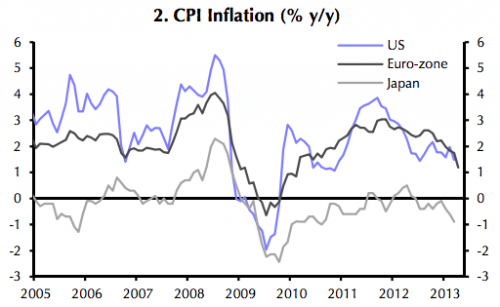
Nevertheless, the money supply indices (both credit and monetary base) show an increasing trend even after QE, while inflation appears to decrease:

Source: FT Alphaville
A careful look at the data provided by the Federal Reserve shows that the increase in money supply is losing speed: In the first 4 months of 2012 it was 1.18%; in the first 4 months of 2013 it was 0.7% (note: the Fed itself states that the increase was 2.9%. After re-doing the calculations the above percentages came up). Thus, money creation is slowing down, which forces inflation to fall. The fact that the monetary base in increasing is basically pittance given the amount of money in the system, although if it was reduced then inflation would drop even further. Yet, are credit/money creation and unwilling banks the whole story or is there something more to QE?

Enter velocity of money. According to theory, money velocity depends on an additional 6 factors, of which the quantity of money, the propensity to consume and liquidity preferences (with the 2nd and 3rd factors being essentially the same) are the most volatile. As we have seen in the previous paragraph, QE does not affect the quantity of money unless new credit is created by the banks (and the slow increase is shown in the above graphs). As a consequence, all we are left with is the marginal propensity to consume, or basically how much of our income we choose to save or consume. It is a well-known fact that people spend more (and save less) in times of boom and spend less (thus saving more) in times of recession/depression. Thus, at times of depression it is only logical that, even if the money supply is constant, the velocity of money is reduced and thus the price level is reduced.

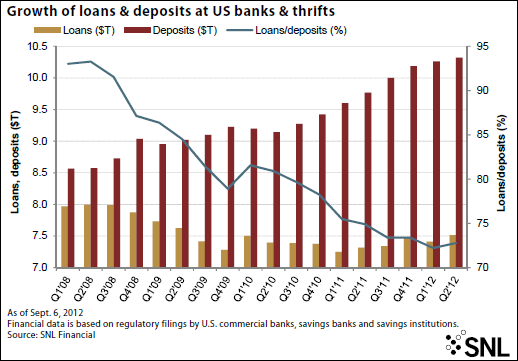
The above appear to have nothing to do with QE, yet, as we also know, it is difficult (extremely difficult to be fair) to distinguish between the forces which affect inflation. Thus, we cannot really infer by how much prices are affected by the QE or by the business cycle (i.e. the recession) in general. Thus, even as QE is initiated, bank loans are growing by much less than bank deposits (until 2012). Nevertheless, deposits and loans are again not telling us the whole story: why is inflation falling now and not in 2012 when the loans/deposits ratio reached its lower value? In 2013, Fed data show that loans have been increasing by more than deposits once again.
Source: The Wall Street Journal

The most obvious outcome of QE is an increase in bond and stock prices; which is what it should do, in order for stock and bond returns to lower and people start using their money for other investment plans. However, although there exists a ceiling over which bonds do not offer a good return to their owners, this does not exist in the stock market. Shares can, theoretically at least, increase forever (and the 1990's have shown such examples of rapid and strong growth).

As a commentator stated "QE is to stocks as booze is for self-confidence". Since people believe that QE is good for the economy, their expectations concerning growth are raised. Continuing on the chain of causality, when the economy grows, it is only rational that stock prices will rise. Thus, in order to make profits from that increase in stock market prices people pour more funds in the market to buy them while they are "cheap". In addition, an increase in the stock market indices, is an added incentive to invest in it, since returns are high and risk is relatively low. Then, as more money is poured in the stock market, prices rise, while consumption lags. As consumers focus more on the future than the present, it is obvious that short-term consumption will be decreased, an outcome of both the shifting of preferences and the increased returns of the stock market. Then if preferences are shifted from the present to the future, an increase in the stock market makes more people want to invest (long-term possibly?). Thus, consumption (i.e. money velocity and aggregate demand) is decreased while savings and stock market investment is increased. (Note that because of the recession, most investors are more risk-averse than what they were during the boom phase. Thus, they have an added incentive to invest in already established "blue chip" listed companies than riskier start-ups or smaller firms)

Summing up the chain of causality:
1. Government announces QE because the economy is doing bad, hoping that the banks will use that extra money to create additional credit.
2. If banks are not constrained by either the risk/reward trade-off or by any regulatory requirements, they lend and more credit creation results in increased inflation.
3. If not, then banks lend much less than the government hoped for.
4. Since investors are unaware of whether #2 or #3 hold, they choose to invest in the stock market, given that in any of the two cases growth is more than what they were currently experiencing and thus stock prices are expected to rise.
5. Thus market prices rise because more agents enter the market.
6. With prices rising, consumers who have been saving a much larger amount of their income than they were doing before because their time preferences have changed (i.e. they lower current consumption for future consumption), wish to increase the amount they will be able to use in the future by investing in the market (either directly or indirectly).
7. In addition, banks may use that extra QE "cash" to invest (speculate?) themselves in the stock market.
8. Thus, either by reducing credit or by reducing the amount spent, both aggregate demand and money velocity are reduced.
9. This leads to a slowing of inflation or to deflation.
10. Nevertheless, this situation will not necessarily perpetuate. As people see stock prices rise, they start selling off at one point and they choose to either invest in other products (i.e. lend if they are banks) or consume more (if they are individuals).

In short, QE might be deflationary if banks can and choose not to lend and stock prices rise; yet, it can also be inflationary if they do so. The deflationary effects are not permanent though: over time, and with the effect of QE declining, funds will flow from to the stock market to the real economy, boosting both consumption and money velocity. Overall, QE is not a bad strategy. Nevertheless, it does not always work like policymakers expected.

UPDATE: It looks like Paul Krugman had suggested that the QE2 success was in promoting growth via increasing consumption by raising stock prices. This appears to agree with point #10, where the  people start selling off to capitalize on their gains. Yet, if this increasing trend in stock prices persists, people, assisted by the uncertainty of the current era, will tend to defer consumption for the future, as long as they believe that they will be able to consume more then than now.