Showing posts with label haircut. Show all posts

Friday, 27 December 2013

New Year's Change of Mind: Was the Cyprus Haircut more equal than we think?

2013's most startling development was probably the Cyprus deposit haircut, an unprecedented event which caused numerous reactions around the world. In March, the Eurogroup came up with Plan A, i.e. to haircut all existing depositors, regardless of institution or the amount of money in their accounts, at a flat rate of 6.75%; a decision which the Cypriot Parliament rejected. After 2 long weeks of bank "holidays" and intense negotiations, the plan changed to the dissolution of Laiki Bank and the haircut of all deposits above 100,000 euros in the Bank of Cyprus (the final amount of the unsecured deposit haircut was 47.5% as agreed in late July).

My reaction to the first plan was that it was unfair: a person with 10,000 in his bank account would suffer more than a person with €10 million in his after a 6.75% cut. The second plan still seemed unfair but had the advantage that depositors in other banks would not be hurt and that the "little guy" would remain an unscathed. Obviously, the "big boys" still get hurt, which means less investment and less growth, equaling more unemployment. Yet, there is actually much more good in this than was first considered.

First of all, the ones which got hurt more in the crisis were not CEO's or other businessmen; it was paid employees. Have a look at the following table compiled by the Economic Policy Institute:
As the reader may observe, in 2011-2012 average worker compensation shrunk by 1.6% while average CEO compensation increased by more than 14% during the same time-frame. What this indicates is that high-income earners do not get hurt by much during a recession. The average paid employee does. The simple reason is that the worker goes out first and the businessman continues to operate; most importantly it is the latter who makes the decision not the former. Even when a recession begins to fade out the businessman can exploit the situation and earn much more than before since wages are much stickier than profits (as also seen in the 2013 results of US firms).

The trouble with Plan A, i.e. the haircut on both secured and unsecured deposits is that the former (i.e. secured depositors) are more prone to the use of their wealth than the latter. As Simon Kuznets has shown back in the early 50's, the higher the income, the less percentage of your income you spend (for a discussion of austerity and income see this). This means that most of the money a low- or middle-income worker earns will end up back in the economy in the form of consumption. On the contrary, the money a high-income person earns are employed differently: if you take away from him, his consumption will not be reduced by as much for the simple reason that he will just save less. Since the economy is mainly driven by consumption (it comprises of the largest part of GDP) if it decreases, GDP will also be decreased.

A question which may arise concerns the banks' ability to lend if we experience dis-savings. The thing is that it will not matter by that much. Remember that if one spends, another will pocket the proceeds, thus the money ends up in the bank anyhow, i.e. the bank will not lose any funds. Second, even though the bank has less deposits now, it has much greater equity which allows it to lend out more funds to boost the economy either directly or indirectly.

This is what has happened in Cyprus since March: those with big, unsecured deposits, found themselves at a loss. Recent IMF estimations, after the second examination of the island's program development, showed that private consumption has fallen by just 2.8% year-to-year, much less than the severe contraction in Greece or other periphery countries, even though the unemployment rate has reached 17% (the 3rd highest in the Eurozone). Since private consumption has not fallen by much, GDP contraction was less than expected. Most importantly, what the less-than-expected decrease in consumption means is that Cyprus has a better chance of experiencing growth faster than other countries is recession; since demand does not fall, employers have less incentives to fire people and businessmen have greater incentives to invest.

There is a caveat in this though: the haircut exacerbated the already declining confidence in the banking sector, meaning that individuals prefer to keep their money under the proverbial (in this case even literal) mattress than deposit it. This can be easily seen in the data, with total deposits following a downwards trend since March, forcing the banks to request liquidity from the ECB. Yet, as the IMF points out, this exit of deposits appears to have reached its peak, with the overall amount in the system stabilizing in October. NPL's are still a major cause of headache in the island, yet an increase in consumption, in addition to the banks' increased ability of issuing of new loans due to higher equity ratios means that better days are ahead.

Summing up, the haircut on unsecured deposits is much more equal than first considered. It hurts those with larger wealth, who spend much less of their income (as a percentage) than those who are on the other side of the spectrum. This means that consumption is less affected by the haircut than by austerity measures: compare Greece and the succession of harsh austerity measures and tax hikes imposed which resulted in a 5-year depression to Cyprus where the haircut was accompanied by mild austerity measures (mostly in 2011 and 2012, with a few ones in 2013). The difference is extraordinary. Yet, as mentioned before, the haircut's caveat is the exacerbation of the already fragile trust towards the banking system, which is the cause of decreased liquidity; yet, if the ECB can ascertain that it will live up to the task of providing "whatever it takes" to the banks, it might be that the haircut is not a terrible idea at all.

Saturday, 4 May 2013

We could have seen this coming. Or couldn't we?

A Black Swan in "Petra tou Romiou" in Cyprus. Photo by XristonPn
The handling of Cyprus's troubles will go down as one of the worst in economic history. Not only is one systemic bank forced to liquidation but the other has been treated as such (and will probably end up as such) since the infamous Eurogroup announcement on March 16th. Then, as the world was trying to accept the results, many began defending the handling of the situation, calling it necessary, moral and fair.

The basic premise of the "defense" is that people should have seen this coming and take the appropriate measures to counter it. Yet, what all of them fail to see is that nobody had ever warned about such things before. The most notable article on this was Peter Spiegel's one concerning a confidential memorandum on a haircut which would be "involving more foreign depositors and bond holders". Yet, this was not the outcome of some economic or political forecast of any kind. This was the result of a journalist doing his job (and doing it very well), at a time where nobody expected such decisions. There were some other articles which appeared in the press by the time the Eurogroup decision had been reached but these were the whole deal: a debate by Charles Goodhart of LSE arguing against bail-ins, an article in Bruegel which compared the similarities between a Cyprus and a Danish bail-in, a Reuters article presenting the possibilities for the Eurogroup meeting, another SSRN paper proposing measures to prevent such a bail-in, one on the NYT questioning whether such proposals might actually be feasible and one by yours truly explaining why a deposits haircut was a terrible idea. Note that the earliest of this articles (the NYT one) was just published on January 10th, with all the rest (except the SSRN paper which was again in late January) published a couple of days before the haircut.

Again, this was not the result of any economic analysis which predicted such an outcome. At most, it was an examination of what might happen, based on media reports which were more volatile than most speculative trades. Any person who calls himself an investor would not dare decide on such information, much less a depositor who has almost no idea what to do even if he understands this information, especially if most of his money are already tied up in time deposits. In all the aforementioned articles (other than the Peter Spiegel one), nothing specific on who would participate in such a haircut appeared. (Just notice the difference between the two Eurogroup decisions: the first was a levy on all depositors in all banks while the second was a levy on uninsured depositors in the two large banks). What happened next was what Nassim Nicolas Taleb would describe as a Black Swan
  1. The event is a surprise (to the observer).
  2. The event has a major effect.
  3. After the first recorded instance of the event, it is rationalized by hindsight, as if it could have been expected; that is, the relevant data were available but unaccounted for in risk mitigation programs. The same is true for the personal perception by individuals.
We cannot fully understand the effects of the decision on Cyprus yet, thus although point 2 may be out of our reach at the moment, yet, point 3 is what we should be focusing on. A notable example is Jean Pisani-Ferry who stated the following after the first Eurogroup decision was made:
The link provides a summary of the accounts a Russian bank was (is?) providing in Cyprus, with their respective interest rates. Yet, it appears that no earlier statements had been made on Cyprus, either warning about the eminent collapse or of the increasing interest rates, which by the way were always high even before Cyprus's entry in the EU or the Eurozone. As for the seriousness of the argument that savers should have deposited in Germany it appears that although there may be many pensioners with more than 100,000 in a bank (which may be nothing more than saving €100 per month for several years), the idea of sending their money abroad is almost incomprehensible if they never had a background in investments and especially if they use that money in their everyday lives, or they are tied in time deposits.

People have taken the chain of events in Cyprus even further as Barnejek now proposes that abolishing deposit insurance would be good for the bank health. Again, we have a failure to understand what we can forecast and what we cannot. In a discussion after my asking what we should do if a similar crisis occurred in the 2030's and we had no deposit insurance the argument was that we shouldn't worry about a future crisis. Abolishing deposit insurance would supposedly make banks stronger and people would be more careful on their choice of bank. Nevertheless, I would like to remind the reader that we tend to forget fast and the "this time it's different" motto will be heard again when the economy is booming. Who would be willing to go through 200+ pages of annual reports to understand whether a bank is good or not or even if one would be willing to do so how many of us have what it takes to really see through these? If we all could then Warren Buffett wouldn't be the only billionaire investor.

Then, the argument about making banks stronger would perhaps hold for some time after the recession, although it is the case that banks have very strong balance sheets when the economy shifts from recession to growth (Minksy had mentioned this back in the 1980's on what he called the financial instability hypothesis). Then as times are good, banks fund more loans of less and less quality, resulting in trouble again (again, Minsky is the originator of these theories). Then, when it hits the fan, and they lose money or are at the brink of doing so, people start paying attention to what their bank had been doing before and complain that we should have seen this before (just remember the Madoff scheme which lasted more than 40 years-in which case people could actually foresee trouble.). If we have no deposit insurance then as soon as news of financial distress hit the market (regardless of being justified or not) a bank run will occur destroying the bank through a huge outflow of liquidity. Thus, if (or after) trust is replaced by suspicion, any rumour that a bank is not financially well will in fact destroy it. A better alternative, the creation of a fund similar to the FDIC, has not promoted thus far. (Roger Lowenstein provides a short history of the Deposits Insurance Scheme in the US here).

In addition to the above, it has been suggested that the bail-in wasn't something new and if we kept our eyes open we could have seen it in a 2010 proposal. Well, first of all, a proposal for a directive is not the same as a directive. Just because 1 million Americans asked for the construction of a Death Star does not mean they are going to get it. If the documents which leaked 2-3 weeks before the event were classified as confidential then how was that public information? There was an outflow of deposits from the Cypriot banking system yet, this was more out of concern and reaction to rumours (which also proves the point made in the previous paragraph) than of predicting the outcome.

In retrospect everything appears to be easy, yet were where the voices of concern from Cypriot authorities when the Bank of Cyprus or Laiki Bank invested in Greek bonds? How about from Bundesbank officials when German banks did the same? (Yes, German banks got rid of much of those bonds later although it is doubtful whether this was done through BuBa pressure) As a former member of the BoC board states the decision to invest in them was considered good and profitable for the bank at the time. It would be unrealistic to believe that directors (and especially the CEO) of a bank would choose a terrible investment on purpose as this is not to their best personal interest: the bonuses they received were based on bank performance meaning that if the bank was doing bad then they received nothing. Nevertheless, it would also be unrealistic to assume that these choices were not terrible or that the directors used good risk management rules (as German banks did at the time). Yet, could they have seen the PSI before? Not a chance.

It is not just that there was no precedent in Europe. Those bonds were at their worst rated as A3, paid a significant amount of interest and were considered zero risk by everyone. Many (including yours truly) would like to see a post dated prior to 2009, stating that Greece, or any other country in the EU for that matter, would face so much trouble that a bond haircut would occur and that the risk premium was high. Yet, I have serious doubts on whether anyone was able to do it (and first of all, I admit that I could not see such a thing happen in a million years).

We should all be very careful in promoting policies which are based on "we could have seen this" arguments, since most of the times we wouldn't be in a bad situation if we could have really seen it coming. This is not providing an excuse for everything though: the Greek, Italian and Portuguese governments had been overspending for at least the past 10 years and Spain and Cyprus were in a housing bubble which was doomed to burst sooner or later. Nevertheless, the timing of such bursting, including its outcome are mostly unknown as I have argued before. Prevention should not be confused with vague forecasts of disasters. "This time it's different" has about the same validity as the "we could have seen this coming" premise and any policy based on our ability (or willingness) to see the future is doomed to fail.

Monday, 1 April 2013

Contagion, Capital Controls and Too Big To Fail: Outcomes of the Cyprus agreement

Corralito Protests in Buenos Aires
Just when I thought that nothing more would have to be said about the Cyprus experiment, a literature over capital controls, whether Cyprus should leave the Eurozone and if potential contagion is something to be feared in the future arose. Economists have been evaluating every one of the aforementioned issues and just as they always do, they could not agree on anything.

Capital controls have been in Cyprus for four days now and apart from the mess at the banks as a result of the 12-day "holiday" no significant flight of capital occurred (and no bank run, to the delight of everyone, even journalists). Although the ECB does not publish real-time Target2 balances, it appears that the capital controls have done their job (if one excludes the stupid decision to close down all banks and leave branches in Russia and Romania open). Probably every article online condones the measures taken by the Cypriot government, yet, some of them agree that there was no other option. Fellow blogger Protesilaos Stavrou commented that if controls persist even after the first tranche is paid by the Troika, then the whole programme was a fiasco; a statement I partially agree with.

Abolishing capital controls cannot happen over a day. The strict regulations applicable now should be transformed to more lax ones over time, with the aim of completely abolishing them until the end of the year (at the very extreme). Why the end of the year? Simply because anything that lasts more than 9 months should be considered as permanent no matter what the authorities may claim. Receiving the first tranche from the Troika does not really mean anything unless the ECB is willing to increase the ELA funding for the Cypriot banks, whose reputation has sunk over course of this deal. If 10 or 20bn of deposits exit the island will the ECB be ready to accommodate the lack of liquidity? 

Many compare Cyprus with Iceland. I beg to differ. First of all, Iceland was not part of the Euro-Area, which means that it had to create its own liquidity. If the ECB agrees to provide ELA funding for the Cypriot banks which may need it (so far only the Bank of Cyprus appears to be in need), then Cyprus can abolish the controls (again, over time) without any more harm to its reputation or economy. In addition, Cyprus banks only account for 10% of GDP and the economy receives a strong boost of foreign money in the form of the 2.5 million tourists who visit the island every year; not be rude to Iceland but we have to admit that their tourism is much less than that. Even without that amount of tourism, Iceland, having imposed capital controls for about 5 years now, exhibited a 3.1% growth in GDP in 2011 with an unemployment rate of less than 5% in mid-2012. Thus, although most economists discern capital controls they have really benefited the country's economic performance. Having capital controls is not bad per se; it's how long you keep them and how harsh they are that makes the difference.

Let's move on to contagion issues. A New York Times article stated that the Bank of Cyprus is no bigger than Indy Mac Bankcorp, a savings and loans institution in the US, which failed five years ago and needed a bail-out. The author misses a little detail though: the US has a GDP of $15 trillion while Cyprus's is about 1,000 times lower. Thus, Indy Mac was approximately 0.0018% of GDP (it had $27bn in assets), while the Bank of Cyprus is approximately 1.5 times as big as the Cypriot GDP. The difference between the two was that Indy Mac was NOT too big to fail. As stated before, there would be no severe contagion in any monetary terms from Laiki bank failing. Neither Bank of Cyprus for that matter. What made the two banks systemic was there strong presence in Greece. After selling that for the cheaper price they could get, they now pose no danger to the European economy (bad move for the Cypriots). 

What makes a difference though, are the psychological effects this issue has had. The banking union, planned for 2014, now appears to be a vague dream; no predictability of institutions exists in any form. If someone thinks that the situation is not so bad and people still trust their banks then why should Wolfgang Schauble have to tell us that the savings in euro are safe? Ordinary citizens have no other viable option in the EU but to place their savings in a bank account. Yet, the less-than-100k accounts do not amount to much. For example, in Laiki bank, only €4bn out of a total of  €20bn will be saved, i.e. 80% of deposits belong to large depositors. These are the people who have the ability and knowledge to transfer funds from one country to another at the click of a button. It is, unfortunately or not, the big depositors that the EU has to reassure to the small ones. In addition, it is not just depositors that have to be persuaded. It is also emerging economies or other countries who use the euro as a reserve currency. The Economist observes that countries in the developing world are drastically reducing their reserves in the Euro, with reserves being at their lowest in a decade. The Euro is as strong as its weakest link and we do not even know who that link is.

Uncertainty is running wild in the Union, as the Eurogroup does not appear to understand the decisions it is making. Another outcome of the Cyprus experiment is that a brand new Too-Big-To-Fail bank has emerged in Greece. Pireaus Bank, after securing 16.2bn of loans at the ridiculously low price of €524 million, has become probably the largest bank in Greece controlling 28% of loans and 27% of deposits. With no agenda on being pessimistic isn't market concentration in the banking industry a big issue, especially in an economy in recession? Time will tell. Yet, it now appears that Greece is being dominated by 3-4 banks, which is almost never good for competition and always never good for the economy if they face trouble. If the Eurogroup decided to reduce the Cypriot banking sector the EU average by making one bank default and make the other less systemic why isn't it doing the same in Greece? Oh, I forgot: we are only looking for solutions AFTER the problem has hit us over the head with a baseball bat. 

This is has been a great week for euro-skeptics. A Euro-exit appears to be less distant know that ever before. The question is who will take the first step. The outcome of Italy's elections will dominate the Euro-Area over the next few weeks, while all of us will keep an eye in France, whose fiscal deficit was still very high in 2012. If the austerity cycle resumes then we are all in big trouble; especially Germany.

Saturday, 23 March 2013

Cyprus, the next day

Yesterday, the Cypriot Parliament passed 9 bills in its intention to reduce the recapitalization funds the island needs as part of its restructuring process (for a review of the legislation this earlier post sums it up).

Two decisions have been the talk of the town (the Union is a better term): the imposition of capital controls (as Pawel Morksi commented, neither of us has ever seen such a thing in the Western World during our lifetime) and the decision to split Laiki bank into a good bank/bad bank scheme. As far as capital controls are concerned there is nothing to be critical about: had Cyprus not imposed these measures then we would have witnessed the first bank run in the 21st century; and either the ELA would have to pump 20bn in the system to save the country, or they would have to go bankrupt with both insured and uninsured depositors losing their money. It may not look good, but it is the only decision that will save the banks' deposit base.

With regards to the Laiki restructuring, there are some clear advantages and some issues which appear somewhat vague. As far as the advantages go, after this decision the Cypriot state will not be liable for the €1.8bn assistance which the bank "received" about a year ago. This amount is approximately 10% of the country's GDP. In addition, the recapitalization needs should be significantly reduced since the bad assets will not be counted as part of the whole procedure. Given this, some have stated that the whole assistance package has now been reduced to approximately half of what it originally was. This makes the Cypriot public debt sustainable and in addition no further austerity measures have to be taken in order to secure income.

In addition to these, there is also the huge advantage of having avoided the deposits haircut. Exotix’s Gabriel Sterne, presented the following graph on Twitter yesterday, shows that a haircut decision (as promoted by Troika last week) would mean a 20% contraction of GDP.

Yet, a haircut on uninsured deposits is not completely out of the table. It is very likely that uninsured depositors at the Bank of Cyprus will also receive a 20% haircut, for the bank's recapitalization needs. The drawback of such decisions is that they affect provident funds, pension funds, charities and other NGO's. The Cypriot Parliament committed yesterday to look into such issues, although given the island's financial position it would be difficult to compensate large depositors' losses in full. Some estimates place the final loss taken by uninsured depositors to about 20-40% of their funds (based on previous examples like this one). However, this avoids depositors in Coop's or other banks operating in Cyprus having to pay for the two banks' needs, safeguarding a significant amount of deposits. (latest developments indicate that a 4% tax on all uninsured deposits will be levied in order to cover the losses of provident funds, charities, etc from the separation of Laiki's operations)

On the bad side, what appears to be rather odd is the intention of merging the "good" bank with the Bank of Cyprus. This means that a huge bank will be created, one which will contain more than 50% of the island's deposits. Talk about too big to fail! Why the "good" Laiki bank does not continue with its operations independently is beyond my understanding. Adding to the stream of irrational decisions is the one to sell off the Cypriot banks Greek subsidiaries for approximately 1.5bn of which the Cypriot state will have to pay 0.5bn. I cannot help but wonder who was the genius behind this decision. This is not just inane is it exceedingly stupid. The Greek subsidiaries took all the damage from NPL's in the Greek economy over the past 3 years and just about when the potential for growth is at the door, they slam the door right at its face! In addition, this is exactly what made Cyprus systemic. Decreased recapitalization needs is what (in my opinion) caused this decision yet people should look just a few steps ahead when planning. It does not make sense to sell off your assets in a recession, when growth is to follow in the next couple of years.

An pertinent issue to affect the local economy is the shortage of liquidity. Imposing capital controls will mean that exchanges will be limited for an undefined amount of time, which will harm the already fragile local economy. As another article stated "For Cyprus, the single currency would be dead in all but name". Yet, as already mentioned, there is no option but imposing them. The drainage of capital due to Laiki's liquidation will also mean a shortage of funds in the economy, not the mention increased unemployment as an outcome of the Laiki merge. More than half of Laiki's employees or approximately 2,000 people will be jobless in the course of the next few years. This will inevitably push the island further into a recessionary cycle and destroy it's reputation as a financial center (what is left of that reputation anyhow).

Nevertheless, the most important aspect of last week's decision is that Cyprus did not set a precedent. They managed to stand up to what the inane decision of the Eurogroup had imposed on them and by protecting their insured deposits they have protected the whole of Europe's as well. The following years will not be easy on the island. Recession, thanks to the efforts of Germany and all those who did not oppose its politics and tactics, will reign over people who had no idea of what was going on in the political salons of Europe. The same people who will bear the burden of their leaders'  decisions, those who will be unemployed and hungry, those who will be homeless and even hopeless. People not just in Cyprus, but everywhere in a European Union tormented by austerity and unwilling to deviate from obsessions of a previous century.

P.S. Waiting for the Eurostat data on 2013's first quarter... Recession in Germany appears to be a good bet. We will wait and see.

Monday, 18 March 2013

Cyprus: the bail-out, the bail-in and the laundering

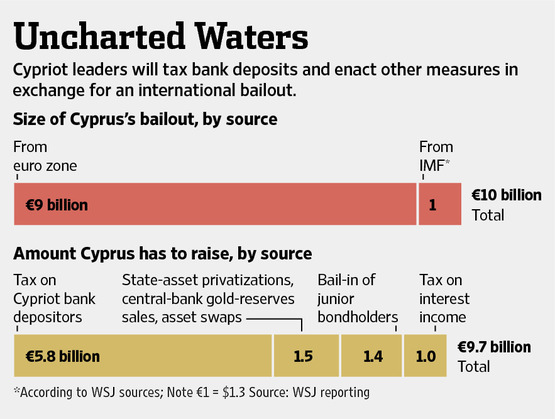
For those who haven't heard, the latest Eurogroup summit on Friday (or better Saturday morning) ended with an agreement for Cyprus to impose a one-off deposit tax of 6.75% on deposits up to 100,000 and 9.9% for over that amount. In addition, the Cypriot government has agreed to increase company tax to 12.5% from 10% and privatize some of its profitable state-owned businesses. The total amount expected to be generated from the Cyprus deal is the following:

Source: Wall Street Journal
The so called Troika has been arguing that a €17bn package would be sufficient to revive the island's economy, yet it would make its debt burden unsustainable as it approximately equals Cyprus's GDP. Yet, it appears that the total funds which have to be generated will near €20bn, of which 5.8bn will be produced via the deposits levy. A levy which has caused global outrage given that it affects deposits which were considered to safe under every scenario; most importantly it creates a precedent which experts fear that can be used against Italy or Spain when they opt for a bail-out. Another question which has not been answered yet is why was the amount increased and if the Eurogroup is essentially forcing Cyprus to pay on its own.

The German Chancellor Angela Merkel, as well as most German politicians who appear to support the aforementioned deal, stated that Cypriot depositors should assume responsibility for what their banks have done. Money-laundering and the extreme size of the Cypriot banking sector are often brought forward as the rationale behind their actions. (for a review of the money laundering issues in Cyprus, Matina Stevis's article in Wall Street Journal is an excellent source)

Let's take these issues from the start:

1. Money-laundering: It may (or may not) be true that Cypriot banks have been involved in money laundering activities. However, it is quite unlikely that ordinary people who are working in 9-5 jobs in any sector are involved in this. Yet, it is these people who are being targeted in the levy. Not high-profile managers, lawyers or bankers but people who are struggling to save some money to pay for their children's education or have an easy retirement.

2. Risk Premia: Some have also argued that "with interest rates as high as 5% in term deposits there was a substantial risk premium which indicated danger". Perhaps this is true. However, these rates only apply for term deposits with amounts in excess of 50,000 and not for current accounts or savings accounts where most of the money lies. In addition, not everyone is a hedge-fund manager with the ability of sending enormous amounts of money abroad. Everyday citizens cannot afford the luxury of having their paycheck deposited in Germany or anywhere else in Europe for that matter.

3. The size of the banking sector: Stories have been circulating the web that the problem is Cyprus's enormous banking sector. The following graph indicates that private sector deposits in Italy are much higher than the ones in Cyprus. From the same data it appears that Ireland's case was much worse prior to 2010. No-one can doubt that the banking sector is big indeed. Yet, forcing it to break-up (for example exiting from Europe) will mean that you are depriving it of many growth opportunities over the next decade; especially after it has taken all the losses from bad loans and bond haircuts.


4. Greek PSI: One cannot help but wonder why the EU had not taken into consideration that the cause of the Cyprus problem was essentially the decision to slash the Private Sector Involvement in Greek bonds by 70% (a proposal that the former Cyprus Central Bank Governor Athanasios Orphanides had strongly opposed). The decision cost Cyprus approximately €5 billion (without counting for the bad loans which arose as a consequence).

The worst part of the deal is that it is bound to set a precedent: if Italy applies for a bail-out fears of deposit haircuts will wreck havoc in the country's economy with a bank run bound to occur as soon as the news hit the market. Although Cyprus is not systemic per se, the trust issues which arise are. From now on, every time a country will opt for a bail-out fears of deposit haircuts will evoke memories of the Cyprus case. 

Frances Coppola wonders "under what type of taxation scheme are people provided with shares to compensate them for the taxes they have paid?", while on another post yours truly has argued against risk-free assets transforming to risk bearing ones. While the Cypriot Parliament will reconvene tomorrow the question on when the banks will resume business is still vague: Although today is an established bank holiday, tomorrow has been announced as one as well. New information says that a new plan will involve less cuts for those under €100,000 (approximately 3%), yet this is still unofficial. In addition, small depositors are almost sure not to take their money abroad. It is the big depositors, with millions of funds who are the threat to the island's banking sector.

What poses the greatest threat for Eurozone's health is not that Cyprus will cause a bank run in other Member-States; it is highly unlikely (although a run will probably occur in Cyprus, with foreign depositors leaving en masse from the island). What is feared is the precedent: if they have done it before, they can do it again. And an escalating crisis arising from bank runs in Italy or Spain under rumours of bail-out could probably bring the Eurozone at its knees.

Sunday, 17 March 2013

5 Unanswered Questions on the Deposits Haircut

The Cypriot Parliament was to convene today concerning the issue of the deposits levy, yet sources state that they have postponed the issue until tomorrow. I am not a Member of the Parliament (not a very pleasant occupation during these times) yet if I was I would be worrying about several complications the 6.75-9.9% tax would cause.

1. What happens to the money?
If the haircut goes through then the two big banks (Cyprus Popular and Bank of Cyprus) will have an additional €5.8 billion in share capital. From what I can assume, approximately 4-4.8bn will be put to the former and €1.8-1bn to the latter bank in order to raise their capital adequacy ratios (namely Core Tier 1 and Tier 1). This is to be considered as cash accounting-wise since banks will ship the funds obtained via the haircut to the Central Bank, which will then distribute them as per each bank's needs. Then as shareholder equity will be increased to account for the increase in share number, cash amount will also be increased by those amounts. What will the banks do with that money then? If we assume that assets are down (due to the levy) then adequacy ratio will not be so hard to be reached and even exceed. Thus, the banks remain with three options:
    • Use it to infuse liquidity in the market by way of lending
    • Keep it as reserves
    • Fund government debt
Option 1 would be the best for the overall economy, since it will boost businesses and assist in both consumption and investment. The only drawback is that the Cypriot people may just be too scared to invest or consume now. Option 2 will do nothing more than safeguard the banks in the case of the economy worsening (which it will do if Option 1 is not used). Option 3 will be very good for the state, yet the economy will not be able to enjoy this as the state cannot boost it through payments or investment (given the austerity measures and its agreement to abide by austerity and decrease it's budget deficit). Ideally, a combination of all 3 would be the best choice. Keep some money as reserves, boost the economy by providing liquidity in the form of loans and fund some government debt in order for the state to continue functioning smoothly.

2. Why does Cyprus need so much money (about 10bn) to sustain its government debt if it's deficit will be less than 3% in 2013 and Russia will roll-over the €2.5bn loan?
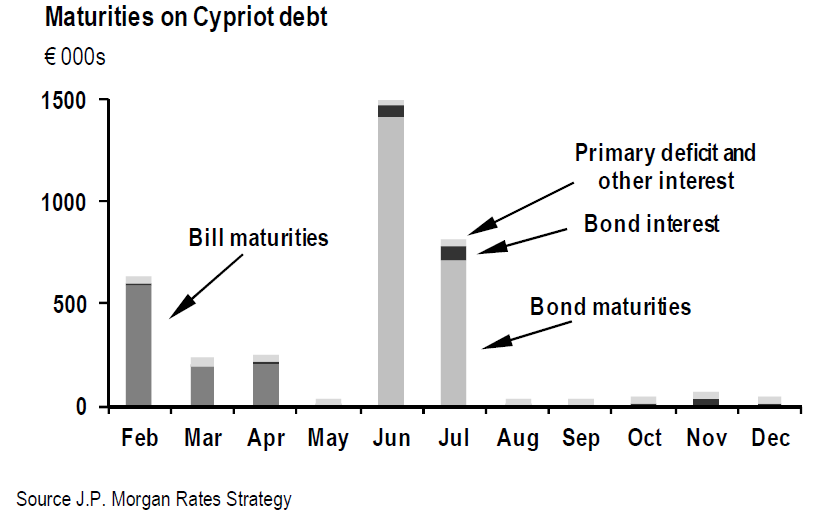
The question is pretty obvious: if the 2013 deficit is expected to be approximately 3% which is considered a yardstick for debt stability why does the island need  €10bn? In 2013 the debt maturities are:

This means that all that is needed is to roll-over the debt, provided that no surprise expenses arise. Even if they do, then part of 5.8bn obtained from the deposits levy can be used to fund those. Then, the question once again becomes why does Cyprus need an additional €10bn?

3. What happens to loans attached to deposits?
Many banks do the following practice: they lend you €X while they freeze your €X cash amount in their accounts. Thus, they benefit from interest rate difference and you get a much lower rate. This kind of loan is considered to be 100% safe. Yet if you have a 110,000 loan guaranteed by a same amount term deposit then the levy would mean that your deposit is now worth €102250 (6.75 until 100,000 and approximately 10% after that). This is equal to a 7.05% decrease which the bank would now have assign an appropriate risk weight. I cannot know the numbers but how much will that additional risk weighting cost the Cypriot banks? (and this time were are talking about all the banks not just the two big ones)

4. Why sell out all bank branches in Greece?
Greek Finance Minister Giannis Stournaras has announced that Greek banks will almost surely take over the operations of the Cyprus banks subsidiaries in Greece. The problem with this situation is that Cypriot banks have assumed all the damage so far (i.e. 70% PSI, bad loan write-offs) which exacerbated their balance sheets. In addition, Greece is most likely out of the deep now and will start growing again in 2014-2015. Admittedly the worst is done. If we already know this, how can Cypriot banks grown over the next decade if they are being denied of all their opportunities? They have taken all the damage there was to take, and now just about when things are going to get better they are denied the opportunity to profit from their operations. Now that doesn't sound like a good scenario does it?

5. How can the outflow of money be stopped? 
Nobody can doubt that many foreigners will intend to remove their money from Cyprus. Some will, other will not (the rationale for the latter being they have already taken what they wanted). Yet, can Cypriot banks cope with such an outflow? Wouldn't that severely damage their deposits' base? How will regulators and banks react if on Tuesday €10bn want to exit the system? Bank runs can be electronic nowadays too...

Given all the above, it makes being a Cypriot MP probably one of the worst jobs in the world. If they can answer all of the above and be certain that the benefits exceed the negatives then by all means go ahead with the haircut. But, wait a second; can you really be answer all of the above and be ready for their worse case scenarios?

Don't think so... The return to the Cyprus pound does sound more attractive now doesn't it? If one can bear the consequences that is...

Saturday, 16 March 2013

Habemus Referendum: The sad case of Cyprus

We are witnessing finance history ladies and gentlemen: It is the first time in history where risk-free assets (i.e. cash) will be traded with risk-bearing ones (i.e. shares); and this appears to be a good deal! According to some sources, the German Finance Minister, Wolfgang Schäuble, entered the negotiations demanding a 40% deposit haircut and threatening to cut all ECB funding to the Cyprus Popular Bank (which amounts to about €6 billion) at once if Cyprus returned to the pound. 

It appears that Germany has assumed the role of "The Master and Commander" of the EU without notifying anyone else. Why else would they support a plan which would promote such an issue? The same leaders who promoted a plan which has taken away €4-5 billion from Cypriot banks through the Greek PSI are now planning to re-capitalize them by taking money from people who have been working all their lives to save some. Where is the democratic accountability in that?

The rationale behind decisions of this kind is: your banks are in a bad position, we mess-up in Brussels, the banks are now in deep trouble, we delay things to make the markets uncertain and thus making the economy contract and as a consequence every citizen with more than €1 has to pay.

Pawel Morski has already published an excellent article stating the alternatives and most of the outcomes of the Cyprus case. Now, let's have a look at the numbers:

Total Deposits in Cyprus: €126 billion.
Total Foreign Deposits: 34 billion. 

Who exactly is this measure supposed to be punishing and who is exactly is it protecting? Because it appears that the people who are about to be worse-off are Cypriots and not the "Russian Oligarchs". From what Pawel states it appears that they are promoting this to set the Russians at ease that it is not just their money that are going to get the haircut. Well, I am sure that Cypriots are thrilled by this! 

As with the Greek case, the only ones who benefited from these kind of solutions are hedge-fund managers who have gambled excessively with the probability of a Cyprus default. Ah, the grandeur of capitalism. The rich and the risk-lovers will get their rewards while those who have been saving small amounts of money will lose. Why isn't their a limit in the deposit cuts? Will the "oligarchs" feel the injustice if people with less than €10,000 or 20,000 in the bank do not have to pay? Do you really believe that the "billionaires" would care for such trivial amounts? Yet the average Joe or Jane, who earns €1000 euros a month and saves €50 for a rainy day does. I have already explained why a deposits haircut is a terrible idea. What makes this deal even worse is that it also hits lower income people; everybody has to pay.  

Where is democracy and accountability if a those who are unemployed and living off their savings until the recession is over have to pay for something they did not create? How are they going to spend, how are they about to eat or drink until a recession, promoted by others is over? Some may think that 6.75% is not much. Well, for a person with €10,000 in the bank, 675 euros could have supported her/his family for a month until a job was found.

The other question is why did Cyprus had to go to a Eurogroup to have a decision like that? Couldn't they have made it on their own? What is the point of discussing with possible creditors for a €16bn package when 6bn are going to come from a deposits haircut, an additional from increased taxation on interest received and an extension of the 2.5bn loan from Russia. Oh, wait, the IMF is going to chip in the "enormous" amount of 1.3bn. Which may not be of any use after all.

It appears that Machtpolitik has not been eradicated from Europe yet. Leaders may preach of solidarity, accept and support but it appears that talk is all they do. The ESM has not been used yet, the hope is that the OMT will not have to be applied and we really abide by the principle of having a "bazooka" ready but never firing it; not even when we are in danger of blowing up. 

I would not dare say that Cypriot politicians do not have their share of blame as Protesilaos Stavrou has already stated. However, the responsibility for correcting crooked decisions lies in the hands of the regulators who should come up with better ideas to rescue a country if the Eurozone is to have a future. Neither the solution of Ireland, nor Greece nor Portugal nor Cyprus was a good one. Yet, we keep on implementing on solutions which have been proven wrong even by their proponents.

Yet, measures of these kind will have huge effects on the economy. Is it not an extreme form of austerity? The one that even the IMF has said it does not support? Or is indirect austerity better than the direct one? I guess that a reduction in savings does not automatically mean a reduction in funds available for lending, nor does it mean a reduction in consumption or it does not force consumer confidence to take a free-fall. Or how will the loans which are based on term-deposits react? Will those be considered as "bad debts" or not? How can a country which cannot stimulate its economy via government spending achieve short-term growth? How many people realize that this may cause a bank-run? And exactly why don't they realize that this can only hurt the economy as it does not promote economic growth? Are we bloggers the only ones who can think 2 steps ahead?

Two months ago I had stated that the referendum would be given to Cyprus after the February elections. I was right on that. Yet, rest assured that the troubles for little Cyprus will not end here. If an influx of new cash in the economy does not occur then the crisis will be prolonged. The only hope for Cyprus is for the natural gas drillings to go through. Otherwise, the recession will last for more than 2013-2014...

Now, I would also like to ask the geniuses in Brussels the following: what should the risk-weighting of cash deposits be? 

Monday, 4 March 2013

Why a Deposits Haircut is a Terrible Idea

One of the newest ideas that the great masterminds of the European bail-outs have come up with is the one where a deposit haircut takes place, in order for the Cypriot state to assume less debt in the bank re-structuring process. Although we have not yet seen what such a proposal actually promotes (since it has also never been implemented in any country in the world), it would be save to assume something of the following according to Reuters:

People with deposits over amount X in a bank (although it has not yet been defined whether this would include just banks which need restructuring or any bank at all) would take a loss in order to make the banking sector smaller; this loss is expected to be compensated by new share issues. Reuters puts number X to equal 100,000.

The amount at first appears significant enough; not everyone can brag for 100,000 cash in their accounts can they? Yet, a closer look shows otherwise. A person who saves just 110 a month, assuming a 3% nominal interest rate, will end up with more than 100,000 in the bank after 40 years. Would anyone call such a person rich or well-off? I do not think so. It is more likely that this person plans to send his children to the university or live his later years live more easily with that amount.

Then, we should consider the risk assumed by the deposit-holder. Cash are unanimously considered as zero risk financial assets both because they are guaranteed by governments and because the initial investment is never at risk. If such a scheme is applied then we are essentially transforming risk-free assets to risk-bearing ones. What is more, we are transforming them into the second riskiest asset class (the first one being derivatives) there exists: stocks. Why would a person, who does not want to assume any risk, be willing to put money in the bank then if they are safer under the mattress?

In fact, a deposit haircut appears to be even worse than most austerity measures. It is a purely un-democratic proposal which aims precisely at allowing innocent people assume responsibility for someone else's fault. Austerity measures are usually promoted with the aim of reducing state expenses and affect the current income of workers; the deposit haircut is promoted just to save financial institutions and it affects consumer wealth. If we know that a decrease in government spending leads to a reduction in consumption and an increased rate of non-performing loans how can we even believe that the results of decreasing wealth will not have even worse results in the real economy?
As already noted, this has never before been implemented in any part of the world. If Cyprus, who under the English Law allows bondholders to sue the state for any debt haircuts, tries to implement such a scheme, results are bound to be devastating. In a 2010 paper on repo haircuts the authors conclude that (emphasis my own):

"Increases in repo haircuts are withdrawals from securitized banks - that is, a bank run. When all investors act in the run and the haircuts become high enough, the securitized banking system cannot finance itself and is forced to sell assets, driving down asset prices. The assets become information-sensitive and liquidity dries up. As with the panics of the nineteenth and early twentieth centuries, the system is insolvent"

Their results can be easily understood in terms of trust. If I do not trust that the bank will take care of my money and that they will be there when I need them why should I keep my money there? Then, if this does not hold for me, why should it hold for everyone else? Thus, we all refrain from keeping our money in the bank and we move to withdraw them; bank runs occur. With the enormous drop in liquidity the general economy also takes a tumble. For those who do not believe that such bank runs are possible nowadays I would point that Cyprus lost €1.7 billion in deposits during January, when this scheme was just a rumour.

The time for utilizing ESM funds has arrived. Although Mario Draghi put the markets at ease in September by saying that the ECB will do everything it takes to keep the euro alive, very few will still believe his words if they are not put into practice. The EU officials should be thankful that the opportunity to test the ESM came with Cyprus and not with Italy or Spain. If something does not work in the Cypriot case then the amount of money lost will be minimal compared to what would happen if Spain or Italy were assisted and things did not turn out as planned.

Again, let us not forget: our economic system is based on trust. If we cannot continue to trust the system then it will simply collapse.

Tuesday, 21 August 2012

Greece's Progress

Many are always accusing the Greeks for the situation their country currently faces and their lack of action for the persistence of financial problems. However, a recent IMF study begs to differ:
As you many see from the above table (it is also in page 93 of the IMF study) Greece's primary deficit is expected to be 1% of GDP this year (i.e. 2012), move to an 1.8% surplus in 2013 and having surpluses until 2030. This would mean that over the next years, Greece will essentially be paying its existing debts, without having any deficits other than the repayments! Gross refinancing needs will drop from 34 billion to 14 billion over the next year meaning that it will essentially take much less money to refinance debt. 

However, the need for debt restructuring may occur, as it is expected to reach 167% of GDP this year. At least this time, I hope that the troika decides better than hair-cutting the debt again! (for an alternative solution to the Greek haircut read this). The Greeks have suffered through severe austerity measures too rapidly, which forced the country's GDP to contract vastly and that is why the debt burden as a percentage of GDP has increased so rapidly (allow me to explain. If debt is 100 and GDP is 100 then debt is 100% of GDP. If the GDP contracts - as is the case with Greece - to 80 then the debt would be 125% of GDP)

The 2.5 billion they are currently requesting is nothing compared to another haircut (or worse a default) which would make financial markets (and especially banking institutions) even more chaotic. European leaders seem like impatient children, who want to see debt reduction and positive growth from one moment to the next instead of thinking that such a procedure requires much more time.

Sunday, 12 August 2012

Economists and the Real-Life Economy

Every time a crash, or a crisis or recession or any bad news in general comes up, people run to economists to "help" them "understand" what has happened. What most people fail to understand is that, about 99% of economists have no idea what is happening in the real world. The reason is simple: they are so caught up in their studying, publishing articles, using advanced mathematics and statistics to impress other economists with their knowledge that they do not actually know, let alone understand, about what goes on in the real world. 

Thus, their knowledge is purely theoretical. Even what economists call empirical work (i.e. something which actually uses observed data instead of pure mathematical theories) is in fact a manipulation of past data, under statistical tools, to reach a certain point. Very few can leave the stagnant traditional economic thinking and start to think on their own. If one remembers, in a scene of Bryan Singer's Usual Suspects, Kevin Spacey states: "The greatest trick the Devil ever pulled was convincing the world he didn't exist.". In the same context, the greatest trick economists ever pulled was convincing the world that they understood economics.

The worst outcomes of this "misunderstanding" are that:
1. Economists with no idea on how the real world operates are appointed in critical positions in the economy
2. Good economists are mistakenly thought as bad ones, a consequence of bias and prejudices (obviously, if you ask an economist whether he belongs to the 99% or the 1% of economists s/he will  always say he belongs to the 1%)

This situation is described in Esther Dulfo's and Abhijit Banerjee's book, titled Poor Economics. They talk about a situation named the 3 I's: Ideology, Ignorance, Inertia. Although the authors (which I believe deserve to be at the 1% we have talked about earlier) mostly use it in describing politics and policies in third world countries, this situation is more than evident both in the EU as well as the world economy.

People with an ideology try to promote changes or policies (either for better or for worse) and the policies seem to fail, mainly due to their ignorance on the subject, as they are watching it from a distance. The situation, does is not made better due to inertia, i.e. people's "apathy" towards a policy which in essence does nothing.

The same rationale holds for the Greek bailout: economists and policymakers decided that a haircut of 70% of the bonds' value and severe austerity measures should be great to fix the problem. Well, I guess the situation looks better and decisions are easier when its not your job, city or country on the line. Or is it now?

Saturday, 11 August 2012

Greece is downgraded (again)

S&P has recently downgraded Greece's outlook from stable to negative. In the agency's announcement it is stated that another haircut on the existing debt amount is expected, since the austerity policies, which have been implemented with a notable delay of 2 months during which Greece was without a formal Prime Minister, and the fact that Greece's GDP is expected to shrink by about 10-11% until 2013 will make the country need an additional 7bn euros this year and make its debt burden unsustainable in the future (not the distant one, 2013-2014).

This would in turn demand for another haircut in order to make it sustainable, which would mean that EU banks are going to need additional capital increases to conform to legislators' Tier 1 requirements. Guess what that means to most EU banks - and their host countries - which are still trying to find money to cover their losses from the previous haircut. Things are about to get a lot worse...

The Greek haircut was not a good idea. Anyone who disagrees with that clearly ignores economic realities. One cannot understand the rationale behind the policymakers' decision to cut Greek debt by 70%. A better alternative would be this. It is not economically difficult to achieve, however it takes a substantial amount of political will and nerve, something that most politicians in the Union do not possess. It is not late for a new plan, although it may be too late if we wait until another country fall off the cliff.

The downgrade increases the fear that some country (countries?) will eventually exit the euro. In my opinion individual countries should not be allowed to exit the Euro, both for economic as well as political reasons. In the end, we should either learn how to be a true Union, or just shut it down. There is no other option left. Either we are together or we are not.