Showing posts with label deposits. Show all posts

Friday, 27 December 2013

New Year's Change of Mind: Was the Cyprus Haircut more equal than we think?

2013's most startling development was probably the Cyprus deposit haircut, an unprecedented event which caused numerous reactions around the world. In March, the Eurogroup came up with Plan A, i.e. to haircut all existing depositors, regardless of institution or the amount of money in their accounts, at a flat rate of 6.75%; a decision which the Cypriot Parliament rejected. After 2 long weeks of bank "holidays" and intense negotiations, the plan changed to the dissolution of Laiki Bank and the haircut of all deposits above 100,000 euros in the Bank of Cyprus (the final amount of the unsecured deposit haircut was 47.5% as agreed in late July).

My reaction to the first plan was that it was unfair: a person with €10,000 in his bank account would suffer more than a person with €10 million in his after a 6.75% cut. The second plan still seemed unfair but had the advantage that depositors in other banks would not be hurt and that the "little guy" would remain an unscathed. Obviously, the "big boys" still get hurt, which means less investment and less growth, equaling more unemployment. Yet, there is actually much more good in this than was first considered.

First of all, the ones which got hurt more in the crisis were not CEO's or other businessmen; it was paid employees. Have a look at the following table compiled by the Economic Policy Institute:
As the reader may observe, in 2011-2012 average worker compensation shrunk by 1.6% while average CEO compensation increased by more than 14% during the same time-frame. What this indicates is that high-income earners do not get hurt by much during a recession. The average paid employee does. The simple reason is that the worker goes out first and the businessman continues to operate; most importantly it is the latter who makes the decision not the former. Even when a recession begins to fade out the businessman can exploit the situation and earn much more than before since wages are much stickier than profits (as also seen in the 2013 results of US firms).

The trouble with Plan A, i.e. the haircut on both secured and unsecured deposits is that the former (i.e. secured depositors) are more prone to the use of their wealth than the latter. As Simon Kuznets has shown back in the early 50's, the higher the income, the less percentage of your income you spend (for a discussion of austerity and income see this). This means that most of the money a low- or middle-income worker earns will end up back in the economy in the form of consumption. On the contrary, the money a high-income person earns are employed differently: if you take away from him, his consumption will not be reduced by as much for the simple reason that he will just save less. Since the economy is mainly driven by consumption (it comprises of the largest part of GDP) if it decreases, GDP will also be decreased.

A question which may arise concerns the banks' ability to lend if we experience dis-savings. The thing is that it will not matter by that much. Remember that if one spends, another will pocket the proceeds, thus the money ends up in the bank anyhow, i.e. the bank will not lose any funds. Second, even though the bank has less deposits now, it has much greater equity which allows it to lend out more funds to boost the economy either directly or indirectly.

This is what has happened in Cyprus since March: those with big, unsecured deposits, found themselves at a loss. Recent IMF estimations, after the second examination of the island's program development, showed that private consumption has fallen by just 2.8% year-to-year, much less than the severe contraction in Greece or other periphery countries, even though the unemployment rate has reached 17% (the 3rd highest in the Eurozone). Since private consumption has not fallen by much, GDP contraction was less than expected. Most importantly, what the less-than-expected decrease in consumption means is that Cyprus has a better chance of experiencing growth faster than other countries is recession; since demand does not fall, employers have less incentives to fire people and businessmen have greater incentives to invest.

There is a caveat in this though: the haircut exacerbated the already declining confidence in the banking sector, meaning that individuals prefer to keep their money under the proverbial (in this case even literal) mattress than deposit it. This can be easily seen in the data, with total deposits following a downwards trend since March, forcing the banks to request liquidity from the ECB. Yet, as the IMF points out, this exit of deposits appears to have reached its peak, with the overall amount in the system stabilizing in October. NPL's are still a major cause of headache in the island, yet an increase in consumption, in addition to the banks' increased ability of issuing of new loans due to higher equity ratios means that better days are ahead.

Summing up, the haircut on unsecured deposits is much more equal than first considered. It hurts those with larger wealth, who spend much less of their income (as a percentage) than those who are on the other side of the spectrum. This means that consumption is less affected by the haircut than by austerity measures: compare Greece and the succession of harsh austerity measures and tax hikes imposed which resulted in a 5-year depression to Cyprus where the haircut was accompanied by mild austerity measures (mostly in 2011 and 2012, with a few ones in 2013). The difference is extraordinary. Yet, as mentioned before, the haircut's caveat is the exacerbation of the already fragile trust towards the banking system, which is the cause of decreased liquidity; yet, if the ECB can ascertain that it will live up to the task of providing "whatever it takes" to the banks, it might be that the haircut is not a terrible idea at all.

Sunday, 1 September 2013

The Banking System Part II: Repayments and NPL's

On a recent post, I gave an overview of how the banking system works and how the Central Bank assists in increasing bank liquidity when the latter wish to issue loans but do not have the liquidity necessary for that. The story presented in that article is what happens when the banks issue the loan and the customers use (i.e. spend) the money to purchase goods and services. As any good lender, the bank is not really giving the money to the public without expecting them back. Unfortunately for the bank, this promise to return the funds is not always kept as many borrowers default on their debts. In this post, I examine both scenarios (i.e. debt repayment and default on debt) and their implications in the economy as a whole.

1. Repayment
It would be much more suitable to examine the outcome of debt repayment by presenting a simple example. Let's assume that at time 0 the bank lends 100 units of currency a borrower, Mr A, who spends it in buying equipment for his shop. A year later, Mr A has to repay the loan with an added interest of 5 units of currency. For simplicity we will assume that there are no installments, just a large payment at year 1; in addition we assume that the bank only charges the interest at year 1. (In essence we are assuming the loan to have bond-like characteristics to make this analysis simpler. The same conclusions could also be reached even if our model was more realistic in its assumptions). Now, as stated before, when the bank issues the loan, it creates a simultaneous credit entry (the amount owed to the customer) and a debit entry (the amount owed by the customer) in its books, with each entry cancelling the other out. 

The amount of money in the economy also increases by 100 units when the loan is withdrawn and used by the customer. Yet, at withdrawal time, the bank does not owe the customer anything any more since the money was taken from it. This leaves the bank with just one debit entry: the loan granted to the customer.

At year 1, Mr A's investment paid off and he has enough money to repay his loan. He goes to the bank, hands them 105 units and bids them adieu. The bank accepts the money, accounts for it in its cash ledger and crosses off the debit entry assigned to Mr A.

Now, overall, if the money in the economy at time 0 had been X, granting the loan would have made it X+100. At time 1, if nothing else changed, the amount of money in the economy would become X+100-100-5=X-5. The startling discovery appears to be that when borrowers return money then overall money in the economy is reduced. Is this true? The answer is a bit more convoluted than expected. 

Money in the economy appears to be decreasing but this is not a permanent effect: in a real economy with millions of participants, just when any Mr A repays his loan, Mr B,C,D or E is eagerly waiting for his loan approval to use the money for buying a house, equipment or a fancy car. Thus, although the amount of loans in the economy appears to be reduced, this is just trivial and very short-lived: the reduction in money will be quickly countered with the increased liquidity the bank will have; given that the bank has not reached its regulatory capital maximum, the bank will now have 105 units available for lending which will mean that the money supply will again be increased shortly (provided of course that the bank finds enough good opportunities for lending).

An interesting question is what happens if, say 10% of borrowers decide to repay their loans at the same time: the answer is that a large decrease in the supply of money in the economy will occur, with all the known consequences of that (liquidity crises, deflation, etc). The only reason this has not happened is that people do not operate in such a fashion; it is much easier to spread payments over  5-6 years and pay a fixed amount every month than live on a shoestring and repay the loan in 2 years' time. Since life is generally unpredictable and people generally prefer stability it should not amaze us why people do not rush to the banks en masse to repay their loans.

2. Non-Performing Loans (Bad Debts)
Now suppose that Mr A could not find any suitable buyer for the goods he produced and thus he cannot repay his loan, making it a non-performing loan (NPL) for the bank (the usual definition is that of a loan whose payments are more than 90 days past due). This means that the bank will never receive its money back. What does the bank do then? Accounting-wise, the debit balance is transferred to the bad debts balance (for the purposes of this analysis bad debts will be the name this account has, although in practice the name may be different) which in its turn appears as a loss in the bank's financial statements.

Remember that when a bank issues a loan, it increases the money supply in the economy and it transfers liquidity to the customer when he or she withdraws it. In the case where the borrower cannot repay the bank, the money in the economy is unaltered (at the moment) while the bank's liquidity is reduced. A reduction in liquidity means that the bank will not be able to continue lending at the pace it previously could. While a non-performing loan here and there may not cause any issues, having too much can cause the bank to fail. When the bank does not receive its money back it means that it has no longer the liquidity it was supposed to have, which means that it can no longer keep lending or even worse, it will not be able to repay the Central Bank (or other corporations) for the liquidity it has provided. As a consequence, the bank will face liquidity issues and may be forced to default if the Central Bank does not allow it to borrow more.

Even though the total amount of money in the economy will appear not to change, it's rate of increase will be affected if banks face liquidity issues; bank credit will be decreased which means that money circulating in the economy will also be decreased (when we talk about money in the economy we usually use measures which include savings. Yet, savings are not usually used for transactions). Thus, less money available for transactions means that consumption will be reduced forcing the economy into a recession. Add to this fear resulting from reduced consumption and the recession and the velocity of money is further decreased, making a perfect crisis. This is what's currently happening in the South of Europe: banks face too many NPL's and cannot (and do not want as they fear for even more NPL's) lend as much as before, reducing the money available in the economy.

Now, let's suppose that Mr A put his house as collateral for the loan, promising to hand it over to the bank if he faced trouble. The best case scenario for the bank (and possibly for Mr A as well) would be for Mr A to sell his house to someone and repay the loan, keeping the rest to himself. Yet, if Mr A cannot do that, the bank will have to confiscate it. The problem here is that the bank does not really want the house unless it can sell it quickly and at a price high enough to cover the loan. A bank with too many hard assets confiscated (houses, equipment, etc) may face liquidity issues if it cannot sell them fast and at a good price; this is exactly what happened to the US housing market in 2007-2008 when banks found themselves with too much assets and too little liquidity.

From the above two simple conclusions can be extracted:
1. Repaying bank loans may appear to decrease money in the economy but since banks can reinvest the money received to other loans the decrease is not permanent. In fact, it may trigger a larger expansion of credit if the bank has not reached its regulatory maximum (in some countries, banks have actually lent money to their employees so they could purchase new equity issued thus increasing the regulatory maximum)
2. A large percentage of non-performing loans to total loans can seriously impair the bank's ability to lend. This will also affect the overall economy by decreasing the money available for transactions, thus reducing consumption and the velocity of money, resulting in a recession. If steps are not taken to boost bank liquidity an even harsher recession is most probably going to occur since people will reduce their spending even more, out of fear and uncertainty.

As already said, the banking system is not as complicated as many like to believe. By understanding simple accounting and macroeconomics and admitting that everything is connected, financial crises are easy to explain, and occasionally forecast (timing is of course extremely difficult). Although it is seldom mentioned, banks provide the lubricant for the economy machine; without them, the machine would clog and unclogging it would require much more effort than if we just kept the lubricant at a steady pace. Yet, the lubricant should never be too much: this could lead to spilling and creating more of a mess than keeping the wheels turning. It is just as important to keep the lubricant at reasonable levels as it is to ascertain that we do not run out of it.

Tuesday, 20 August 2013

The Banking System Made Simple

One of the most popular discussions on the web is banking. Numerous commentators have been commenting on how banks work or how we perceive that they work. These views are occasionally correct while they are also occasionally wrong. In addition, a relative confusion on how bank loans are created or why deposits are needed by the banks appears to exist. What follows are three simple examples intending to indicate how banking really works, how deposits and loans are created and how the Central Bank functions in a financial system.

In all examples, we assume (for simplicity) a closed economy where banks face a mandatory reserve requirement of 10% and a Tier 1 ratio which cannot fall under 10%. It is also assumed that the money needed in the economy for transactions is on average a fixed amount M (already existing in the economy) and all loans have a fixed risk weight of 40%. 

Note: all of the above assumptions can be altered with no change to the conclusions reached.

Example 1:One-Bank Economy
In this economy we have a bank which has in its balance sheet deposits of 100 units of currency with its equity being 10. In period 1 it decides, according to the regulations imposed above, to lend out 90 units. These units, we have just one bank in the economy will be deposited in the banks' accounts. A simple balance sheet would indicate the following:
Then, the bank would continue to operate under the same way until it reached the limit of 10%. This limit is nevertheless not the one imposed by the reserve requirements but by the Tier 1 needs. The reserve requirements would, under these assumptions, allow the amount of loans available in the economy to reach 1000 units had there not been for the Tier 1 ratio which essentially forces the bank to stop at 250 (for more details about the money multiplier see this). The "final" balance sheet would look like this:
Example 2: Two-Bank Economy
Now let's suppose that 2 banks exist in the economy, both having a 50% share of the market. Their equity values would be 5 each and their starting deposits would be 50.

In the first period of time, each bank will lend 45 units to the public. Each bank knows that it controls only 50% of the market thus it makes sense to expect 22.5 of those units to be deposited in its rival. Yet, the total amount of loans in the economy has not been altered even though the banks are now more and lending less individually. Total loans will still be 90 and they will be divided equally between each bank. Thus, each bank now knows that if the other bank lends as much as it will they will both get back in the form of deposits as much currency as they have provided as loans. In addition, the number of banks is irrelevant to the conclusion, as is their market share. If we had 10 or 200 banks in the economy total loans would still be 90 and the market share would have been the same after the lending as it was before. More still, the situation would not have been altered even if market shares were unequal. 

With some frictions, this is what most commonly occurs in real life: as banks do not have the same amount of loan applications or do not grant the same amount of loans in each period of time, market shares are continuously changing. Thus, although banks (usually) want to lend until their Tier 1 limit is reached, they cannot do this as easily (either because of lower demand or because applications do not match the perceived risk-reward profile needed) thus making market shares and loans growing at different paces in every bank. In addition, reputation makes a great difference; banks who were leading the market once are now mere followers as clients view others as better alternatives.

Example 3: Two-Bank Economy with a Central Bank Providing Liquidity
Assuming that the previous initial conditions hold, the situation should theoretically be the same. Yet, reality is different. Since the Central Bank can provide liquidity (what is called ELA in the Eurozone) for banking needs then it means that the banks can allocate their loans based on demand and not based on their liquidity constraints; what the Central Bank essentially does is eliminate the liquidity constraints in the short-run by lending banks. 

The situation would unfold as following: In period 1, banks face increased demand and decide that they should lend 60 units each instead of the 45 they are allowed by their liquidity constraints. This means that the Central Bank has agreed to lend an additional 21 units of currency (additional 10 to cover for the difference from 50 to 60 and another 11 so that they can have their regulatory minimum and not fact trouble in their day-to-day operations) to each bank with the banks promising to return it at a later date. The banks' balance sheets would now look like:
Notice that the Tier 1 ratio was 28% in Example 1's first period while it is 21% now. The reason is simple: more loans can be generated in less time using the Central Banks' available liquidity. 

A question is how the Central Bank will get its money back; after all this funding is nothing but a loan to the bank. Notice now that the bank who received the funding still has received 60 units of capital as deposits back. Now, according to the rules, the bank only has to maintain 11 units (10% of total deposits, i.e. 110) for liquidity. This means that it can afford to give the liquidity back to the Central Bank, hold the regulatory minimum for liquidity and still have 28 units (60-21-11) at hand which it will be able to lend in the next period.  That is if the bank does not get any more funding from the Central Bank to boost its loans.

As with example 2, in reality things are a little different. Banks not only borrow from the Central Bank but from each other as well, since their liquidity is changed every day (as stated before loan grants and demand is unequal between banks) and they may find themselves in need of some extra cash or have some extra liquidity which they prefer to lend out in order to get some interest instead of having it idle.

From the above examples we can derive the following conclusions:
  • Deposits matter with regards to liquidity. Yet, they do not matter to the amount of loans to be given. As the balance sheets have indicated loans cancel out since their creation is a simultaneous creation of an asset and a liability. Thus, the bank has no limitation to the amount of loans it can create other than the regulatory capital requirements (e.g. Tier 1)
  • The amount of money given by the Central Bank will be returned to it, yet its effect will be permanent. If the Central Bank agrees to give X units of currency to the banks then the money supply will be increased by more than X permanently even if banks return it to the Central Bank. This happens because that money is created by the banks and even if the extra liquidity is returned the amount of loans in the economy would have still been increased.
  • The starting value of deposits is irrelevant. It does not matter whether initial deposits were 10 units of 10 million units. The amount of loans to be granted will be exactly equal to the amount allowed by the regulatory requirements and not by the initial state of deposits (obviously, deposits have to be greater than 0 for this to work since the bank cannot print money).
  • The more cash at hand and the more government bonds banks purchase the more money supply they can create since both instruments are of zero risk weight and are thus excluded from the calculation.
  • Increased regulatory requirements at a given amount of equity, means that less loans can be created, thus making money supply will in general be less; an increase in the regulatory requirement (e.g. from 10% to 11%) means that ceteris paribus less new loans will be created in the future. This situation is evident in the EU at the moment.
  • The only way for money supply to be increased is for banks to raise more equity. If it is raised then more money can be created in the economy.
As the reader has seen through this analysis, the way banking works is not as complicated as we usually think it is. Nevertheless, understanding how the banking system works is paramount to the economy and has been an issue which had received much less attention than it should have. As stated above, the examples can be very easily extended to include more complexity; yet understanding the larger image can most of the times provide us with more knowledge than by narrowing our focus to the specifics of banking.

Thursday, 4 April 2013

What (German) Taxpayer Money at Risk?

It is not that anyone expected small countries to receive the same treatment as larger ones. Nor that everyone would be treated equally in the EU. Other than proclaiming "solidarity, friendship, co-operation" the people of Europe have seen very little of that from their politicians (not to mention other nations' politicians). What makes matters even worse is that decisions taken at the highest level are not even consistent.

Lately, an article in Spiegel reminded us of two incidents which happened during 2011:
1. The bail-out and nationalization of Hypo Real Estate
2. The bail-out of Commerzbank

In the first case, the German state assisted the mortgage-lender with more than €20bn, while simultaneously guaranteeing about €145bn of assets in it. The latter is just a case of the state funding the bank with more than €18bn and the bank winning a European approval to postpone the sale of its real-estate unit by 2014, effectively changing the bail-out terms.
What should be noted is that these funds came from actual German taxpayer money, with no obligation of actually returning those money back. In contrast, all other bail-outs in Europe cannot be considered a waste of taxpayer money. Let's elaborate on that. About a year ago, the bail-out agreement with Greece resulted that the latter would have to pay an interest rate of about 3.65%. Four months ago, at a Eurogroup meeting, Finance ministers agreed to reduce that rate by 1%, in order for the debt burden to remain sustainable. Thus, the effective interest rate earned is approximately 2.65%.

For comparison, the highest deposit rate for fixed or time deposits in Germany is currently at 1.4% according to Europe Bank Account Rates. Thus, the German state is in fact investing German taxpayer money, earning a substantial 1.2% more than having it sit around in a bank. There are those who might say that this reflects the fact that Greece represents a risky investment that makes interest rates so high. Yet, according to formally used risk-weights investing in government bonds is a zero-risk investment. In addition, none of the money invested in the country has so far been lost; in contrast 71% of the private sector money involved in the deal vanished into thin air. The EU appears to be the best investor in the world right now: it has money to invest, needy countries who are begging for money, thus agreeing to pay a higher interest rate (although lower than the market one) and it has the opportunity to shape laws the way it wants so that its funds are protected.

Until now, the EU has agreed on providing €144.7bn to Greece, out of a total €164.5bn package. This means, that if percentages are used as in the European budget, 21.11%, or €30.54bn of that money will come from Germany. This is an amount less than 1% of the German GDP, yet it allows for more than €800m for interest proceeds per year, for the next 30 years. What is more, this is more than €380m per year more than what they would have gotten if they had invested the money in a bank. 

It was more than known that Germany was earning huge amounts of money through lower debt interest rates; during last August, the yield for German bonds was actually negative! People were actually paying Germany to hold their money. Yet, Germany, as the rest of the well-off EU countries are pushing the deal even further by being both regulators and investors. The excuse of protecting "German Taxpayer Money" is not quite valid at the point: the German taxpayer is either earning a significant amount of money for that investment, or his money is not at all in danger if the ESM/EFSF or the ECB is paying. Regarding every euro coin as your own does not make it such.

Think of the latest deal with Cyprus. The amount to be given via the EFSF/ESM funds is €10bn, with the island paying an interest rate of about 2.5-2.7%. The most interesting part is that there are no taxpayer money at risk: by construction, all Eurozone countries have to guarantee the fund, yet no country will actually hand over any assets to it; bonds will be issued in order to cover the bail-outs it will make. Essentially, this makes the EFSF a large speculative fund with no chance of losing money: 2.5% yearly return on risk-free assets, through borrowed money and an ability to shift regulation at its will.

Then why is it that they worry about taxpayer money if that is not invested? I will leave the discussion on whether having a state act as a speculative vehicle good is beneficial. Yet, if the major concern for assisting an ailing state is moral hazard, then why not regulate banks more efficiently in the first place? For example, why did the ECB throw so much money at a bank which was evidently bankrupt since last summer? Better policies are in need if the intention is to keep the euro alive. 

P.S. As for the obsession with price stability, if the ECB is generating money, even via the "printing machine" so feared by German authorities, this does not mean that Germany will face a large inflation rate nor is that money German; they belong to Europe and the receiving nation. In addition, as Paul Krugman stated more than two years ago, money in one country does not affect inflation in all the others. For example, Cyprus could have a 20% inflation and the overall EU inflation would have been affected by much. This simple fact is also declared on the ECB's website (although I could not find the actual weights) and yet it is never mentioned.

Saturday, 23 March 2013

Cyprus, the next day

Yesterday, the Cypriot Parliament passed 9 bills in its intention to reduce the recapitalization funds the island needs as part of its restructuring process (for a review of the legislation this earlier post sums it up).

Two decisions have been the talk of the town (the Union is a better term): the imposition of capital controls (as Pawel Morksi commented, neither of us has ever seen such a thing in the Western World during our lifetime) and the decision to split Laiki bank into a good bank/bad bank scheme. As far as capital controls are concerned there is nothing to be critical about: had Cyprus not imposed these measures then we would have witnessed the first bank run in the 21st century; and either the ELA would have to pump €20bn in the system to save the country, or they would have to go bankrupt with both insured and uninsured depositors losing their money. It may not look good, but it is the only decision that will save the banks' deposit base.

With regards to the Laiki restructuring, there are some clear advantages and some issues which appear somewhat vague. As far as the advantages go, after this decision the Cypriot state will not be liable for the €1.8bn assistance which the bank "received" about a year ago. This amount is approximately 10% of the country's GDP. In addition, the recapitalization needs should be significantly reduced since the bad assets will not be counted as part of the whole procedure. Given this, some have stated that the whole assistance package has now been reduced to approximately half of what it originally was. This makes the Cypriot public debt sustainable and in addition no further austerity measures have to be taken in order to secure income.

In addition to these, there is also the huge advantage of having avoided the deposits haircut. Exotix’s Gabriel Sterne, presented the following graph on Twitter yesterday, shows that a haircut decision (as promoted by Troika last week) would mean a 20% contraction of GDP.

Yet, a haircut on uninsured deposits is not completely out of the table. It is very likely that uninsured depositors at the Bank of Cyprus will also receive a 20% haircut, for the bank's recapitalization needs. The drawback of such decisions is that they affect provident funds, pension funds, charities and other NGO's. The Cypriot Parliament committed yesterday to look into such issues, although given the island's financial position it would be difficult to compensate large depositors' losses in full. Some estimates place the final loss taken by uninsured depositors to about 20-40% of their funds (based on previous examples like this one). However, this avoids depositors in Coop's or other banks operating in Cyprus having to pay for the two banks' needs, safeguarding a significant amount of deposits. (latest developments indicate that a 4% tax on all uninsured deposits will be levied in order to cover the losses of provident funds, charities, etc from the separation of Laiki's operations)

On the bad side, what appears to be rather odd is the intention of merging the "good" bank with the Bank of Cyprus. This means that a huge bank will be created, one which will contain more than 50% of the island's deposits. Talk about too big to fail! Why the "good" Laiki bank does not continue with its operations independently is beyond my understanding. Adding to the stream of irrational decisions is the one to sell off the Cypriot banks Greek subsidiaries for approximately €1.5bn of which the Cypriot state will have to pay €0.5bn. I cannot help but wonder who was the genius behind this decision. This is not just inane is it exceedingly stupid. The Greek subsidiaries took all the damage from NPL's in the Greek economy over the past 3 years and just about when the potential for growth is at the door, they slam the door right at its face! In addition, this is exactly what made Cyprus systemic. Decreased recapitalization needs is what (in my opinion) caused this decision yet people should look just a few steps ahead when planning. It does not make sense to sell off your assets in a recession, when growth is to follow in the next couple of years.

An pertinent issue to affect the local economy is the shortage of liquidity. Imposing capital controls will mean that exchanges will be limited for an undefined amount of time, which will harm the already fragile local economy. As another article stated "For Cyprus, the single currency would be dead in all but name". Yet, as already mentioned, there is no option but imposing them. The drainage of capital due to Laiki's liquidation will also mean a shortage of funds in the economy, not the mention increased unemployment as an outcome of the Laiki merge. More than half of Laiki's employees or approximately 2,000 people will be jobless in the course of the next few years. This will inevitably push the island further into a recessionary cycle and destroy it's reputation as a financial center (what is left of that reputation anyhow).

Nevertheless, the most important aspect of last week's decision is that Cyprus did not set a precedent. They managed to stand up to what the inane decision of the Eurogroup had imposed on them and by protecting their insured deposits they have protected the whole of Europe's as well. The following years will not be easy on the island. Recession, thanks to the efforts of Germany and all those who did not oppose its politics and tactics, will reign over people who had no idea of what was going on in the political salons of Europe. The same people who will bear the burden of their leaders'  decisions, those who will be unemployed and hungry, those who will be homeless and even hopeless. People not just in Cyprus, but everywhere in a European Union tormented by austerity and unwilling to deviate from obsessions of a previous century.

P.S. Waiting for the Eurostat data on 2013's first quarter... Recession in Germany appears to be a good bet. We will wait and see.

Monday, 18 March 2013

Cyprus: the bail-out, the bail-in and the laundering

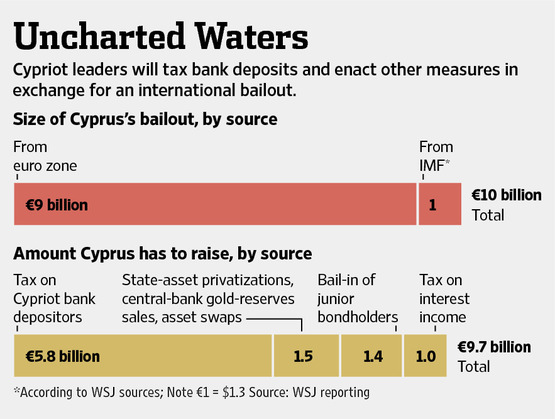
For those who haven't heard, the latest Eurogroup summit on Friday (or better Saturday morning) ended with an agreement for Cyprus to impose a one-off deposit tax of 6.75% on deposits up to €100,000 and 9.9% for over that amount. In addition, the Cypriot government has agreed to increase company tax to 12.5% from 10% and privatize some of its profitable state-owned businesses. The total amount expected to be generated from the Cyprus deal is the following:

Source: Wall Street Journal
The so called Troika has been arguing that a €17bn package would be sufficient to revive the island's economy, yet it would make its debt burden unsustainable as it approximately equals Cyprus's GDP. Yet, it appears that the total funds which have to be generated will near €20bn, of which €5.8bn will be produced via the deposits levy. A levy which has caused global outrage given that it affects deposits which were considered to safe under every scenario; most importantly it creates a precedent which experts fear that can be used against Italy or Spain when they opt for a bail-out. Another question which has not been answered yet is why was the amount increased and if the Eurogroup is essentially forcing Cyprus to pay on its own.

The German Chancellor Angela Merkel, as well as most German politicians who appear to support the aforementioned deal, stated that Cypriot depositors should assume responsibility for what their banks have done. Money-laundering and the extreme size of the Cypriot banking sector are often brought forward as the rationale behind their actions. (for a review of the money laundering issues in Cyprus, Matina Stevis's article in Wall Street Journal is an excellent source)

Let's take these issues from the start:

1. Money-laundering: It may (or may not) be true that Cypriot banks have been involved in money laundering activities. However, it is quite unlikely that ordinary people who are working in 9-5 jobs in any sector are involved in this. Yet, it is these people who are being targeted in the levy. Not high-profile managers, lawyers or bankers but people who are struggling to save some money to pay for their children's education or have an easy retirement.

2. Risk Premia: Some have also argued that "with interest rates as high as 5% in term deposits there was a substantial risk premium which indicated danger". Perhaps this is true. However, these rates only apply for term deposits with amounts in excess of €50,000 and not for current accounts or savings accounts where most of the money lies. In addition, not everyone is a hedge-fund manager with the ability of sending enormous amounts of money abroad. Everyday citizens cannot afford the luxury of having their paycheck deposited in Germany or anywhere else in Europe for that matter.

3. The size of the banking sector: Stories have been circulating the web that the problem is Cyprus's enormous banking sector. The following graph indicates that private sector deposits in Italy are much higher than the ones in Cyprus. From the same data it appears that Ireland's case was much worse prior to 2010. No-one can doubt that the banking sector is big indeed. Yet, forcing it to break-up (for example exiting from Europe) will mean that you are depriving it of many growth opportunities over the next decade; especially after it has taken all the losses from bad loans and bond haircuts.


4. Greek PSI: One cannot help but wonder why the EU had not taken into consideration that the cause of the Cyprus problem was essentially the decision to slash the Private Sector Involvement in Greek bonds by 70% (a proposal that the former Cyprus Central Bank Governor Athanasios Orphanides had strongly opposed). The decision cost Cyprus approximately €5 billion (without counting for the bad loans which arose as a consequence).

The worst part of the deal is that it is bound to set a precedent: if Italy applies for a bail-out fears of deposit haircuts will wreck havoc in the country's economy with a bank run bound to occur as soon as the news hit the market. Although Cyprus is not systemic per se, the trust issues which arise are. From now on, every time a country will opt for a bail-out fears of deposit haircuts will evoke memories of the Cyprus case. 

Frances Coppola wonders "under what type of taxation scheme are people provided with shares to compensate them for the taxes they have paid?", while on another post yours truly has argued against risk-free assets transforming to risk bearing ones. While the Cypriot Parliament will reconvene tomorrow the question on when the banks will resume business is still vague: Although today is an established bank holiday, tomorrow has been announced as one as well. New information says that a new plan will involve less cuts for those under €100,000 (approximately 3%), yet this is still unofficial. In addition, small depositors are almost sure not to take their money abroad. It is the big depositors, with millions of funds who are the threat to the island's banking sector.

What poses the greatest threat for Eurozone's health is not that Cyprus will cause a bank run in other Member-States; it is highly unlikely (although a run will probably occur in Cyprus, with foreign depositors leaving en masse from the island). What is feared is the precedent: if they have done it before, they can do it again. And an escalating crisis arising from bank runs in Italy or Spain under rumours of bail-out could probably bring the Eurozone at its knees.

Sunday, 17 March 2013

5 Unanswered Questions on the Deposits Haircut

The Cypriot Parliament was to convene today concerning the issue of the deposits levy, yet sources state that they have postponed the issue until tomorrow. I am not a Member of the Parliament (not a very pleasant occupation during these times) yet if I was I would be worrying about several complications the 6.75-9.9% tax would cause.

1. What happens to the money?
If the haircut goes through then the two big banks (Cyprus Popular and Bank of Cyprus) will have an additional €5.8 billion in share capital. From what I can assume, approximately €4-4.8bn will be put to the former and €1.8-1bn to the latter bank in order to raise their capital adequacy ratios (namely Core Tier 1 and Tier 1). This is to be considered as cash accounting-wise since banks will ship the funds obtained via the haircut to the Central Bank, which will then distribute them as per each bank's needs. Then as shareholder equity will be increased to account for the increase in share number, cash amount will also be increased by those amounts. What will the banks do with that money then? If we assume that assets are down (due to the levy) then adequacy ratio will not be so hard to be reached and even exceed. Thus, the banks remain with three options:
    • Use it to infuse liquidity in the market by way of lending
    • Keep it as reserves
    • Fund government debt
Option 1 would be the best for the overall economy, since it will boost businesses and assist in both consumption and investment. The only drawback is that the Cypriot people may just be too scared to invest or consume now. Option 2 will do nothing more than safeguard the banks in the case of the economy worsening (which it will do if Option 1 is not used). Option 3 will be very good for the state, yet the economy will not be able to enjoy this as the state cannot boost it through payments or investment (given the austerity measures and its agreement to abide by austerity and decrease it's budget deficit). Ideally, a combination of all 3 would be the best choice. Keep some money as reserves, boost the economy by providing liquidity in the form of loans and fund some government debt in order for the state to continue functioning smoothly.

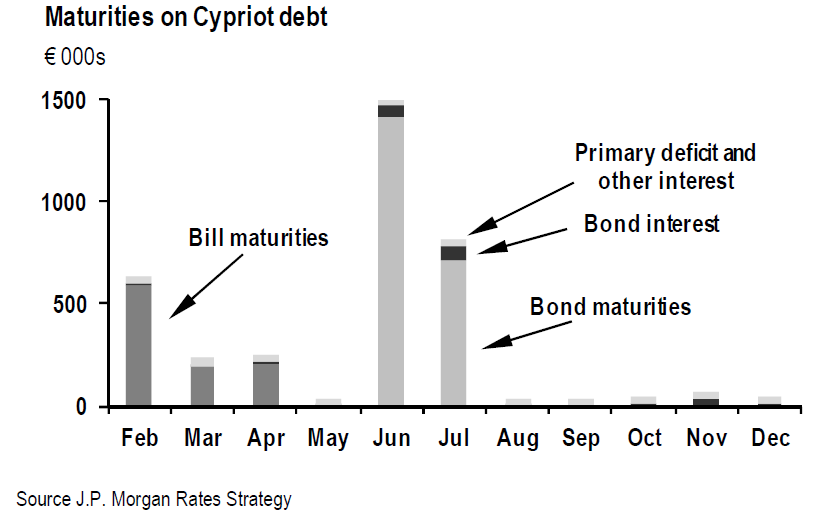
2. Why does Cyprus need so much money (about €10bn) to sustain its government debt if it's deficit will be less than 3% in 2013 and Russia will roll-over the €2.5bn loan?
The question is pretty obvious: if the 2013 deficit is expected to be approximately 3% which is considered a yardstick for debt stability why does the island need  €10bn? In 2013 the debt maturities are:

This means that all that is needed is to roll-over the debt, provided that no surprise expenses arise. Even if they do, then part of €5.8bn obtained from the deposits levy can be used to fund those. Then, the question once again becomes why does Cyprus need an additional €10bn?

3. What happens to loans attached to deposits?
Many banks do the following practice: they lend you €X while they freeze your €X cash amount in their accounts. Thus, they benefit from interest rate difference and you get a much lower rate. This kind of loan is considered to be 100% safe. Yet if you have a €110,000 loan guaranteed by a same amount term deposit then the levy would mean that your deposit is now worth €102250 (6.75 until €100,000 and approximately 10% after that). This is equal to a 7.05% decrease which the bank would now have assign an appropriate risk weight. I cannot know the numbers but how much will that additional risk weighting cost the Cypriot banks? (and this time were are talking about all the banks not just the two big ones)

4. Why sell out all bank branches in Greece?
Greek Finance Minister Giannis Stournaras has announced that Greek banks will almost surely take over the operations of the Cyprus banks subsidiaries in Greece. The problem with this situation is that Cypriot banks have assumed all the damage so far (i.e. 70% PSI, bad loan write-offs) which exacerbated their balance sheets. In addition, Greece is most likely out of the deep now and will start growing again in 2014-2015. Admittedly the worst is done. If we already know this, how can Cypriot banks grown over the next decade if they are being denied of all their opportunities? They have taken all the damage there was to take, and now just about when things are going to get better they are denied the opportunity to profit from their operations. Now that doesn't sound like a good scenario does it?

5. How can the outflow of money be stopped? 
Nobody can doubt that many foreigners will intend to remove their money from Cyprus. Some will, other will not (the rationale for the latter being they have already taken what they wanted). Yet, can Cypriot banks cope with such an outflow? Wouldn't that severely damage their deposits' base? How will regulators and banks react if on Tuesday €10bn want to exit the system? Bank runs can be electronic nowadays too...

Given all the above, it makes being a Cypriot MP probably one of the worst jobs in the world. If they can answer all of the above and be certain that the benefits exceed the negatives then by all means go ahead with the haircut. But, wait a second; can you really be answer all of the above and be ready for their worse case scenarios?

Don't think so... The return to the Cyprus pound does sound more attractive now doesn't it? If one can bear the consequences that is...

Monday, 4 March 2013

Why a Deposits Haircut is a Terrible Idea

One of the newest ideas that the great masterminds of the European bail-outs have come up with is the one where a deposit haircut takes place, in order for the Cypriot state to assume less debt in the bank re-structuring process. Although we have not yet seen what such a proposal actually promotes (since it has also never been implemented in any country in the world), it would be save to assume something of the following according to Reuters:

People with deposits over amount X in a bank (although it has not yet been defined whether this would include just banks which need restructuring or any bank at all) would take a loss in order to make the banking sector smaller; this loss is expected to be compensated by new share issues. Reuters puts number X to equal €100,000.

The amount at first appears significant enough; not everyone can brag for €100,000 cash in their accounts can they? Yet, a closer look shows otherwise. A person who saves just €110 a month, assuming a 3% nominal interest rate, will end up with more than €100,000 in the bank after 40 years. Would anyone call such a person rich or well-off? I do not think so. It is more likely that this person plans to send his children to the university or live his later years live more easily with that amount.

Then, we should consider the risk assumed by the deposit-holder. Cash are unanimously considered as zero risk financial assets both because they are guaranteed by governments and because the initial investment is never at risk. If such a scheme is applied then we are essentially transforming risk-free assets to risk-bearing ones. What is more, we are transforming them into the second riskiest asset class (the first one being derivatives) there exists: stocks. Why would a person, who does not want to assume any risk, be willing to put money in the bank then if they are safer under the mattress?

In fact, a deposit haircut appears to be even worse than most austerity measures. It is a purely un-democratic proposal which aims precisely at allowing innocent people assume responsibility for someone else's fault. Austerity measures are usually promoted with the aim of reducing state expenses and affect the current income of workers; the deposit haircut is promoted just to save financial institutions and it affects consumer wealth. If we know that a decrease in government spending leads to a reduction in consumption and an increased rate of non-performing loans how can we even believe that the results of decreasing wealth will not have even worse results in the real economy?
As already noted, this has never before been implemented in any part of the world. If Cyprus, who under the English Law allows bondholders to sue the state for any debt haircuts, tries to implement such a scheme, results are bound to be devastating. In a 2010 paper on repo haircuts the authors conclude that (emphasis my own):

"Increases in repo haircuts are withdrawals from securitized banks - that is, a bank run. When all investors act in the run and the haircuts become high enough, the securitized banking system cannot finance itself and is forced to sell assets, driving down asset prices. The assets become information-sensitive and liquidity dries up. As with the panics of the nineteenth and early twentieth centuries, the system is insolvent"

Their results can be easily understood in terms of trust. If I do not trust that the bank will take care of my money and that they will be there when I need them why should I keep my money there? Then, if this does not hold for me, why should it hold for everyone else? Thus, we all refrain from keeping our money in the bank and we move to withdraw them; bank runs occur. With the enormous drop in liquidity the general economy also takes a tumble. For those who do not believe that such bank runs are possible nowadays I would point that Cyprus lost €1.7 billion in deposits during January, when this scheme was just a rumour.

The time for utilizing ESM funds has arrived. Although Mario Draghi put the markets at ease in September by saying that the ECB will do everything it takes to keep the euro alive, very few will still believe his words if they are not put into practice. The EU officials should be thankful that the opportunity to test the ESM came with Cyprus and not with Italy or Spain. If something does not work in the Cypriot case then the amount of money lost will be minimal compared to what would happen if Spain or Italy were assisted and things did not turn out as planned.

Again, let us not forget: our economic system is based on trust. If we cannot continue to trust the system then it will simply collapse.

Wednesday, 1 August 2012

Interest Rates and Growth-Part 2

In the previous article I have shown data which indicate that the interest rates for loans in the South is much greater than the ones in the North. One way of explaining why is by looking at the bank rates for deposits with maturity of less than a year (Source: ECB). Have a look:
Cyprus

Greece

Spain

France
Well I think that the graphs are obvious: the cost of money for the Southern banks is substantially higher than for the Northern ones (for a graph of Germany's deposit rates take a look here). So, apparently the lending rates will be higher in the South than in the North. The big question here is why does it cost so much get new money in Cyprus, Greece and Spain?

In my opinion it boils down to two things: Uncertainty about the future of the economy and the banking system and the constant need for new money to fulfill regulatory requirements from a fixed pool of deposits. 

While the first is obvious, meaning that when a depositor or investor fears about losing his money he should be given a risk premium (i.e. additional motives, in this case a higher interest rate) in order to entice him not to leave. However, as many investors are risk averse (i.e. afraid of taking risks, in the finance lingo) they are fearful of moving their money to a country with economic difficulties and thus banks have difficulties in getting money from abroad, especially if they only operate within the country.

It is true that most Southern countries do not have banking institutions which operate in many EU countries. For example while Bankia, is the 4th largest bank in Spain and while it operates in Germany, Austria, China, France, Ireland, Italy, Poland, Portugal, the UK and the US it has limited access to funds outside Spanish borders. In the end of the spectrum, Banco Santnader, with significant presence all over the world has negligible needs. The same goes for Cyprus as Cypriot banks only have important presence in Greece, which has now evolved as the main cause of their problems. The only bank with a relatively large presence in the island which is not either Greek or Cypriot is Société Générale. In Greece HSBC and Citi are the only ones which are neither Greek nor Cypriot. In all three countries the market share of international banking institutions is minimal. The same holds for Italy, where only UniCredit has substantial presence in foreign markets.

Although I am not in favor of large banks (remember too big to fail scenarios in 2008-2009?) in this case, having a presence abroad would mean access to cheaper deposits, thus in its turn lowering both the deposit and lending rates in the country. Note that the banks which needed government intervention for continuing their operations during the EU sovereign crisis (and not the sub-prime lending one) were mostly the ones with limited access to foreign cash.

In addition to what I have said above look what the Governor of the Central Bank of France has stated: the interest rate facing individual private banks depends on the funding costs of the state where they are domiciled and not on the ECB overnight interest rate”

Yet, it seems like none of the EU policies has taken this phenomenon under consideration. If policies in the Euro level cannot have any effect in the national level then what is the Union's and ECB's purpose?