Showing posts with label recession. Show all posts

Friday, 27 December 2013

New Year's Change of Mind: Was the Cyprus Haircut more equal than we think?

2013's most startling development was probably the Cyprus deposit haircut, an unprecedented event which caused numerous reactions around the world. In March, the Eurogroup came up with Plan A, i.e. to haircut all existing depositors, regardless of institution or the amount of money in their accounts, at a flat rate of 6.75%; a decision which the Cypriot Parliament rejected. After 2 long weeks of bank "holidays" and intense negotiations, the plan changed to the dissolution of Laiki Bank and the haircut of all deposits above 100,000 euros in the Bank of Cyprus (the final amount of the unsecured deposit haircut was 47.5% as agreed in late July).

My reaction to the first plan was that it was unfair: a person with €10,000 in his bank account would suffer more than a person with €10 million in his after a 6.75% cut. The second plan still seemed unfair but had the advantage that depositors in other banks would not be hurt and that the "little guy" would remain an unscathed. Obviously, the "big boys" still get hurt, which means less investment and less growth, equaling more unemployment. Yet, there is actually much more good in this than was first considered.

First of all, the ones which got hurt more in the crisis were not CEO's or other businessmen; it was paid employees. Have a look at the following table compiled by the Economic Policy Institute:
As the reader may observe, in 2011-2012 average worker compensation shrunk by 1.6% while average CEO compensation increased by more than 14% during the same time-frame. What this indicates is that high-income earners do not get hurt by much during a recession. The average paid employee does. The simple reason is that the worker goes out first and the businessman continues to operate; most importantly it is the latter who makes the decision not the former. Even when a recession begins to fade out the businessman can exploit the situation and earn much more than before since wages are much stickier than profits (as also seen in the 2013 results of US firms).

The trouble with Plan A, i.e. the haircut on both secured and unsecured deposits is that the former (i.e. secured depositors) are more prone to the use of their wealth than the latter. As Simon Kuznets has shown back in the early 50's, the higher the income, the less percentage of your income you spend (for a discussion of austerity and income see this). This means that most of the money a low- or middle-income worker earns will end up back in the economy in the form of consumption. On the contrary, the money a high-income person earns are employed differently: if you take away from him, his consumption will not be reduced by as much for the simple reason that he will just save less. Since the economy is mainly driven by consumption (it comprises of the largest part of GDP) if it decreases, GDP will also be decreased.

A question which may arise concerns the banks' ability to lend if we experience dis-savings. The thing is that it will not matter by that much. Remember that if one spends, another will pocket the proceeds, thus the money ends up in the bank anyhow, i.e. the bank will not lose any funds. Second, even though the bank has less deposits now, it has much greater equity which allows it to lend out more funds to boost the economy either directly or indirectly.

This is what has happened in Cyprus since March: those with big, unsecured deposits, found themselves at a loss. Recent IMF estimations, after the second examination of the island's program development, showed that private consumption has fallen by just 2.8% year-to-year, much less than the severe contraction in Greece or other periphery countries, even though the unemployment rate has reached 17% (the 3rd highest in the Eurozone). Since private consumption has not fallen by much, GDP contraction was less than expected. Most importantly, what the less-than-expected decrease in consumption means is that Cyprus has a better chance of experiencing growth faster than other countries is recession; since demand does not fall, employers have less incentives to fire people and businessmen have greater incentives to invest.

There is a caveat in this though: the haircut exacerbated the already declining confidence in the banking sector, meaning that individuals prefer to keep their money under the proverbial (in this case even literal) mattress than deposit it. This can be easily seen in the data, with total deposits following a downwards trend since March, forcing the banks to request liquidity from the ECB. Yet, as the IMF points out, this exit of deposits appears to have reached its peak, with the overall amount in the system stabilizing in October. NPL's are still a major cause of headache in the island, yet an increase in consumption, in addition to the banks' increased ability of issuing of new loans due to higher equity ratios means that better days are ahead.

Summing up, the haircut on unsecured deposits is much more equal than first considered. It hurts those with larger wealth, who spend much less of their income (as a percentage) than those who are on the other side of the spectrum. This means that consumption is less affected by the haircut than by austerity measures: compare Greece and the succession of harsh austerity measures and tax hikes imposed which resulted in a 5-year depression to Cyprus where the haircut was accompanied by mild austerity measures (mostly in 2011 and 2012, with a few ones in 2013). The difference is extraordinary. Yet, as mentioned before, the haircut's caveat is the exacerbation of the already fragile trust towards the banking system, which is the cause of decreased liquidity; yet, if the ECB can ascertain that it will live up to the task of providing "whatever it takes" to the banks, it might be that the haircut is not a terrible idea at all.

Friday, 13 December 2013

Capping Banks' Rates

I've recently been in a discussion win which some academic proposed an interest rate cap for bank loans. When I asked whether he meant during the crisis or in general, his answer was "of course in general". His argument was that given the Modern Portfolio Theory which states that specific risk can be diversified away, when banks have a large amount of people as loan-takers then their individual risk will be diversified away and all you will be left with will be systematic risk which you can do nothing about. Thus, if the risk you have is just the latter, why should the banks charge different interest rates to lenders?

Although at first the idea might sound appealing to some, (it also abides with the "banks are bad people are good" motto), the problem with these kind of statements is that it shows a basic misunderstanding about how both the banking system and the risk-reward relationship actually work. To begin with, even in academia, higher risk is associated with higher reward. The basic reason is that you require a higher expected return to invest in something which will have a higher probability of costing you money. Simply put, if the risk of losing money is 10% one will surely ask for more potential money than if the risk is 5%. Thus, if the bank chooses to lend money to someone who has a 10% probability of defaulting then it makes sense to charge a higher rate than the one to be charged to someone whose probability of defaulting is just 5%.

"Sure" the academic would go on "but that risk can be diversified away". Well it depends what you really mean by that. Suppose that you have a stock market with stocks, between which you have to distribute your funds, having the following risk-return relationship:
Now suppose that someone told you that regardless of the risk, all stocks would have returns of exactly 6%. Where would you put your money into? Any reasonable investor would not be foolish enough to put his money in any stock which has a return of more than 6% in the above scenario because he knows that he will not be compensated for the risk he will assume. Thus, stocks 1,4,7,8,9 and 10 would have no-one to purchase them since their return would not be sufficient for the risk the investor assumes. In addition, stocks 2,5,6,11 and 12 would receive too much attention from investors since the risk they are posing is very little compared to what the capped return has become.

Let's put this is into banking perspective: instead of stocks, we have loans. Loans with higher expected return are those with higher interest rates, as for example business lending. If we cap the return banks can have at e.g. 6% then there will be loans which will not be issued, although in normal times the bank would most likely assume that risk and provide the funds (at a higher rate of course). What would this mean: essentially, those who have safe assets they can put as collateral, such as real estate or cash, would get funding while those who do not (for example 90% of the population) will not. This policy is not that terrible to the banks as they can adjust for these shortcomings; it is much more hazardous to the ordinary person who does not have collateral and cannot borrow at the low rates the bank will offer.

Why can't we force the bank to lend to the little guy you might inquire. Simply because the little guy bears more risk than the "big" guy. The bank has the discretion to reject any loan application it does not fit its risk-return profile. Forcing the bank to take up any loan while at the same time capping the rate is not a good idea; unless of course we really want another sub-prime lending crisis. 

In addition, high risk loans require higher capital requirements: business and consumer loans without any guarantees require much more than the 60% it is required for guaranteed ones. But the banks still give them. Not too many of course but they do. The thing is that if you take out all of the high risk loans you will be left out with no new Facebook, Google or Twitter. To get big you have to start small. And small without any lending is just tiny.

The reader would notice that my question was on the timing of the policy: if this is just a policy to be implemented as a short-term one I would have no problem against it. Why? Simply because just after a crisis banks are less willing to lend, and if they do then they lend to those who has a very low risk profile (i.e. the "big" guy). You don't have to take my word for what I described in the previous sentence; Hyman Minsky and Joseph Stiglitz said it much better, more than 30 years ago. Thus, as banks are less willing to give out funds, it would be much better to cap the rates during a crisis than after or before it for the simple reason that it would be much better for the existing loan-takers. It would take the burden off their shoulders, create an additional boost in consumption (or increase savings), thus moving us out of the recession. 

The short-term nature of this cannot be over-stated. If such policies are to be followed in the long-run then we would be in a situation where those who have will get more and those who haven't would get nothing. This is not only unfair it is also economically inefficient as, growth would also be threatened under such a scenario as no new high-risk projects would be assumed. Summing up: capping bank rates is good for the short-run, but only during a severe banking crisis; otherwise it does more destruction than benefit.

Friday, 22 February 2013

Let Cyprus fail? Why?

Although I thought I would never have to write anything more of the subject it appears that some people just don't get it. The usual comments on the subject include "why save Russian oligarchs?" or "why is the country systemic?" or "they are have money laundering issues" or even "we should set a precedent". Again, I will direct any people who still believe any of the above comments to some of the previous posts on this blog, where you may find a long explanation of why these are not good excuses. (the reader may have a look here, here, and here).

In brief the answers to the above comments is that:

1. Why save Russian oligarchs?
Answer: Russian oligarchs are in no need to be saved by anyone. They can simply transfer the funds from one bank to another at the click of a mouse. And no oligarch has such an important amount of money in the country that it can really affect him even if he loses it. The bail-out is for the Cypriot banks which have suffered from the inane decision for a 70% PSI and for the government for is to take us this responsibility. In essence, it is for the Cypriot people and not for the rich. This is capitalism people; the rich are well-off both in recessions and booms.

2. Why is the country systemic?
Answer: Does it really matter? We are not talking about handing them with €100 billion but with €17. This does sound like much for us ordinary people but it isn't really that much for a government. And if the agencies do their mathematics well they will see that the whole situation can be reversed with about €4 (for details have a look at this article).

3. They are have money laundering issues  
Answer: Not really... According to the non-profit Basel Institute on Governance Cyprus is on the 114th position for money laundering. (the lower a country is ranked are less possibility for money laundering exists). Compare that with Germany (68th), Netherlands (109), United States (97th) or Switzerland (71th) and Austria (74th). And I do remind you that this is an independent organization.

4. We should set a precedent
Answer: Set a precedent for what? When the EU screws up in its decisions (hint: 70% PSI involvement on the Greek haircut) why are going to let those affected by those, fail? So the rationale behind this is simply: "we didn't let Greece default, but we screwed up thus we have to let someone else take the fall for no apparent reason". And who is easier to take the fall but the little guy? Of all the excuses for not helping Cyprus this is by far the worst; it exemplifies the sort of money-focused, nationalistic, opportunistic behaviour which the EU was hoping to destroy. What do we care if a nation is destroyed based on our bad decisions?

There are two options actually: either they get the money or the fail. If it's the second then why not exit the Eurozone and print some new Cypriot pounds to compensate for their losses? And if this happens how about some new pesetas or drachmas? I repeat what I have said before: if one country exits the Eurozone or the EU then others will follow.

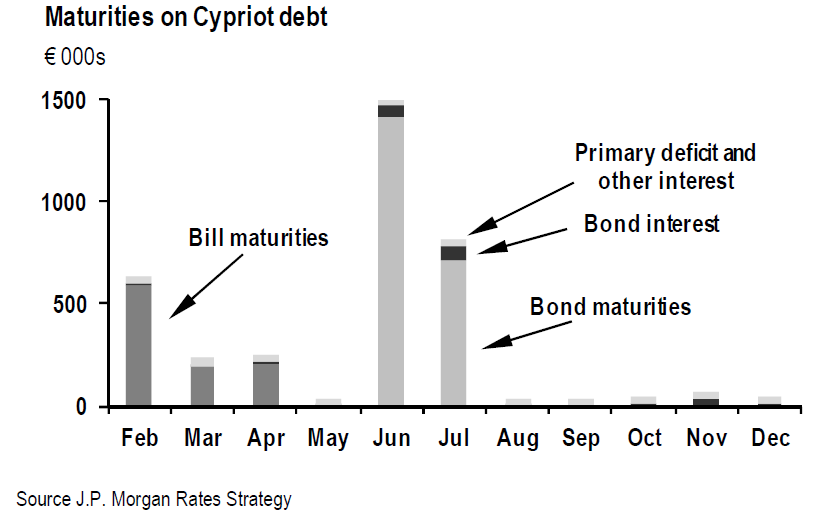
A look at the graph at the beginning of this article will tell you that the Cypriot state does not really have a problem with debt maturities before June and July. It is claimed that if Cyprus can last until the German elections in September it will be easier on them. But if they can last until September then why bother with a bail-out?

Thursday, 14 February 2013

GDP is falling down...

Eurostat published its latest statistics on Q4 2012 in the Eurozone. Nothing that we did not expect actually: Portugal -1.8%, Cyprus -1.0%, Italy -0.9%, Spain -0.7%. No statistics were published regarding the state of the Greek economy.

These results indicate that during the last three quarters the Eurozone had a contraction in each and every one of them. (I would remind you that the definition of a recession is two consecutive quarters with negative GDP growth. And we are experiencing three...)

What many did not expect though was the following:
Germany: -0.6%
Finland: -0.5%
France: -0.3%
UK: -0.3%

We all thought that the German economy was impervious to such things as recessions right? Well, let me remind you that this was a not-so-unexpected phenomenon. I have explained that the recession would have a very important effect on the German exports (which are about 60-65% to countries within the EU, and specifically within the Eurozone) in this article published in mid-November. Wolfgang Schäuble was said to secretly prepare for this downfall in the last days of 2012 by "cutbacks to prepare for a weakening economy and possible fallout from the euro crisis" (for details read this).

It looks like this time is now here for Germany. I have no other explanation for persistence in plans which do not work than obstinance and illusory beliefs and views of the world. If Schäuble is allowed to do the same with Germany as he proposed (and unfortunately pulled through) with Greece, Spain, Portugal and Cyprus the Germans are in for a much worse fate than they expected. 

And this will only be the beginning...

Monday, 7 January 2013

Eurozone in Recession

It appears that what we had been thinking about has become a reality. In a recent article, Eurostat indicates that the Eurozone has retracted by 0.1%, while it rose by 0.1% in the EU27 in the 3rd quarter of 2012. Add this to the previously known -0.4% and -0.2% for the second quarter and we have our very first official recession for the Eurozone, meeting the formal definition of two consecutive quarters with negative GDP growth. 

What difference does it make one may ask? If one considers that GDP is a broad measure of the economy's well being, then it says a lot; notably that our economy is getting smaller and smaller with this having tremendous effects on unemployment, consumption, production and investment. As can be seen from the publication, investment has fallen by 0.7% meaning that the next quarter will be even harder if measures are not taken to ensure that investors regain their trust in the economy.

In the meantime, Spiegel has stated that Angela Merkel should tackle the problem of stabilizing Europe against the crisis in 2013. So far, the German government has done nothing to ensure that the crisis will soon be eliminated. All they have achieved until now, is a mountain of austerity measures which have destroyed the productive ability of most of the South's economies and proceeded in the alienation of Germany's views and tactics from the rest of Europe.

A rapid proponent of these views and tactics is the most important German economist (as a result of his position) is nowadays Jens Wiedmann, Bundesbank's President. In a recent interview, (which can be found here) he has stated that:
"The core of the crisis is located in the periphery countries: burgeoning household debt, excessive government debt and insufficient competitiveness, which creates doubts that those countries will be able to manage their debt burden on their own."
Not willing to come off very bad here Jens, but isn't the Greek haircut one of the major causes of the worsening of this situation? And let us remember who designed, proposed and voted for it: the Eurogroup. Let's also assume that every politician in the South was stupid enough to accept this without viewing the consequences it would have to their countries. How about the Bundesbank or the ECB? Out of the thousands of economists employed there not even a voice of disagreement on the had been heard. And now, competitiveness, household and government debt are being blamed. 
Hamburg Bundesbank. Source: Wikimedia Commons. Author: Andreas Praefcke
I would not argue against the South having these problems. Yet the transition between over-spending and spending would have been easier than the transition between over-spending and no-spending! The point is we did not need such a great recession in the first place. The transition could have been much smoother had the ECB and the Eurogroup taken better measures to tackle the situation. Let us not forget however that the crisis is, first of all a crisis in institutions either in business and finance or in politics.

Nobody can remember all announcements by either the ECB nor the Bundesbank but if my memory serves me right neither of the aforementioned institutions had said anything about competitiveness or household and government debt in the periphery. If they had not known then why are they blaming Member-nations now or if they had known why didn't they warn us about this? It appears that the Bundesbank is merely trying to save its reputation and justify its actions and stance on the whole subject by assigning the blame to someone else.

Friday, 16 November 2012

The Effects of Recession on German Exports

Let's admit it. Germany one of the most well-off nations in Europe at the moment. The monetary value of its exports rank it as the second country in the world after China. Yet, although it has been mentioned that Germany has been lucky to have demand for its products rise due to emerging economies the data might suggest something different. In total Germany exported goods values about €1.061 trillion in 2011. Here is the list of the top 20 country to which Germany has exported goods:
Source: Statistischess Bundesamt, Wiesbaden.
As you may France, the Netherlands, Italy, Belgium and Spain account for about €350 billion of German exports. Why did I just select these countries? Well, France's economy is at the brink of recession, with zero growth over the last two quarters, Belgium has already initiated austerity programs and has seen its GDP contract by 0.2% last quarter and the Netherlands have just resurfaced from recession. And the reasons are obvious for Italy and Spain. (second quarter data can be found here)

Even if we just measure the most distressed nations in the Union (Greece, Spain, Italy, Portugal, Cyprus and Ireland) the total amount of exports to those nations is €112 billion, more than 10% of total exports.

The above graph shows the percentage of intra-EU and extra-EU trade per country. As you may see, about 60-65% of Germany's exports are within the EU. The only nations which have a high percentage of non-EU exports are Greece, Italy and the UK.

What is my point here? That when recession hits a nations, the first thing that falls is imports. And to nations who depend on each other for imports and exports, this is of tremendous importance. Imagine what would happen if suddenly all 6 of the above nations saw demand for foreign goods collapse (and need I remind you that with the possible exception of Ireland we are talking about countries who are producing and exporting great amounts of food and cheap clothing so we can assume that they are importing goods whose demand is elastic, i.e. can vary according to price or buying power) then Germany will lose a vast amount of its trade. And when this happens then I am sure that France and Belgium will be the next places where demand for imports will fall as well.

I do believe that Europe is now facing its own Great Depression. As no measures have been taken, it would be easy to see that an EU-wide recession will eventually set up. Although Germany now has a very strong economy, as so do the Scandinavian nations, the correlations between nations are so strong that one severe recession in one country can cause a domino effect. Time will indeed show...

Thursday, 6 September 2012

A change in mentality?

Over the last week a serious change in attitude towards ailing countries within the EU has occurred. Leading with Chancellor Angela Merkel, the political scene in Europe has witnessed a 180 degrees turn. The change was so radical and impressive that Der Spiegel has published a full article on this. This could mean one of three things: 
1. The South has made real progress over the last month (hmm or week maybe?).
2. Merkel has understood that her policies and stance are making both her as well as Germans in general extremely unpopular in Europe (and elections are coming up in a year).
3. She has accepted that trying to push through many things very rapidly is not such a great policy after all.

Whatever the reason may be (Spiegel states that it's No2) the fact is that leaders now appear to be more united than ever before. Even statements of the "Greece should leave the euro/Union" kind are treated coldly by EU officials now. Still, as progress for unification in the political level appears to be improved the economy still fails to recover. Italy, just like Spain and Greece, has seen unemployment rates soar over the last months. While Mario Monti is doing his best to improve the overall economy, unemployment of youths under 25 has reached 40%. And with recession here to stay in Italy (forecasts expect GDP to contract by 2% this year) the situation does not seem to improve. 

European leaders fail to understand that people cannot live on GDP. After an EU-wide summit on unemployment nothing seems to have changed: the employed have not (cannot?) find anything to do about the jobless. I have proposed my set of ideas over reducing unemployment here, and while the list I have presented is not exhausting nothing has been done yet. Just as I have predicted, the EU will face a recession over the next few months. New evidence indicate that the recession will be far worse than we expected. The Purchasing Managers' Index (PMI) for the Eurozone predicts that the output will shrink by 0.5-0.6% over the current quarter instead of the initial 0.2% prediction. 

The worst part of these forecasts is that the EU's safest economy, the one where people actually paid to invest their money, Germany, is bound to move to the red. The OECD predicts that although Germany has grown by 0.5% and 0.3% in the first two quarters, in the following two an annualized contraction of 0.5% and 0.8% is expected. Only France may be able to remain more-or-less unscathed with output falling this quarter and rising on the next.

In addition to all these, Mario Draghi has announced a program allowing unlimited purchases of sovereign bonds in the secondary market, in order to keep interest rates at sustainable levels. The only opposition to this program is Bundesbank head Jens Weidmann who believes that the program is too close to state financing through the money press. He may be right up to a point, however, I do believe that the program is much ado over nothing, The problem with what Draghi has proposed is that the ECB will only assist countries that appeal for help to the euro bailout fund and submit to the required austerity conditions. What he also meant is that the ECB would only be able to do this for nations which are not considered as junk by the 3 rating agencies (Moody's, Fitch, S&P), i.e. Greece and Cyprus cannot be assisted.

Thus this leaves only two countries: Italy and Spain. However, the announcement failed to mention the amount which would be available to fund this action. Given the size of the Italian and the Spanish economy, it would have to be enormous. Yet, we are still unaware of the size and extent of the intervention and it would be nice to know some more details about it instead of the general idea.

In the meanwhile, what journalists have not yet proposed is that another reason of Merkel's newly appeared empathy towards the crisis-ridden countries maybe be that she is preparing to identify herself with the rest of the ailing nations if OECD forecasts are true. We will just have to wait until the official data is published to find out.

Wednesday, 29 August 2012

Signs of the Crisis Ending?

An article in Der Spiegel yesterday mentioned that the crisis-hit countries in Europe are becoming more competitive as a result of reduced wage costs and trade imbalances. Specifically, Italy has reduced its trade deficit to almost zero, while Spain and Portugal have reduced their current account deficits by 50% and 40% respectively. Greece has managed to reduce its trade deficit by 54% from 2008 to 2011 and its exports have reached their 2007 level. Meanwhile, Italy has issued new 6-month bonds with their coverage reaching 1.69 times over the amount issued, with interest rates falling to 1.585% compared to 2.454% in their end-of-July issue.

Does this mean that the crisis will be over soon and Europe may breathe the air of growth again? Well... Probably not. I hope I may prove to be wrong, however "One swallow does not a summer make". Maybe GDP will not fall during this quarter, although I highly doubt it. However, people cannot eat GDP or any other macroeconomic indicators for that matter. Job creation is still low in all Southern countries and unemployment is sky high. I have stated it before and I will state it again: this quarter's results will sink Eurozone into recession. Although it will not last for more than a quarter at the EU level, a recession will hopefully make some politicians and policymakers reevaluate their actions on the matter. 

This will hopefully bring an end to the current Grexit scenarios as the country's economy will not contract any more over the next years. However, the need for more austerity measures over the next year still exists, in order for the nation to become more competitive.

Wednesday, 15 August 2012

Welcome Recession

Yesterday, Eurostat published a news release concerning the GDP data of the Eurozone countries, compared to last year's. Not surprisingly, the results were that Greece's output shrunk by 6.2%, Spain's by 1%, Cyprus's by 2.4%, Italy's by 2.5% and Portugal's by 3.3%. Even in the UK, output was reduced by 0.8% compared to 2011. The only surprise was France, which avoided recession (which is measured as two consecutive quarters of negative growth) by reporting a 0.0% change compared to the previous quarter.

Germany's GDP on the other hand, rose by 1.0% a change attributed mainly to an increase in exports and domestic consumption, as investment levels have fallen. In general, GDP dropped by 0.2% both in the EA17 and EU27, while in the previous quarter it had remained stable at 0.0% change. What does this mean? Well essentially, if the next quarter is one of negative growth, the EU will officially be in recession. And I am almost certain that there will be negative growth in the next one.

That is, unless Mario Draghi (or any other EU official) decides to do something about this. By something, I mean effectively use his power as the ECB governor and buy bonds directly, which would boost investment and restore confidence in the region, something that he directly stated that the ECB could do in the future. I hope that Mario Monti's statement that "we have to reach the night before the euro collapses in order for the ECB to do what it has to do" proves to be wrong. I really hope that the officials will come to their senses before it is too late and large-scale measures to save the Eurozone have to be devised. 

Nevertheless, I do think that another quarter of negative growth, moving the EU in the recession zone, will be their wake-up call. We are humans, and like human beings most of us have do not care as much about the future as we do about the present (talking about German policies here; to be accurate it's just Merkel policies as many in Germany oppose her actions). In order to change ideas and mentalities we have to be convinced that things are going bad. Entering a recession will do that kind of convincing.

It seems that "smart" people need to wait until the very last minute to be convinced that their policies have created more chaos rather than reconstructing the Union. That is why an EU-wide recession is needed and, unfortunately, we are going to get one. Just wait until the next quarter.

P.S. The only person acknowledging what the bailed-out countries have done is Olli Rehn in one of the best articles I have read about the Eurozone. One cannot wait until September Olli, in order to see whether the ESM will be able to recapitalize banks directly.

Sunday, 12 August 2012

Economists and the Real-Life Economy

Every time a crash, or a crisis or recession or any bad news in general comes up, people run to economists to "help" them "understand" what has happened. What most people fail to understand is that, about 99% of economists have no idea what is happening in the real world. The reason is simple: they are so caught up in their studying, publishing articles, using advanced mathematics and statistics to impress other economists with their knowledge that they do not actually know, let alone understand, about what goes on in the real world. 

Thus, their knowledge is purely theoretical. Even what economists call empirical work (i.e. something which actually uses observed data instead of pure mathematical theories) is in fact a manipulation of past data, under statistical tools, to reach a certain point. Very few can leave the stagnant traditional economic thinking and start to think on their own. If one remembers, in a scene of Bryan Singer's Usual Suspects, Kevin Spacey states: "The greatest trick the Devil ever pulled was convincing the world he didn't exist.". In the same context, the greatest trick economists ever pulled was convincing the world that they understood economics.

The worst outcomes of this "misunderstanding" are that:
1. Economists with no idea on how the real world operates are appointed in critical positions in the economy
2. Good economists are mistakenly thought as bad ones, a consequence of bias and prejudices (obviously, if you ask an economist whether he belongs to the 99% or the 1% of economists s/he will  always say he belongs to the 1%)

This situation is described in Esther Dulfo's and Abhijit Banerjee's book, titled Poor Economics. They talk about a situation named the 3 I's: Ideology, Ignorance, Inertia. Although the authors (which I believe deserve to be at the 1% we have talked about earlier) mostly use it in describing politics and policies in third world countries, this situation is more than evident both in the EU as well as the world economy.

People with an ideology try to promote changes or policies (either for better or for worse) and the policies seem to fail, mainly due to their ignorance on the subject, as they are watching it from a distance. The situation, does is not made better due to inertia, i.e. people's "apathy" towards a policy which in essence does nothing.

The same rationale holds for the Greek bailout: economists and policymakers decided that a haircut of 70% of the bonds' value and severe austerity measures should be great to fix the problem. Well, I guess the situation looks better and decisions are easier when its not your job, city or country on the line. Or is it now?

Wednesday, 8 August 2012

The Big Bang Policies

It has been noted that the Troikans are in favor of rapid changes in bailed-out economies, a policy that has been very cleverly been dubbed "big bang solutions". The same policy is to followed (or at least Troika intends in following it) in Cyprus. As if the consequences in Greece are (unfortunately the past tense cannot be used here) not a great example of what these rapid changes can cause. It looks like some people never learn from their mistakes.

The Wall Street Journal hosts an interview by Mario Monti, with the latter stating that he is certain the ECB will do what it takes to save the euro, the night before it disintegrates. He wonders: Do we have to reach that night before the ECB does something? For me the answer is obvious: Yes Mario we do. The crisis has began to spread amongst the EU countries which were so far resilient, like France which is expected to witness a 0.1% contraction of GDP in the third quarter of 2012, while expectations were that a 0.1% contraction would have occurred as well in the second quarter. Two consecutive contractions and then welcome recession!
 )
The same holds for Germany which has witnessed both imports and exports declining and is hoping that demand from emerging markets will offset the fall in demand in the EU. German GDP is expected to rise by 1% in 2012. I wouldn't be surprised if that proves to be an optimistic estimation. Even politicians in Germany have started to doubt whether the policy Angela Merkel is pursuing in the EU is a rational one. The next Federal Parliamentary elections in Germany are to be held in September-October 2013. If Merkel is defeated then a new Chancellor may have different views on the subject. Can the euro last until then without any assistance? Most likely not.

Mario Monti said yesterday that high lending costs reflect not only the economic situation in a country, but the fears that the euro will collapse. In addition I believe the markets also fear that the country might leave the euro. Unfortunately, Super Mario is right, although he may not be able to save his country from bankruptcy. (Thank 8 years with Mr. Bunga Bunga for that) If the ECB does not intervene to lower borrowing costs in the South, we may be talking about a euro collapse in the next year. And to think I am mostly an optimist!

What I would love to see is Draghi take some action, and Merkel leaving him alone to act. Holland has been strangely quiet over the last month or so, which makes me wonder whether the "anti-austerity" policies he claimed before the elections were just the usual political promises.