Showing posts with label policy. Show all posts

Saturday, 8 March 2014

Policy and Self-Fulfilling Prophecies

I've been raging about confidence for a while now. Since any other form of stimulus is either unproductive (e.g. monetary policy due to the ZLB) or infeasible (e.g. QE or government spending), the only way we could actually see growth in the region is via an increase in confidence, which basically means an improvement in our current expectations about the future. Simply put, if I am going to either spend or invest more, I have to know that I will continue to have a job in the near future or that the overall situation in the economy will be better than now.

The problem is that many of us (especially journalists) take a particular liking to bad news; it appears that they sell more than good ones and that is why we tend to emphasize on that (disclaimer: I may have fallen into that trap myself at times). This wouldn't necessarily be hurtful to the economy if we did not live in a world where we somehow create it ourselves. In physics, bad news about a specific group of atoms would not cause all other atoms to stop obeying natural laws. In economics though, bad news about some may cause others to react badly as well.

Think for example what happens when austerity measures on the public sector are imposed: although it may be right that some workers in some countries are overpaid, lowering their wages in a recession comes at a cost. As civil servants lower consumption, the private sector sees its demand fall and reduces investment, causing unemployment to rise. Then, until we adjust to the situation, the economy moves in cycles of reduced demand and investment, causing unemployment to rise and incomes to fall. In the Eurozone, we are now experiencing the time where most of the adjustment has already taken place and even though demand is weak and investment is low, we are much better off (expectations-wise) than a year ago.

Yet, some still point out to the bad things; while, for example, the outflow of deposits from Cyprus appears to be stabilizing with the overall amount registering ups and downs in the past couple of months (compared to huge decreases before), some focus on the downs. The problem of over-focusing on the bad news is that it creates another cycle of uncertainty, one which, on its own, can cause more damage than policies can. You see, if I am bombarded with constant emphasis on how bad the economy is doing (it's not doing good by the way but it does certainly fare better than last year) then I will be more than skeptical to invest or spend. The cycle, as described in the previous paragraph, is indicative of what will happen when confidence falls; the issue here is that over-exposure to "bad" news means that these will turn out to be true if people believe them to be. It is the equivalent of fiat money: it works just because you trust it, nothing more and nothing less.

This kind of over-emphasis can actually derail many of the countries already in a bail-out agreement. Biased information about Greece is what made Greeks believe that they are faring worse than expected, pushing the vicious cycle of austerity deeper into the economy. Now that they are faring much better, biased information and vastly exaggerated opinions are still appearing on popular websites. While I am certainly not a fan of irrational optimism (remember I was one of the first to note that the Cypriot economy was badly in need of a rescue package in 2012 and that Spain is not really out of its trouble) I do think that we should really think before we offer an opinion, especially if it is bound to affect millions.

The bottom line is simple: be very careful of the information you use to make decisions. Emphasis on what could go wrong never really helped anyone; and neither  it will in the future

P.S. As far as forecasts are concerned here are my own (obviously biased) ones: Greece will need no more loans after 2014, but she will most probably not exit the bailout programme by year-end as the Greek PM has predicted. Cyprus will have a tough year but it may actually show us some quarter-to-quarter growth in late 2014. Spain will be rather stable with a slight increase in GDP compared to last year but the big question is what will happen in Italy and whether Slovenia will opt for a bail-out. On the latter two we just wait and see.

Saturday, 4 May 2013

We could have seen this coming. Or couldn't we?

A Black Swan in "Petra tou Romiou" in Cyprus. Photo by XristonPn
The handling of Cyprus's troubles will go down as one of the worst in economic history. Not only is one systemic bank forced to liquidation but the other has been treated as such (and will probably end up as such) since the infamous Eurogroup announcement on March 16th. Then, as the world was trying to accept the results, many began defending the handling of the situation, calling it necessary, moral and fair.

The basic premise of the "defense" is that people should have seen this coming and take the appropriate measures to counter it. Yet, what all of them fail to see is that nobody had ever warned about such things before. The most notable article on this was Peter Spiegel's one concerning a confidential memorandum on a haircut which would be "involving more foreign depositors and bond holders". Yet, this was not the outcome of some economic or political forecast of any kind. This was the result of a journalist doing his job (and doing it very well), at a time where nobody expected such decisions. There were some other articles which appeared in the press by the time the Eurogroup decision had been reached but these were the whole deal: a debate by Charles Goodhart of LSE arguing against bail-ins, an article in Bruegel which compared the similarities between a Cyprus and a Danish bail-in, a Reuters article presenting the possibilities for the Eurogroup meeting, another SSRN paper proposing measures to prevent such a bail-in, one on the NYT questioning whether such proposals might actually be feasible and one by yours truly explaining why a deposits haircut was a terrible idea. Note that the earliest of this articles (the NYT one) was just published on January 10th, with all the rest (except the SSRN paper which was again in late January) published a couple of days before the haircut.

Again, this was not the result of any economic analysis which predicted such an outcome. At most, it was an examination of what might happen, based on media reports which were more volatile than most speculative trades. Any person who calls himself an investor would not dare decide on such information, much less a depositor who has almost no idea what to do even if he understands this information, especially if most of his money are already tied up in time deposits. In all the aforementioned articles (other than the Peter Spiegel one), nothing specific on who would participate in such a haircut appeared. (Just notice the difference between the two Eurogroup decisions: the first was a levy on all depositors in all banks while the second was a levy on uninsured depositors in the two large banks). What happened next was what Nassim Nicolas Taleb would describe as a Black Swan: 
  1. The event is a surprise (to the observer).
  2. The event has a major effect.
  3. After the first recorded instance of the event, it is rationalized by hindsight, as if it could have been expected; that is, the relevant data were available but unaccounted for in risk mitigation programs. The same is true for the personal perception by individuals.
We cannot fully understand the effects of the decision on Cyprus yet, thus although point 2 may be out of our reach at the moment, yet, point 3 is what we should be focusing on. A notable example is Jean Pisani-Ferry who stated the following after the first Eurogroup decision was made:
The link provides a summary of the accounts a Russian bank was (is?) providing in Cyprus, with their respective interest rates. Yet, it appears that no earlier statements had been made on Cyprus, either warning about the eminent collapse or of the increasing interest rates, which by the way were always high even before Cyprus's entry in the EU or the Eurozone. As for the seriousness of the argument that savers should have deposited in Germany it appears that although there may be many pensioners with more than €100,000 in a bank (which may be nothing more than saving €100 per month for several years), the idea of sending their money abroad is almost incomprehensible if they never had a background in investments and especially if they use that money in their everyday lives, or they are tied in time deposits.

People have taken the chain of events in Cyprus even further as Barnejek now proposes that abolishing deposit insurance would be good for the bank health. Again, we have a failure to understand what we can forecast and what we cannot. In a discussion after my asking what we should do if a similar crisis occurred in the 2030's and we had no deposit insurance the argument was that we shouldn't worry about a future crisis. Abolishing deposit insurance would supposedly make banks stronger and people would be more careful on their choice of bank. Nevertheless, I would like to remind the reader that we tend to forget fast and the "this time it's different" motto will be heard again when the economy is booming. Who would be willing to go through 200+ pages of annual reports to understand whether a bank is good or not or even if one would be willing to do so how many of us have what it takes to really see through these? If we all could then Warren Buffett wouldn't be the only billionaire investor.

Then, the argument about making banks stronger would perhaps hold for some time after the recession, although it is the case that banks have very strong balance sheets when the economy shifts from recession to growth (Minksy had mentioned this back in the 1980's on what he called the financial instability hypothesis). Then as times are good, banks fund more loans of less and less quality, resulting in trouble again (again, Minsky is the originator of these theories). Then, when it hits the fan, and they lose money or are at the brink of doing so, people start paying attention to what their bank had been doing before and complain that we should have seen this before (just remember the Madoff scheme which lasted more than 40 years-in which case people could actually foresee trouble.). If we have no deposit insurance then as soon as news of financial distress hit the market (regardless of being justified or not) a bank run will occur destroying the bank through a huge outflow of liquidity. Thus, if (or after) trust is replaced by suspicion, any rumour that a bank is not financially well will in fact destroy it. A better alternative, the creation of a fund similar to the FDIC, has not promoted thus far. (Roger Lowenstein provides a short history of the Deposits Insurance Scheme in the US here).

In addition to the above, it has been suggested that the bail-in wasn't something new and if we kept our eyes open we could have seen it in a 2010 proposal. Well, first of all, a proposal for a directive is not the same as a directive. Just because 1 million Americans asked for the construction of a Death Star does not mean they are going to get it. If the documents which leaked 2-3 weeks before the event were classified as confidential then how was that public information? There was an outflow of deposits from the Cypriot banking system yet, this was more out of concern and reaction to rumours (which also proves the point made in the previous paragraph) than of predicting the outcome.

In retrospect everything appears to be easy, yet were where the voices of concern from Cypriot authorities when the Bank of Cyprus or Laiki Bank invested in Greek bonds? How about from Bundesbank officials when German banks did the same? (Yes, German banks got rid of much of those bonds later although it is doubtful whether this was done through BuBa pressure) As a former member of the BoC board states the decision to invest in them was considered good and profitable for the bank at the time. It would be unrealistic to believe that directors (and especially the CEO) of a bank would choose a terrible investment on purpose as this is not to their best personal interest: the bonuses they received were based on bank performance meaning that if the bank was doing bad then they received nothing. Nevertheless, it would also be unrealistic to assume that these choices were not terrible or that the directors used good risk management rules (as German banks did at the time). Yet, could they have seen the PSI before? Not a chance.

It is not just that there was no precedent in Europe. Those bonds were at their worst rated as A3, paid a significant amount of interest and were considered zero risk by everyone. Many (including yours truly) would like to see a post dated prior to 2009, stating that Greece, or any other country in the EU for that matter, would face so much trouble that a bond haircut would occur and that the risk premium was high. Yet, I have serious doubts on whether anyone was able to do it (and first of all, I admit that I could not see such a thing happen in a million years).

We should all be very careful in promoting policies which are based on "we could have seen this" arguments, since most of the times we wouldn't be in a bad situation if we could have really seen it coming. This is not providing an excuse for everything though: the Greek, Italian and Portuguese governments had been overspending for at least the past 10 years and Spain and Cyprus were in a housing bubble which was doomed to burst sooner or later. Nevertheless, the timing of such bursting, including its outcome are mostly unknown as I have argued before. Prevention should not be confused with vague forecasts of disasters. "This time it's different" has about the same validity as the "we could have seen this coming" premise and any policy based on our ability (or willingness) to see the future is doomed to fail.

Monday, 29 April 2013

Are Keynesianism and Monetarism the same?

Note: The author would like to thank Frances Coppola for reviewing earlier drafts of this article and and providing excellent insight on modern monetary theory (of course any mistakes are mine). What follows is an argument of purely theoretical value intended to show that other than purely ideological obstacles, Keynesianism and Monetarism are suggesting the same thing and any further discussion is redundant.

John Maynard Keynes and Milton Friedman, other than being the two most influential economists of the 20th century were the originators of two schools of thought which have sustained a debate for a full 50 years (Friedman published his "A Monetary History of the United States 1867-1960" book in 1963). Although both schools of thought are in agreement that the aggregate demand curve (i.e. output) is downward-slopping they are in disagreement about what causes the curve to shift.

Monetary Theory
Monetarists use the quantity theory of money in their view of aggregate demand: 
M*V=P*Y (1)
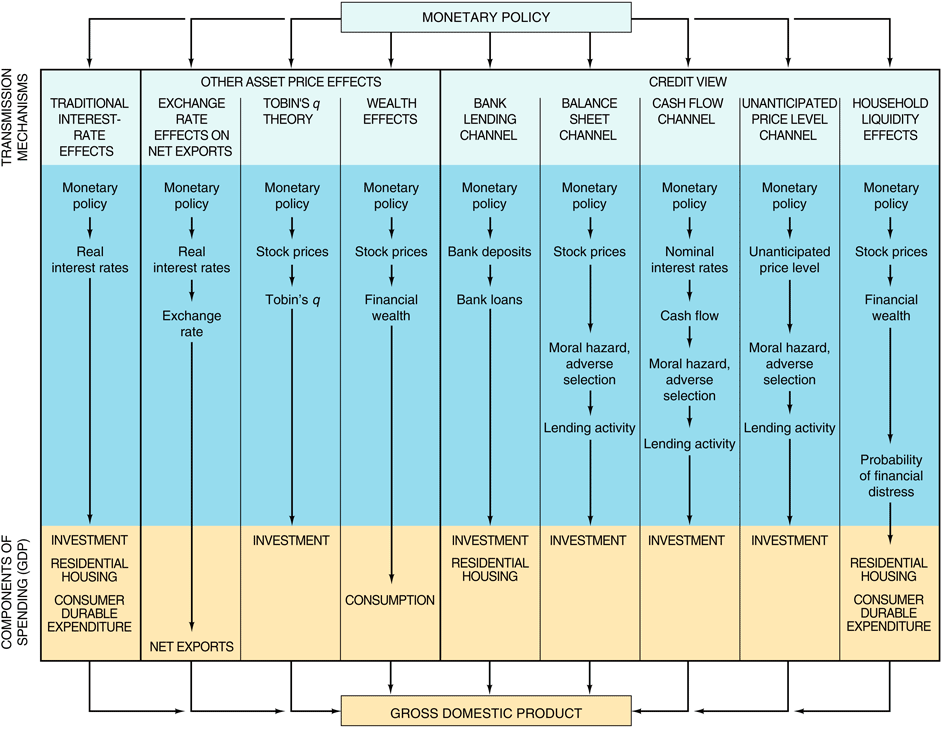
with M being the quantity of money in the economy, V the velocity of money (i.e. the average number of times per year that a unit of currency is spent on final goods and services), P is the price level and Y is aggregate real output (or equivalently, real income). Using the above identity, monetarists argue that in order for output to increase, a rise in the money supply has to occur. (for example, if V=1 and P=2 are constant, then in order for Y to increase M has to increase). The monetary policy transmission mechanisms are summed up in the following table (Click to Enlarge):
Source: Frederic Mishkin, Economics of Money, Banking, and Financial Markets, 9th edition
Keynesian Theory
In the Keynesian framework
Y=C+I+G+NX, (2)
with Y being output, C consumer expenditure, I is planned investment expenditure, G government spending and NX being net exports (i.e. Exports-Imports). In the Keynesian view, if the price level (P) falls, while M is constant, the quantity of money in real terms is larger, thus causing the interest rate to fall which in turn makes investment grow. Thus, output (Y) grows as well. A similar argument is made by saying that after the interest rate falls, currency depreciates, net exports increase thus output increases again.

The main difference between the two theories is that Keynesians believe that factors other than the money supply are also important in causing the aggregate demand curve to shift. More importantly, it is the change in Y which causes the change in M. Increasing the current state of output depends on factors include manipulation of government spending and taxes, changes in net export and changes in consumer and business spending.

Two sides of the same coin
The Keynesian premise states that increased government spending or a reduction in taxes makes people have more to spend than before; either because they give away less in taxes or because increased spending increases their income. Here, the debate of crowding out private spending occurs (i.e. if the increase in government spending will induce a decrease in other parts of the output equation, notably private investment and spending, thus leaving it unaffected). Nevertheless, crowding out only occurs when the economy is in full capacity and not at any other level (the only other possibility is when the state effectively steps in to take private sector jobs, yet this is irrelevant of whether the approach is one or the other). However, what most monetarists do not observe is that the case of government spending not being done by issuance of government bonds (i.e. borrowing) but by printing new money, is practically the same as increasing money supply in the first case of the above picture (although in the modern economic system either borrowing or printing would be more or less the same). Thus, if increased government spending is done via the printing machine then the monetarists' argument of crowding out the private sector cannot hold as it would necessarily have to hold when we use the monetarist doctrine (in which case crowding-out does not happen as theory and practice state). This means that both the Keynesian and the Monetary doctrine are in fact promoting the same issue, albeit with different ideology.

Either increasing government spending or increasing the amount of M in the economy would have the same result. Printing money would equal increasing government spending (e.g. build more roads) since you actually have to use that money somehow and not just have them lying around; and you cannot throw it over the country with a helicopter (well you can, but it's not a very good policy!). Thus, unless we speak of creating money and giving them to the banks so they can increase lending (which again is not good policy as it is subject to the whims of the banking system),  printing is the same as increasing government spending (one may argue that the money can be used to finance the same amount of spending as before, yet this will also affect the economy albeit indirectly through decreased supply of government bonds).

It appears that Monetarists cannot accept that changes in consumer and business spending also affect output. This is somewhat against their own logic once again: Note that in identity (1) the quantity theory of money states that "keeping all else constant" only M can change Y. Yet, an increase in consumption (keeping M constant) means that the average times a euro is spent over a year (i.e. V) increases. If V increases then (keeping everything else constant) it means that either P or Y have to increase. Nevertheless, if P (the price level) is affected only by the money supply in economy (according to the monetarist theory), then it cannot be increased without an increase in M. Thus the only part of the equation which can be increased is Y.

The point here is that inflationary pressures will occur whatever the approach may be. Yet, this is exactly what policy should be aimed at: as real interest rates increase and nominal rates decrease during a recession (just have a look at Japan currently or at the US during the Great Recession) the only way to induce spending is by increasing these rates. Both theories provide some good tools for this although they present it differently:
1. Monetarists say that an increase in the money supply will increase output.
2. Keynesians say that an increase in government spending or a reduction in taxes will do that. 
Source: Wheelock, D. 1992 "Monetary Policy in the Great Depression.
What the Fed did and Why"
Nevertheless, when we replace "government spending" with "government spending via increasing money supply" instead of borrowing then the Keynesian doctrine is identical to the Monetarist one. Krugman and DeLong point out that in a liquidity trap government lending will not cause interest rates to rise. In addition, Krugman comments that the IS-LM (Keynesian) model equals the Modern Monetary Theory one once a country finds itself in a liquidity trap. The argument here is that the two approaches are the same not just in a liquidity trap setting but in recessions in general (in a liquidity trap it would be actually easier to go through with fiscal stimulus since it does not require the same amount of commitment as a monetary expansion). Then, since crowding out effects do not occur during a money supply increase if we trust the Monetarist view on the subject, we are forced to conclude that they do not also rise even if the channel is increased government spending.

In practice, both theories should work well in a recession as long as the government steps in to cover for the private sector's unwillingness to invest or consume; both are also expected to be inflationary and cause private sector crowding out at times where the economy is operating at full capacity (or if supply-side inefficiencies occur). Thus, what is left when all economic arguments lifted is pure ideology: is a large government sector better than a small one? And the answer, similar to all issues of economics and life is, it depends...

Tuesday, 5 February 2013

The misunderstood effects of a default: A Guide to Politicians and Policymakers

Although I had thought that the issue with Cyprus was very similar to the one with Greece, Portugal and Ireland it appears that it isn't so in the eyes of some. From what I can see on some websites, it appears that the case is not so clear for one reason or another. For example, denying aid to the island has been an issue in the German parliament over the past few weeks. Notably, Angela Merkel's coalition partners the FDP have raised their voice in opposing a bail-out scheme. Even in Merkel's own party (the CDU) there appears to be some hesitation. Yet, it appears that they are not so against it as they used to be, if we believe Spiegel.

From my point of view, it appears that some politicians are not really thinking this through. For their sake, let's take a walk through this once again. Just to make it simple for them I will not even use country names so that it will be easier to be used as a formula in the future.

We have two options:
1. We give money to [insert nation here]
2. We let them default

Consequences of Option 1:
The nation receiving the aid would have to be very careful with its public finances. Thus it will inevitably have to make some budget cuts, including cuts in wages and salaries. However, these cuts will have to be implemented slowly. If they are rapidly employed on the economy they will cause a severe contraction (for a simple thought experiment on fiscal multipliers have a look at this) and thus increase the debt-to-GDP ratio significantly, making the debt unsustainable. This would mean that a debt haircut must be implemented which will mean that either private investors (with banks being the majority) or assisting nations (or both) would lose money. If a haircut is to be avoided then further assistance in the form of extending the debt period and significantly lowering the interest rates is to be given. Yet, this would also mean money lost and since losing money is not good for reputation we can agree that the best way to deal with option 1 would be to give the nation the money it needs but make gradual fiscal corrections in order for its debt to remain sustainable. In addition what would be an even better idea would be to directly bail-out banking institutions and force them to invest these money in their government's bonds, but that might be too much thinking. So let's stick to what is easy: If we give money then we have to be sure that change is being done gradually if we do not want unnecessary losses.

What should be mentioned here is that the ECB could also be given the authority to deal with the issue of financial aid. As it has large quantities of money available it can readily assist any ailing nation without any other nation's assets being in danger.

Consequences of Option 2:
If the nation does not receive any aid then it will survive for as long as it can with what money it has left and then declare bankruptcy. The issue is what happens next. The definition of default is when a nation cannot pay the interest on its debts. Then, sooner or later this will also mean that it will also cease to pay its debt (the technical term for that is insolvency). What happens then: well first a debt restructuring for foreign creditors occurs, which means either debt restructuring or debt cancellation. This is in essence a haircut which ends up in loses for the nation's creditor. Then after this huge mess where the state itself has to decide which creditors to ignore and which to honour, another issue arises: how is the nation going to get new money to finance its needs (including the needs of its banks)?

There are only two options for that: either receive money from external sources or print more of its national money. For a country which is in the Eurozone, however, the latter cannot be done. So other countries have to decide again whether to lend it or not. If they do decide to lend the nation then they would be inconsistent to the decision they have made before (when not choose Option 1 instead of Option 2, and suffer the complications of these decisions if you are going to give money after all?) so they will most likely choose not to lend it money again. To which, the already defaulted nation has to respond with exiting the Eurozone in order to print its own money.

Thus, choosing not to lend money to a nation in danger of default leads to their exit from the Eurozone. 

Is this bad? Well it depends. First of all we cannot have conflicting policies: either we assist all nations in need or we do not assist any. So if we assist one we have to assist all the others as well. Second, we have to figure out whether we want to preserve the Eurozone or not. David Cameron stated that the UK should have a referendum on whether it would prefer to stay in the EU or not. If one country exits the euro then it will only be a matter of time before every country which faces the dilemma of inane austerity and a Eurozone exit will choose the latter over the former.

When we analyze it deep enough it boils down to whether we want to maintain a common monetary union or not. If we do then the only solution is to assist all countries needing a bail-out. If we do not then why do we bother having this discussions at all?

Monday, 13 August 2012

Unspecified Policies

Over the history of mankind, whenever politician wanted to speak in presence of the public, their words spoke of broad generalizations on the subjects they were to address and accusations towards their political opponents. Over the centuries this kind of talking was (and is) the norm of political conversation. However, since the beginning of the 20th century, and due to the increased exposure to information mankind has obtained since then, people have started to catch up with them and demand specific answers to specific problems. Unfortunately, politicians (and policymakers as well) are yet to live up to these standards. 

There are only three possible explanations about this phenomenon: 
1. They think that by dizzying their audience with excessive verbiage will make the latter think that they know their stuff
2. They really don't have any idea about a subject and the only way not to look stupid would be to speak in broad generalizations (which would be fine as long as they only did it on a few subjects. Being excessively general means that they either No.1 or No.3 is true or hmm they have no idea about any subject at all!)
3. If they give a specific solution to a specific problem people will expect them to enforce what they propose.

Studies have shown that people respond better to politicians and policymakers who propose specific solutions to specific problems. From my point of view, being specific help people understand how the policy will affect them and even improve it by direct communication with the policymaker. This helps avoid the three I's as stated in Poor Economics: Ideology, Ignorance, Inertia. Specific policies lead to more votes for politicians and more credibility for policymakers.

It is thus not strange that Draghi-type statements ("the ECB will do everything to save the euro") are not very popular. "Do everything" does not mean anything at all. What is everything? Does it mean stand still and wait as it all breaks down? Does it mean financial aid to banks? Does it mean new plans for a Greek haircut? It could mean anything. Or it most probably means that they have no idea of what to do and just hope to boost financial markets by statements. Guess what guys: Markets (and everything else in REAL LIFE) don't go up in words, only in action.

Sunday, 12 August 2012

Economists and the Real-Life Economy

Every time a crash, or a crisis or recession or any bad news in general comes up, people run to economists to "help" them "understand" what has happened. What most people fail to understand is that, about 99% of economists have no idea what is happening in the real world. The reason is simple: they are so caught up in their studying, publishing articles, using advanced mathematics and statistics to impress other economists with their knowledge that they do not actually know, let alone understand, about what goes on in the real world. 

Thus, their knowledge is purely theoretical. Even what economists call empirical work (i.e. something which actually uses observed data instead of pure mathematical theories) is in fact a manipulation of past data, under statistical tools, to reach a certain point. Very few can leave the stagnant traditional economic thinking and start to think on their own. If one remembers, in a scene of Bryan Singer's Usual Suspects, Kevin Spacey states: "The greatest trick the Devil ever pulled was convincing the world he didn't exist.". In the same context, the greatest trick economists ever pulled was convincing the world that they understood economics.

The worst outcomes of this "misunderstanding" are that:
1. Economists with no idea on how the real world operates are appointed in critical positions in the economy
2. Good economists are mistakenly thought as bad ones, a consequence of bias and prejudices (obviously, if you ask an economist whether he belongs to the 99% or the 1% of economists s/he will  always say he belongs to the 1%)

This situation is described in Esther Dulfo's and Abhijit Banerjee's book, titled Poor Economics. They talk about a situation named the 3 I's: Ideology, Ignorance, Inertia. Although the authors (which I believe deserve to be at the 1% we have talked about earlier) mostly use it in describing politics and policies in third world countries, this situation is more than evident both in the EU as well as the world economy.

People with an ideology try to promote changes or policies (either for better or for worse) and the policies seem to fail, mainly due to their ignorance on the subject, as they are watching it from a distance. The situation, does is not made better due to inertia, i.e. people's "apathy" towards a policy which in essence does nothing.

The same rationale holds for the Greek bailout: economists and policymakers decided that a haircut of 70% of the bonds' value and severe austerity measures should be great to fix the problem. Well, I guess the situation looks better and decisions are easier when its not your job, city or country on the line. Or is it now?