Showing posts with label politics. Show all posts

Thursday, 24 January 2013

Lack of Leaders or Why I Understand Abstention

As a fellow blogger noted, in 2013 elections are approaching in Cyprus, Italy, Malta, Bulgaria, Germany and Austria (in that order). Although their outcome is highly controversial, their importance cannot be overstated as they will affect developments in the aforementioned countries as well as in the EU for the next 4-5 years. Electoral campaigns have been raging in Italy and Cyprus and although German elections are scheduled in September, speculation began about a year earlier.

Yet, even though most politicians spend millions of euros trying to promote themselves and/or their parties people's appetite for voting seems to have reached satiety. Young people specifically are not very eager to listen to the same political agendas that candidates have been preaching over the last 20 years. What is worse for politicians is that even those who have been participating in elections and are now middle-aged, appear to be fed up with the situation.

Once you start listening to people, you find out that what they really want is someone they can trust. And they cannot find that in 99% of politicians. People want credibility and reliability; no candidate appears to have it. So it boils down to either voting for the one who appears to be somewhat better than the competition or not vote at all. Which option is the best? Let's have a look at them

Option 1: Vote for the best of the worst.
The essence of this choice is that in the land of the blind, the one-eyed man is king. It is inevitable that one of the candidates (if we are talking about a presidential election which we will assume for simplicity) will be elected regardless on whether we vote or not. There are some people who will vote whether we want it or not, (those being the hard-headed political cronies or fanatics) so the only thing we can do in order for their candidate not to be elected (if it is indeed the worst option) is to vote for someone who is even slightly better than him/her. Yet, if we use this option and the candidate we have voted ends up being the same as all politicians have ever been, or even worse, it is no-one's fault but ours. Worse, we may even know from before what the final outcome may be. The most important consequence of this option is that we are forced to compromise every single time, keeping our needs and ideals hidden, adhering to principles which do not express us and, what is worst, allowing politicians to be the same as ever. It is the same as a pilot not having the map of the airport he is landing and trying to make it up with having the map of another. You wouldn't feel so good being on that plane would you?

Option 2: Do not vote at all
This is an interesting choice which has two possible explanations: either we do not like politics and abstain from them completely or we do not have have any preference on the candidate elections which means we have no motive to vote. Yet, on closer look both explanations seem to converge into one: we do not like the politicians of our country. Thus, we prefer to pass on our right to vote. The problem is that we essentially have given others the right to decide who is going to run our affairs for the next years and we have had no opinion on the subject. We allow our disappointment for the affairs of our nation and the current unfortunate realities to take the best of us and make us give power to someone else. The candidate elected may have been the worst of the lot. Yet, as we did not cast our vote we have not done our best to prevent it from happening. It is the same as saying "I do not care what happens to my relationship" while in fact you do, and feel just disappointed and sad when things get ugly. What is enough for bad things to happen is for good people to do nothing.

Joseph de Maistre has stated: Every country has the government it deserves. Is he right though? What is the lesser of two evils as presented in options 1 and 2? You may have guessed it. None. Neither of the above is a valid option. Why? Because people everywhere deserve much better than this. We need someone we can trust, who will (for once) keep the promises made, and make some changes. I think I am saying this on behalf of most Europeans: we have had enough. We do not want politicians fighting on issues and do nothing, we want them to shut up and start working. The world has never changed in words and neither will it ever do. 
Mohandas Gandhi and Nelson Mandela. Probably the most influential politicians of the 20th century

Is this too much to ask? Yet we have not even asked the future generation of politicians to stand on its own. We are tired of hearing the same over and over again. What is the point of being young if you have the same ideas of a 50-year-old? It is what Alex Ghita has dubbed Democratic Masochism. Democratic Masochists are people who belong to option 1; and those who belong in option 2 allow them and their country to remain that way for ever. 

Think about it for a second. When was the last time that some politician inspired you? For me it hasn't been this way almost since I was born. We are currently living in a century whose main characteristic is the lack of great people; people who can inspire confidence and trust. The only bright examples of the current period were the actions of Mario Monti and Antonis Samaras. If Greece, with a series of rotten politicians dating almost since its inception can have a good man running it why not every other country as well? I am not claiming that Monti or Samaras are perfect or error-free. They have done their share of errata. Yet, they are honest, hard-working and do not engage in unnecessary discussions or promise things they do not deliver. In fact, most of the times they did not even promise anything. We should not expect politicians to be perfect. Yet we should expect them to give their best for their country and be held responsible for their actions.

Hope is not to be lost. Better men and women will get into politics and we should be able to move forward with them. Yet, we should not lay idle and not do anything while rotten people are running our country for us. Take action, any way that you can. If people do not start saying what they believe and what they expect no-one will ever give it to them.

Tuesday, 15 January 2013

The Consequences of Exits

The case of Cyprus undoubtedly resembles the case of Greece. The amount the country needs is not large per se, as was the case with Greece, yet it is the equivalent of about 100% of its GDP, casting doubts on whether its lenders would ever be able to get their money back. In both cases, two options exist (and existed): either give the country all the money it requires to completely avoid default or let it fall and consequently exit the EU or more likely the Eurozone.

Advocates of the latter base their arguments mainly on whether it is rational or good practice to send good money after bad, or whether the EU will forever be the lender of last resort for troubled nations. As the number of Member-States which face trouble as a consequence of either irrational expenditure or housing bubbles continues to rise, proponents of the Pontius Pilate method (i.e. "I wash my hands of the subject") believe that a line should be drawn somewhere. Yet, where should that line be drawn and what are the consequences, if any, of that action?

During the most severe case of the Greek crisis over the last 6 months, notably over the summer months, it was stated that there was a great danger of Greece exiting the Union. What we have witnessed, however, is that Brussels made the decision to support the nation, both monetary as well as politically, given that the Greeks would play their part as well (which they did). Economic consequences would have been severe had Greece exited, but what of the consequences of a Cyprus exit or another small country's?

Here, the problem is mainly political and not an economic one. Having barely 0.2% of the EU's GDP does not qualify the island on being an economic force whatsoever. Nevertheless, think of the consequences of setting a precedent by letting Cyprus fail. The probability exists that all other countries will fear that their turn will come if they do not pay attention to their fiscal policies and they will do their best to follow suit on the instruction of the IMF and Brussels (or is it Berlin?). Yet, there is another possibility: that the Member-States will think that such a behaviour is not an acceptable one, and one could liken it with bullying: kick the little guy out so the medium ones can see what will happen to them if they disobey. And what of the probability that other Member-States may think "if Cyprus is out of the Eurozone and can work it out why don't we exit as well?"

It has to be considered though that it is highly unlikely that another country will be in direct need of assistance in the near future (one cannot foresee the outcome of the Italian elections however). This would mean that essentially what the EU would be doing is that they should be supporting one of their own; or even better something they created. Was it not Victor Frankenstein's fault for the monster he had created? Now it is their fault for not looking two steps ahead when they were making the decision on the Greek haircut about a year ago. 

Exits should not be an option for either Eurozone or EU countries. If even a small country the size of Cyprus exits then you may mark the day as the one which set off the destruction of the EU. All that has been built over the past 70 years, all that nations have been through over the past couple of years, with uncertainty and economic misery would be in vain. What is the message by the EU officials if when a nation is in trouble we fail to assist it?

Cyprus is merely an example. Greece was the example in the last few months, and hopefully Italy will not become the next example in the following ones. We cannot have a perfect Member-State, we cannot have a perfect Union. Yet, we can support each other, regardless of petty issues. Spiegel mentions that the island is considered a safe haven for tax fugitives. One can remember posts about Russians moving funds to Cyprus for the last couple of years. Why now? Why didn't the EU try to impose stricter regulations on Cypriot banks earlier than that? 

The same issues arose in Greece, Italy and Spain. Why did Brussels fail to do nothing, not even suggest something when they had known about tax evaders in Greece since 2009 (the now notorious Lagarde list featuring more than 100 names of fraudsters with millions of deposits abroad)? Or why did they not try to change the Italian election law, which essentially does not let the people elect whom they want to lead them? Even better, why haven't they tried to do it when Mario Monti was in charge (he tried to pull it through but I believe that the legislation has not yet been passed) or even try to push Italian politicians now to do it? How about Spain and the horrible situation with evictions and homeless people? 

I can agree that the EU does not have the power to meddle in Member-States legislation and politics; nor should it. Yet, it should be noted that EU law is superior to country law, and thus many a legislation could be passed on in Brussels; legislation on important issues like election law, money laundering or evictions. What is more is that they should be able to impose severe sanctions to the members who disobey on serious issues. Being an optimist I hope that the memorandums have given the EU an opportunity to make the living environment better in the ailing countries than it was before; not used merely for punishment.

Cypriot presidential candidate Nikos Anastasiades with Angela Merkel.
As for a prediction: the EU will grant Cyprus its memorandum and support. How much money the island will receive and what sacrifices they will have to do I cannot know. Yet, it is highly unlikely that they will receive it before the February election results as a change of government will bring a change in credibility; the same issue with Greece over the summer. Just wait and see...

Monday, 17 December 2012

On Modern Democracy

Lately, I had the opportunity to attend a symposium on democracy, economics and ethics. While there, one of the orators spoke about how democracy had changed over the years and the ideas different philosophers, politicians or even economists had concerning it. In his conclusion, what struck me with great amazement was his lack of any alternatives or optimism on the future of what is generally perceived as the greater of all other forms of governance. The question that we have not seen anyone address is: What are the problems of representative democracy and what can we do about them?

To begin with, a representative democracy is founded on the principle of elected people representing a group of persons, as opposed to direct democracy in which people vote on policy initiatives directly. Now, although the latter would appear to be much better than the former, this would only occur in theory. In practice imagine that every person in every country would have to learn everything about every law, article or paragraph, each time a new law or an amendment to one was going to be passed. What would happen would be a state of sciolism: the quality of showing opinions on at least one subject of which the perpetrator has little or no knowledge, the practice of this, an instance of the practice of this. (definition by Wiktionary). You may only imagine the consequences of such practices. 

A common argument in favour of direct democracy would be that since they had done it in ancient Athens, with the notable example of Pericles, it can be done again. And since the internet would allow us to participate or vote in a subject without having to enter crowded rooms, this issue would also be resolved. Now one issue of internet voting would be the ability of the state to maintain secret ballots. Internet crime is very high during these time, and the state would have to select excellent system administrators of the e-election system so that no manipulation occurs. Nevertheless, if an impenetrable system would be devised, then that might be a good alternative to voting.

The development of such a system, would not necessarily mean that direct democracy is a great idea. One would remind the reader of the great mistakes the Athenian democracy had done like the execution of Socrates, the ostracism of Aristides or the wars against Sparta and other Greek city-states. Unfortunately, when many people are to cast an opinion on something, sciolism is almost always the consequence.

Obviously, no-one would dare to accuse people of sciolism in modern day societies, where a person has to work at least 8 hours per day, and there are indeed times where we would require more than 24 hours in a day just to be able to handle everything. A citizen in ancient times had all the time in the world to discuss and argue about state affairs just because he had slaves doing all the work for them (oh, and you had to be over 30 and male as well to be allowed vote). Now, imagine a working single mother, having to wake up at 07:00 to be at work at 08:00, drop her child at school, work until 17:00 or 18:00, return home, pick up her child from school, cook, shop for groceries, take care of the house and spend some time with her child; she will obviously be dead tired by 22:00 or 23:00 o'clock and at which time nobody would blame her if she had no appetite to read complicated laws which would demand her full attention. One may think of many examples like this one, and in our time, the reason we still choose to elect representatives is for them to do what we cannot. That is keep track with every development in both native and world affairs and have an opinion on it. And that is what they should be getting paid for.

In essence, representative democracy is, in a broad sense, a form of a technocracy; the latter signifying a form of government in which experts in technology would be in control of all decision making. The word has also been used to indicate any kind of management or administration by specialized experts ('technocrats') in any field (for example, the non-elected Prime Minister of Italy, Mario Monti is considered a technocrat, as are the Troika representatives visiting a country requesting a bail-out). Although it may sound as a good idea that a group of knowledgeable people to control power in a state, instead of politicians, a real-life application may prove otherwise.

The main problem with technocratic systems is that the leaders are not being democratically elected.This would lead to some sort of aristocratic or oligarchic system of governance where the people in power would not be willing to step off and they would be in full control of who would rise to power and who will be edged off. People in power are 99% of the time unwilling to let go of that power. We have witnessed in soviet Russia before its collapse, and the results were anything but spectacular. In addition, defining intelligence would be a difficult task: would a high IQ suffice, or would we require more than that? How about an ability to forecast consequences, or to understand diplomacy, politics and law? How can we measure someone's ability to make proper decisions? A high IQ person does not necessarily make a good politician or decision-maker. Many examples of academics who have failed in the real world can be found (for an economic-wise example have a look at the story of the story of the LTCM Fund).

As we have so far seen technocracy and direct democracy cannot function in real life as their consequences would be too adverse. This statement should at least hold under the current state of affairs; if the situation changes then the statement should also change. This would leave us with the only functional form of democracy in real-life: representative democracy. 

As with all other forms of governance, representative democracy also comes with several caveats: by giving the representatives the power to pass laws or proceed with other decisions, we are essentially granting them with powers over us. Powers, which if used correctly can promote the greater good and if abused they can be the cause of great pains to citizens. Thus, the purpose of a correct form of governance would be to find a way to prevent politicians from abusing their power. How can this occur one may ask if the representatives are allowed to pass laws even concerning their own salaries and allowances?
Democracy Tempted. Source: Wikimedia Commons
Although we would hope that the people we elect are wise enough to put the country's interest as well as that of their fellow citizens before their own, occasionally (not to say very often) this does not appear to be the case. When would man be so altruistic as to pass on more money offered in return for his services? And trust me, almost every one of us would do the same in their position... Thus, in essence what we would have to do is protect democracy from the representatives themselves. 

The big question now is how we are going to achieve that. The answer might actually be much simpler than what one would expect. Forbid the representatives from passing any laws concerning their duties or remuneration, and instead let the people decide about that via a referendum. This referendum, concerning representative remuneration, should occur no often than once every two years. This would allow the people to actually evaluate the work of the representatives and agree or not on whether they should get something for what they have done during that time. The two-year horizon would allow the people to correctly assess the work of the representatives over a significant time span, (in most countries this is approximately half of the representatives' incumbency) and give honest feedback about what they believe. Should the timing of the referendum coincide with elections, then the referendum should occur before the elections in order for the future representatives to prepare with what they are about to face.

On the referendum, a choice between whether people are happy with the current representatives or not should be accompanied with whether the people would like to see representatives' wages increased or decreased as a reward or punishment. In order to avoid vindictive or super-rewarding behaviour, the maximum amount of increase or decrease of a wage would have would be around 10% every 2 years. This would allow the citizens to have a more direct power over their elected representatives, other than the power to elect them every 4-5 years. 

The main issue with this proposal, other than the referendum on the representatives' evaluation, is how to distinguish between what would benefit the representatives wither directly or indirectly, and whether this would be important enough for a referendum. For example, a law which would grant more power to the representatives to alter the constitution without considering any judiciary decisions would be more important than one which would increase public allowances by 2%. This responsibility to examine all the possible effects of a decision should rest on the shoulders of the judiciary sector. In practice, the court would do nothing more than to examine whether a law can give too much power to politicians and thus the law's fate should be decided by a referendum. 

This policy would ensure five things:
1. People have more power over elected representatives. Nowadays, the pubic can only monitor representatives by agreeing whether to re-elect them or not, something that does not appear to have much effect on the latter's decisions. Now, by being able to control how much remuneration they are liable to get, based on their activities, it would mean that people can have much greater confidence that their representatives will choose to do what is best for the common good. In addition, people should be allowed to decide whether they would like to see the powers of the representatives increased or not, and not just watch helplessly on what the elected ones are doing.
2. The power of the representatives is greatly diminished. By not being able to make decisions on themselves, and having their performance evaluated every two years it would mean that greater care should be taken on whether they are indeed promoting something that is good for the society and not something that is just good for them.
3. People can just evaluate the performance of the representatives based on what they have shown them so far. This would be a form of a direct democracy, yet one which would allow citizens to process a much lesser amount of information than the one needed in a real direct democracy. In addition, the referendum concerning a direct or indirect increase in representative power should allow them to be specific on the knowledge they should acquire, something which should be much easier than practically learning about everything.
4. Judiciary power is not increased. This would not lead to some sort of increased power of the judges, as the courts would only be able to express an opinion on whether the decision about to be made should be considered as increasing the power of the representatives and nothing more.
5. Technocracy is avoided. Since power is still in the hands of elected representatives and not other non-elected officials, and now the people have more power over them, no need for imposed experts would be present.

In conclusion, securing a better system for the future does not require any extensive changes in governance. Just very few are needed for a far more democratic system than the one we are currently living in. All it takes for us is to be innovative enough to implement them and think of more.

Friday, 23 November 2012

Democratic Masochism

In a discussion yesterday, Alexandru F. Ghita coined the term democratic masochism for the countries which seem to vote the same people over and over again despite their obvious lack of credibility. I have always been wondering about the cause of this phenomenon and it would appear that habit is stronger than common sense or the ability to change. The main rationale appears to be "well, we know that the people we have running our country are [insert negative word here] but at least we know who they are and we have been seeing them over some time, so they must know something. Why elect someone new, with ideas different than those we have been living with up to now? Right?'' Wrong.

We cannot escape our human nature: we are creatures of habit; we seek the same thing over and over again, not because we really enjoy it, but mainly because we are used to it and our expectations meet reality every time. Truth is, that occasionally something happens and wakes us up from our lethargy. However, events of that significance occur only once in a lifetime and we cannot count on them; thus, we have to make the change ourselves.

For those of you thinking "sure but this does not happen with me or my country" I would challenge you to remember how much the political leadership in Southern Europe has changed over the past 10-15 years. Any new faces? Any new ideologies, morals or beliefs? None whatsoever. The same adherence to old regimes, undemocratic and obsolete beliefs, rigid principles combined with an exquisite ability of politicians to switch to any side of the political spectrum suits better to their plans of assuring a position of power. Name one country in the South, or maybe in the whole of Europe as well, where this has not been taking place over the past years.

The worst part is that younger politicians seem to be a carbon copy of the older generation. You cannot enter the political life of a country with an ideology of your own. No political party will ever accept you in its ranks if you do not fully embrace its beliefs and support each and every decision it makes, whether it makes sense or not. Independent thinking is punishable with expulsion, and that would mean the end of one's political career. The only solution would be forming a new party, but only very few would be willing to go through the trouble of obtaining just 1% or less in elections, with the hope that someday that percentage will rise.
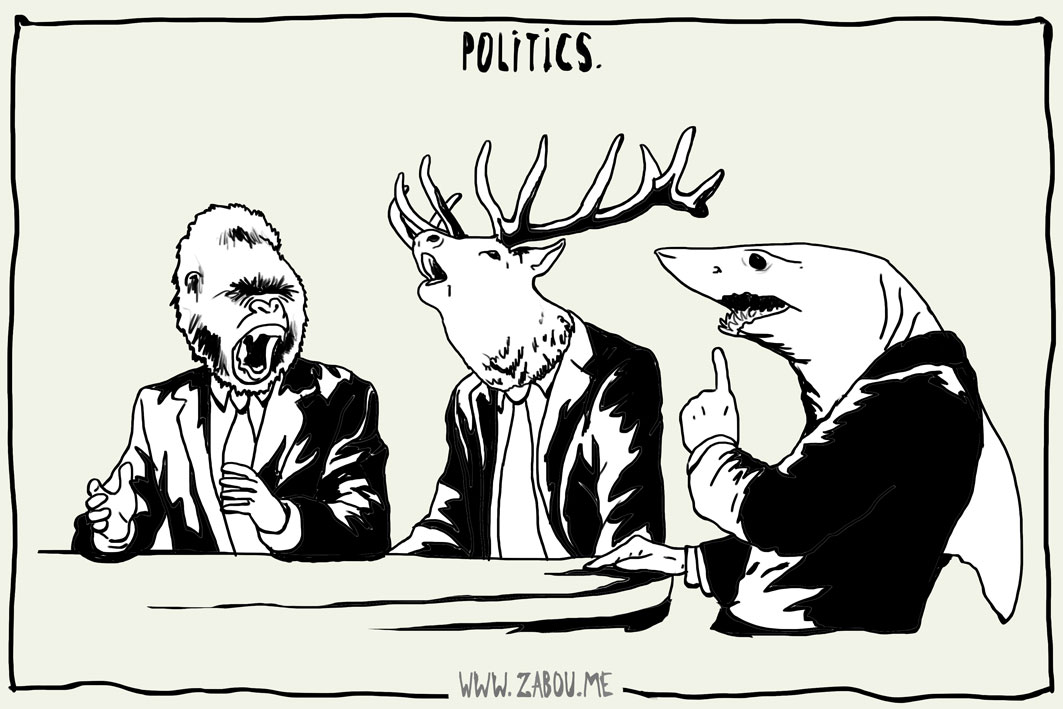
Source: zabou.me
So what does the future hold for us in politics? Although the formation of new parties continues, very few of them will ever be in a position to obtain enough votes to affect anything. For example, the Pirate Party in Sweden received a 7.13% in the European election and its German affiliate a 2% in the national ones. Nevertheless, the German participants seem unable to act on what they preach and thus the party appears to be on the brink of disaster, with voters repulsed from what they are watching.

Which brings us to credibility. If the leader(s) of a party cannot act on what they say, then nobody will ever do the same. That is the main reason why Golden Dawn has been so successful in Greece: they may support nationalistic, racist and fascist ideas but at least they abide to what they preach and people know what to expect from them.

This is where is all boils down: honesty. If politicians are honest then people trust them with their votes. And believe me, people know...

Thursday, 8 November 2012

Who's fault is it for the Crisis?

To be honest, I wanted to write this article for a while now. I have heard almost everything concerning whose fault it is for the current situation: banks, politicians, people, Greece etc. Thus, today I am giving you my honest opinion on whose fault it is for the chaos we are currently living. The answer is not, as some may have thought, just a person or a nation. It is a continuing series of absurd, irrational mistakes which have, step-by-step, led us to this situation. Without further ado I present you with the list of the 3 groups of people to blame for this situation:

1. Greek Politicians and Greek People
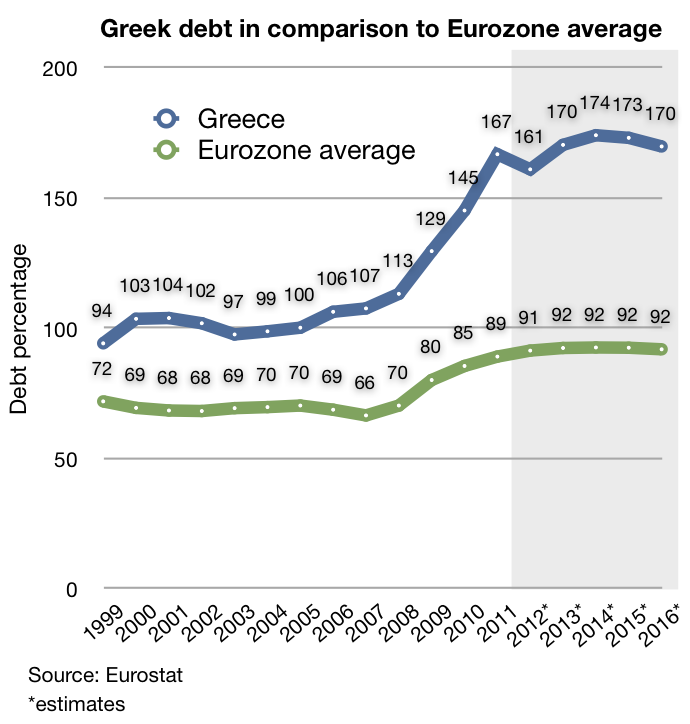
Politicians in Greece, strong proponents of a system named Kleptocracy, which in essence means a system where the government increases the personal wealth and political power of its officials and the ruling class at the expense of the wider population. Greek politicians were (are?) notorious for embezzling state funds, shipping their money to Swiss bank accounts and receiving bribes so that they could arrange something for someone. Greek government debt, issued to fund such abuse of power rose from 94% in 1999 to 167% in 2011 as one may see from the graph below.
Source: Wikimedia Commons and Eurostat
The reason for this astonishing debt growth is obviously the large government deficits, which allowed for politicians and other officials (or their affiliates and business partners) to practically steal from the state using as a preface works for public good. 

Then why the Greek people one might ask? Well, to put it simply because they tolerated and perpetuated this situation. When in public hospitals (which are supposedly free for everyone) you have to bribe doctors for the right to an examination, when you know that many are stealing from state funds and not only you do not do anything to oppose such a thing but try to come up with ways to steal some yourself, when people's parents die and do not mention the fact to the police so that they can continue to receive their pensions (and this has happened repeatedly) then one cannot just blame politicians for it. I am not at all suggesting that every person in Greece is at fault for this directly. Nevertheless, they are at fault indirectly since they have tolerated and perpetuated this situation throughout the years. All that is necessary for the triumph of evil is that good men do nothing.

2. EU Banks

Although EU (and non-EU for that matter) banks must have had the data for the increase of the Greek debt (Eurostat publishes a quarterly analysis which is free and open to public) they had chosen to ignore the possibility that a country issuing large amount of bonds could possibly face trouble. The following data is from the Bank for International Settlements in 2011 and indicate the exposure of non-Greek banks to Greek sovereign debt.
An casual observer can see that the first 12 banks have an exposure of more than 1 billion. At first, your reaction might be that obviously they had enough money to compensate for large losses in Greek debt. After all they are large, well-off organizations aren't they? Well, have a look at the next data set.
What is more astonishing is that people running the two Cypriot banks, Dexia or BPI, Commerzbank or any other bank which had a large exposure in Greek debt, did not think about having more than 10-20% of their equity in one single country. Now I am no expert in risk management, but from what I can remember there is a notion called diversification which means that you shouldn't put all your eggs in one basket. It looks like the officials who ordered such massive buys of Greek bonds should have taken a good look a their exposure and the amount of Greek debt before they invested. They did not.

3. Decisions by the EU

So far the usual suspects were at blame: greedy bankers and corrupt state officials. Now how about we take it to the next level? In an announcement in February 2012 the Eurogroup decided that the Private Sector Involvement (PSI) in the Greek debt restructuring would amount to a total of 75%. For those of you counting, the first 15 banks of the above chart lost a total of 21 billion euros in one day. These were the biggest losses of all times for most of the banks involved. 

As if this was not enough for the banks, the European Banking Authority had issued a "temporary" rule (which now is bent on making it permanent - for details read this) of increasing Core Tier 1 Capital requirements from 8% to 9%. Although this might not seem like much, the increase forced the banks to come up with €116 billion of new capital. And all that in the midst of a crisis, where finding funds is even more difficult. For a detailed view of where these funds came from have a look at the following image:

Source: Wall Street Journal
Thus, keeping in mind that when banks are in need for money they do not lend out much it not amazing why we have reached a situation where individuals and companies are struggling for liquidity. The worst part is that due to the severity of the decisions many banks in the EU are struggling for liquidity as well, which has led countries like Cyprus and Spain to seek for assistance. What has happened is that, in essence, the EU authorities have taken a country-specific crisis and transformed it to an EU-wide one through erroneous handling. These decisions can (unfortunately) be compared to the ones the US Federal Reserve had made in the early 1930's which had strengthen the Great Depression, prolonged its duration and increased its severity.

As a conclusion I would like to remind you of the timeline of errors which led to the crisis:
1. Corrupt officials and politicians in Greece were stealing money from the country and were financing their spending with government bonds,
2. Banks had not paid attention to the increase in government debt and kept on buying more and more lured in by the high returns offered, and
3. EU authorities, by handling the situation badly, have transformed the Greek crisis to an EU crisis

The situation worsens as politicians and policymakers in the EU are throwing good money to follow bad. As they cannot admit their mistakes they hope that two wrong can make a right. Well, the saying doesn't go that way. 

Saturday, 3 November 2012

Unemployment Update in the EU

Source: Eurostat
Well, the figures give more or less the same story as last month. Unemployment is roughly the same in the EA17 or the EU27 (up just 0.1% in the EA17), Greece and Spain are champions both in youth as well as in overall unemployment, Italy, Ireland and Cyprus saw their unemployment rate rise while Austria's, Netherlands's, Luxemburg's and Germany's remained the countries with the lowest figures.

What I am eagerly waiting for some time now, is for the Eurostat announcement that EU27 and EA17 GDP has contracted over the last quarter thus officially throwing the Union into recession. I am not doing this out of hate towards the Union; just because I hope that this will be a wake-up call for politicians and policymakers all through Europe that what they have been doing up to now is erroneous. What the reader may ask is whether they have the common sense to admit their mistakes, which unfortunately I cannot answer now. Time will show and hopefully after that time we will still be part of a Union. Better late than never.

Change can only come from within as Protesilaos states in his latest article. Here's the part that I liked the most:
"The troika's "expertise", or in general the technocratic, "objective" knowledge of the various bureaucrats that make crucial decisions on the citizens' behalf (e.g. the preposterous proposal to have a Commissioner veto national budgets), is in effect nothing more than the facade which conceals an apocryphal desire or rather a specific strategy for the redesign of the Euro area along the lines of a corporatist-neoliberal economic system that will realize economies of scale for a selective corporate elite at the expense of suppressing the standard of living of most people across Europe; while also rendering any spontaneous entrepreneurial initiative practically unprofitable or near-impossible due to the complexity of legislation and entry criteria, which always operate as means of insulating big business from the powerful forces of real competition (neoliberalism should never be confused with genuine free markets)" 

I do not know whether there is a plan or strategy behind Troika's decisions. Nevertheless, it seems that the measures they are proposing are damaging the middle and lower class and leave the upper class unaffected. This basically means that people pay for the faults of their governments and/or banks without the latter assuming anything of the blame. Now I do not know how do you call such a regime but exploitism sounds like a good name.

Tuesday, 30 October 2012

Berlusconi Behind Bars Now!

On Friday, a court in Milan had sentenced the former Italian Prime Minister Silvio Berlusconi, to 4 years of jail for crimes concerning tax fraud related to the acquisition of TV rights by his company Mediaset. He was also banned from public office for five years and ordered to pay €10m (£8.3m) to the Italian tax office, but these are just minor compared to a 4-year incarceration sentence. Nevertheless, as we now read, Berlusconi will most likely never see a prison cell in his life. 

Well I hope not! Source: http://www.soxfirst.com/
The reasons are simple: In 2006, a centre-left government had introduced a 3-year amnesty for crimes committed before that year, which would mean that Berlusconi's sentence would essentially be reduced to 1 year. In addition to that, the former Prime Minister is entitled to two appeals before a definitive sentence. Given the speed of the Italian courts' this would probably never end, as the aforementioned trial lasted for about 6 years and the statute of limitations (a legal term stating that if a legal system has a statute, for example, limiting the time for prosecution of a debt or crimes designated as misdemeanors to two years after the offense occurred, under such, if a person is discovered to have committed a misdemeanor three years later, the time has expired for the person to be prosecuted.) of the Mediaset case will take effect in about a year from now. In addition as an Italian journalist has stated in The Guardian: "The fine and the ban on public office will only take effect after the final appeal, but if he is given a conclusive conviction, he will have to leave parliament. In Italy, you go to jail only if you receive three years, so if the sentence is cut to one, Berlusconi will not go to jail."

Well if you ask me, this is something more than ridiculous! We expect our citizens to respect the laws, nevertheless it takes 6 years to complete the trial of an "important" member of the society and it will probably take as long as that to reach a definitive conclusion. And he will not even be put in jail. This is not just for Berlusconi. The former Prime Minister is an example of a judicial system which does not function properly. People in Italy, Greece and Cyprus (and to a much lesser degree in Spain and Portugal) are certain that the rich will never pay for what they have done! And the courts do nothing else than to confirm this notion.

In another article, a commentator in The Guardian has stated that even though Berlusconi will never see the inside of a prison cell, the decision matters politically as its party now has much less support than before. He is implicitly stating that the Italians, fed up with corruption and paid politicians/policymakers/lawmakers will will make a better choice for leaders this time. 

I am not sure of that. If Berlusconi, or any other "Berlusconi" for that matter, is allowed to walk away like nothing has happened, then what is the point of sentencing him? It is the same as politicians promising a million things and not doing even one. People are tired of this. They want credibility. They want a person who will say something, mean it, and then do it. Theories and political games are out-of-date. They want leaders and policymakers/lawmakers who are not afraid to stand up for what they believe and fight for it. They are not afraid of a corrupt system nor of the power of industrialists and businessmen. 

This is the main reason why "Golden Dawn" has become so successful in Greece: they do what they say they will. (for an excellent article on Golden Dawn read Protesilaos Stavrou's article here or here) Even if I disagree with what they represent, what we must understand from their action is that people prefer honesty to anything else. 

And this is exactly what must be done in the South. We need a system which we can trust, a system where even though some occasional members will be corrupted, we have to know that this will not be tolerated. But most of all we need honesty. We need people who they will say something, mean it and do it. We need more people like Giovanni Falcone and not like Silvio Berlusconi or the majority (if not all) of politicians in South.

And that is why Berlusconi needs to be sent to jail. To signify the end of an era of corruption, control of government by industrialists, and an era where money made a difference whether you could be behind bars or not. Let's hope that the people of Italy and the Italian courts make a stand on this.

Monday, 29 October 2012

Old Words, Perennial Truths

After reading the Gettysburg Address by Abraham Lincoln, delivered on 1863, I was amazed by the wisdom of a person who is considered to be one of the best American Presidents of all time. One of the most quoted lines is the following:
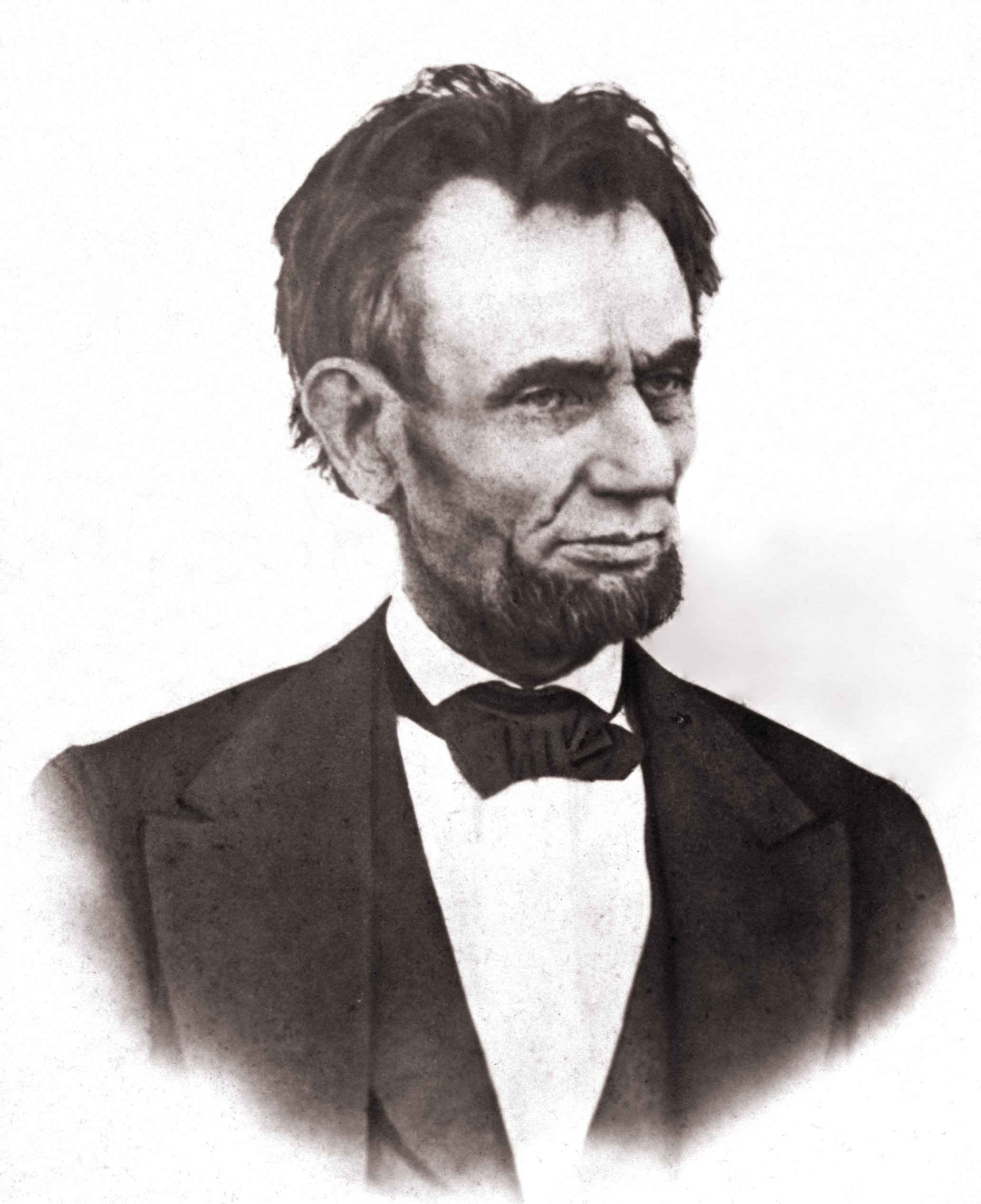
The last high quality photograph of Abraham Lincoln. Source: Wikimedia Commons
"(..) that government of the people, by the people, for the people, shall not perish from the earth"

Even though it is a phrase of just 19 words, it holds with it the true meaning of politics: governments are elected to represent the people of a nation (of the people), are elected from the votes of the people of the nation (by the people) and are in power to serve the interests of the people who have supported and elected it (for the people). This is the correct form of governance, nevertheless a form which has been forgotten over the course of the years. 

From the 2006, film, V for Vendetta, comes the following quote, uttered by the film's main character, V:

A Guy Fawkes mask. Source: Wikimedia Commons
"People should not be afraid of their governments. Governments should be afraid of their people."

It seems as though governments have forgotten about this fact. Or is it just that people nowadays feel that they are powerless against the all-powerful force which governs them, and they can do nothing to change the situation? I would hope that this does not hold. When Aldus Huxley published "Brave New World" in 1932, this was exactly what his fears were. According to social critic Neil Postman,

"What Huxley feared was that there would be no reason to ban a book, for there would be no one who wanted to read one.(..) Huxley feared those who would give us so much [information] that we would be reduced to passivity and egotism, (...) feared the truth would be drowned in a sea of irrelevance. (...)Huxley feared we would become a trivial culture, preoccupied with some equivalent of the feelies, the orgy porgy, and the centrifugal bumblepuppy [terms describing amusement in Brave New World]. As Huxley remarked in Brave New World Revisited, the civil libertarians and rationalists who are ever on the alert to oppose tyranny "failed to take into account man's almost infinite appetite for distractions."

What is evident from today's society is that too much effort is aimed towards providing more and more amusement, or distractions as Huxley would comment, which result in making the public less and less inclined to take up common affairs or issues of much more importance. The term "armchair protest" is more suitable for describing the situation in many states around the world nowadays, as especially people of older age, (fortunately younger persons are less prone to this kind of demonstration) do express their opinions about politics, economics or others, just in the safety of their families or close circle. 

Speaking of opinions and situations, another quote, this time by an anonymous author, slips to mind: 

"A recession is a period during which we have to live without things our grandparents had not even dreamed about."

Although, most of the people out in the street protesting are doing so because they cannot find work to support their families or are worried that their children will not be able to be a productive member of society (or at least that is what I hope they are protesting about!) there are others who are merely protesting for not making enough to support them buying expensive clothes, having the newest edition of smartphones or tablets or any other goods or services they may think. This is not the meaning of recession. A recession, should be an opportunity to re-evaluate what we have done, see where we did wrong and try to fix it. Nevertheless, some people feel they are not obliged to do so, and what is more they believe their standard of living before the bubble burst should be maintained. 

A Cypriot friend of mine told me of a Member of their Parliament, who stated that some colleagues "just" earn their salary and are struggling through life. Given that their salary is around €5,000 a month, I seriously doubt that claim, my friend stated. This is exactly what the above paragraph was stating: an inability to accept that the world has changed and that those who do not change with it are bound to be doomed. It is the politicians who should set the example for the change and not the people, who were struggling to get by even before the recession.

Let's hope that the people can really make their governments change their minds and attitudes as far as extreme austerity measures (and not irrational allowances and over-crowded public sectors) are concerned. A bright example in this case is the President of Uruguay who donates 87% of his salary to charities and drives an old Volkswagen to work every day. How about some of the Presidents of Europe imitate him as well?

Friday, 26 October 2012

Youth, Politics and Incredibility

European Leaders on Vacation. Can you spot a young one? Picture Credit: Euronews
 Recently, the Cypriot Ministry of Finance had reevaluated its estimation on the country's fiscal deficit. The new estimation assumed that the 2012 fiscal deficit would amount to 4.5% of GDP, instead of the 3.5% it had originally announce. Now, as the negotiations with Troika are supposed to come to an agreement, new evidence show that in the January-September period of 2012, fiscal deficit amounted to about 3.27% of GDP, instead of 3.08% over the same period in 2011. Note: 2011's deficit reached an astonishing 6.3%.

Although I have credited incredibility as the main source of trouble for most of the EU-periphery, it looks like no-one has learned anything about what I have been saying for months. It is a political tradition in the South to promise things you cannot deliver. And people have always known about this, yet the times when they actually chose to do something about it were extremely rare. People, especially politicians, have very short memories. It looks like they cannot even remember what they promised, promoted, supported last week if this goes against their interests. The worst thing about this situation: People always followed and supported them.

It is really annoying to find people nowadays who are still blinded by ideology. And ideology based on what? A politicians ideas and slogan? I am not at all against believing in people. Far from it. But following people, and especially obsolete political parties, blindly is what got us to this situation. 

People (especially the young) do not believe (much less trust) their governments anymore. Why should they? What has changed over the last 10,20 or sometimes even 30 years? Just the faces. The same ideas, the same persistent ideologies, the same arguments we have heard for thousands of times over the course of our lifetime and that we have grown so accustomed to that we have even stopped paying attention to what they say. 

Why? Because all they do is talk. Assigning blame to one another, talking about what should be done, about what they should have not done, talk, talk, talk. As for action: none.

I do not know whether they have heard that actions speak louder than words. Well, they do really. Most of the people in the EU are now looking at their governments with mistrust. They know they supposedly are there to serve them but what do they do: they serve themselves. 

People in governments, especially those older than 50, are still reminiscing of a time where the world is not as it is now. When they could promise and not deliver, when incompetence did not matter, where people believed and admired politicians in spite of their inability to rule. Well, this is over. The world moves forward and it seems like they are getting left behind. 

It is not just them, however. It is their voters as well. People who are of a certain age, who are too old to protest, to do anything else but work. People who did not have the same access to information and world events, like we now do and who are too stubborn to change their mind, not because they have some good arguments for their beliefs, but because having those belief has so defined them that they can no longer change.

From what I hear, you have to be at least 25 years of age to be elected in the parliament, and over 35 to be elected as a Prime Minister/President. Yet, the majority of nation leaders are much older than that:
  • Mariano Rajoy - Spain: 57
  • Mario Monti - Italy: 69
  • Antonis Samaras - Greece: 61 
  • Demetris Christofias - Cyprus: 66
  • Pedro Passos Coelho - Portugal: 48
  • François Hollande - France: 58
  • Angela Merkel - Germany: 58 
In comparison, Sweden's Prime Minister was only 42 when he was elected, Denmark's was 45 as was Norway's. Even more impressive, Finland's Prime Minister, Jyrki Katainen, was just 40 years old when he was elected in 2011, having before been voted as the best Finance Minister in Europe by the Financial Times in 2005, when he was just 34.

I would not support that every young person is better than any older person. Yet, as you may see from above, the political scene in the South needs immediate youthification. And this are just the ages of the nations' leaders since I could not get my hands on the Parliament's average age or the average Cabinet age in each country . I am sure that we will find that most of them are near (if not) retired as well.

The problem is not so much age as persistence to a failed system and false (or belonging to a different age) ideologies. Youths usually lack experience yet they more than compensate for that with drive, determination and the belief that they can change the world. As the older generation sits back, protesting in their armchairs that the world would never change, the youth try to make the change. 

The young ones do not possess the pessimism surrounding most of the older generation. They start life with enthusiasm and will to achieve something to make the world a better place. Yet, due to this political mechanism under which politicians are elected only when they reach retirement age, pessimism and inaction are substituted with more pessimism and inaction. 

The situation reminds me of a George Bernard Shaw quote (although a bit modified to suit the situation):
 
The old look at the world and think "Why?" while the young look at it and think "Why not?".

Thursday, 27 September 2012

Resistance: Politics and Economics

In what seems to be a great development in Italian politics, 37-year-old mayor of Florence Matteo Renzi is roaming around Italy, visiting 20 cities in 2 days, in order to promote himself as the Democratic Party (PD) candidate for the Italian presidency. In the eyes of the young Italians, disgusted from numerous scandals, trials, bribes and overall incompetence of the previous generation of politicians, many of which are still key players in the country's political scenes, Matteo Renzi is the hope for the future. 

Renzi's most controversial view is that politicians which have been around for more than 20 years should retire from the scene. Although this has been accepted with enthusiasm by his supporters, the politicians who are going to be affected by this, as expected, do not share that enthusiasm. This has always been the norm in both Italian as well as world politics. When new contestants appeared, willing to perform important changes in a nation, resistance to this kind of progress was always evident to those who would be affected, i.e. politicians, policymakers and policy-beneficents.

This has long been evident in both economics and business. As many business fight for their survival, governments, under political pressure, arrange for subsidies and other benefits so that those firms should continue to exist, without any regard to whether the time for that business to perish has come. This resembles the case where a patient has already died and the doctors keep pumping him with drugs. Job destruction is an unavoidable fact which means that the time has come for an industry to die and for another to take its place. For example the last company which produced typewriters in the world (located in India) has closed down about 2 years ago.

What many do not understand is the economy's everlasting change of leading companies. Thirty years ago Microsoft was a miniature of a firm. So was Apple. Yet today they one of the largest companies in the world. The same holds for Altavista which was once the world's best search engine and was taken down from the web in 2011. (It has again reappeared, however, using the Yahoo! search engine).

In the US, from March 1999 until March 2000, as many as 90,000 establishments were closed. If the amount seems extremely large then one should also note that during the same period 106,000 new establishments opened. (for details click here). During the same period, the labour market grew by 383,000. Thus, many more people were employed during that year than the previous one. What is true is that the situation now does not resemble the one in the US during 1999, when the dot-com bubble was at its peak. Nevertheless people should never forget that ups always follow downs and vice versa. 

The message I intend to pass here is not that every business should be allowed to collapse (and I need not remind you that a bank is not like any other company). It is that many companies are not worth saving while some others are. The same holds for the politics of Matteo Renza. Not every politician who has been in the stage for more than 20 years is incompetent (for example Mario Monti would be one although his career is not exactly one of a politician). However, if one is presented with the choice of keeping or discarding them all, being either politicians or companies in distress, in my opinion, one should be better off in discarding them. 

Saturday, 18 August 2012

Trust no one over 30

It is known that the Southern European countries face an unemployment problem. It is known that youth unemployment has reached 50% in some countries. What is also known is that politicians and other policymakers seem not to do anything about this. In an excellent article in Der Spiegel this situation is outlined. What is not offered in the article is a remedy.

To be honest, I cannot think of a better remedy than removing all existing politicians and policymakers over 50 and replacing them with people under 30. This is of course impossible under the current circumstances. Old heads would never understand what they are doing wrong and would never quit. The problems that come with aging are denial, the inability to believe that you are wrong and someone else is right until the moment it all blows on your face and the inability to understand and accept something new.

The main problems in Europe originate from the old heads: young people are more idealistic, much less racist, have more knowledge, refuse to enter to political games of power, require more access to information, more transparency and less corruption. On the other hand old heads accept these issues (no information, no transparency, corruption, political games, racism) as unavoidable and "the way the world is". They are unwilling to do anything to change the current situation as they believe that anything they do will be futile. Monetary returns are far more important than anything else.

Youths do not share these problems: they are eager to act, do not usually fall victims of pessimism and past views, understand the power of people, do not usually follow their family's voting tradition as they think for themselves and are less prone to corruption. They lack in experience, true, however what they lack in experience they more than make it with action. I would prefer a person with no experience doing things, than a person with experience doing nothing.

Most EU governments are elected by the votes of the persons over 50. Most youths are indifferent to elections. The reason is more than obvious: When a politician in his late 60's states his campaign issues, he/she usually avoids addressing the issue of the youth. Even when one does address it, give me one rational person in his 20's, be it late or early, who would believe that a person 40 years his senior would understand how he feels.

The solution would be political parties by youth for the youth. We need more parties like the Pirate Party (which actually originated in Sweden not Germany). Power should be given to the youth and not to the old. We have seen what the old can do. Basically, divide Europe and cause economic distress. Now, lets see what the young can do.

Monday, 13 August 2012

Unspecified Policies

Over the history of mankind, whenever politician wanted to speak in presence of the public, their words spoke of broad generalizations on the subjects they were to address and accusations towards their political opponents. Over the centuries this kind of talking was (and is) the norm of political conversation. However, since the beginning of the 20th century, and due to the increased exposure to information mankind has obtained since then, people have started to catch up with them and demand specific answers to specific problems. Unfortunately, politicians (and policymakers as well) are yet to live up to these standards. 

There are only three possible explanations about this phenomenon: 
1. They think that by dizzying their audience with excessive verbiage will make the latter think that they know their stuff
2. They really don't have any idea about a subject and the only way not to look stupid would be to speak in broad generalizations (which would be fine as long as they only did it on a few subjects. Being excessively general means that they either No.1 or No.3 is true or hmm they have no idea about any subject at all!)
3. If they give a specific solution to a specific problem people will expect them to enforce what they propose.

Studies have shown that people respond better to politicians and policymakers who propose specific solutions to specific problems. From my point of view, being specific help people understand how the policy will affect them and even improve it by direct communication with the policymaker. This helps avoid the three I's as stated in Poor Economics: Ideology, Ignorance, Inertia. Specific policies lead to more votes for politicians and more credibility for policymakers.

It is thus not strange that Draghi-type statements ("the ECB will do everything to save the euro") are not very popular. "Do everything" does not mean anything at all. What is everything? Does it mean stand still and wait as it all breaks down? Does it mean financial aid to banks? Does it mean new plans for a Greek haircut? It could mean anything. Or it most probably means that they have no idea of what to do and just hope to boost financial markets by statements. Guess what guys: Markets (and everything else in REAL LIFE) don't go up in words, only in action.