Showing posts with label sovereign. Show all posts

Friday, 14 December 2012

Does the Troika undermine sovereignty?

The first experiment is Greece. Cyprus is about to become the second. Wherever the Troika has gone it has left nothing less than a trail of ashes behind them and a whole nation blaming them for the harsh measures their governments are forced to implement. A recent article in Spiegel states that the Cypriot government has taken up measures which will make the current recession last at least 2 more years.

Yet, the most important aspect of this story is that the Troika is actually trying to undermine sovereignty in the small island. Cyprus is expected to have a major source of income from gas deposits discovered in the area. Although the first income from the exploitation of these natural resources is not expected to come until the next 5 years, the Troikans have specifically requested that they should have the first say to what the Cypriots will do with the money; a request that the Cyprus government has so far rejected. In addition, the Troika has asked for the yearly budget to be presented to them first and then, if they approve it, it should move for a parliamentary approval; which reminds me of what they are doing with Greece. The idea is the same as the preposterous initiative to have a Commisioner veto national budgets, discussed in depth by Protesilaos here.

The problem is not that they are merely trying to control these issues for a specific period of time. It appears that a new, technocratic system is eager to impose itself in the world. A system which will be based on the knowledge that people with PhD's have obtained in the course of their studies. A system which always put quantity over quality. A system which would tolerate irregularities or breaches of regulations just for higher profits. (for a small sample of what I mean have a look at this article: a Ryanair pilot dropped the plane so rapidly that he had to lift it up again so it wouldn't hit the ground. What is most frustrating is that none of the passengers complained.)

It appears that people are becoming more and more passive (fortunately with some notable exceptions) and that the leaders are slowly shaping the world, and especially the EU, as they would wish. In another article by Protesilaos Stavrou, an important comment may be found (commenting on the "blueprint for a deep and genuine economic and monetary union" found here): 
"... will realize that a sovereign state with an independent budget and with powers to tax and to force elected governments and entire peoples into specific forms of action, or to place them in various straitjackets, is already being contemplated. In this new ideological type of "integration", genuine democracy is secondary in importance, if it can be considered important at all, for the technocratic elite of Europe already agrees that such democratic 'complications' will be discussed over the longer-term, long after all important fiscal, banking and economic powers have been forever withdrawn from elected governments and centralized at the Euro-area level. As a matter of fact the Commission's blueprint envisages "discussions" for some fig leaf of democracy after 5 years from now and once all the technocratic aspects of the Euro-state have been set in place and become fully functional." 

I can safely say for myself that I am not against solidarity in Europe. On the contrary I am a huge supporter of the issue. Nevertheless, integration and solidarity should occur without forcing the participating nation to comply with what the EU elite has designated. The EU motto is "United in Diversity" and not just "United". Although a banking union is an excellent idea, removing almost any power a national government has is not. 

What nationalism with Hitler and Mussolini did 80 years ago technocracy is trying to do now: nations which are dissatisfied with their current leaders, governments and politicians are given the "opportunity" to allow foreigners to run things for them; what is essentially happening in Greece and Cyprus at the moment. Nationalists told the citizens of their country that they would be a better alternative. All they had to do was give them the power to do as they pleased; the technocrats are merely trying to remove that power and tell us that we should not have to assume any responsibilities as they will take care of things for us. And as the Greek experiment has shown, the short-term and medium-term consequences of their actions are horrendous. One can only wait and see how long the supposed long-term benefits will take.

I have stated it before and I will state this again: I am not a conspiracy theorist. Nevertheless, what has been presented in this article are not mere figments of my imagination. They are presented in official EU blueprints and in almost every media source in the world as what the Troika demands from sovereign nations in order to assist them.

We are indeed at the crossroads of history. Either nations will revolt and demand greater democracy and less external manipulation or they will do nothing and end up in a much worse place than we are now. This is not the case for merely Cyprus and Greece. It has to start from somewhere and the crisis has given this opportunity. If we let is flourish then almost nothing can stop it.

Martin Niemöller, originally a Nazist and then a concentration camp prisoner, wrote the following on the inactivity of the German intellectuals during the first years of Hitler's chancellorship:
First they came for the communists,
and I didn't speak out because I wasn't a communist.
Then they came for the socialists,
and I didn't speak out because I wasn't a socialist.
Then they came for the trade unionists,
and I didn't speak out because I wasn't a trade unionist.
Then they came for me,
and there was no one left to speak for me.

Thursday, 8 November 2012

Who's fault is it for the Crisis?

To be honest, I wanted to write this article for a while now. I have heard almost everything concerning whose fault it is for the current situation: banks, politicians, people, Greece etc. Thus, today I am giving you my honest opinion on whose fault it is for the chaos we are currently living. The answer is not, as some may have thought, just a person or a nation. It is a continuing series of absurd, irrational mistakes which have, step-by-step, led us to this situation. Without further ado I present you with the list of the 3 groups of people to blame for this situation:

1. Greek Politicians and Greek People
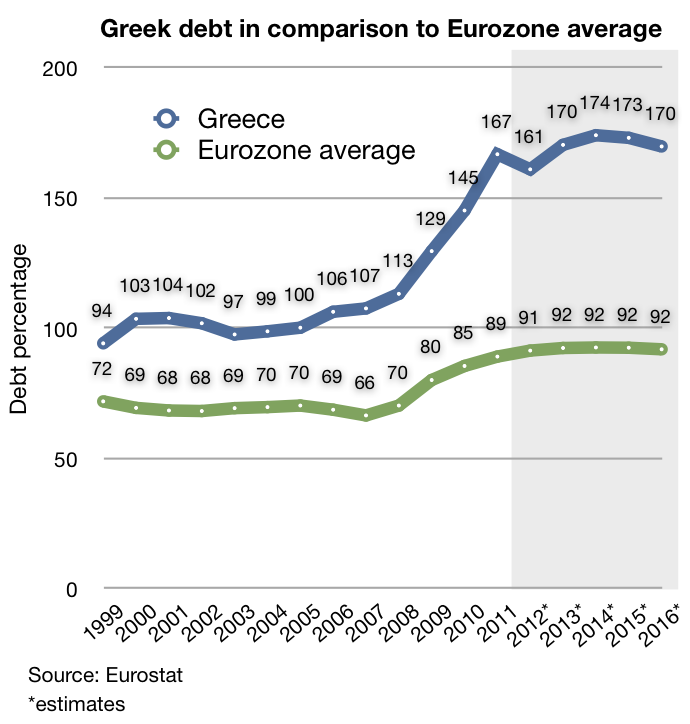
Politicians in Greece, strong proponents of a system named Kleptocracy, which in essence means a system where the government increases the personal wealth and political power of its officials and the ruling class at the expense of the wider population. Greek politicians were (are?) notorious for embezzling state funds, shipping their money to Swiss bank accounts and receiving bribes so that they could arrange something for someone. Greek government debt, issued to fund such abuse of power rose from 94% in 1999 to 167% in 2011 as one may see from the graph below.
Source: Wikimedia Commons and Eurostat
The reason for this astonishing debt growth is obviously the large government deficits, which allowed for politicians and other officials (or their affiliates and business partners) to practically steal from the state using as a preface works for public good. 

Then why the Greek people one might ask? Well, to put it simply because they tolerated and perpetuated this situation. When in public hospitals (which are supposedly free for everyone) you have to bribe doctors for the right to an examination, when you know that many are stealing from state funds and not only you do not do anything to oppose such a thing but try to come up with ways to steal some yourself, when people's parents die and do not mention the fact to the police so that they can continue to receive their pensions (and this has happened repeatedly) then one cannot just blame politicians for it. I am not at all suggesting that every person in Greece is at fault for this directly. Nevertheless, they are at fault indirectly since they have tolerated and perpetuated this situation throughout the years. All that is necessary for the triumph of evil is that good men do nothing.

2. EU Banks

Although EU (and non-EU for that matter) banks must have had the data for the increase of the Greek debt (Eurostat publishes a quarterly analysis which is free and open to public) they had chosen to ignore the possibility that a country issuing large amount of bonds could possibly face trouble. The following data is from the Bank for International Settlements in 2011 and indicate the exposure of non-Greek banks to Greek sovereign debt.
An casual observer can see that the first 12 banks have an exposure of more than 1 billion. At first, your reaction might be that obviously they had enough money to compensate for large losses in Greek debt. After all they are large, well-off organizations aren't they? Well, have a look at the next data set.
What is more astonishing is that people running the two Cypriot banks, Dexia or BPI, Commerzbank or any other bank which had a large exposure in Greek debt, did not think about having more than 10-20% of their equity in one single country. Now I am no expert in risk management, but from what I can remember there is a notion called diversification which means that you shouldn't put all your eggs in one basket. It looks like the officials who ordered such massive buys of Greek bonds should have taken a good look a their exposure and the amount of Greek debt before they invested. They did not.

3. Decisions by the EU

So far the usual suspects were at blame: greedy bankers and corrupt state officials. Now how about we take it to the next level? In an announcement in February 2012 the Eurogroup decided that the Private Sector Involvement (PSI) in the Greek debt restructuring would amount to a total of 75%. For those of you counting, the first 15 banks of the above chart lost a total of 21 billion euros in one day. These were the biggest losses of all times for most of the banks involved. 

As if this was not enough for the banks, the European Banking Authority had issued a "temporary" rule (which now is bent on making it permanent - for details read this) of increasing Core Tier 1 Capital requirements from 8% to 9%. Although this might not seem like much, the increase forced the banks to come up with €116 billion of new capital. And all that in the midst of a crisis, where finding funds is even more difficult. For a detailed view of where these funds came from have a look at the following image:

Source: Wall Street Journal
Thus, keeping in mind that when banks are in need for money they do not lend out much it not amazing why we have reached a situation where individuals and companies are struggling for liquidity. The worst part is that due to the severity of the decisions many banks in the EU are struggling for liquidity as well, which has led countries like Cyprus and Spain to seek for assistance. What has happened is that, in essence, the EU authorities have taken a country-specific crisis and transformed it to an EU-wide one through erroneous handling. These decisions can (unfortunately) be compared to the ones the US Federal Reserve had made in the early 1930's which had strengthen the Great Depression, prolonged its duration and increased its severity.

As a conclusion I would like to remind you of the timeline of errors which led to the crisis:
1. Corrupt officials and politicians in Greece were stealing money from the country and were financing their spending with government bonds,
2. Banks had not paid attention to the increase in government debt and kept on buying more and more lured in by the high returns offered, and
3. EU authorities, by handling the situation badly, have transformed the Greek crisis to an EU crisis

The situation worsens as politicians and policymakers in the EU are throwing good money to follow bad. As they cannot admit their mistakes they hope that two wrong can make a right. Well, the saying doesn't go that way.