Showing posts with label Germany. Show all posts

Friday, 15 November 2013

The German Export Beast

It appears that the US have been critical of Germany's attitude towards exports. Basically, the US, now backed by the IMF, are critical of the German Chancellor's claim that exports indicate a healthy economy. Although I disagree with Merkel's claim for the pure reason that an export-based economy is basically relying on others to prosper, I cannot help but cast my doubts on the stance many have taken against Germany.

My regular readers will certainly know that I am not a friend of German policy on most subjects. Still, I find it rather odd that a country which is having trouble with too much imports and is actually trying to decrease its current account deficit is trying to support that another country shouldn't have a large current account surplus. To be honest, I find it rather hypocritical, especially from the IMF's point of view. The fund’s First Deputy Managing Director David Lipton urged Germany to "lift its sights to the global horizon" and that cutting excessive deficits in the euro area “simply can’t happen unless surpluses are down as well.” 

Maybe Lipton is right and maybe Merkel should pay attention to what he is saying. Still, what was his employer doing when they organized the bail-out of 5 Eurozone countries in past 5 years? Simply, they were creating the situation that Germany is currently "exploiting": high uncertainty, low competitiveness, high unemployment and most importantly a depreciated euro. I will not delve into whether Germany had a say in all those or not; it is irrelevant to the role the IMF played. The IMF is supposedly an independent organization which assists ailing nations with or without the assistance of others. In any case, the IMF has supposedly been independent and unbiased in both its estimations and its opinions.

Yet, where was this opinion when the Irish bail-out was orchestrated? Or how about the Spanish or Portuguese or Greek or Cypriot one? Did the IMF change its stance on the subject as time passed on? This is an article from last February commenting on what the Washington Post published as Olivier Blanchard's mea culpa on the IMF policies in Greece. Yet, the directors never changed their tune and did the same in Cyprus just a month later. Now, they are basically blaming Germany for taking advantage of a situation they have created. But is it just Germany though or is it a general trend in the Eurozone surplus? Eurostat data favour the latter view: Euro-Area trade surplus increased to 7.1 billion in August 2013, compared to 4.6 billion in August 2012 (which was not just because of the North surpluses). 

There are those of course who are not taking a like to the US stance on the subject. FT's Gideon Rachman comments "If you had to single out a major Western economy whose irresponsible economic policy has posed a persistent danger to the global economy, the obvious candidate would be the United States." His points are correct all the way. The Great Recession alone supports his view, and if we wanted we could easily find more (the Great Depression for example). QE has been a drag on both the US and the world economy for long now and stories about whether the Fed should taper or not (or whether it can) are a major cause of uncertainty, without the officials doing anything about it. In addition, if we are to pin-point, why just Germany? China and Japan have been doing the same for years yet there has been no criticism of their actions (other than the one for the remnibi's "constant" depreciation).

Others though still think that Germany is, in their words, "a weight on the world". The arguments Wolf makes are correct and the risk of permanent deflation exists in the periphery. I doubt whether such a scenario would occur in reality, yet I think the probability exists and deflation in 2014 is something we can expect. Is Germany employing a beggar-thy-neighbour policy? To be honest, I doubt whether it can. Germany can earn significant amounts from exporting heavily, yet this comes at a cost: inflation in Germany as current data show is at 1.7% thus far, slightly higher than the EA average of 1.6%. 

Is this increase significant? Perhaps not, but the inflation monster so feared by Germany might prove too hard to kill given the ECB rate cut and the increased probability that the rest of the Eurozone recovers. As Evans-Pritchard puts it, the ECB is ready to print and Germany is ready to scream; he also rightly points out that a bout of deflation in Italy is much more severe than a bout of inflation in Germany. My take is that the ECB will finally move the way it should. Although the rate cut was much ado over (almost) nothing, it was a step towards the right direction, mainly to boost inflation in Germany and the North and investment and consumption everywhere else.

In any case, arguments like "the Germans do not work as hard as they think" (which Matt Yglesias makes) are really unnecessary and I remember deconstructing them more than a year ago. The US exports as much as Germany Matt states, but forgets to mention that the former's GDP is more than 4 times larger than the latter's and its population approximately 4 times as much, meaning that imports will be (and are) much higher and the current account will be negative. Yet, that is not a problem for the US since it has a sovereign currency of its own. Germany and the rest of the Eurozone do not. As he again points out the proposal is one to "buy more foreign-made goods and services." But these all depend on their cost and how they fare with German products. And let's face it: German products are (usually) of great quality.

Thus, as deflation sets in the rest of the Eurozone in 2014, prices in Germany will rise as a result of exports, making goods from other Eurozone countries look more appealing. This will help both the periphery countries increase their exports and Germany reduce it's dependence on foreigners (i.e. reduce exports) with the additional effect of appreciating the euro. The bottom line is that high exports are not a sign of a healthy economy, they are a sign of dependence on foreign factors. Still, blaming a country for high exports when you cannot control your own or when you were at large the culprit for the creating of the situation which allows them to pursue such policies does not make sense at all.

Wednesday, 2 October 2013

The 1920's all over again: The Greek Transfer Problem

Germany in the 1920's: The Transfer Problem
Keynes, in 1929, stated that the problem of German reparations after World War I could be reduced into two issues: the Budgetary Problem (i.e. how to extract the necessary amount from the country) and the Transfer Problem (i.e. converting the German money received into foreign currency). The fact that Germany had been borrowing abroad for domestic capital purposes temporarily solved the problem, yet the situation could not hold for ever. Thus, the only potential resolution of finding the funds to cover for the Budgetary Problem would be to increase exports by a significant amount; a feat that could only be achieved by shifting factors of production from other employments to the German export industry.

The only reasonable explanation for Keynes was that Germany had to reduce her costs of production first, as supply of labour was more than enough at the time. Using this rationale, solving the Transfer problem would mean that German gold-costs of production relative to such costs elsewhere would have to be reduced either through increased efficiency, lowering of interest rates or lowering efficiency wages. As the first two did not appear to be available for change (efficiency was high at the time and lowering interest rates, i.e. cheap money for Germany, was not an option) a reduction of the efficiency-wages in Germany was the only alternative left.

However, such a reduction in efficiency wages would make the extraction of the funds needed for reparations (i.e. the Budgetary Problem) much more challenging. In addition, lowering money-wages would be to no avail if:
i.   Output could not be exported
ii.  Demand elasticity for Germany’s goods was less than one
iii. Germany’s competitors reduced their efficiency wages pari passu
iv.  Foreign customers imposed tariffs on German goods

This lowering of money-wages would not mean that real-wages would be reduced by the same amount as home-goods prices are expected to fall. On the other hand, efficiency could also be reduced in response to the wages which could trigger an even larger decrease in money-wages and so on.

The mechanisms which would provide for such a decrease in wages were two: the fall of the German Mark’s exchange rate (which was prohibited by the Dawes scheme) or by allowing the Reichsbank to enforce deflation, which would curtail the activity of business and throw people out of employment, so that when sufficient amount of workers are out of employment they would accept a reduction in their money wages. In Keynes's own words "Whether this is politically and humanly feasible is another matter".

Greece in the 2010's
On May 2nd, 2010, the IMF and the Eurozone authorities (Troika) agreed on a bail-out loan of €110 billion. The influx of funds, which was mainly employed in bank recapitalizations and debt restructuring, came with the need to increase government revenue, while simultaneously reducing expenses so that future installments could be met. Given that Greece did not possess a national currency to devaluate (much like Germany in the 1920’s) the additional three options had to be assessed; greater efficiency, cheaper money or lowering the money-wages.

Blue line: Corporate Lending Rate. Orange line: Mortgage Lending Rate
Although interest rates decreased slightly, they remained a relatively high level compared with the rest of the Eurozone, perhaps indicative of the fact that Greece is still at risk. Issuance of sovereign bonds was not an option for the country since she had been out of the markets since April 2010, thus, no opportunity for cheap money was not available. Increased efficiency was an issue considered in the country, yet, due to over-crowding in the government sector, lay-offs were implemented, both as a measure to increase efficiency as well as a measure to decrease government spending. Thus, the only remaining alternative was a reduction in money-wages.

Reduced government spending meant reduced state stimulus in the economy; thus, the Budgetary problem had to be resolved as less available money would have to compensate for the same amount of state revenues (to meet debt repayments). The challenge was no less tempting than the one faced by Germany in the 1920’s and the necessity to create additional income to compensate for the increased installments which had to be paid in the following periods, drove the economy to the only other alternative: deflation.

Not possessing a national currency (much like Germany could not devaluate hers) meant that the nation would either be forced to borrow from abroad to repay her current installments (which was infeasible for Greece) or increase the trade balance in favour of exports. In Keynes's mind, this could only occur if money-wages were reduced; as we have seen before indicate that before, money-wages in Greece decreased, although they were much stickier than most expected.

The shift of factors of production in Greece the borrower’s price of Imports relative to Exports is consistently rising over time, which leads to decreased export prices and increased import ones. This is consistent with the Keynesian premise that factors of production need to shift from industries which focus on domestic goods to ones which focus on exports, consequently decreasing export prices as a result of lower efficiency wages.

Import over Export Prices
Conclusion
Since Greece was unable to devaluate her currency to accommodate for the flow of goods in her economy after the first bail-out, the transfer problem deteriorated the nation’s finances, which promoted a shift in the factors of production from home-goods to export-goods, albeit at a significant cost to the country’s economy: unemployment has exceeded 26%. Consequently, the Budgetary problem of extracting a significant amount of funds from a reduced amount of wages in an economy, arose; this in its turn provided the need for debt restructuring, both in the sense of reducing the debt burden as well as making debt terms more lax. 

Why should we pay attention to this? Simply because this has been largely ignored by most economists when the design of the Greek restructuring plan took place (and every other EU bail-out before or since, to be fair) and led to consequences econometric models were unable to project. In addition, since none of the countries which received a bail-out has been able to come out of it successfully yet, (although Cyprus has some hopes since new bank loan offers have already began) the matter presented here should be of extreme interest both for any future bail-outs that may be needed (Slovenia is likely candidate for example) as well as for re-examining where policy went wrong in the Eurozone. Past experiences with austerity when countries had their own sovereign currencies had nothing to do with what was (and is) asked of the bailed-out member: a depreciation of the exchange rate when there is no exchange rate to depreciate. This is what has mainly been the cause of the severe contraction of the Eurozone economy has been the inflexibility of the economy (see also here) which is a result of stickiness in the short-run and the lack of sovereign currency to depreciate. In its turn, this forced the shifting of factors of production from one sector to another while at the same time created an army of unemployed.

To paraphrase Keynes, it appears that such policies were deemed as politically and humanly feasible in the 2010's EU. Unfortunately, the costs were both miscalculated and neglected.

Tuesday, 14 May 2013

Are labour costs all that matters in reducing prices?

A month ago, Eurostat published the 2012 data concerning labour costs in the EU. Attention should be drawn to the following graph:

(Click to Enlarge)
As the reader may observe, of the crisis-ridden countries, only Ireland is (barely) over the EA-17 average, while the rest of the countries, although they have been accused of high labour costs and the need for a more competitive economy are facing much lower costs than the "stronger" economies of Europe. Then, in the following chart we can see the change in labour costs compared to the change in real GDP for 2012.

Although not many data can be seen above, it is the case that a decrease in labour costs and a decrease in GDP go hand in hand, although labour costs appear to be lagging with respect to GDP change (see Italy or Cyprus). Economic theory states that for a nation to become more competitive, it either has to decrease its costs of production or depreciate its currency. In the Euro Area case, the second option is unavailable, thus the "need" for the first. Nevertheless, too much emphasis on the reduction of labour costs does not yield good results. 

It is doubtful that anyone would dare state that Greece or Portugal or Spain are more competitive than Germany. Yet, German labour costs were 30.4 per hour compared to €14.2, €12.2 and €21 respectively. If a person knowing just the economic theory described above and the labour costs per nation was told that Germany was the leading exporter in the EU then he would be rightly confused. It is not that Germany has a weaker currency either. In theory, a euro is a euro anywhere in Europe (well, other than Cyprus, that is).

Thus, since Germany is the leading exporter of goods it does either of three things:
1. Buys raw material at cheaper prices
2. Has a better reputation and creates better goods
3. Sells with less profit

Better reputation and quality of goods is not a thing that can be attributed to labour costs. On the contrary, when workers are paid better, it is to their best interest to create better goods. Thus, decreasing labour costs would not assist in neither better reputation nor better quality. Selling with less profit may be an issue, yet it is one we will never find out, as finding out what the profit margin of every company in Greece or Germany is, appears impossible. Then, all we are left with is producer prices. According to Eurostat, Germany's industrial producer price index (which indicates changes in the ex-works sale prices of all products sold on the domestic markets of the various countries, excluding imports) stood at 108.4 compared to 112.9 for Greece, 111.8 for Spain and 111.1 for Portugal. 

The producer index signifies that the German producer is able to purchase goods at lower prices than his Spanish or Portuguese counterpart. Rising prices do not have to do just with labour costs though. If we assume that raw materials are bought at the same prices (i.e. oil, ferrous and non-ferrous metals, etc) given a world-wide market, then all we have left are procedures, costs and productivity. Thus, of the constituents of prices, the only one which is influenced by the state of the economy is costs; which at the end does not even matter that much. 

Productivity is wholly different subject though. Eurostat calculates labour productivity per hour worked per year and the results are impressive. Germany's stands at 42.3, while Portugal's at 16.8, Italy's at 32.5, Spain's at 31.3 and Greece's at 20.3. This means that a German worker actually produces more than double of what a Greek or a Portuguese one does. As a result, the labour cost of a worker in Germany is approximately the same as for a Greek worker if we account for the fact that the former produces more (with the added advantage that the German firm produces more). 

Thus, the issue is not how to decrease wages, but how to to make workers produce more. This is not an easy subject. The main issue here is what makes a worker produce less. Is it because he is just lazy or because the whole system does not allow for more production? If obsolete equipment and stagnant procedures are to be blamed for this (again, as economic theory states), then a renewal of equipment and less bureaucracy would benefit the economy more than any reduction in labour costs would. If all workers in a country were lazy then we would not have any production at all, thus, although it is true that some people are lazier than others, the case is that if you have to work, you will eventually become as productive as your job requires you to be or as productive as it allows you to be.

We can all agree that a contraction in GDP leads to lower labour costs. Yet, we should not forget that it also leads to lower demand and thus less income for any firm. In addition, increasing productivity is a much better way to lower labour costs, increase production and subsequently income. Thus, although the current focus is on decreasing everything that may be decreased, the state of events indicates that this approach has been on the wrong: if productivity is increased then any periphery country may be able to sell more goods, both in the domestic as well as the international market, at a much lower price with much greater profit.

The quick lesson is this: if productivity is increased via increased investment in new and better equipment, then both effective labour costs will be lowered and the country's output as well as the firm's profitability will be increased.

Thursday, 4 April 2013

What (German) Taxpayer Money at Risk?

It is not that anyone expected small countries to receive the same treatment as larger ones. Nor that everyone would be treated equally in the EU. Other than proclaiming "solidarity, friendship, co-operation" the people of Europe have seen very little of that from their politicians (not to mention other nations' politicians). What makes matters even worse is that decisions taken at the highest level are not even consistent.

Lately, an article in Spiegel reminded us of two incidents which happened during 2011:
1. The bail-out and nationalization of Hypo Real Estate
2. The bail-out of Commerzbank

In the first case, the German state assisted the mortgage-lender with more than €20bn, while simultaneously guaranteeing about €145bn of assets in it. The latter is just a case of the state funding the bank with more than €18bn and the bank winning a European approval to postpone the sale of its real-estate unit by 2014, effectively changing the bail-out terms.
What should be noted is that these funds came from actual German taxpayer money, with no obligation of actually returning those money back. In contrast, all other bail-outs in Europe cannot be considered a waste of taxpayer money. Let's elaborate on that. About a year ago, the bail-out agreement with Greece resulted that the latter would have to pay an interest rate of about 3.65%. Four months ago, at a Eurogroup meeting, Finance ministers agreed to reduce that rate by 1%, in order for the debt burden to remain sustainable. Thus, the effective interest rate earned is approximately 2.65%.

For comparison, the highest deposit rate for fixed or time deposits in Germany is currently at 1.4% according to Europe Bank Account Rates. Thus, the German state is in fact investing German taxpayer money, earning a substantial 1.2% more than having it sit around in a bank. There are those who might say that this reflects the fact that Greece represents a risky investment that makes interest rates so high. Yet, according to formally used risk-weights investing in government bonds is a zero-risk investment. In addition, none of the money invested in the country has so far been lost; in contrast 71% of the private sector money involved in the deal vanished into thin air. The EU appears to be the best investor in the world right now: it has money to invest, needy countries who are begging for money, thus agreeing to pay a higher interest rate (although lower than the market one) and it has the opportunity to shape laws the way it wants so that its funds are protected.

Until now, the EU has agreed on providing 144.7bn to Greece, out of a total 164.5bn package. This means, that if percentages are used as in the European budget, 21.11%, or €30.54bn of that money will come from Germany. This is an amount less than 1% of the German GDP, yet it allows for more than 800m for interest proceeds per year, for the next 30 years. What is more, this is more than 380m per year more than what they would have gotten if they had invested the money in a bank. 

It was more than known that Germany was earning huge amounts of money through lower debt interest rates; during last August, the yield for German bonds was actually negative! People were actually paying Germany to hold their money. Yet, Germany, as the rest of the well-off EU countries are pushing the deal even further by being both regulators and investors. The excuse of protecting "German Taxpayer Money" is not quite valid at the point: the German taxpayer is either earning a significant amount of money for that investment, or his money is not at all in danger if the ESM/EFSF or the ECB is paying. Regarding every euro coin as your own does not make it such.

Think of the latest deal with Cyprus. The amount to be given via the EFSF/ESM funds is €10bn, with the island paying an interest rate of about 2.5-2.7%. The most interesting part is that there are no taxpayer money at risk: by construction, all Eurozone countries have to guarantee the fund, yet no country will actually hand over any assets to it; bonds will be issued in order to cover the bail-outs it will make. Essentially, this makes the EFSF a large speculative fund with no chance of losing money: 2.5% yearly return on risk-free assets, through borrowed money and an ability to shift regulation at its will.

Then why is it that they worry about taxpayer money if that is not invested? I will leave the discussion on whether having a state act as a speculative vehicle good is beneficial. Yet, if the major concern for assisting an ailing state is moral hazard, then why not regulate banks more efficiently in the first place? For example, why did the ECB throw so much money at a bank which was evidently bankrupt since last summer? Better policies are in need if the intention is to keep the euro alive. 

P.S. As for the obsession with price stability, if the ECB is generating money, even via the "printing machine" so feared by German authorities, this does not mean that Germany will face a large inflation rate nor is that money German; they belong to Europe and the receiving nation. In addition, as Paul Krugman stated more than two years ago, money in one country does not affect inflation in all the others. For example, Cyprus could have a 20% inflation and the overall EU inflation would have been affected by much. This simple fact is also declared on the ECB's website (although I could not find the actual weights) and yet it is never mentioned.

Friday, 22 February 2013

Let Cyprus fail? Why?

Although I thought I would never have to write anything more of the subject it appears that some people just don't get it. The usual comments on the subject include "why save Russian oligarchs?" or "why is the country systemic?" or "they are have money laundering issues" or even "we should set a precedent". Again, I will direct any people who still believe any of the above comments to some of the previous posts on this blog, where you may find a long explanation of why these are not good excuses. (the reader may have a look here, here, and here).

In brief the answers to the above comments is that:

1. Why save Russian oligarchs?
Answer: Russian oligarchs are in no need to be saved by anyone. They can simply transfer the funds from one bank to another at the click of a mouse. And no oligarch has such an important amount of money in the country that it can really affect him even if he loses it. The bail-out is for the Cypriot banks which have suffered from the inane decision for a 70% PSI and for the government for is to take us this responsibility. In essence, it is for the Cypriot people and not for the rich. This is capitalism people; the rich are well-off both in recessions and booms.

2. Why is the country systemic?
Answer: Does it really matter? We are not talking about handing them with €100 billion but with 17. This does sound like much for us ordinary people but it isn't really that much for a government. And if the agencies do their mathematics well they will see that the whole situation can be reversed with about 4 (for details have a look at this article).

3. They are have money laundering issues  
Answer: Not really... According to the non-profit Basel Institute on Governance Cyprus is on the 114th position for money laundering. (the lower a country is ranked are less possibility for money laundering exists). Compare that with Germany (68th), Netherlands (109), United States (97th) or Switzerland (71th) and Austria (74th). And I do remind you that this is an independent organization.

4. We should set a precedent
Answer: Set a precedent for what? When the EU screws up in its decisions (hint: 70% PSI involvement on the Greek haircut) why are going to let those affected by those, fail? So the rationale behind this is simply: "we didn't let Greece default, but we screwed up thus we have to let someone else take the fall for no apparent reason". And who is easier to take the fall but the little guy? Of all the excuses for not helping Cyprus this is by far the worst; it exemplifies the sort of money-focused, nationalistic, opportunistic behaviour which the EU was hoping to destroy. What do we care if a nation is destroyed based on our bad decisions?

There are two options actually: either they get the money or the fail. If it's the second then why not exit the Eurozone and print some new Cypriot pounds to compensate for their losses? And if this happens how about some new pesetas or drachmas? I repeat what I have said before: if one country exits the Eurozone or the EU then others will follow.

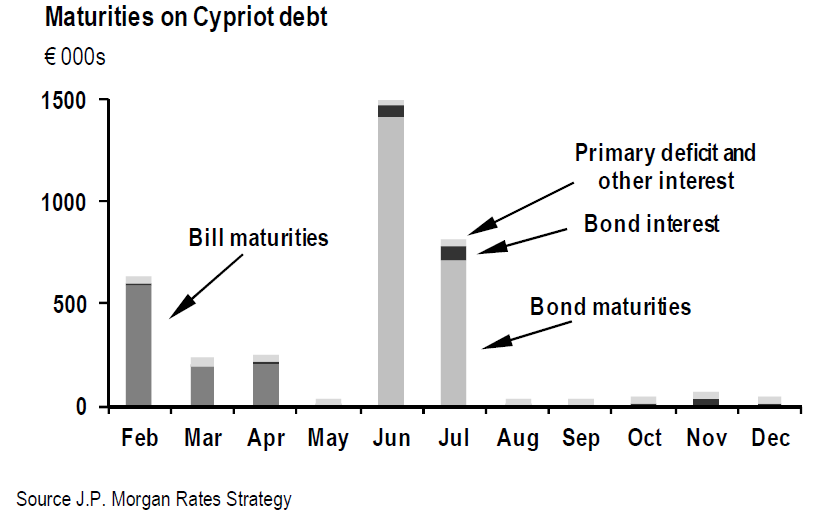
A look at the graph at the beginning of this article will tell you that the Cypriot state does not really have a problem with debt maturities before June and July. It is claimed that if Cyprus can last until the German elections in September it will be easier on them. But if they can last until September then why bother with a bail-out?

Thursday, 14 February 2013

GDP is falling down...

Eurostat published its latest statistics on Q4 2012 in the Eurozone. Nothing that we did not expect actually: Portugal -1.8%, Cyprus -1.0%, Italy -0.9%, Spain -0.7%. No statistics were published regarding the state of the Greek economy.

These results indicate that during the last three quarters the Eurozone had a contraction in each and every one of them. (I would remind you that the definition of a recession is two consecutive quarters with negative GDP growth. And we are experiencing three...)

What many did not expect though was the following:
Germany: -0.6%
Finland: -0.5%
France: -0.3%
UK: -0.3%

We all thought that the German economy was impervious to such things as recessions right? Well, let me remind you that this was a not-so-unexpected phenomenon. I have explained that the recession would have a very important effect on the German exports (which are about 60-65% to countries within the EU, and specifically within the Eurozone) in this article published in mid-November. Wolfgang Schäuble was said to secretly prepare for this downfall in the last days of 2012 by "cutbacks to prepare for a weakening economy and possible fallout from the euro crisis" (for details read this).

It looks like this time is now here for Germany. I have no other explanation for persistence in plans which do not work than obstinance and illusory beliefs and views of the world. If Schäuble is allowed to do the same with Germany as he proposed (and unfortunately pulled through) with Greece, Spain, Portugal and Cyprus the Germans are in for a much worse fate than they expected. 

And this will only be the beginning...

Tuesday, 12 February 2013

Austerity and Wages: The Real Data

From what we can see very few have actually bothered to see the effects of austerity measures in the lives of people. Thus, after some (very light) data mining I present you the effects that these austerity measures had on the Greek and Irish economies. Unfortunately, we do not have the opportunity to study other nations for the time being, as data only go as back as June 2012. Yet I will contrast the results for Greece with those of Germany during the 2006-2012 period.

Note: All results are inflation-adjusted (i.e. real) and account for gross wages (y-axis represents aggregate wages in the economy)

Real Wages in Greece
In the graph above, the two vertical lines represent the first two austerity packages the country passed, one in May 2010 and the other in February 2012. According to the data, the real value of the country's wages began to fall just before the 1st memorandum and is continuing its downwards slop up to day. In contrast, have a look at real wages in Germany:
Real Wages in Germany
Here, real wages only took a slight fall during the late 2008 crisis, but have resumed their upward trend in 2010, rising substantially over the past couple of years. If the Greek data are not enough let's have a look at the next graph:

Real Wages in Ireland
As anyone can see, wages in Ireland have also taken a tumble over the past 3 years. The straight line represents the 2009 budget which was aimed at salvaging the Irish banks and reduced government spending so that the debt burden assumed would be sustainable. The point of contrasting the aforementioned two countries with Germany is not to blame the latter. It is merely to point that Germany is here a case where policies have worked well while Greece and Ireland the cases where terrible policies did not have the results expected by policymakers. Worse of all, the result expected had no relationship with reality whatsoever. 

As economists, we expect that once the public's purchasing power is lowered then prices will fall as a result of less demand. This is actually what is being taught in Economics 101 in every university in the world. (see graph below)
Simplistic economics: Lower demand (Demand 2) means lower price (P2).
What economists in the IMF and the EU have failed to see is that prices do not change so fast. In fact, they may not change at all during the short-term (depending on how you measure short-term of course. Here, I assume is it as less than 2 years). In fact, an article in a Greek newspaper stated that prices in the economy just showed a declined. The date: February 6th, 2013. One could post data on inflation in Greece but these would be redundant. Real wages represent the current state of the economy much better and with greater insight on the public's purchasing power.

Since people do not behave as economists believe they do (and no economist has ever thought about changing the models or defining "rationality" in a different way) it is obvious that real-life effects will differ significantly from what is expected in theory. Greece and Ireland appear to have been nothing more than economic experiments; so that economists can learn that the world does not function the way they had thought. Unfortunately, it takes more than just one nation for economists to understand and admit mea culpa. The same situation is about to happen in Cyprus and has already happened in Portugal, Italy and Spain.

Did the authorities have an alternative? Yes: induce less rapid austerity measures, so that the reduction in government expenses would not cause such extreme responses, making a more gradual move from over-spending to under-spending. Now, let's assume that they did not know about this and they had to make a mistake to learn about it; now that they have learned, will they do anything fix this situation?

Thursday, 27 December 2012

Recession in Germany?

Although these are festive days and everybody deserves to be happy, one cannot help but comment on this article on Der Spiegel, stating that "Wolfgang Schäuble is secretly planning cutbacks to prepare for a weakening economy and possible fallout from the euro crisis". Hate to say "told you so" Wolfgang, but I did here about 1.5 months ago. What had mentioned in that article was that given that German exports within the EU accounted for about 60-65% of the total exports. If demand falls in those countries guess who would be in trouble: exactly, Germany.

It appears that German strategists in the center-right coalition parties are planning to enhance benefits for families, pensioners and the long-term unemployed while experts in Schäuble's ministry are believe that the next government - no matter who - won't be able to boost spending but it will have to impose a rigorous spending restraint. It appears that Schäuble wants to give his countrymen a taste of the medicine he (along with Angela Merkel) has been promoting in Europe over the past couple of years.

The measures promoted by Schäuble will include decreases in pensions for early retirement instead and a significant reduction the 55% of their deceased spouse's income widowers and widows now receive. It appears that Germany has now reached the tipping point; either they go down with the rest of Europe or they manage to save themselves along with the rest of the countries in critical condition. The first scenario is easy to picture: Germany imposes austerity measures, people reduce consumption, and investment along with the already reduced government spending and GDP falls. The same old story as in Spain, Italy, Greece, Cyprus and Portugal. 

The second scenario is the most difficult of the two. How can Germany and Europe be saved? The answer is not as complicated as it appears though. The ECB should be allowed to directly finance banks, under the EFSF/ESM funds. This means that it will be able to gather all problematic banking institutions under a common umbrella and thus deal with their problems without any pressuring time constraints. To those who believe that this appears to be similar to what Jens Weidmann, Bundesbank's President, has dubbed as "supporting countries with the printing-machine" I would agree that it is. Yet, there is one significant difference: Weidmann's comment was referring to bond guarantees by the ECB, which in essence mean direct nation support, instead to what this proposal is: direct banking support. Would anyone disagree that it is the definition of the Central Bank's duties to monitor and support banking institutions and this is the main reason Central Banks were invented in the first place? 
It could might as well be now: unemployed workers waiting in line
in 1938, towards the end of the Great Depression.
By directly funding the banks we would not, of course, solve every problem we currently face. Still, we would solve the greatest one, banking recapitalization which is the main issue in countries like Spain and Cyprus and a major secondary issue in Greece. In Portugal and Italy, policymakers would just have to implement moderate spending cuts (like the ones the Monti government had applied in Italy) to survive. Even with the aforementioned solution, it is irrational to believe or hope that everything would be better in the next year. The effects of such reforms would not start to show until 2014. Nevertheless, if we do not implement such solutions, it would mean that we cannot even hope for an improvement of the situation in 3 or 4 years from now. 

The outcome of the proposed austerity measures will be the reason why future economists and politicians will condemn us. We will be responsible for promoting a regional crisis to Europe's Great Depression; and we all know that this will not be a good outcome. Have a look at the 1930's and 1940's decades and history will tell you what happens after great calamities. We have to learn from our mistakes and fast: otherwise it will be too late to alter the situation

Monday, 26 November 2012

Pensions and Retirement

After years and years of the retirement age remaining stable and citizens being able to compute when they would have been able to retire peacefully without any worries, suddenly countries have decided to alter the retirement age for state pensions. The reasons stated for that were that it is infeasible for the state to pay pensions for so long as the average life expectancy of a person has risen over time. For reasons of comparison, I offer you a list of several EU nations with their respective retirement ages (additional information and more nations can be found in Wikipedia and this Eurostat publication (p.78) ):
I will not argue with the feasibility or not of the pension system in each country. Nevertheless, I would argue with something that is more important in my mind. All of the above retirement ages are fixed to a specific age and not the amount of years a person has worked.

I will illustrate what I mean with a simple example. Take for example the case of Germany:
We have two persons Mr A and Mr B, both aged 18 at the moment. Given that the retirement age in the country is 67 both persons have approximately 49 years of work in front of them. Average life expectancy in Germany is now exactly 80.0 years as quick Google search can show and recent EU projections state that it will rise to 84 years by 2060 when our two friends will retire. 

Thus, both of them are expected to work for 49 years and enjoy their pensions for another 17. The big problem arises when Mr A decides to take up a university degree. As in Germany an academic degree usually takes about 5 years to be completed (with even considering any delays or further study) it would mean that Mr A would in fact work for 44 years and receive a pension for his remaining 17.

Some of you may say that if Mr A gets a higher salary due to his university degree it would be same as if he had worked those extra 5 years. Well, maybe or then again, maybe not. This is not always the case as many people without any degrees have managed to do extremely well, better than others who had graduated from universities. In any case, my point would be this: why not let people select their own retirement age based on the years they have worked?

I am not an actuary, however, it would seem very plausible that people who are essentially working for e.g. 43-44 years should be allowed to choose whether they would like to retire or not. In our example above, Mr B should be free to select whether he would like to retire at any age in the 62-67 range. Based on the value of their stream of payments to the social security system, the last few years' worth of installments would account for much less than the ones in their first years of employment. This essentially means that the last few years of payments would not matter as much to the amount Mr B receives per month as his pension (for a more elaborate view on the subject have a look at the time value of money). Thus Mr B would be free to choose whether he would like to continue work until his 67 years of age or stop at any time between 62-67. As people differ in their ability to work in old age, this would mean that persons who are not strong enough (due to accidents or other health reasons or even by nature) are allowed to retire without being a burden to the system, as they are now being considered whilst those who feel strong enough to continue may do so.

This rationale would work both in a funded as well as an unfunded benefits plan, given that in both cases the amount of pension to be received is to calculated based on the amount of payments one has given into the system. (for differences between plans read this)

The solution described above is much more optimal than those implemented now, as it allows for the person to be judged on his years of service and not by a rule-of-thumb age. It even prevents cases of social injustice as it correlates years of work with the ability to retire without forcing people to be employed when their nature forces them to do otherwise. Nevertheless, as with many ideas, ideological stubbornness does not allow politicians and policymakers to see the forest and not just the tree.

Tuesday, 20 November 2012

Ideologies Redux

Have you heard of Hans-Werner Sinn? If you have not (like I had not until very recently) then as a quick search in Wikipedia could have indicated, he is an economist and the President of the Ifo Institute for Economic Research. So far so good. According to an article in today's Spiegel he is also promoting the idea that Portugal and Greece should temporarily exit the monetary Union until their competitiveness is restored and then return to it.

(Sigh) Some people never see the real world... First of all, let us assume that it is indeed better for Portugal and Greece to exit the monetary Union. Then they exit, and supposedly nothing bad happens during that transition period. Then let us assume that, after some unspecified period of time, their competitiveness is finally restored. Then why on earth would theses two countries ever want to return to the monetary Union? Their competitiveness is high, they still do not pay tariffs for goods to and from the EU because they are still members and they possess an ability to devalue their currency every time their public debt reaches high levels.

Then, if relatively small countries like Portugal and Greece should exit then why not Spain or Italy? What would stop them from returning back to the peseta and the lira? The plan Sinn is proposing is not one of strengthening the Union but one of demolishing it. People do not realize that if one country exits the Eurozone then many will follow. And many, (amongst them myself) have stated it in the past: we need more solidarity not more division.

We have also assumed that nothing bad happens to Portugal and Greece if they exit the monetary Union. But if you would remember, I had posted the following chart about inflation rates after the Euro induction in the Eurozone countries:
On average, inflation in the Eurozone countries was higher by 0.95% in the times after the initiation of the Euro than before. (for a detailed analysis I would refer you to this) You may imagine the chaos that would be presented if they suddenly returned to their own currency. Another round of high inflation would render the nations completely uncompetitive for the at least the next 5-10 years.

According to Sinn, "Euro-zone member states have made available €1,400 billion ($1,780 billion) in bailout loans, €700 billion of which has been contributed by the Bundesbank through its TARGET loans. On top of this, there is the ESM with €700 billion, which is to be leveraged to €2,000 billion with the help of private investors. This stabilizes the capital markets, but it also destabilizes the remaining stable European states and wipes out the savings of retirees and taxpayers." 

What he seems to be forgetting is that the way out of the crisis is by the devaluation of the currency and not by letting it remain at high levels. Yet, he seems to remain stuck to the idea of a strong currency. I fail to see how the bail-outs would have caused any harm had the Germans allowed the ECB to just print money. Yes, I can understand that this is something against German ideology of strong and stable currency, but how could this have hurt German taxpayers and retirees? Had Germany not wanted to play the part of the lender of all nations then none of this would have made sense.

By allowing the ECB to print money in order to finance the ailing nations, then the Euro would have just been devalued and no harm would be possible for the German taxpayer or retiree. On the contrary it would have boosted German as well as EU exports.

I am not blaming the Germans for this situation. Just some of their politicians and policymakers. But having an economist state that an exit and a return of a country in the Union is the best alternative to this situation is just the case I presented here where economists do not consider a real world with implications for every action. In addition the German taxpayer should not be worried if his/her government allowed the ECB to function the way a real central bank does. Only if...

Friday, 16 November 2012

The Effects of Recession on German Exports

Let's admit it. Germany one of the most well-off nations in Europe at the moment. The monetary value of its exports rank it as the second country in the world after China. Yet, although it has been mentioned that Germany has been lucky to have demand for its products rise due to emerging economies the data might suggest something different. In total Germany exported goods values about €1.061 trillion in 2011. Here is the list of the top 20 country to which Germany has exported goods:
Source: Statistischess Bundesamt, Wiesbaden.
As you may France, the Netherlands, Italy, Belgium and Spain account for about €350 billion of German exports. Why did I just select these countries? Well, France's economy is at the brink of recession, with zero growth over the last two quarters, Belgium has already initiated austerity programs and has seen its GDP contract by 0.2% last quarter and the Netherlands have just resurfaced from recession. And the reasons are obvious for Italy and Spain. (second quarter data can be found here)

Even if we just measure the most distressed nations in the Union (Greece, Spain, Italy, Portugal, Cyprus and Ireland) the total amount of exports to those nations is €112 billion, more than 10% of total exports.

The above graph shows the percentage of intra-EU and extra-EU trade per country. As you may see, about 60-65% of Germany's exports are within the EU. The only nations which have a high percentage of non-EU exports are Greece, Italy and the UK.

What is my point here? That when recession hits a nations, the first thing that falls is imports. And to nations who depend on each other for imports and exports, this is of tremendous importance. Imagine what would happen if suddenly all 6 of the above nations saw demand for foreign goods collapse (and need I remind you that with the possible exception of Ireland we are talking about countries who are producing and exporting great amounts of food and cheap clothing so we can assume that they are importing goods whose demand is elastic, i.e. can vary according to price or buying power) then Germany will lose a vast amount of its trade. And when this happens then I am sure that France and Belgium will be the next places where demand for imports will fall as well.

I do believe that Europe is now facing its own Great Depression. As no measures have been taken, it would be easy to see that an EU-wide recession will eventually set up. Although Germany now has a very strong economy, as so do the Scandinavian nations, the correlations between nations are so strong that one severe recession in one country can cause a domino effect. Time will indeed show...

Wednesday, 7 November 2012

Easier to Preach than Implement

Don't know if you have seen it, but an article in Der Spiegel states that although Angela Merkel and Wolfgang Schäuble have forced almost every Southern nation in the EU to take harsh austerity measures, they do not plan to follow that recipe themselves. With less than a year until elections, Angela Merkel is planning on increasing government spending in the form of subsidies and pension raises. While this may be speculative as the German Chancellor has committed to presenting a balanced budget for 2013, it is in severe contrast with Schäuble's on austerity in the current G-20 summit in Mexico City.

You see, as in most philosophies and other principles and values, it is easier to preach and condemn people for not implementing them or even force people to apply them, than to use them yourself. The great socioeconomic experiment we are currently witnessing in Greece (and will soon witness in Cyprus as well) is indicative of people who are stuck in ideology and cannot understand simple economic reality. I am not talking about complex equations or ideas here: what I mean is the mere understanding that if you cut salaries and wages things will get worse than what they were. Any high school student could see and understand this. Sadly, we have no high school students in a position to apply policy.

If austerity measures were implemented to reduce structural problems the countries were facing, I would admit that, even though rapid implementation is never good, the measures were aimed at producing something good. Nevertheless, the measures are only aimed at reducing expenses and not addressing problems. As a result, they do nothing to improve a country's well-being. In contrast, what they do is deepen the gap between social classes, as the lower class assumes most of the burden.

The Greek domino effect. Source: socialistrevolution.org
It would look like policymakers and politicians in the EU are not really reading any blogger articles. The EU blogosphere has been expressing its objections about this for months now. What seems to be even more amazing is that even though blogger voices against austerity have increased over time, nothing is being done to correct the situation. What I fear is not that a nation will be destroyed. It is the domino effects of this destruction that I fear the most. A Greek bankruptcy, or even a fall of the government, would most likely force the nation out of the Union and the common currency. And if this occurs then maybe Cyprus, Spain and Italy will also flee, thus rendering the EU a non-Mediterranean union. Although the ties between nations are strong, which can be evidently seen in the youth, they are nevertheless weaker in the older population. As the older generation rules, it will be more difficult not to follow suit if Greece exits the Union.

What is suggested above is not just a far-fetched scenario. It is one of extreme likelihood if the austerity measures are not passed through the Greek parliament. And I am not sure what is worse for the Greeks: the painful austerity plans or the fall of a government? In the long run obviously the second would yield worse results, but in the short run austerity will bring those of the Greeks still standing, to their knees. 

Unfortunately, Greece, as well as Cyprus in a few days, is at the mercy of its creditors. They tell the country how much it shall be lent, when and what is should do with the money. It is essentially being an unelected and uninvited government. Can you really blame the citizens for not liking the Troika and what it represents?

Monday, 5 November 2012

Is it money or reforms they are after?

Yanis Varoufakis's latest article states that the Greek government should only cut about 2.5 billion euros, which is the nation's primary deficit at the moment, and then renegotiate the loan agreement with the Troika. Although it does sound like a good idea in theory, I am afraid that the only way to achieve what he proposes would be for the Greek government to exercise tremendous political on the ECB or the IMF.

In short, what Yanis proposes is for the Greeks to cut 2.5 billion, receive 31 billion and then renegotiate the loan agreement. Yet I am under the impression that if the "old-heads" of the IMF won't see the measures they have proposed, passed through the Parliament, they will not allow for the 31 billion tranche to reach Greece. As the stupidity that the EFSF-ESM will not directly recapitalize Greek banks remains then I am afraid that all Greece, Spain and Cyprus are doomed to forever move in a recessionary spiral.

Norwegian chocolate bar Troika. Too bad their measures are bitter. Source: Wikimedia Commons
It is impossible to understand why the Germans and many other Northerners are opposing the idea of a direct aid to the EU banks. If that was to occur, then the EU nations which opted for a bail-out would only have to receive half of the aid they are currently receiving, if not even less. And for those who do not remember, most (if not all) of the EU banks are facing troubles due to the decision to haircut the Greek bonds held by the private sector by essentially 79% (30% plus 70% on the remaining) and the equally irrational decision to raise Core Tier 1 capital adequacy ratios by 1% in the midst of the crisis. 

For those who fear that the "German taxpayer" would have to pay for bank recapitalization, I need not remind you that the ECB can just guarantee the adequacy of the EU banks, without spending a cent, forcing the banks to come up with the money in a number of years and not now. Nevertheless a money injection in the ailing banks could be good for the economy as a whole. And if you consider this to be greatly risky for taxpayer I repeat: money does not have to be spent to make the Union's wheels turning.

While Yanis's proposal is great in theory, I am afraid that the only way around the austerity measures proposed would be to pass them through the Parliament, receive the 31 billion and then annul some of them. This however, would not make the Greeks more credible, nevertheless it would make it more possible for them to get through 2013 without another severe recession. As a Kathimerini article states today, some fear that the recession will be closer to 9% than 4.5% in 2013.

What worries me more is that while the country is at the brink of disaster, the Troika or the EU does not seem to understand the effects the undertaken measures will have on the ordinary people. In the previous article I have stated that the measures affect the low- and medium-income families much more than the higher income ones. Given that the latter have much more elastic demand it is more than obvious that when their income is reduced, their consumption is reduced by a large factor. (the formal term is propensity to consume)

Thus, although eliminating the primary deficit and renegotiating the loan agreement would be a good idea, it would be nearly impossible, given the state of mind of the Troika and the EU officials. What we need is rational measures, implemented on a long time-frame, with structural reforms and mentality changes. Yet, all we see is spending cuts. What are the Troika objectives is really beyond me.

Friday, 2 November 2012

Strange Tactics

To my (and I think everyone's) surprise, yesterday German Finance Minister Wolfgang Schäuble, has stated that he does not expect concrete negotiations between Cyprus and international lenders to start before 2013, suggesting that the island has missed a November 12 deadline and could be at risk of running out of money before the end of the year. In addition, the Cypriot are now fearing that Troika will enforce an increase in the tax rate for businesses, which is now at an attractive 10%. What ever happened to your supporting the Eurozone Wolfgang?

It seems that Schäuble's comments where not the only strange stories on the news. Having heard the estimates for the financial aid Cyprus will need to overcome the current situation I was struck with amazement: Troika suggests a €12 billion pack for the two large Cypriot banks (Bank of Cyprus and Popular Bank) and an additional €5 billion for government needs. If one has a look at the balance sheets of those two companies (you can find them here for the Bank of Cyprus and here for the Popular Bank) the total number of loans of both banks combined does not exceed €50 billion. (To be fair the amount is about €46 billion, nevertheless I will be kind to Troika and round it up to 50). Thus we have: €50 billion in loan portfolio and €12 billion in aid, which means, hmm that essentially 24% of ALL loans given out by the two banks are considered as non-performing.

Really? 24%? How on earth could these banks have survived so far? Were they using nothing as collateral? If the numbers are true, then it would be better to incarcerate all of the top management of both banks, and all officers of the regulatory authority. Nevertheless, if those numbers were true, the banks should have been declared insolvent a long time ago. If one every 4 loans is non-performing I cannot see how a bank could have survived. However, to the extent of my knowledge, (and in accordance to their financial statements) both banks are still functioning and are still profitable.

Source: politico.ie

I do not know how the Troikans have reached these conclusions but they hardly seem plausible. Negotiations seem to reach an impasse on the amount of assistance the island needs. The Cypriot government says €6 billion, Troika insists on €12 billion. I think this is the first time in history when the receiver of the loan states that he does not need more and the loan giver insists on him taking some more. (then again a resemblance with the sub-prime lending policies in the US does come in mind...). Imagine it happening in a bank:

Client: Can I have a €10.000 loan?
Bank Officer: I think you should have a €20.000 one. It is better for you.
Client: But I believe that €10.000 would be sufficient, and besides I would have trouble repaying any larger amount.
Bank Officer: Still, I think that you should take the €20.000.

Thank God the IMF is not a regular bank or we would be bailing them out every now and then. 

Thursday, 1 November 2012

Poor Greece... (Literally)

At last, the outline for the new austerity measures has been agreed with Troika and presented yesterday... Good news for Troika, horrible news for the Greek people. 

Greece's next economic model. So unfortunately true... Source: Wikimedia Commons
With the announcement of the austerity package came the announcement for a 48-hour general strike next week, when the measures are expected to be voted on the Parliament. The total monetary value of the austerity package is expected to be about €13.5 billion, the majority of which (€9.2 billion to be exact) is expected to be implemented in 2013. The package consists of a two-year increase in retirement age (from a current 65), pension cuts and even greater taxation. Greece is now waiting for the additional installment of €31 billion from the IMF and EU, without which the country will run out of money on November 16th.

As for the latest forecasts for Greece's indicators: unemployment will rise to 22.8%, government debt to 189.1% of GDP, deficit will grow from 4.2% to 5.2%, primary surplus of a mere 0.4% and an economic contraction of 4.5%! One cannot help but wonder what the outcome would have been, had the measures been lighter and Greece received the €31 billion installment. I guess things would have been better wouldn't they?

Now, pessimism will prevail in all issues of the economy, uncertainty will rule everyday life and with this, economic activity will take a larger tumble. One cannot understand the rapidity of movements concerning budget cuts. If the country was not already in a recession, then effects would not have been that great and rapid, harsh reforms could have been pushed through faster and will less implications. Yet, this is not the case.

Greece's lenders want their money back. That makes sense, but why do they need it now? When banks invest in government bonds, they either stick to their investment until maturity or try to sell it through the secondary market. It seems like Greece's lenders do not want either of these! Using the same rationale, banks should be allowed to force a man who has a contract for a 20-year housing loan, to repay them in 5 years! Now that seems to be a bit odd doesn't it? They say that markets know better. Well they do, and when a person goes to a bank and says "I cannot pay the remainder of my housing loan with the monthly installment this high" the bank does not force that person to take severe cuts in his life to repay it. Instead it refinances the loan for a longer period of time, with less monthly installments, making them both happier: the person can pay less per month and live better than before, and the bank receives more cumulative interest. 

Truth or Lies? Your choice. Source: Wikimedia Commons
The same idiotic reasoning holds with Schäuble's proposal for an all-powerful Commissioner to have veto rights over countries' national budgets. Really? Then why not have an all-powerful Commissioner to dictate policy in all matters of the EU? Or why not have that Commissioner draft the budgets himself? (for a great discussion on Schäuble's proposal read Protesilaos's article here)

Let's focus again on Greece: rapid solutions, especially in times of recession, cause extreme trouble. The US, after the collapse of Lehman Brothers in 2008 injected 3 Quantitative Easing packages in the economy. And the economy has only now started to grow. In comparison, Greece has only made budget cuts and reforms. I do not know whether the Troika has a "long-run plan" but the "short-term" consequences are horrid. And any recession which is expected to last for 6 years is not "short-term" any more. Remember Keynes: "In the long-run we are all dead"

A €13.5 billion package could have been easily broken up to fit a 3- or 4-year horizon. That way, the consequences from it would have been much softer. What difference does it make to Troika if a pensioner in Greece earns €600 or €700 a month? None. It only cares whether the country can repay its debt and that its lenders do not lose any money. Thus, why not have a longer horizon? If GDP rises, then it would make sense that income from taxes will rise too. Then, the debt-to-GDP ratio would have been lower and the country would be able to continue paying its interest and even imposing more reforms, tax increases or budget cuts GRADUALLY!

I guess the above plan was too difficult for the IMF, EU and EC "experts" to understand. If they can understand this then I would ask the Troika to let us know whether or not they are interested in destroying just specific economies (e.g. Spain, Cyprus, Greece) or the EU in general. Worst of all, the Germans, usually (supposedly?) people with patience and common sense, agree with them.

Friday, 26 October 2012

Youth, Politics and Incredibility

European Leaders on Vacation. Can you spot a young one? Picture Credit: Euronews
 Recently, the Cypriot Ministry of Finance had reevaluated its estimation on the country's fiscal deficit. The new estimation assumed that the 2012 fiscal deficit would amount to 4.5% of GDP, instead of the 3.5% it had originally announce. Now, as the negotiations with Troika are supposed to come to an agreement, new evidence show that in the January-September period of 2012, fiscal deficit amounted to about 3.27% of GDP, instead of 3.08% over the same period in 2011. Note: 2011's deficit reached an astonishing 6.3%.

Although I have credited incredibility as the main source of trouble for most of the EU-periphery, it looks like no-one has learned anything about what I have been saying for months. It is a political tradition in the South to promise things you cannot deliver. And people have always known about this, yet the times when they actually chose to do something about it were extremely rare. People, especially politicians, have very short memories. It looks like they cannot even remember what they promised, promoted, supported last week if this goes against their interests. The worst thing about this situation: People always followed and supported them.

It is really annoying to find people nowadays who are still blinded by ideology. And ideology based on what? A politicians ideas and slogan? I am not at all against believing in people. Far from it. But following people, and especially obsolete political parties, blindly is what got us to this situation. 

People (especially the young) do not believe (much less trust) their governments anymore. Why should they? What has changed over the last 10,20 or sometimes even 30 years? Just the faces. The same ideas, the same persistent ideologies, the same arguments we have heard for thousands of times over the course of our lifetime and that we have grown so accustomed to that we have even stopped paying attention to what they say. 

Why? Because all they do is talk. Assigning blame to one another, talking about what should be done, about what they should have not done, talk, talk, talk. As for action: none.

I do not know whether they have heard that actions speak louder than words. Well, they do really. Most of the people in the EU are now looking at their governments with mistrust. They know they supposedly are there to serve them but what do they do: they serve themselves. 

People in governments, especially those older than 50, are still reminiscing of a time where the world is not as it is now. When they could promise and not deliver, when incompetence did not matter, where people believed and admired politicians in spite of their inability to rule. Well, this is over. The world moves forward and it seems like they are getting left behind. 

It is not just them, however. It is their voters as well. People who are of a certain age, who are too old to protest, to do anything else but work. People who did not have the same access to information and world events, like we now do and who are too stubborn to change their mind, not because they have some good arguments for their beliefs, but because having those belief has so defined them that they can no longer change.

From what I hear, you have to be at least 25 years of age to be elected in the parliament, and over 35 to be elected as a Prime Minister/President. Yet, the majority of nation leaders are much older than that:
  • Mariano Rajoy - Spain: 57
  • Mario Monti - Italy: 69
  • Antonis Samaras - Greece: 61 
  • Demetris Christofias - Cyprus: 66
  • Pedro Passos Coelho - Portugal: 48
  • François Hollande - France: 58
  • Angela Merkel - Germany: 58 
In comparison, Sweden's Prime Minister was only 42 when he was elected, Denmark's was 45 as was Norway's. Even more impressive, Finland's Prime Minister, Jyrki Katainen, was just 40 years old when he was elected in 2011, having before been voted as the best Finance Minister in Europe by the Financial Times in 2005, when he was just 34.

I would not support that every young person is better than any older person. Yet, as you may see from above, the political scene in the South needs immediate youthification. And this are just the ages of the nations' leaders since I could not get my hands on the Parliament's average age or the average Cabinet age in each country . I am sure that we will find that most of them are near (if not) retired as well.

The problem is not so much age as persistence to a failed system and false (or belonging to a different age) ideologies. Youths usually lack experience yet they more than compensate for that with drive, determination and the belief that they can change the world. As the older generation sits back, protesting in their armchairs that the world would never change, the youth try to make the change. 

The young ones do not possess the pessimism surrounding most of the older generation. They start life with enthusiasm and will to achieve something to make the world a better place. Yet, due to this political mechanism under which politicians are elected only when they reach retirement age, pessimism and inaction are substituted with more pessimism and inaction. 

The situation reminds me of a George Bernard Shaw quote (although a bit modified to suit the situation):
 
The old look at the world and think "Why?" while the young look at it and think "Why not?".