Showing posts with label economics. Show all posts

Wednesday, 20 February 2013

Rational Rationality vs Irrational Rationality

Having just read this made me realize what people are actually thinking about when they are making their assumptions on economic modelling:
"(..)economists have conventionally assumed rational behaviour. There's a reason for this. Such an assumption generates testable predictions, whereas if we assume people are mad then anything goes."

What people like the above do not realize is that it depends how you define rationality. Although mainstream economists say that they understand the limits of their models, it appears that do not actually do so. Most of the economic models I have seen assume homogeneity. That is basically stating that all people behave alike. This makes calculations easier but it doesn't make them more truthful. To be fair, people who actually use heterogeneous agents exist in the economic literature. Yet, they are actually imposing behaviours which do not really make them so distinct. For example, a recent paper (which I will not name) states that "we have heterogeneous agents who, for simplicity, we assume that they behave similarly." The calculus behind heterogeneous agents is indeed horrendous thus I will refrain from criticizing people for not using them any further.

Yet, the problem still remains: people do not behave similarly. Basic psychology tells you that. (actually a day in the world tells you that but how many economists who go out in the real world do you know?) Now, if I am presented with three different choices, I will most probably choose something different from what Joe, Jim, Sarah and Mary would. Which does not make my choice any more or any less correct than the one of the others.

Yet, economists propose that a "Rational Expectations Equilibrium" exists and it is the "optimal" choice. First of all, what is "Rational Expectations" and what makes it the correct choice? If given some data I reach conclusion A based on deduction and Mrs B reaches conclusion B on a whim, what good will rational expectations do to me if B happens? Nothing. The point is that in real life there is no "rational expectations" because shocks do exist (call them Black Swans or Normally Distributed errors or whatever else). If economics is trying to explain the real world then what is the point of making a false interpretation of it?

Is a rational expectations equilibrium reachable? Maybe if all the people in the world were machine-like, operating in the same way every time. Oh, wait: machines break; and make mistakes. Not to mention what we would also have to force the earth not to create hurricanes, earthquakes, tsunamis, too much rain or too much sun. Since perfect forecastability for these events is not really an option, then we cannot really obtain a perfectly forecastable equilibrium.

Rationality is not some notion which should be totally discarded though: one point is true. People are rational, yet in their own individual, unique way. What do I mean by that? Well people believe that they are doing the best they can in every situation. If you ask a person why he chose option A instead of B he will justify it. In that person's mind the best choice given the knowledge he had at the given time and the outcome he wanted to reach (which is distinct in every person I would remind you!) has been made. No person would choose to make a wrong choice (some may do but they are sure to be sure that the wrong choice would make them happier, e.g. letting a child win at a game).

It is simple to see that we are all rational. Nevertheless, we are not the same and the future cannot be forecasted accurately. This are the main points that economic modelling is lacking.

Oh, and a steady-state doesn't really exist either.

Saturday, 9 February 2013

Efficient Market Hypothesis vs Modern Portfolio Theory

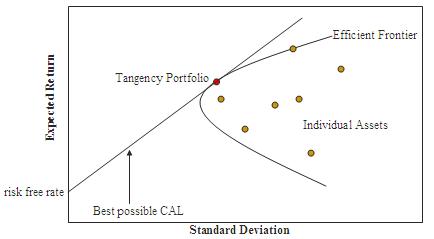
The Markowitz Efficient Frontier
Note: Unlike my previous articles this is "supposedly" a bit more technical, although no mathematics will be employed in its process. The response to those who claim that the EMH and MPT are not contradictory in the long-run can be found here.

What is the current state of the economics profession? From what we can witness any person who is not an economist would think that the state is bad (although there have been many within the profession which share this opinion, for example Paul Krugman not to mention many bloggers). Lately, I have had some time available to have a look at what appears to be the most influential theories of the 20th century (regarding stock markets that is):  the Modern Portfolio Theory (MPT) and the Efficient Market Hypothesis (EMH). The former was introduced in the early 1950's by Harry Markowitz and the latter was introduced by Paul Samuelson and Eugene Fama in the early 1960's. Of the three people mentioned above two (Markowitz and Samuelson) received a Nobel price later on.*

I will waste no time in discussing whether the assumptions used by both theories are valid or not. This debate has been raging for nearly 40 years and I do not think that anything can be said to settle it. Besides, the limitations of the assumptions used were first presented by the persons who introduced it (for example one may have a look at Markowitz's or Samuelson's articles). Other than the assumptions and their implications as to the validity of the models, no article has ever stated what I think is the most important aspect of the debate:

If the MPT holds then EMH cannot hold and vice versa.

What do I mean by that? Having a a look at the EMH forms as presented by Fama we get the following:
1. Weak-form efficiency
Future prices cannot be predicted by analyzing past prices or past returns.
2. Semi-strong-form efficiency
In addition to the point (1), share prices adjust to publicly available new information very quickly and in an unbiased fashion, such that no excess returns can be earned by trading on that information.
3. Strong-form efficiency
In addition to point (2), share prices reflect all information, public and private, and no one can earn excess returns. 

Given that the Strong-form efficiency is considered impossible in the real world we are only left with the first two alternatives. These two take for granted what Samuelson proved: properly anticipated prices fluctuate randomly, i.e. that future price movements are determined entirely by information not contained in the price series. In simple words, prices must follow a random walk.

The random-walk hypothesis is the pillar of the EMH. Without it nothing holds. If one could prove that prices do not fluctuate randomly then everything would collapse. Yet, as it has yet to be proven we may take for granted that prices do indeed follow a random walk. Even proponents of the EMH who have stated that markets may not always be perfectly efficient, such as Burton Malkiel, continue to believe that this holds.

Let us now have a look at the MPT as presented by Markowiz:
The underlying assumption is that higher expected returns also mean higher risk assumed by the investor. While many may argue that this does not hold, this sort of discussion is beyond the scope of this article. In any case, the MPT uses the expected returns of an asset, either by employing past returns or by using investors' "beliefs" for the future (which are rational and match the true distribution of returns) to form a portfolio of assets which maximizes expected return over a given risk amount. 

Economists have been raging over the years if the models' assumptions are correct, what could happen if the assumptions are altered or whether the world functions this way. Now here I just assume that both models are correct. 

Then ponder on the following:
If the EMH holds (even at its weakest form) then past prices are not a good forecast of future prices since future prices are to follow a random walk. In addition, any forecast of the future prices, given that they follow a random walk, would be erroneous as it would not be a good proxy for neither risk nor expected return. Thus, we would not be able to use MPT for investing purposes as it would not yield proper results.

Conversely, if MPT holds it would mean that either past prices can predict future returns or that investors beliefs are the real distributions of returns the random walk hypothesis does not hold. 

Which of the two theories is correct? I would not know. Yet, what I would know is that if one of them holds, as described in its original form, then the other cannot. The worst part for their proponents is that the answer cannot lie in-between this as any deviation would mean that the random-walk hypothesis is discarded. If it holds and investors cannot forecast anything then why should they bother putting their money in the market? It appears that we can either forecast or not. It all boils down to whether stocks follow a random walk. If they do then the the EMH holds and the MPT is discarded. If they do not the opposite is true.

Simple enough isn't it?

*Update: Since the writing of this article, Eugene Fama has won the Nobel Prize in Economics for 2013. There has been a lot of talk about whether it was a good call or whether it was right to award Robert Shiller alongside with him. Dan Davies has an excellent article on why this was done, which reminded me of the conclusions in Paul Samuelson's paper which started the whole EMH literature (titled "Properly anticipated prices fluctuate randomly"):

“I have not here discussed where the basic probability distributions are supposed to come from. In whose minds are they ex ante? Is there any ex post validation of them? Are they supposed to belong to the market as a whole? And what does that mean? Are they supposed to belong to the “representative individual”, and who is he? Are they some defensible or necessitous compromise of divergent expectation patterns? Do price quotations somehow produce a Pareto-optimal configuration of ex ante subjective probabilities? This paper has not attempted to pronounce on these interesting questions.”

It appears that Paul Samuelson had a much greater understanding of what he was doing than most economists have about his work since.

Sunday, 12 August 2012

Economists and the Real-Life Economy

Every time a crash, or a crisis or recession or any bad news in general comes up, people run to economists to "help" them "understand" what has happened. What most people fail to understand is that, about 99% of economists have no idea what is happening in the real world. The reason is simple: they are so caught up in their studying, publishing articles, using advanced mathematics and statistics to impress other economists with their knowledge that they do not actually know, let alone understand, about what goes on in the real world. 

Thus, their knowledge is purely theoretical. Even what economists call empirical work (i.e. something which actually uses observed data instead of pure mathematical theories) is in fact a manipulation of past data, under statistical tools, to reach a certain point. Very few can leave the stagnant traditional economic thinking and start to think on their own. If one remembers, in a scene of Bryan Singer's Usual Suspects, Kevin Spacey states: "The greatest trick the Devil ever pulled was convincing the world he didn't exist.". In the same context, the greatest trick economists ever pulled was convincing the world that they understood economics.

The worst outcomes of this "misunderstanding" are that:
1. Economists with no idea on how the real world operates are appointed in critical positions in the economy
2. Good economists are mistakenly thought as bad ones, a consequence of bias and prejudices (obviously, if you ask an economist whether he belongs to the 99% or the 1% of economists s/he will  always say he belongs to the 1%)

This situation is described in Esther Dulfo's and Abhijit Banerjee's book, titled Poor Economics. They talk about a situation named the 3 I's: Ideology, Ignorance, Inertia. Although the authors (which I believe deserve to be at the 1% we have talked about earlier) mostly use it in describing politics and policies in third world countries, this situation is more than evident both in the EU as well as the world economy.

People with an ideology try to promote changes or policies (either for better or for worse) and the policies seem to fail, mainly due to their ignorance on the subject, as they are watching it from a distance. The situation, does is not made better due to inertia, i.e. people's "apathy" towards a policy which in essence does nothing.

The same rationale holds for the Greek bailout: economists and policymakers decided that a haircut of 70% of the bonds' value and severe austerity measures should be great to fix the problem. Well, I guess the situation looks better and decisions are easier when its not your job, city or country on the line. Or is it now?