Showing posts with label Quantitative Easing. Show all posts

Tuesday, 1 April 2014

Does QE mean money printing?

Although the debate on the effects of QE on the economy and whether QE is deflationary or inflationary has (at least in my mind) been settled, there seems to exist a rather going "concern" on whether the buying of government bonds from the Central Bank equals money printing. Whether it does or it does not have separated people into two camps: those who believe that too much QE can lead to hyperinflation and those who believe that it will cause nothing of this kind.

But first things first: QE, although usually defined as the purchase (by the Central Bank) of government bonds in the possession of commercial banks. Yet, there is also an additional point: the one where the Fed purchases new bond issues. To see why this points holds see the following breakdown:

As it is obvious from the above, the only major change in the categories is the increase in foreign demand for US debt and the increase in the Fed's share of debt. Essentially, as many have argued before, when QE is initiated, collateral in the form of government bonds becomes more scarce in the economy. This is supposed to make the banks focus their funds elsewhere, meaning an increase in lending. These operations are usually conducted by the Fed either at the expiration and the re-introduction of a bond or by direct "investment" in the markets.

The point to be made here is that if the bonds are purchased from the pile of existing bonds then QE is nothing but an asset swap: cash is exchanged with bonds (both at zero risk for the bank). This does not mean an increase of the money supply whatsoever. Yet, if the government decides to issue additional bonds (remember the whole "raising the debt ceiling" debate?) then the Fed is essentially creating new money by purchasing some of them.

Remember that in order for newly printed money to enter the market it has to either be channeled through government spending or by throwing these amount off a helicopter. (If we choose the former then Monetarism and Keynesianism are essentially saying the same thing.) Thus, if the Fed purchases bonds from new issues, then it is essentially creating new money to enter the market via the government spending channel. Here, we are talking about money which did not exist before. Again, if it was a bond rollover then we would be talking about an accounting increase in cash and a decrease in government bonds (both on the asset side of the balance sheet) which have no effect on the money supply. If the money is lent, then we have an indirect increase in the outstanding amount of money in the economy, via the money multiplier, yet, this is not money printing. It is printing only if the Fed purchases new bond issues.

Now suppose that the Fed buys some new bond issues. Should we experience hyperinflation? The answer is no and not because increasing the money supply does not mean an increase in inflation. It is simply because of timing. Since the money base (M0) is just about 1/3 of the broad money in the economy (MZM) the effects of a rise in M0 just offset the decrease in MZM due to deleveraging. This is the major reason why the money supply in the US has been increasing over the last year despite the decrease in loans. It is just now, that the increase in bank lending has returned to its "normal" growth rate, that QE has began tapering.
Is QE a panacea? Obviously not. As already said, it may cause short-term asset bubbles and disinflation as a result of increased investment in the stock market. Still, those are just short-term effects and compared to the contrary (in the case of the US, a huge depression). In addition, just like fiscal stimulus, it can only be implemented when times are bad. In booms, QE and fiscal stimuli can cause private investment "crowding out" thus forestalling growth and creating additional inflation. In booms, the latter two tend to cause more damage than good. The two camps referred to at the beginning of this article can both be right but at different times: when times are good, QE can cause high inflations. When times are bad, it does not.

Overall, QE remains a good idea, despite its short-term side effects. The big question of whether the ECB will be able to apply something like it in the Eurozone remains to be answered.

Wednesday, 12 February 2014

ECB's OMT, QE and why they won't matter

The biggest news on Friday was that the German Constitutional Court had passed on the examination of whether the Outright Monetary Transaction (OMT) scheme proposed by Mario Draghi in August 2012 was legal under the ECB mandate, to the European Court of Justice. This story was considered as a win by most on the pro-ECB camp, under the assumption that the ECJ would actually approve the scheme. The problem is that whether it does or not, it makes no difference. 

As Frances Coppola noted at the time of the Draghi announcement (and has recently repeated to all those who haven't been listening), the whole idea of the OMT is not to protect the Member-States but to protect the Euro. Even more, the OMT is best used as a threat rather than actual implementation. Market reaction to the threat was as predicted: pressure on the euro started to decline and soon the currency was much stronger than before. Yet, as many know, in this case, the threat is stronger than anything else.

You see, even if the ECJ approves OMT, it will do nothing to ensure that the crisis ends. The main function of the scheme is to purchase bonds in countries which are paying high interest rates (and are in bail-out agreement). As of lately, no country is paying especially high rates; even Greek bonds have shown significant signs of decrease. Thus, even if the scheme passes, no country will benefit.

Another idea, (one which I have to disgracefully admit that I thought was rather interesting before thinking it through) was a European Quantitative Easing. The problem here is how the markets that the ECB will purchase bonds from will be defined. It's easy in the US and the UK as there is just one market with sovereign bonds; what happens when you have 17 of them, each faced with its own issues? Clearly, QE is not the answer.

In order to find the correct answer, we have to make sure we are facing the right question, and the one in our case is how to stimulate demand. Forget of all the "competitiveness" and "supply liberalizations" which some think will cure everything. As stated before, supply does create its own demand but not all the time; and this time it's different. The problem is that the usual stimulants, i.e. government intervention (either in increasing demand or decreasing taxation), are constrained in the bailed-out countries, and many others by their debt-to-GDP ratios and fact that they are in a currency union. The other usual way, of increased bank lending, is again constrained by either the banks' inability to lend or the peoples' unwillingness to borrow.

Thus what is left one might add, if supply won't help and banks and governments are constrained? The magic word here is confidence and expectations. As recent research has shown, expectations matter more than we usually thought; the recovery from the 1929 Great Depression was most likely driven by a shift in expectations as Eggertson (2008) suggests. So what shifts expectations is the big question?

Simply put, it's the willingness of the governing authorities (whether those be politicians or policymakers) to stick to their agenda of reforms and promote the idea that inflation will increase in the future, or forward guidance in the central bank parlance (something that BoE's Mark Carney is famous about). The problem is that just saying so doesn't really change anything, you have to stick by what you claim and make efforts to keep them in line with peoples' expectations.

How to do that is rather simple: either the ECB should issue fresh money and channel them to the countries (most likely via the EIB) at a scale larger than ever before or boost bank lending in countries where banks are willing to lend (but are constrained) and people are willing to borrow, most likely by decreasing the ELA rate. I see no other solution to the current problems: either the banks are supported and they are allowed to lend, and more investment is brought forth directly from the EU or the shift in expectations will take much longer to manifest, just like it did in the 1930's. Trust me here, we do not want a repetition of history.

Friday, 7 June 2013

Stock Markets and Money Creation

On the recent QE debate, the main issue discussed by the participants is whether or not the asset swap of Treasury securities for "cash" is inflationary or deflationary. What we should also focus when defining what QE does, is finding out what it affects. According to traditional (neoclassical) economic theory, for inflation to rise (or to occur) the money money supply needs to be increased. This means that money needs to be created, via the usual monetary policy transmission mechanism, the banking sector, or by employing the printing machine. As I have argued in a previous post, although it is doubtful whether QE can actually do that, it is very successful when it comes to increasing stock prices. This, as I will later argue, if it is persistent, will increase inflation expectations and thus boost the economy.

Thus, the question is: can the stock market increase money supply? The short answer is yes, if it has a persistent increasing trend over some time, as I will shortly argue. 

Assume we have a closed economy (for simplicity) where we have a fixed amount of money supply (M), a stock market exists with just 1 company listed (again, for simplicity) and some amount of agents (i.e. consumers/investors). Then, we can safely assume that the profits of the listed company will represent the state of the economy (i.e. if the economy grows, profits grow. If it contracts, profits contract) and thus its stock market valuation will represent both the current state of the economy as well as the agents' expectations about its future state. 

If the agents decide to put some of their money in the stock market, they will do it with the purpose of having some gain in the future (otherwise it will be just foolish). If the economy is growing, it is likely that more and more people will want to invest some of their money in the company, hoping that its rising profits will result in rising prices (or higher dividends), thus rendering them some profits. If we assume that the company price was 1 at time 0 (when we start observing this economy), with a capitalization value of €1bn for 100m profits, an increase in the price to 2 would mean that the market capitalization of the company would be increased to €2bn. Yet, as the reader may observe, this extra 1bn came out of thin air! Thus, at the end of the day, money supply has been theoretically increased by 1bn without any money printing and without any lending by the banks.

Nevertheless, this amount cannot be used to purchase goods or services (unless it is employed as collateral for loans) since it represents what traders call "paper profits". This are profits which have not yet been realized (i.e. you have not sold the shares you own yet), yet the potential for realizing them exists. If everyone tries to sell their shares when the price reaches €2, it is more than likely that the price will fall, maybe to a level even lower than the starting one. If this happens, then although many will have profited from their speculation, many will suffer losses, making it unsure whether the actual money stock has been increased or decreased. Thus, what we need is a sustainable higher level of stock prices, one which would make the realization of paper profits and the increasing of the money stock possible (for those wondering what happens to the money stock with constant buying and selling until it reaches the €2 level, it increases. Yet for simplicity we do not use this here)

Increasing the money stock would mean that prices (i.e. inflation) would also increase. With inflation rising, investment would soon follow and the economy would continue its course. Yet, for this we need the stock market price to follow an upwards trend not just for a few periods but for longer. The rationale behind this is both because of the need of investors to be reassured that the trend is here to stay as well as for them to have time enough to both invest (i.e. reduce consumption) and sell out (i.e. increase consumption and money). As a consequence, even if in the short run, we may experience deflation or disinflation, it is more than possible to experience inflationary pressures in the medium- and long-run. (for the chain of events after QE see chain of causality here)

Japan is a good example in this case. Rising Nikkei prices lead to increased inflation as the real estate bubble grew larger and larger and by the time inflation reached its peak in early 1991, the Nikkei had already began its downwards trend which basically lasted until early 2013, when Shinzo Abe's policies intended to boost the economy. Any notion of GDP reduction causing the stock market fall can easily be discarded as the graph indicates that the fall in GDP occurred six year later, in 1996, although a flattening of GDP can be seen in the 1990-1991 period.
Nikkei values up to 31/12/1990. Source Yahoo! Finance

Nikkei values from 1991 to 2013
What should be noted is the decrease in money supply, an outcome of the bubble, over the 1990-1991 correction period, which, combined with the stock market crash, resulted in a reduction of the GDP growth rate from 2.5% to approximately -0.3% in just one year. Nevertheless, as stated above, GDP continued to rise over time, with an upward trend visible (albeit much smaller than before).
Most importantly, what holds of inflation, can also hold for deflation in our case. Thus, if a protracted period of falling stock market prices occurred in the economy, it would, in its turn, decrease the money stock, which would cause either disinflation or deflation. What should be noted, of course, is that although the stock market has an effect on the money stock, this is an outcome of the policy implemented and not of the market itself. It may be true that we cannot have a protracted period of deflation unless we self-induce it, yet, it is more than possible for deflationary pressures to exert their powers in the market over the short-run. Thus, through the use of QE, increased stock market prices would result in higher inflation expectations in the future but only if they can last long enough to make this point credible.

Friday, 31 May 2013

Is QE deflationary? A Conjecture

On Monday, a very interesting post came to my attention: Frances Coppola commented that the possibility of Quantitative Easing (QE - the process by which the Central Bank buys back government bonds and gives "cash" back to the banks so that they could increase lending) being deflationary instead of inflationary, as theory expects it to be, is large; and the data seem to agree with her (for her excellent points have a look here). This discussion, spurred spin-off blog where an abundance of sources on the issue can be found. As in any discussion, supporters of both views exist. An example would be Pawel Morski, who provides a very interesting graph and comments that QE is nothing but the only option, and this is better than doing nothing at all.

Although QE may be better than sitting idly around, the question of it being either inflationary or deflationary still exists. Thus, the question now becomes how QE can affect the level of prices. As the quantity theory of money states, MV=PQ. Given that we want to observe the effects QE has on the price level, we want to check how it affects money, velocity and output (M,V and Q respectively). The theoretically obvious effect of QE is on the money supply. If banks have more cash, then they would be inclined to lend more money, thus increasing money supply.

The above would hold if and only if the banks decide to increase their lending. If the banks are constrained by their regulatory needs or choose not to give out loans for any other reason, having more cash will not assist them in increasing spending (for further details on how this works I refer the reader to a previous post). During the QE phase, banks essentially swapped a 0% risk-weighted asset (bonds) with another 0% risk-weighted asset (cash), thus their risk-weighted assets (RWA) have not changed; yet, RWA will be increased if banks lend out any money (all personal/mortgage/corporate loans have a risk weight of at least 20%).

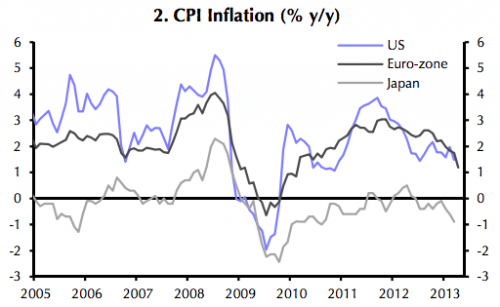
Nevertheless, the money supply indices (both credit and monetary base) show an increasing trend even after QE, while inflation appears to decrease:

Source: FT Alphaville
A careful look at the data provided by the Federal Reserve shows that the increase in money supply is losing speed: In the first 4 months of 2012 it was 1.18%; in the first 4 months of 2013 it was 0.7% (note: the Fed itself states that the increase was 2.9%. After re-doing the calculations the above percentages came up). Thus, money creation is slowing down, which forces inflation to fall. The fact that the monetary base in increasing is basically pittance given the amount of money in the system, although if it was reduced then inflation would drop even further. Yet, are credit/money creation and unwilling banks the whole story or is there something more to QE?

Enter velocity of money. According to theory, money velocity depends on an additional 6 factors, of which the quantity of money, the propensity to consume and liquidity preferences (with the 2nd and 3rd factors being essentially the same) are the most volatile. As we have seen in the previous paragraph, QE does not affect the quantity of money unless new credit is created by the banks (and the slow increase is shown in the above graphs). As a consequence, all we are left with is the marginal propensity to consume, or basically how much of our income we choose to save or consume. It is a well-known fact that people spend more (and save less) in times of boom and spend less (thus saving more) in times of recession/depression. Thus, at times of depression it is only logical that, even if the money supply is constant, the velocity of money is reduced and thus the price level is reduced.

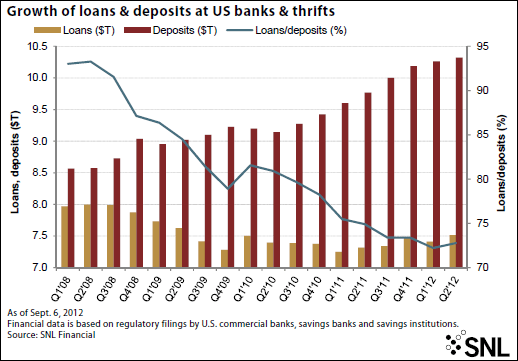
The above appear to have nothing to do with QE, yet, as we also know, it is difficult (extremely difficult to be fair) to distinguish between the forces which affect inflation. Thus, we cannot really infer by how much prices are affected by the QE or by the business cycle (i.e. the recession) in general. Thus, even as QE is initiated, bank loans are growing by much less than bank deposits (until 2012). Nevertheless, deposits and loans are again not telling us the whole story: why is inflation falling now and not in 2012 when the loans/deposits ratio reached its lower value? In 2013, Fed data show that loans have been increasing by more than deposits once again.
Source: The Wall Street Journal

The most obvious outcome of QE is an increase in bond and stock prices; which is what it should do, in order for stock and bond returns to lower and people start using their money for other investment plans. However, although there exists a ceiling over which bonds do not offer a good return to their owners, this does not exist in the stock market. Shares can, theoretically at least, increase forever (and the 1990's have shown such examples of rapid and strong growth).

As a commentator stated "QE is to stocks as booze is for self-confidence". Since people believe that QE is good for the economy, their expectations concerning growth are raised. Continuing on the chain of causality, when the economy grows, it is only rational that stock prices will rise. Thus, in order to make profits from that increase in stock market prices people pour more funds in the market to buy them while they are "cheap". In addition, an increase in the stock market indices, is an added incentive to invest in it, since returns are high and risk is relatively low. Then, as more money is poured in the stock market, prices rise, while consumption lags. As consumers focus more on the future than the present, it is obvious that short-term consumption will be decreased, an outcome of both the shifting of preferences and the increased returns of the stock market. Then if preferences are shifted from the present to the future, an increase in the stock market makes more people want to invest (long-term possibly?). Thus, consumption (i.e. money velocity and aggregate demand) is decreased while savings and stock market investment is increased. (Note that because of the recession, most investors are more risk-averse than what they were during the boom phase. Thus, they have an added incentive to invest in already established "blue chip" listed companies than riskier start-ups or smaller firms)

Summing up the chain of causality:
1. Government announces QE because the economy is doing bad, hoping that the banks will use that extra money to create additional credit.
2. If banks are not constrained by either the risk/reward trade-off or by any regulatory requirements, they lend and more credit creation results in increased inflation.
3. If not, then banks lend much less than the government hoped for.
4. Since investors are unaware of whether #2 or #3 hold, they choose to invest in the stock market, given that in any of the two cases growth is more than what they were currently experiencing and thus stock prices are expected to rise.
5. Thus market prices rise because more agents enter the market.
6. With prices rising, consumers who have been saving a much larger amount of their income than they were doing before because their time preferences have changed (i.e. they lower current consumption for future consumption), wish to increase the amount they will be able to use in the future by investing in the market (either directly or indirectly).
7. In addition, banks may use that extra QE "cash" to invest (speculate?) themselves in the stock market.
8. Thus, either by reducing credit or by reducing the amount spent, both aggregate demand and money velocity are reduced.
9. This leads to a slowing of inflation or to deflation.
10. Nevertheless, this situation will not necessarily perpetuate. As people see stock prices rise, they start selling off at one point and they choose to either invest in other products (i.e. lend if they are banks) or consume more (if they are individuals).

In short, QE might be deflationary if banks can and choose not to lend and stock prices rise; yet, it can also be inflationary if they do so. The deflationary effects are not permanent though: over time, and with the effect of QE declining, funds will flow from to the stock market to the real economy, boosting both consumption and money velocity. Overall, QE is not a bad strategy. Nevertheless, it does not always work like policymakers expected.

UPDATE: It looks like Paul Krugman had suggested that the QE2 success was in promoting growth via increasing consumption by raising stock prices. This appears to agree with point #10, where the  people start selling off to capitalize on their gains. Yet, if this increasing trend in stock prices persists, people, assisted by the uncertainty of the current era, will tend to defer consumption for the future, as long as they believe that they will be able to consume more then than now.